Ali Abdaal trained and worked as a doctor before shifting his focus to creating videos, a podcast, and educational products. His book Feel-Good Productivity argues for making meaningful work more enjoyable and sustainable. This profile examines his own published advice on studying, creative work, money, recovery, and relationships. — Feel-Good Productivity.
Part 1: The Core Philosophy of Productivity
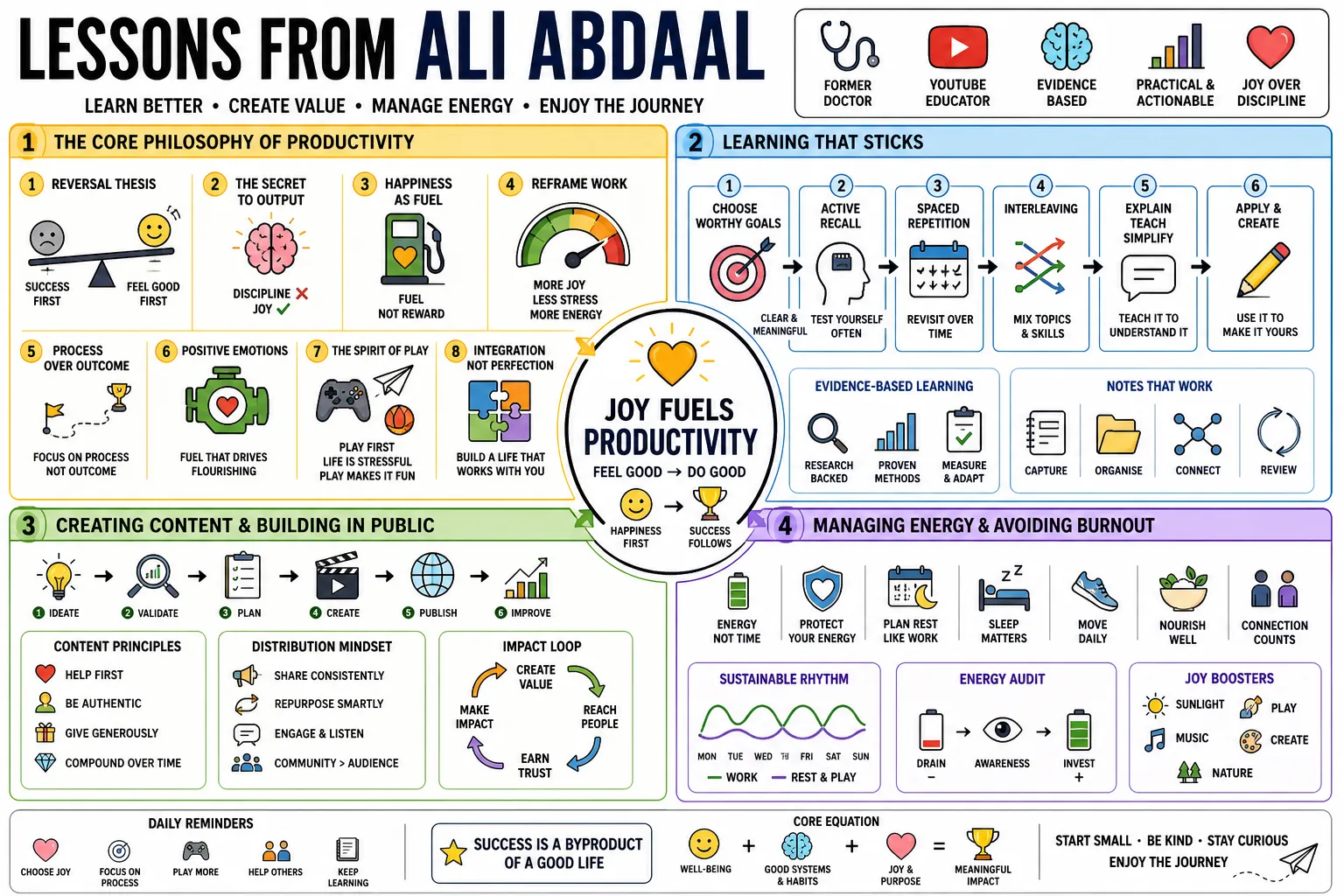
- On the reversal thesis: Abdaal’s central book thesis is that feeling good at work can create energy for doing meaningful work; success is not presented solely as a prerequisite for enjoyment. — Feel-Good Productivity.
- On the secret to output: In Feel-Good Productivity, Abdaal proposes joy and positive energy—not discipline alone—as a way to sustain productive work. — Feel-Good Productivity.
- On reframing work: Abdaal suggests making a task more playful, empowering or social so that even necessary work feels more energising. — 3 Tips to Make Boring Work Energising.
- On process vs. outcome: He advises noticing whether a goal improves the experience of the work itself, rather than treating the final outcome as the only reason to act. — What’s the Point of Goals?.
- On the spirit of play: The book names play among its energisers and treats a lighter approach to work as a practical part of productivity. — Feel-Good Productivity.
- On agency and power: Abdaal calls a sense of agency or power one of three energisers; where possible, changing how one approaches a task can make it feel less draining. — 3 Tips to Make Boring Work Energising.
- On doing what matters: His stated aim is not simply to complete more tasks but to stay consistent with work that matters while reducing stress. — Feel-Good Productivity.
Part 2: Procrastination and Taking Action
- On building confidence: Abdaal recommends reducing the emotional hurdle of difficult work by clarifying the next step and treating confidence as something that can grow through action. — How Procrastination Affects Your Daily Life.
- On the root of procrastination: His procrastination prescription looks for uncertainty and discomfort beneath delay, instead of treating every delay as laziness. — How Procrastination Affects Your Daily Life.
- On overcoming fear: Describing his own hesitation before filming, Abdaal identifies fear and self-doubt as obstacles even when he has ample experience. — How I’m Dealing with Procrastination.
- On self-belief: He recommends a growth-minded reframing of “I can’t do this” into a problem that can be worked on, rather than a fixed verdict on ability. — How Procrastination Affects Your Daily Life.
- On changing methods: When a work strategy fails, Abdaal recommends diagnosing the obstacle and adjusting the system instead of blaming one’s character. — How Procrastination Affects Your Daily Life.
- On framing tasks: Before preparing a talk, he asked how he could make the event more fun and changed its format to suit both his enjoyment and the audience’s questions. — How to Enjoy Doing the Hard Things.
- On failure: Abdaal frames an unsuccessful attempt as feedback for revising the approach, not proof that the person is incapable. — How Procrastination Affects Your Daily Life.
- On the experimental mindset: He recommends treating a stalled task as a solvable experiment: identify the source of resistance, change the next step, and try again. — How Procrastination Affects Your Daily Life.
- On taking the first step: His “going through the motions” method lowers the activation energy of a hard task by starting with concrete preparation before demanding full commitment. — How I Tricked My Brain into Being More Productive.
Part 3: Studying and Learning Systems
- On active recall: Rather than relying only on rereading or highlighting, Abdaal recommends testing what you can retrieve from memory during revision. — The Ultimate Guide to Studying for Exams.
- On the forgetting curve: He recommends revisiting topics at spaced intervals rather than relying on one long cramming session. — The Ultimate Guide to Studying for Exams.
- On effort and memory: He explains that effortful retrieval is part of why self-testing can be a useful study method; that does not establish a simple rule about stronger neural connections in every case. — The Ultimate Guide to Studying for Exams.
- On question-based learning: He turns syllabus material and essay plans into questions that can be answered from memory in later revision sessions. — The Essay Memorisation Framework.
- On taking notes: Instead of only transcribing notes, Abdaal recommends recording questions that can be used for later active recall. — The Ultimate Guide to Studying for Exams.
- On interleaved practice: His exam guide describes mixing topics through interleaving as one way to practice choosing between different kinds of problems. — The Ultimate Guide to Studying for Exams.
- On tracking knowledge: Abdaal describes a retrospective revision spreadsheet that records topics and review performance, helping him decide what to revisit next. — The Ultimate Guide to Studying for Exams.
- On passive review: He argues that repeated rereading can feel productive without revealing what a student can actually recall; practice testing gives a clearer check. — The Ultimate Guide to Studying for Exams.
- On study tools: He used Anki because its flashcards combine self-testing with scheduled review, while cautioning that flashcards are not a complete study system by themselves. — The Ultimate Guide to Studying for Exams.
Part 4: Career Shifts and Leaving Medicine
- On changing identity: Leaving clinical work also meant confronting an identity he had built through years of medical training and practice. — My Identity Crisis.
- On fear-setting: Abdaal reduced the perceived risk of a career change by trying a limited break from medicine before committing more fully to creator work. — What Would You Do If You Knew You Couldn’t Fail?.
- On creative autonomy: In his account, he preferred the flexibility and excitement of online creator work to continuing the medical career he had imagined. — What Would You Do If You Knew You Couldn’t Fail?.
- On returning to safety: He considered returning to medicine a possible fallback while deciding whether to pursue creator work; his account later says he froze his GMC registration. — What Would You Do If You Knew You Couldn’t Fail?.
- On social prestige: Abdaal writes that identity, the prestige attached to being a doctor, and fear all made leaving medicine harder. — What Would You Do If You Knew You Couldn’t Fail?.
- On finding excitement: His experiment away from medicine showed him that building an online business felt more exciting for the life he wanted at that time. — What Would You Do If You Knew You Couldn’t Fail?.
- On following your path: He chose to evaluate his career against the life he wanted, not only the status of the profession he had trained for. — What Would You Do If You Knew You Couldn’t Fail?.
- On acts of omission: His account asks what he would try if fear of failure were removed, using a temporary change of work as a way to test that question. — What Would You Do If You Knew You Couldn’t Fail?.
- On permission to pivot: He describes a difficult identity transition despite having good reasons to value his medical career; a career pivot need not be justified by a crisis. — My Identity Crisis.
Part 5: Content Creation and The Creator Economy
- On treating YouTube as a business: Abdaal advises creators who want commercial results to treat a channel strategically, with clear goals, allocated time and concrete tasks. — A Framework for Achieving Big Goals.
- On audience needs:: His distinction between a hobby and a business encourages creators to consider what viewers want when audience growth is their actual goal. — My Honest Advice for a Struggling Creator.
- On solving problems: He recommends beginning with a subject one knows firsthand; deep personal experience makes content easier to produce and more distinctive. — How to Start Creating.
- On enjoying the business:: He questions whether maximizing views and revenue should outweigh the enjoyment of making the channel and business he actually wants. — What Does It Actually Mean to Be Efficient?.
- On competitor analysis: Abdaal advises leaning into one’s own experience and strengths to stand out rather than copying what superficially works for other creators. — How to Start Creating.
- On systems over motivation: His Target–Time–Tasks–Troubleshoot–Transparency framework translates a creative ambition into scheduled work, next actions and accountability. — A Framework for Achieving Big Goals.
- On starting equipment: He challenges beginners to record a short video on a phone about something they know well, before worrying about a polished setup. — How to Start Creating.
- On providing value: Reflecting on a creators retreat, he emphasizes the value of like-minded peers, exchange and support in creative work. — 4 Short Lessons from a Creators Retreat.
Part 6: Personal Finance and Wealth Building
- On index funds: Abdaal describes broad index funds as a conventional, low-maintenance starting point for stock-market investing, while stressing that his account is personal experience, not financial advice. — How I Make $27,000 in Passive Income Every Week.
- On diversification: He explains that an index fund can spread an investment across many companies, reducing dependence on any one company, although it does not eliminate market risk. — Five Tips To Get Rich.
- On investing in yourself: After interviewing Alex Hormozi, Abdaal says he began to prioritize spending that develops his own earning skills; the return is a possibility, not a guarantee. — Five Tips To Get Rich.
- On paying yourself first: His “pay yourself first” habit means setting aside some income for savings or investments before discretionary spending. — Pay Yourself First.
- On financial independence: He presents financial independence as valuable for the autonomy and freedom it can provide, not as a goal detached from how one lives. — Five Tips To Get Rich.
- On defining 'enough': He reflects that once money has created meaningful freedom, additional work and earnings may no longer buy the same improvement in life. — What Would You Do If Money Were No Object?.
- On get-rich-quick myths: His passive-income guide warns that get-rich-quick schemes are not a reliable route to wealth; earning durable income generally requires providing value or committing capital and time. — How I Make $27,000 in Passive Income Every Week.
- On time horizons: He frames index-fund investing as a long-horizon activity and says money needed soon should not be committed to it. — How I Make $27,000 in Passive Income Every Week.
- On business vs. investing: Abdaal distinguishes operating a business from holding investments: a business takes substantial work to create value, while a diversified portfolio can be less labor-intensive after capital is invested. — How I Make $27,000 in Passive Income Every Week.
Part 7: Navigating Burnout and Recovery
- On the true nature of burnout: Abdaal describes burnout as more than excessive hours: overexertion, insufficient recovery and misalignment can each make one’s working pattern unsustainable. — What Is Burnout and How to Recover From It.
- On overexertion burnout: For overexertion, his Conserve principle recommends recognizing energy limits, protecting time and saying no where necessary. — What Is Burnout and How to Recover From It.
- On depletion burnout: For depletion, his Recharge principle emphasizes meaningful rest rather than assuming a manageable workload alone prevents exhaustion. — What Is Burnout and How to Recover From It.
- On the Write-Off Principle: His Reitoff Principle allows an exhausted person to write off part or all of a day for guilt-free rest instead of forcing more work. — What Is Burnout and How to Recover From It.
- On misalignment burnout: For misalignment, he suggests examining values and adjusting daily work and goals so they fit more closely. — What Is Burnout and How to Recover From It.
- On reframing intentions: He suggests checking whether a goal is driven by external rewards or by work that feels worthwhile and energising. — What Is Burnout and How to Recover From It.
- On sleep as productivity: In describing “pay yourself first” beyond money, he recommends prioritizing roughly seven to eight hours of sleep rather than spending that time on late-night scrolling. — Pay Yourself First.
- On self-compassion: He counsels allowing rest without guilt when energy is depleted rather than treating every low-output day as a moral failure. — What Is Burnout and How to Recover From It.
Part 8: Relationships and Life Advice
- On relationships as skills: Abdaal offers a relationship-review template with prompts couples can use to discuss their partnership intentionally; it is a practical tool, not proof that relationships are scientifically programmable. — Relationship Review.
- On intentional connection: His relationship-review resource encourages partners to make time for intentional questions and everyday habits that support the relationship. — Relationship Review.
- On relationship reviews: He offers structured prompts for partners to ask each other during a relationship review, giving a concrete way to discuss needs and goals. — Relationship Review.
- On relationship coaching: In a newsletter, Abdaal recounts Bill’s advice to consider a relationship coach or couples therapist and says he intended to try it himself; he does not establish a guaranteed return. — Life Advice from the Richest Guy I’ve Ever Met.
- On enjoying the journey:: Abdaal asks whether optimizing the path to a goal can crowd out enjoyment of the activity itself; his video-game example leads him to choose the more interesting route. — What’s the Point of Goals?.
- On the role of community: After a creators retreat, he wrote that being around like-minded peers can be energising and useful for learning. — 4 Short Lessons from a Creators Retreat.
- On doing less: The Sustain section of his book encourages intentional pauses and doing less when needed to preserve energy for meaningful work. — Feel-Good Productivity.