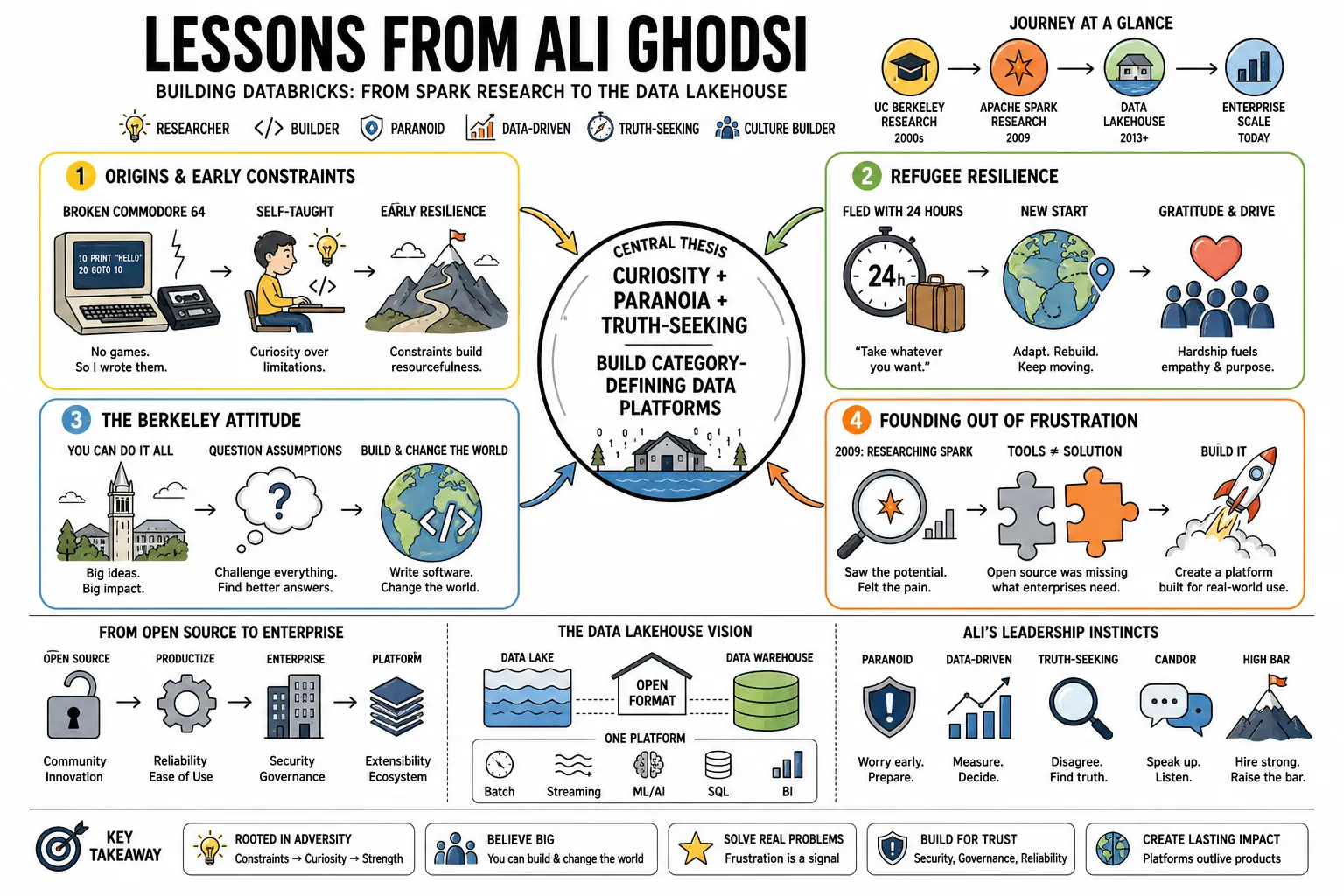
Lessons from Ali Ghodsi
Ghodsi co-founded Databricks with colleagues from the UC Berkeley Spark research team and later became CEO. In his talks and interviews, he reflects on the work of turning an open-source technology into a commercial enterprise platform, building a trusted founding team, and developing a company culture that can scale. — Stanford eCorner Transcript.
Part 1: On Origins and the Founder's Mindset
- On Early Constraints: Ghodsi recounts learning to program on a Commodore 64 after his family settled in Sweden; the constraints of the machine and his limited access to games drew him into writing software. — Unusual Ventures Interview.
- On Refugee Resilience: He describes his family’s displacement from Iran as part of the experience that shaped his appetite for perseverance, without claiming that the experience mechanically guarantees founder success. — Unusual Ventures Interview.
- On the Berkeley Attitude: Ghodsi says Berkeley’s research environment encouraged challenging assumptions and building ambitious technology, a mindset that helped the Spark team envision a company. — Matt Turck Interview.
- On Founding Out of Frustration: He traces Databricks to Berkeley work on faster, more accessible data processing and the team’s belief that Spark could address limitations they saw in Hadoop-era systems. — Matt Turck Interview.
- On the Core Trait of Founders: Looking back on Databricks’ slow early commercialization, Ghodsi emphasizes persistence through several years before the business gained traction. — Unusual Ventures Interview.
- On Surviving the Trough of Sorrow: Despite Spark’s open-source success, Databricks had little commercial revenue in 2015; Ghodsi recalls that period as uncertain and says the team had to focus intensely on building a sales engine. — Sequoia Interview.
- On Cannibalization: He cautions open-source founders that the widely adopted project and the paid offering are different problems: the company must keep creating value customers will buy, rather than assume adoption itself produces revenue. — Stanford eCorner Transcript.
- On Killing Your Darlings: Databricks expanded beyond Spark as its customers’ needs changed; Ghodsi describes the broader data and AI platform rather than treating one original project as the permanent business boundary. — Matt Turck Interview.
- On Academic Blindspots: Ghodsi says technical founders can underestimate marketing and sales; strong technology still needs people who understand how to explain it and reach customers. — Stanford eCorner Transcript.
Part 2: On Leadership and the "Paranoid" Executive
- On Paranoia as a Superpower: Ghodsi describes himself as paranoid about runway and the risks of scaling; he says Databricks combined fast investment with close attention to whether it could survive the strategy. — Battery Ventures Interview.
- On Downside Scenario Planning: His risk management paired ambitious growth with explicit calculations about available runway, future revenue and how quickly the company could grow into its spending. — Battery Ventures Interview.
- On Existential Threat Readiness: Ghodsi links his family’s experience of displacement to an awareness that circumstances can change abruptly; he does not present that as a universal rule for executives. — Unusual Ventures Interview.
- On the CEO as Student: Instead of assuming engineering training translated to sales expertise, Ghodsi says he sought out skilled leaders in sales and other functions and learned how they practiced their disciplines. — Battery Ventures Interview.
- On Taking the "One Shot": When offered the CEO role during Databricks’ difficult commercial period, Ghodsi weighed the uncertain chance to build the company against his long-standing ambition to be a professor. — Sequoia Interview.
- On Managerial Leverage: Ghodsi recommends finding excellent people in disciplines outside a founder’s own expertise and learning from them rather than trying to reinvent every function alone. — Battery Ventures Interview.
- On Rejecting "Gut" Decisions: The 20VC interview frames Ghodsi’s decision-making around analytical evaluation of risks rather than treating intuition as sufficient; the episode notes do not establish the original purported verbatim quote. — 20VC Interview.
- On Constant Reinvention: Ghodsi’s account of becoming CEO shows the role changing from protecting the technology to building a repeatable commercial organization and later solving new strategic bottlenecks. — Sequoia Interview.
Part 3: On Building and Scaling a Culture
- On Culture as the CEO's Personality: Ghodsi says company culture reflects the founder and CEO in practice, so leaders should articulate values they actually model rather than aspirational slogans. — Stanford eCorner Transcript.
- On the First 20 Hires: He stresses that early hires shape the company’s habits; the inspected interview does not justify a literal permanent-DNA threshold at exactly twenty people. — Battery Ventures Interview.
- On Truth-Seeking: He describes truth-seeking as a Databricks cultural value: teams should surface reality and use it to make decisions, even when the result is uncomfortable. — Stanford eCorner Transcript.
- On the Danger of the "Rosy Picture": For Ghodsi, truth-seeking means making it possible to discuss bad news honestly rather than allowing a polished account to hide the problem. — Stanford eCorner Transcript.
- On the "Company First" Principle: He urges employees to weigh the company’s overall interests, not only the priorities of their own function, when resolving difficult cross-team choices. — Stanford eCorner Transcript.
- On Raising the Bar: Ghodsi describes raising the hiring bar and explicitly testing for the qualities Databricks wants in its employees. — Stanford eCorner Transcript.
- On Interview Diagnostics: He says interviews should probe whether a candidate seeks the truth and can speak candidly about difficult facts, not merely present a reassuring narrative. — Stanford eCorner Transcript.
- On Culture Enforcement: His culture advice is operational: hiring, promotion and management decisions must reflect the stated values for those values to matter. — Stanford eCorner Transcript.
- On Radical Candor: Ghodsi argues that direct, candid feedback becomes easier to receive when it is a consistent cultural norm rather than a surprise delivered only during a crisis. — Stanford eCorner Transcript.
- On Maintaining Agility: He identifies fragmented enterprise systems and organizational complexity as barriers to deploying AI effectively, and argues for a simpler open data foundation; the original “food fight” quote was not verified. — Databricks Summit Keynote.
Part 4: On Co-Founders, Trust, and Team Dynamics
- On Large Founding Teams: The seven-person Databricks founding group required unusually strong trust; Ghodsi warns that a team of that size can otherwise fracture over roles, equity or difficult decisions. — Stanford eCorner Transcript.
- On the "Founder Bar": Ghodsi treats trust among co-founders as a prerequisite for navigating inevitable disagreements, not as a substitute for making hard decisions. — Stanford eCorner Transcript.
- On the Bonds of Scarcity: He describes the founders’ shared experience of building through difficult periods as a source of trust and cohesion. — Stanford eCorner Transcript.
- On Delegation and Trust: As Databricks scaled, Ghodsi had to learn to rely on leaders with different expertise and let them run their functions; the original exact quote is unverified. — 20VC Interview.
- On the Necessity of Hard Decisions: He says a large founding team still needs someone willing to make difficult decisions when consensus is not possible. — Stanford eCorner Transcript.
- On Academic Origins: The Berkeley research team’s working relationship gave the founders a shared technical language and trust, but Ghodsi also stresses that a company must make decisions rather than rely on academic consensus alone. — Stanford eCorner Transcript.
- On Peer Support: His company-first culture asks strong individual contributors to support peers and the wider company, not optimize solely for their own team. — Stanford eCorner Transcript.
- On Founder Evolution: Ghodsi presents leading a scaled company as a different challenge from founding one; a founder should decide whether they want to keep learning the next stage or prefer starting something new. — 20VC Interview.
Part 5: On Open Source and Business Strategy
- On the "Two Home Runs" Rule: Ghodsi says an open-source company must achieve two distinct successes: broad adoption of the project and a proprietary offering that creates additional value customers will pay for. — Stanford eCorner Transcript.
- On Cloud Providers: Ghodsi argues that a specialist vendor can compete with cloud platforms by operating and improving its own technology for demanding users, rather than assuming infrastructure ownership decides the market. — Matt Turck Interview.
- On the "Red Herring" of Forking: He focuses the cloud-competition problem on operating a better service and delivering differentiated value, not merely on the possibility that another provider forks open-source code. — Matt Turck Interview.
- On the Shift to Commercialization: Databricks initially emphasized Spark adoption while commercial revenue lagged; Ghodsi later shifted company attention toward building enterprise sales rather than relying on open-source popularity. — Sequoia Interview.
- On Partnering with Giants: He describes working with cloud providers where their infrastructure helps customers while differentiating Databricks in the software and service it builds above that layer. — Matt Turck Interview.
- On Ecosystem Building: In the early Spark years, the team invested in talks, community work and hands-on education to grow adoption before the enterprise business was established. — Unusual Ventures Interview.
- On Contrarian Bets: Ghodsi recalls Databricks making long-term bets on cloud delivery and AI while building on an open-source foundation; he does not claim that every one of those bets was equally novel or certain. — Sequoia Interview.
Part 6: On the Go-To-Market Engine
- On Sales vs. Marketing: Ghodsi’s go-to-market advice puts customer discovery and a capable sales leader ahead of scaling a marketing organization. — 20VC Interview.
- On Founder-Led Sales: He recommends technical founders stay directly involved in early enterprise customer conversations so they can learn what buyers actually need and refine how the product is sold. — a16z Boss Talk.
- On Interviewing for Discovery: To learn an unfamiliar role, he recommends meeting excellent practitioners and understanding what strong performance looks like before delegating the function. — Battery Ventures Interview.
- On the Timing of HR: In his hiring sequence, people operations becomes more important when recruitment itself must scale; the source presents stage-dependent guidance, not an exact universal threshold. — 20VC Interview.
- On Valuation Discipline: Ghodsi advises matching the amount of capital raised to an achievable growth plan, rather than letting a headline valuation or abundant funding obscure runway and execution risk. — Battery Ventures Interview.
- On the Trap of Over-Raising: He says more funding can enable speed but also requires disciplined calculations about how quickly a company can grow into the spending it permits. — Battery Ventures Interview.
- On Preserving Runway: Throughout Databricks’ growth, Ghodsi says he tracked runway closely and paired aggressive investment with a plan to keep the business alive. — Battery Ventures Interview.
- On Staying Private: Ghodsi has argued that remaining private can leave more room for long-horizon product work than managing to public-company quarterly expectations; this is his preference, not a general rule for every company. — Stanford eCorner Transcript.
Part 7: On Artificial Intelligence and the Agentic Future
- On AI Eating Software: Ghodsi expects AI to reshape software work across many industries, extending the earlier shift toward software; the inspected excerpt supports that broad direction, not the original exact quotation. — Goldman Sachs Interview.
- On the AI Hype Cycle: In 2024 he expected a period of AI disillusionment after early hype, while still believing the technology would reshape business software over a longer horizon. — Battery Ventures Interview.
- On the "Context Problem": Ghodsi distinguishes increasingly capable models from the unresolved enterprise context problem: models need governed access to an organization’s private data and meaning to answer useful business questions. — CNBC Interview.
- On the Data Advantage: He sees an enterprise’s own governed data and context as a differentiator when access to general-purpose AI models is widely available. — CNBC Interview.
- On the Agentic Revolution: At the 2025 summit, Ghodsi presented agent-building tools intended to move beyond simple question answering toward multi-step enterprise workflows; those capabilities should not be described as universally autonomous or solved. — SiliconANGLE Summit Report.
- On Fighting AI with AI: The Databricks RSA keynote argues that AI-accelerated attacks require more automated detection and investigation; Lakewatch is the company’s proposed open, agent-assisted security approach. — Databricks RSA Keynote.
- On "Vibe Coding": Ghodsi demonstrates Lakeflow Designer as a way to describe data transformations in natural language, inspect the generated visual flow and code, and approve it before production use. — Databricks Summit Keynote.
- On the Future of Reasoning: Ghodsi argues that broad model access makes an organization’s governed, proprietary data and context central to useful enterprise AI; the source does not establish that models are fully commoditized. — CNBC Interview.
- On the Evolution of Coding: His Lakeflow Designer demonstration points to AI-assisted data engineering that can automate some construction work while leaving practitioners to inspect and govern the resulting pipelines. — Databricks Summit Keynote.
- On the Hidden Costs of AI Training: Using Databricks’ DBRX effort as a case, Ghodsi distinguishes the cost of its successful training run from the larger cluster bill that included smaller experiments, idle time and learning. — Newcomer Interview.
- On Tokenmaxxing vs. Valuemaxxing: Ghodsi points to the cost of enterprise AI usage as a constraint and favors measuring useful business outcomes alongside token consumption, rather than treating maximum usage as the goal. — SiliconANGLE Summit Report.
Part 8: On Data Architecture and the "Lakehouse" Vision
- On the System of Record: Ghodsi describes the open lakehouse as a governed system of record that can supply enterprise data and context to AI agents; the context problem remains an active challenge. — CNBC Interview.
- On the "USB-C for Data": He compares interoperable data formats to USB-C and wants Delta Lake and Iceberg users to exchange data without an avoidable format war; complete unification was still a goal in the interview. — Runtime Interview.
- On Preventing Lock-In: His open-data argument is that customers should retain choice of AI systems and tools without becoming trapped by a proprietary storage format. — Databricks Summit Keynote.
- On Automating BI: Ghodsi expects AI to automate parts of the manual enterprise analytics cycle—from exporting system data to preparing dashboards and decisions—but does not establish that dashboards are already dead. — Battery Ventures Interview.
- On Dynamic Reporting: He shows natural-language interfaces for working with enterprise data and producing analyses, while keeping governed data and human review in the workflow. — Databricks Summit Keynote.
- On the "Lakebase": Databricks positions Lakebase as an operational database layer integrated with the lakehouse, aimed at agentic applications that need low-latency transactions alongside governed data. — Databricks Lakebase Announcement.
- On the Petabyte Era: The Databricks RSA keynote argues that petabyte-scale security telemetry outstrips workflows designed around manual human review and calls for a more automated, open architecture. — Databricks RSA Keynote.
- On the "Data Tax": The keynote calls legacy security-data pricing a “data tax”: organizations may discard telemetry to control cost, leaving blind spots that a more open architecture aims to reduce. — Databricks RSA Keynote.