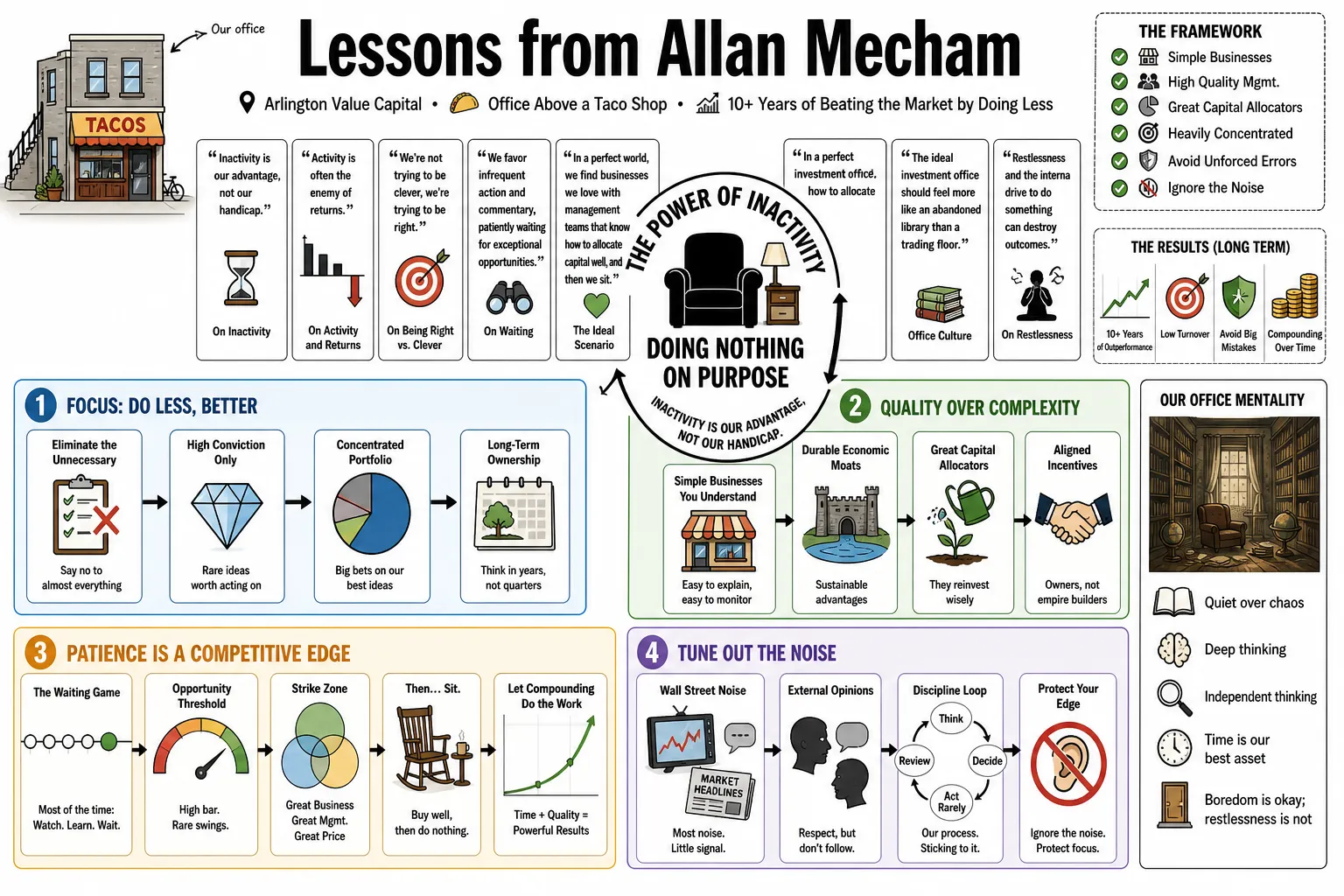
Lessons from Allan Mecham
Allan Mecham ran Arlington Value Capital from an office above a Salt Lake City taco shop, beating the market for over a decade by doing as little as possible. He avoided complex models in favor of a heavily concentrated portfolio of simple businesses, prioritizing the avoidance of unforced errors over high-risk returns. This collection details his framework for stress-testing investments, staying intellectually honest, and tuning out Wall Street.
Part 1: The Power of Inactivity
- On Inactivity: "Inactivity is our advantage, not our handicap." — Vintage Value Investing: Allan Mecham Profile]
- On Activity and Returns: "Activity is often the enemy of returns." — Vintage Value Investing: Allan Mecham Profile]
- On Being Right vs. Clever: "We're not trying to be clever, we're trying to be right." — Vintage Value Investing: Allan Mecham Profile]
- On Waiting: "We favor infrequent action and commentary, patiently waiting for exceptional opportunities." — Focused Compounding: Allan Mecham Portfolio & Case Studies]
- On The Ideal Scenario: "In a perfect world, we find businesses we love with management teams that know how to allocate capital well, and then we sit." — Vintage Value Investing: Allan Mecham Profile]
- On Office Culture: The ideal investment office should feel more like an abandoned library than a trading floor. — Vintage Value Investing: Allan Mecham Profile]
- On Restlessness: Restlessness and the internal pressure to act lead directly to poor decision-making and capital destruction. — Vintage Value Investing: Allan Mecham Profile]
- On Letting Capital Compound: By acting less, investors allow compound interest to work without the constant friction of frequent trading. — MOI Global: Allan Mecham on Accepting the Right Capital]
- On Wall Street Norms: Most fund managers lack the structural leeway from their clients to patiently wait for exceptional opportunities. — Vintage Value Investing: Allan Mecham Profile]
- On Information Overload: "I disagree with the notion that more information is always better." — Vintage Value Investing: Allan Mecham Profile]
Part 2: Intellectual Honesty and Mental Horsepower
- On Self-Deception: "Don't fool yourself, and remember you are the easiest person to fool," citing Richard Feynman as a guiding principle. — Vintage Value Investing: Allan Mecham Profile]
- On Mental Boundaries: "Most investors are their own worst enemies, buying and selling too often, ignoring the boundaries of their mental horsepower." — Vintage Value Investing: Allan Mecham Profile]
- On Knowing Your Limits: Understanding the limits of your own intelligence is a far greater advantage than possessing a high IQ. — MOI Global: Allan Mecham on Accepting the Right Capital]
- On The Electric Fence: An investor's circle of competence should be treated like an electric fence where you simply refuse to step outside of what you truly understand. — Vintage Value Investing: Allan Mecham Profile]
- On Complexity: Complex financial models frequently mask a fundamental lack of business understanding. — Focused Compounding: Allan Mecham Portfolio & Case Studies]
- On Critical Thinking: "There is no substitute for diligence and critical thinking." — Focused Compounding: Allan Mecham Portfolio & Case Studies]
- On Temperament: Patience, discipline, and intellectual honesty matter far more in investing than raw processing power. — Vintage Value Investing: Allan Mecham Profile]
- On Ego: Adopting an ethos of not fooling oneself is the single greatest structural advantage an individual investor can develop. — Vintage Value Investing: Allan Mecham Profile]
- On Humility in Research: Being diligent and thinking independently are the core ingredients of solid risk management. — Focused Compounding: Allan Mecham Portfolio & Case Studies]
Part 3: Avoiding Unforced Errors
- On Reducing Mistakes: "I think if investors adopted an ethos of not fooling themselves, and focused on reducing unforced errors as opposed to hitting the next home run, returns would improve dramatically." — Vintage Value Investing: Allan Mecham Profile]
- On The Loser's Game: Investing is akin to amateur tennis where the winner is typically the person who makes the fewest mistakes, not the one hitting spectacular winners. — Vintage Value Investing: Allan Mecham Profile]
- On The Cost of Errors: "Unforced errors are a major barrier to strong returns." — Vintage Value Investing: Allan Mecham Profile]
- On Finding Big Winners: Avoiding big losers is consistently more important for long-term wealth creation than obsessively hunting for big winners. — MOI Global: Allan Mecham on Accepting the Right Capital]
- On Emotional Interference: "Taking emotion out of the equation is like telling someone what's wrong with their golf game in the middle of their backswing." — Vintage Value Investing: Allan Mecham Profile]
- On Hitting Home Runs: Focusing on base hits and mistake-avoidance yields better aggregate results than swinging for the fences. — Focused Compounding: Allan Mecham Portfolio & Case Studies]
- On Self-Sabotage: The single biggest mistake investors make is acting as their own worst enemies through habitual over-trading. — Vintage Value Investing: Allan Mecham Profile]
- On Structural Advantages: Individual investors have a distinct edge over professionals simply because they aren't forced to act when there is nothing intelligent to do. — Vintage Value Investing: Allan Mecham Profile]
- On The Need to Act: The internal pressure to constantly do something is the primary catalyst for most unforced errors in a portfolio. — Vintage Value Investing: Allan Mecham Profile]
- On Defense vs Offense: "The best sell discipline is a stingy buy discipline." — Vintage Value Investing: Allan Mecham Profile]
Part 4: Concentration and Conviction
- On Deep Understanding: "We believe it's more important to understand a few businesses deeply than dozens superficially." — Vintage Value Investing: Allan Mecham Profile]
- On Frantic Diversification: "Concentrated patience beats frantic diversification every time." — Vintage Value Investing: Allan Mecham Profile]
- On The Shot Clock: "We are a risk-averse fund looking for low-risk layup-type investments while other funds are akin to a run-and-gun offense that routinely takes a smattering of low-percentage shots." — Vintage Value Investing: Allan Mecham Profile]
- On Rarity of Opportunity: Extraordinary investment opportunities are incredibly rare and must be bet on heavily when finally identified. — Focused Compounding: Allan Mecham Portfolio & Case Studies]
- On Fat Pitches: An investor should be willing to put up to half of their capital into an open-net tap-in goal if the conviction is high enough. — YouTube: Allan Mecham Arlington Value Investment Discussion]
- On Core Holdings: A robust portfolio does not need fifty ideas because six to ten high-conviction holdings are often more than enough to compound capital. — Focused Compounding: Allan Mecham Portfolio & Case Studies]
- On Sticking to What You Know: "We stick with what we know." — Vintage Value Investing: Allan Mecham Profile]
- On Managing Turnover: "Turnover usually indicates a failure of judgement." — Vintage Value Investing: Allan Mecham Profile]
- On Selling Mistakes: "Selling is difficult, and my track record suggests it's usually a mistake." — Vintage Value Investing: Allan Mecham Profile]
Part 5: Simplicity and Economic Furniture
- On Economic Furniture: Investors should seek out economic furniture, meaning stable and defensive businesses that fulfill permanent needs. — Vintage Value Investing: Allan Mecham Profile]
- On Reading Habits: Time is better spent reading physical newspapers and historical annual reports than staring at blinking screens. — Vintage Value Investing: Allan Mecham Profile]
- On Forecasting: Predictions and macro-economic forecasting are largely useless distractions from understanding actual unit economics. — Focused Compounding: Allan Mecham Portfolio & Case Studies]
- On Simplicity: A business must be simple enough that its fundamental staying power can be grasped without needing an advanced degree. — Vintage Value Investing: Allan Mecham Profile]
- On Complex Industries: Unproven companies or rapidly shifting, complex industries should be placed firmly in the too hard pile. — Vintage Value Investing: Allan Mecham Profile]
- On Financial Modeling: Deep qualitative understanding of a company’s competitive position beats complex spreadsheet modeling every time. — Vintage Value Investing: Allan Mecham Profile]
- On Common Sense: The investment industry often undervalues basic common sense in favor of false numerical precision. — Focused Compounding: Allan Mecham Portfolio & Case Studies]
- On Predictability: The best investments are those where the outcome is highly predictable, not necessarily those with the highest theoretical ceiling. — Vintage Value Investing: Allan Mecham Profile]
- On The Hourglass Model: Distributors that sit in the middle of fragmented markets possess immense bargaining power and structural durability. — MOI Global: Allan Mecham on Accepting the Right Capital]
- On Staying Power: The most critical variable to assess is a company's staying power over the next decade. — Vintage Value Investing: Allan Mecham Profile]
Part 6: The Owner Mentality
- On Viewing Stocks: "I need to understand the business like an owner," rejecting the idea of stocks as mere pieces of paper to be traded. — Vintage Value Investing: Allan Mecham Profile]
- On Daily Fluctuations: An ownership mentality is the only reliable way to ignore daily market fluctuations and short-term noise. — Focused Compounding: Allan Mecham Portfolio & Case Studies]
- On Assessing Management: The ideal setup requires a management team that intrinsically understands how to allocate capital efficiently. — Vintage Value Investing: Allan Mecham Profile]
- On Business Fundamentals: Buying a fractional share should carry the exact same weight and rigorous diligence as buying the entire enterprise outright. — Focused Compounding: Allan Mecham Portfolio & Case Studies]
- On True Value: The intrinsic value of a business is disconnected from its daily quoted price on a public exchange. — YouTube: Allan Mecham Arlington Value Investment Discussion]
- On Corporate Moats: A durable competitive moat is the primary protection an owner has against the gradual erosion of capital. — Vintage Value Investing: Allan Mecham Profile]
- On Operator Mindset: Thinking like a business operator rather than a fund manager grounds the entire investment process in reality. — MOI Global: Allan Mecham on Accepting the Right Capital]
- On Capital Allocation: Management's ability to reinvest cash flow at high rates of return is the fundamental engine of long-term compounding. — Vintage Value Investing: Allan Mecham Profile]
- On Partnership: Investing should be viewed as a long-term partnership with the underlying business and its operators. — Focused Compounding: Allan Mecham Portfolio & Case Studies]
Part 7: Risk and Stress Testing
- On The Downside: "It's ingrained in my DNA to think about the downside before any potential upside." — Focused Compounding: Allan Mecham Portfolio & Case Studies]
- On The Primary Goal: The primary objective of an investor is not to maximize returns, but to absolutely ensure they do not lose capital. — Vintage Value Investing: Allan Mecham Profile]
- On Stress Testing: Every investment thesis must be severely stress-tested against difficult economic environments, such as high unemployment. — Focused Compounding: Allan Mecham Portfolio & Case Studies]
- On Margin of Safety: A significant margin of safety is non-negotiable because it acts as the ultimate buffer against unforeseen adverse events. — Vintage Value Investing: Allan Mecham Profile]
- On Macro Shocks: Stress-testing should include hypothetical scenarios like sharply rising interest rates to see if the business would actually survive. — Focused Compounding: Allan Mecham Portfolio & Case Studies]
- On Avoiding Zeros: You can recover from a period of low returns, but a permanent loss of capital structurally impairs compounding. — Vintage Value Investing: Allan Mecham Profile]
- On Risk Profiles: Arlington Value sought low-risk, layup-type investments rather than speculating on heavily distressed turnarounds. — Vintage Value Investing: Allan Mecham Profile]
- On Resilience: A business is only as strong as its ability to weather the absolute worst-case scenario. — MOI Global: Allan Mecham on Accepting the Right Capital]
- On Defense: Risk management is not about hedging with derivatives, it is about buying resilient businesses at sensible prices. — Focused Compounding: Allan Mecham Portfolio & Case Studies]
Part 8: Culture, Capital, and Wall Street Contrast
- On Fund Size: "Ben and I gain satisfaction from trying to be among the best, not the biggest." — Vintage Value Investing: Allan Mecham Profile]
- On Hot Money: "Accepting hot money would endanger the culture and my ability to perform." — MOI Global: Allan Mecham on Accepting the Right Capital]
- On Investor Alignment: Having the right capital base composed of partners who understand long-term vision is essential to surviving periods of volatility. — YouTube: Allan Mecham Arlington Value Investment Discussion]
- On Institutional Pressure: The pressure to generate short-term performance forces most institutions to act irrationally at exactly the wrong times. — Vintage Value Investing: Allan Mecham Profile]
- On Location: Operating from above a taco shop provided a necessary psychological distance from the manic noise of Wall Street. — Vintage Value Investing: Allan Mecham Profile]
- On Track Records: True outperformance requires a willingness to look foolish and tolerate non-activity in the face of short-term underperformance. — Vintage Value Investing: Allan Mecham Profile]
- On The Anti-Hero Path: Achieving massive long-term returns is the result of ignoring consensus and adhering strictly to personal boundaries. — Vintage Value Investing: Allan Mecham Profile]
- On Independence: Independence of thought is impossible if you are constantly measuring yourself against a benchmark on a quarterly basis. — Focused Compounding: Allan Mecham Portfolio & Case Studies]
- On Legacy: True investment success is built quietly, without the need for constant media validation or asset gathering. — MOI Global: Allan Mecham on Accepting the Right Capital]