Lessons from Amancio Ortega
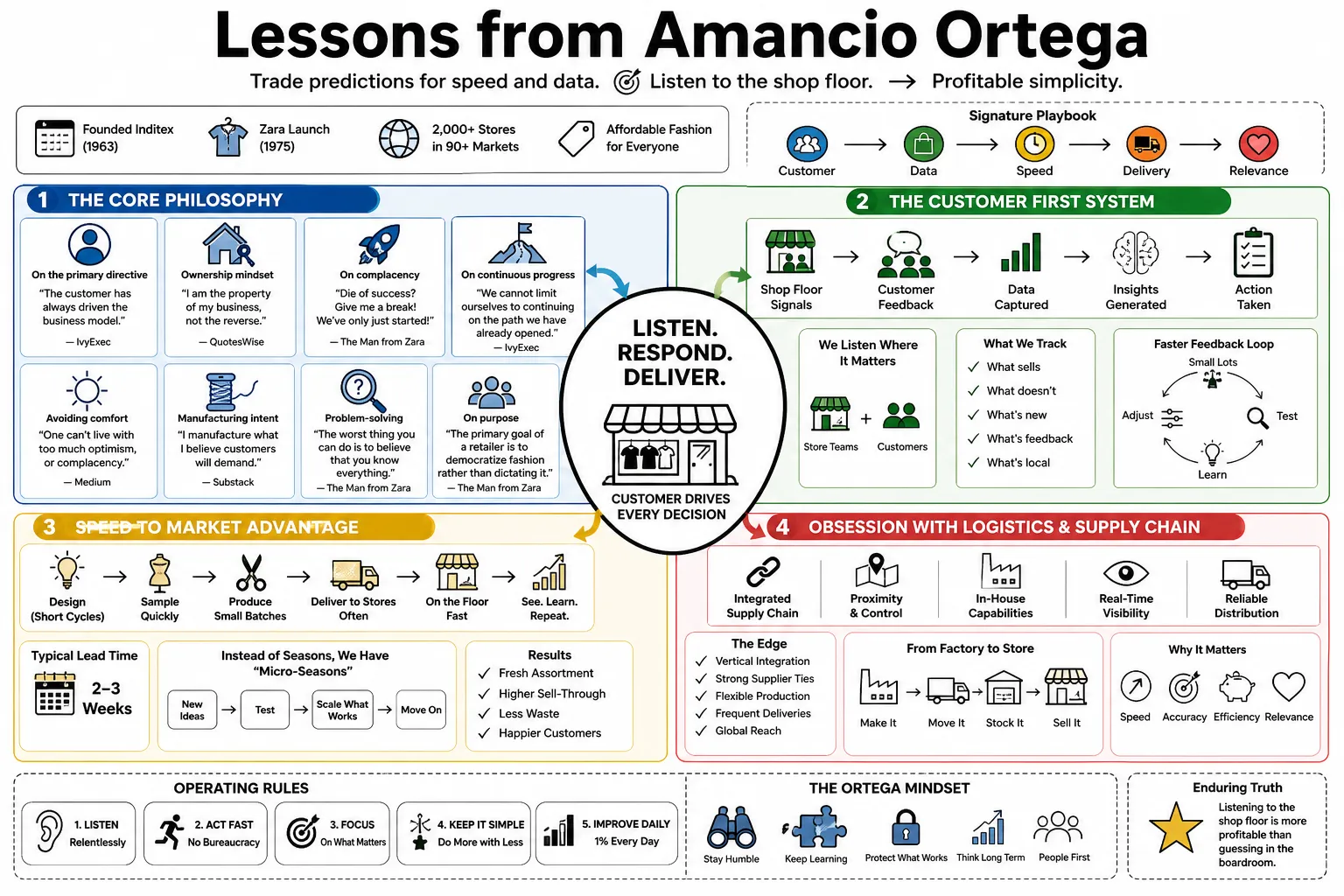
Amancio Ortega began in the textile trade, launched a clothing company in 1963 and created Zara in 1975. He later chaired Inditex, remaining its majority owner through Pontegadea. — Amancio Ortega Foundation Biography.
Part 1: The Core Philosophy
- Customer direction: Inditex places customer demand at the centre of its model, using store and online feedback to renew collections. — Inditex 2015 Customer Services.
- Refuse to settle: In O'Shea's firsthand account, Ortega described the company's refusal to become complacent about success and its willingness to take risks. — Covadonga O’Shea Interview.
- Produce against observed demand: Inditex describes sending customer preferences from stores and online channels to buying and design teams so production can respond during the season. — Inditex 2017 Annual Accounts.
- Learn from others: In O'Shea's reported conversations, Ortega said he listened extensively and learned from people around him to make up for gaps in his formal education. — Covadonga O’Shea Interview.
- Build a demanding culture: Inditex's own business-model presentation identifies commercial focus, initiative, humility and self-criticism as elements of its corporate culture. — Inditex Business Model.
Part 2: The Fast Fashion Supply Chain
- Shorten the fashion cycle: Inditex's integrated design, production and distribution model allows it to respond to customer demand during a selling season. — Inditex 2017 Annual Accounts.
- Coordinate the value chain: Inditex coordinates design, manufacturing and supply, logistics and stores across one customer-oriented value chain. — Inditex 2015 Directors’ Report.
- Use proximity production selectively: Inditex uses production near its Spanish headquarters to preserve flexibility and react to demand during a selling season. — Inditex 2017 Annual Accounts.
- Mix sourcing routes: Inditex combines nearby and long-distance sourcing rather than relying on a single production geography. — Inditex 2017 Annual Accounts.
- Keep production runs short: Short production runs let Inditex refresh collections in response to changing customer demand. — Inditex 2015 Customer Services.
- Treat logistics as part of the offer: Inditex identifies logistics as one of four pillars that bring fresh products to stores twice weekly. — Inditex 2015 Customer Services.
- Replenish frequently: Inditex says its logistics network delivered new products to stores twice a week in the documented 2015 model. — Inditex 2015 Customer Services.
- Use centralized distribution: Inditex's central logistics centres distribute inventory to stores worldwide throughout the season. — Inditex 2015 Directors’ Report.
Part 3: Customer Centricity
- Let customer feedback shape design: Inditex says stores and online channels analyse customer demand daily and designers renew collections using that information. — Inditex 2015 Customer Services.
- Offer design at competitive prices: Inditex offers frequently refreshed fashion at competitive prices. — Inditex 2015 Directors’ Report.
- Use the storefront as a signal: Inditex's business-model presentation names distinctive locations, displays and customer service as features of its store concept. — Inditex Business Model.
- Use store-level information: Inditex reports that information from stores is sent daily and used to keep collections current. — Inditex 2015 Directors’ Report.
- Create variety at scale: Inditex's historical business-model presentation reported about 18,000 Zara models per year, illustrating the scale of its assortment at the time. — Inditex Business Model.
- Make windows do advertising work: In a 2003 direct interview, managing director José María Castellano said Inditex relied on prominent shop windows rather than conventional advertising. — Castellano–Wharton Interview.
Part 4: Store Operations as Data Hubs
- Treat stores as listening posts: Inditex describes physical stores as a place where customer demands are analysed daily and passed into design decisions. — Inditex 2015 Customer Services.
- Refresh window displays: Inditex names display windows and product presentation as elements of its store concept. — Inditex Business Model.
- Adapt to seasonal geography: Inditex's business-model presentation describes different collections for the Northern and Southern Hemispheres. — Inditex Business Model.
Part 5: Leadership and Radical Humility
- Stay close to the work: A British Vogue reporter visiting Inditex's headquarters observed Ortega's desk near his daughter Marta's in an open-plan workshop. — Marta Ortega in British Vogue.
- Delegate daily operations: In a direct 2003 interview, Inditex managing director José María Castellano said Ortega retained strategic responsibility while delegating day-to-day management to a professional team. — Castellano–Wharton Interview.
- Keep a simple personal routine: O'Shea's firsthand account describes Ortega's modest everyday routine despite his wealth. — Covadonga O’Shea Interview.
- Credit the team: Ortega's signed 2001 letter thanked employees and credited their dedication for the company's growth rather than portraying success as a personal award. — Inditex 2001 Annual Report.
- Keep public and private roles distinct: Castellano said Ortega's decision to minimize public appearances reflected a desire to protect his private and family life; he did not present it as a marketing tactic. — Castellano–Wharton Interview.
- Value the people who build the company: In O'Shea's reported firsthand conversations, Ortega said he considered caring for the people working with the company an obligation. — Covadonga O’Shea Interview.
Part 6: Early Life and Drive
- A formative family memory: O'Shea reports that Ortega remembered his mother being refused credit for groceries when he was young. — Covadonga O’Shea Interview.
- Learn the trade early: The Amancio Ortega Foundation says he came from a working family and began working in textiles at a young age. — Amancio Ortega Foundation Biography.
- Start with garment making: Ortega launched his first clothing company in 1963, according to his Foundation's biography. — Amancio Ortega Foundation Biography.
- Open a direct retail channel: Ortega created Zara in 1975, according to his Foundation's biography. — Amancio Ortega Foundation Biography.
- Build with family collaborators: Ortega and his first wife Rosalía Mera made garments together before Zara opened, according to British Vogue's original reporting. — Marta Ortega in British Vogue.
Part 7: Continuous Improvement and Agility
- Keep the organisation relatively flat: Marta Ortega described Inditex as a relatively flat organisation with few titles in a direct interview with British Vogue. — Marta Ortega in British Vogue.
- Invest in customer-facing technology: By 2015, Inditex was using RFID to track individual garments and help staff check availability across stores and online. — Inditex 2015 Customer Services.
- Scale a coordinated model: Inditex extended an integrated design-to-store model across its global store network. — Inditex 2015 Directors’ Report.
- Keep updating the collection: Daily information from stores helps Inditex keep updating collections during the selling season. — Inditex 2015 Directors’ Report.
Part 8: Wealth, Privacy, and Legacy
- Invest beyond textiles: Pontegadea, the investment group chaired by Ortega, holds real-estate assets and invested in Repsol's Delta wind farm in 2021. — Repsol–Pontegadea Delta Agreement.
- Retain a majority ownership stake: Ortega chairs Pontegadea, through which he holds a majority interest in Inditex. — Amancio Ortega Foundation Biography.
- Fund public-health infrastructure: The Amancio Ortega Foundation describes its programme to upgrade equipment for public-hospital cancer diagnosis and radiotherapy, begun in 2015. — Amancio Ortega Foundation Oncology Programme.
- Plan succession before stepping away: In his CNMV-filed 2011 letter, Ortega proposed Pablo Isla as executive chairman while he would remain with the company and its board, crediting the organization and team. — Ortega’s 2011 Employee Letter.
- Protect personal privacy: In O'Shea's reported firsthand conversations, Ortega expressed a desire to live normally without constant public attention. — Covadonga O’Shea Interview.
- Value sustained effort: Ortega's signed 2001 shareholder letter linked the company's achievements to planning, effort and doing the job well. — Inditex 2001 Annual Report.