Lessons from Amit Bendov
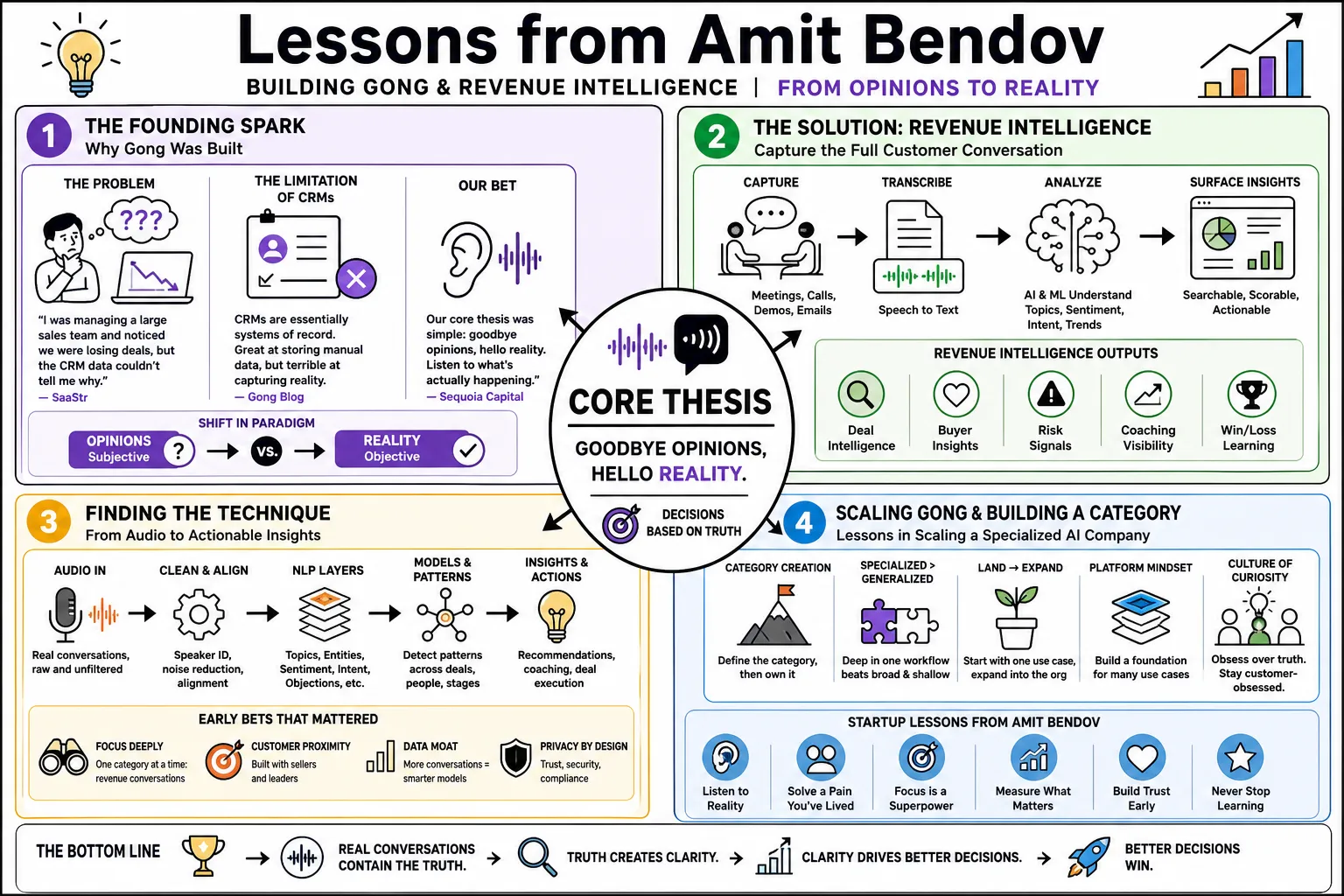
Amit Bendov co-founded Gong after seeing how little of a customer conversation made it into CRM records at the company he previously led. Gong uses interaction data to help revenue teams understand buyers and improve their work. The lessons below separate his documented views from later company analysis. — HBR Cold Call Transcript.
Part 1: The Founding of Gong & Revenue Intelligence
- Start With a Blind Spot: Bendov traces Gong to a bad sales quarter at Sisense: CRM activity metrics did not explain why deals were slipping, so he looked for a way to understand the conversations themselves. — Outplay Founder Interview.
- Recognize What CRM Misses: CRM is useful for contracts, accounts and reporting, Bendov says, but manually entered notes preserve only a small, subjective slice of customer conversations. — HBR Cold Call Transcript.
- Turn Conversations Into Usable Data: Bendov says Gong was conceived to extract structured information from customer interactions; transcription was a means to that broader goal, not the end product. — Sequoia Training Data Interview.
- Use the Right Technical Leverage: Bendov says cofounder Eilon Reshef pushed him to begin with an external transcription API so the team could focus on the application rather than build speech technology first. — Sequoia Training Data Interview.
- Test Willingness to Pay: The first dozen companies tried Gong in beta. Bendov says 11 bought after the team ended the free period, a more meaningful signal than praise alone. — Outplay Founder Interview.
- Address Skepticism in the Product: Bendov says early investors worried that sellers would see recording as surveillance; Gong responded by building features that were valuable to sellers themselves. — AppDirect Decoding Digital Transcript.
- Distinguish Wedge From Vision: Meeting capture helped Gong enter the market, but Bendov says the original ambition was to make customer interactions understandable as structured data. — Sequoia Training Data Interview.
- Build Around Customer Reality: Gong describes revenue intelligence as a platform centered on interactions rather than self-reported CRM fields; category language followed that product distinction. — Gong Revenue Intelligence Account.
- Expose the Conversation Black Hole: At his previous company, Bendov could not listen to thousands of calls or rely on brief CRM summaries; that information gap became the impetus for Gong. — Outplay Founder Interview.
Part 2: Artificial Intelligence & The Future of Sales
- Augment Sellers Before Replacing Them: Bendov’s AMA framed AI as support for sellers: automate administrative work while leaving more time for listening and solving customers’ problems. — Gong AI AMA Recap.
- Separate AI Hype From Useful Work: Bendov says product teams must work with the technology that is reliable today, even while anticipating larger future capabilities. — SaaStr Europa Interview.
- Give Agents Bounded Jobs: Bendov favors specialized AI agents for defined sales tasks and lower-risk workflows over a single agent expected to handle everything autonomously. — Sequoia Training Data Interview.
- Keep Humans on Consequential Sends: Bendov describes AI drafting a customer email while a person decides whether to send it; proposal and contract decisions need still stronger human accountability. — Sequoia Training Data Interview.
- Code Is Only Part of a Software Moat: Bendov argues that software competitiveness also depends on operating securely, supporting production, driving adoption and understanding complex customer context—not merely writing code. — EO Founder Interview.
- Reduce Manual CRM Updates: Bendov says AI can update opportunity records from conversations, easing clerical work, though some teams still require seller confirmation for accountability. — Sequoia Training Data Interview.
- Move From Records to Guidance: Gong’s AMA describes using customer-interaction context to surface deal risks, priorities and recommended next steps, beyond simply transcribing calls. — Gong AI AMA Recap.
- Earn Trust Through Bounded Accuracy: Bendov distinguishes lower-risk assistance from high-stakes proposals, pricing and commissions, where imperfect AI output is not acceptable without review. — Sequoia Training Data Interview.
- Mine More Than Keywords: Bendov says Gong analyzes customer interactions for sentiment, action items and engagement, not only transcripts or keyword mentions. — Bessemer Product Interview.
- Solve the User’s Pain, Not an AI Demo: Bendov says he started Gong to address a problem he had himself: leaders lacked useful information about real customer conversations. — Sequoia Training Data Interview.
Part 3: Understanding Customer Reality (vs. CRM Fiction)
- Look for Repeated Signals: Bendov changed Gong’s initial buyer focus only after hearing essentially the same objection across about 40 sales conversations in six weeks. — Outplay Founder Interview.
- Check the Conversation Against the Summary: Bendov says CRM loss reasons and brief seller summaries often miss what actually happened with a buyer; recordings give teams another way to examine it. — HBR Cold Call Transcript.
- Give Product Teams the Customer’s Own Words: Bendov says Gong’s engineers and product managers can hear customers explain concerns and reactions directly, rather than infer them from internal reports. — Cisco Investments Interview.
- Use Interaction Evidence in Forecasts: Gong’s first-party account argues that call activity and deal engagement can test a seller’s forecast instead of relying solely on stated confidence; this is a company position, not a universal guarantee. — Gong Revenue Intelligence Account.
- Let Product Managers Hear the Pain: Bendov says product managers interview customers about prototypes and share those conversations with engineering, shortening the feedback loop. — Cisco Investments Interview.
- Coach From Observable Behavior: Bendov describes using conversation metrics and recordings to help sellers ask better questions and learn from prior calls, rather than relying on generic feedback. — HBR Cold Call Transcript.
Part 4: Go-to-Market Strategy & Category Creation
- Earn a Category With a Distinct Product: Bendov says a founder cannot simply declare a category; a useful differentiated product comes first, and a category emerges as others enter a successful space. — EO Founder Interview.
- Change Buyers When the Pattern Demands It: Gong first approached sales-operations leaders, Bendov says, but repeated budget and priority objections led the team to sell directly to chief revenue officers. — Outplay Founder Interview.
- Win the End User, Not Only Management: Bendov says Gong created room beside CRM by helping customer-facing people directly and making insights available without requiring them to fill out forms. — Bessemer Product Interview.
- Keep Early Pricing Simple: Bendov says Gong initially chose per-seat pricing because buyers understood it; the team chose to innovate on the product rather than on product and pricing at once. — Sequoia Training Data Interview.
- Publish Findings From the Product Data: Gong Labs describes analyzing real sales interactions and sharing patterns with sellers; the supported lesson is the company’s data-backed content practice, not a verbatim Bendov quote. — Gong Labs Multithreading Analysis.
- Make the Name Evocative: Bendov chose Gong as a short name associated with the sound of a sales win, showing how a brand can evoke an experience without describing the software literally. — HBR Cold Call Transcript.
- Compete Through Execution: Bendov says competitors appeared, so he pushed Gong to establish a clear lead and kept learning from customer conversations; this is his stated approach, not proof competitors could not catch up. — Outplay Founder Interview.
Part 5: Scaling, Hyper-Growth & Startup Lessons
- Start With a Problem You Know: Bendov says he began with an operating problem he could not solve at his prior company, then checked whether other leaders felt the same pain. — Outplay Founder Interview.
- Understand the Venture Tradeoff: Bendov says founding a venture-backed company can demand years of intense work without a guaranteed outcome; founders should understand the market size and risk before committing. — AppDirect Decoding Digital Transcript.
- Reinvent as the Customer Problem Changes: Bendov says Gong has needed to reinvent itself roughly every two years, expanding from its initial use case while keeping customer needs in view. — Sequoia Training Data Interview.
- Hire Exceptional Specialists: Bendov says founders should build strong engineering, marketing, sales and support teams, then give hires who are better in their domains room to operate. — Cisco Investments Interview.
- Validate Market Demand Before Scaling: Bendov advises checking that a market has a painful problem, enough customers and buyers excited about a differentiated solution before relying on growth assumptions. — Cisco Investments Interview.
- Choose Investors for More Than Capital: Bendov says a strategic investor should add market leverage as a potential customer or partner, not merely offer funding. — Cisco Investments Interview.
- Adjust Spending to Real Growth: In Gong’s 2023 company update, Bendov said the team had been sized for faster growth than then expected and reduced positions while protecting product and R&D investment. — Gong Company Update.
- Keep Functions Aligned as CEO: Bendov says a scaling CEO has to integrate specialist teams, communicate frequently and codify operating principles for consistent decisions. — Cisco Investments Interview.
Part 6: Leadership, Culture & Building Teams
- Listen With Humility: Bendov says humility helps teams hear not only explicit customer requests but also unstated needs before forming product assumptions. — Bessemer Product Interview.
- Put Customers Ahead of Outside Narratives: Bendov’s advice to founders is to talk to customers and learn what they need rather than follow investors or influencers uncritically. — Sequoia Training Data Interview.
- Codify How the Team Operates: Bendov says Gong documented operating principles so teams could make decisions and prioritize consistently as the company grew. — Cisco Investments Interview.
- Avoid Sugarcoating Problems: Bendov identifies a Gong principle of frank communication: problems should be described plainly so they can be solved quickly. — Cisco Investments Interview.
- Hire People Better Than You in Their Field: Bendov says strong functional leaders thrive when the CEO gives them autonomy to run their areas, rather than insisting on doing every job personally. — Cisco Investments Interview.
- Be Specific in a Crisis: In his 2023 reduction announcement, Bendov explained the growth assumptions behind the decision, described support for departing employees and opened a channel for questions. — Gong Company Update.
- Repeat the Operating Principles: Bendov says communicating and codifying Gong’s principles keeps functions aligned on how to act, decide and prioritize. — Cisco Investments Interview.
Part 7: Product Development & Customer Obsession
- Aim for Raving Fans: Bendov says Gong’s top operating priority is customers and team members who go beyond merely being satisfied; customer excitement is his measure of success. — Cisco Investments Interview.
- Listen for Implicit Needs: Bendov says product teams should listen for what customers do not yet express clearly, then test their interpretation against data and further conversations. — Bessemer Product Interview.
- Make Enterprise Software Enjoyable: Bendov reports that users’ strong response to Gong’s experience surprised him and cites high net-promoter scores as a company-reported signal of that response. — HBR Cold Call Transcript.
- Use Prototypes to Learn Quickly: Bendov says Gong product managers show customers mockups and prototypes, then circulate their reactions to engineering to shorten development cycles. — Cisco Investments Interview.
- Use Your Own Product to Learn: Bendov says Gong reviews its own sales conversations to spot patterns in objections and help new reps learn from successful colleagues. — Cisco Investments Interview.
- Measure Customer Excitement: Bendov says awards can help, but he looks day-to-day at how customers engage with and react to the product as a truer signal of success. — Cisco Investments Interview.
- Make AI Help Without Extra Work: Bendov’s AMA describes AI that quietly summarizes interactions and prioritizes work so sellers can focus on customer problem-solving, rather than mastering a new technical workflow. — Gong AI AMA Recap.
Part 8: The Evolution of the B2B Buyer and Selling
- Adapt to Self-Directed Buyers: Gong’s first-party account describes buyers researching independently and says teams need a customer-centered sales process; this is a company analysis, not a direct Bendov quote. — Gong Revenue Intelligence Account.
- Keep the Human Conversation Adaptive: The Gong AMA says the enduring seller skills are listening, adapting and problem-solving as AI absorbs repetitive administrative work. — Gong AI AMA Recap.
- Engage More Than One Buyer: Gong Labs reports that won deals in its analysis involved more buyer stakeholders than lost deals, supporting a multithreaded approach without claiming it guarantees a win. — Gong Labs Multithreading Analysis.
- Coach With Conversation Evidence: Bendov says sellers can listen to prior calls and use interaction measures to see how well they ask questions and engage buyers. — HBR Cold Call Transcript.
- Measure Capacity Gains Carefully: Bendov reports that some Gong customers handled substantially more sales capacity—up to about 60 percent—but this is a company-reported result, not a universal effect. — Sequoia Training Data Interview.
- Learn Remote-Selling Skills: Bendov says the shift to remote work required sellers who had met customers in person to learn new ways to build rapport and engage through digital conversations. — AppDirect Decoding Digital Transcript.
- Expect Sales Roles to Change Gradually: Bendov says AI can absorb much BDR work, but does not expect complex outbound SDR work to disappear soon; seller roles may evolve as tools improve. — Sequoia Training Data Interview.
- Use AI to Free Up Customer Time: Bendov frames automation as a way to spend less time updating records and more time understanding and helping customers. — Gong AI AMA Recap.