Before leading FanDuel from 2021 to May 2026, Amy Howe was a McKinsey partner and COO of Ticketmaster. She built a track record of scaling consumer tech companies in fast, heavily regulated markets. This collection organizes her advice on handling rapid growth, protecting time to think, and building capable teams. — Flutter Entertainment: Leadership Transition at FanDuel.
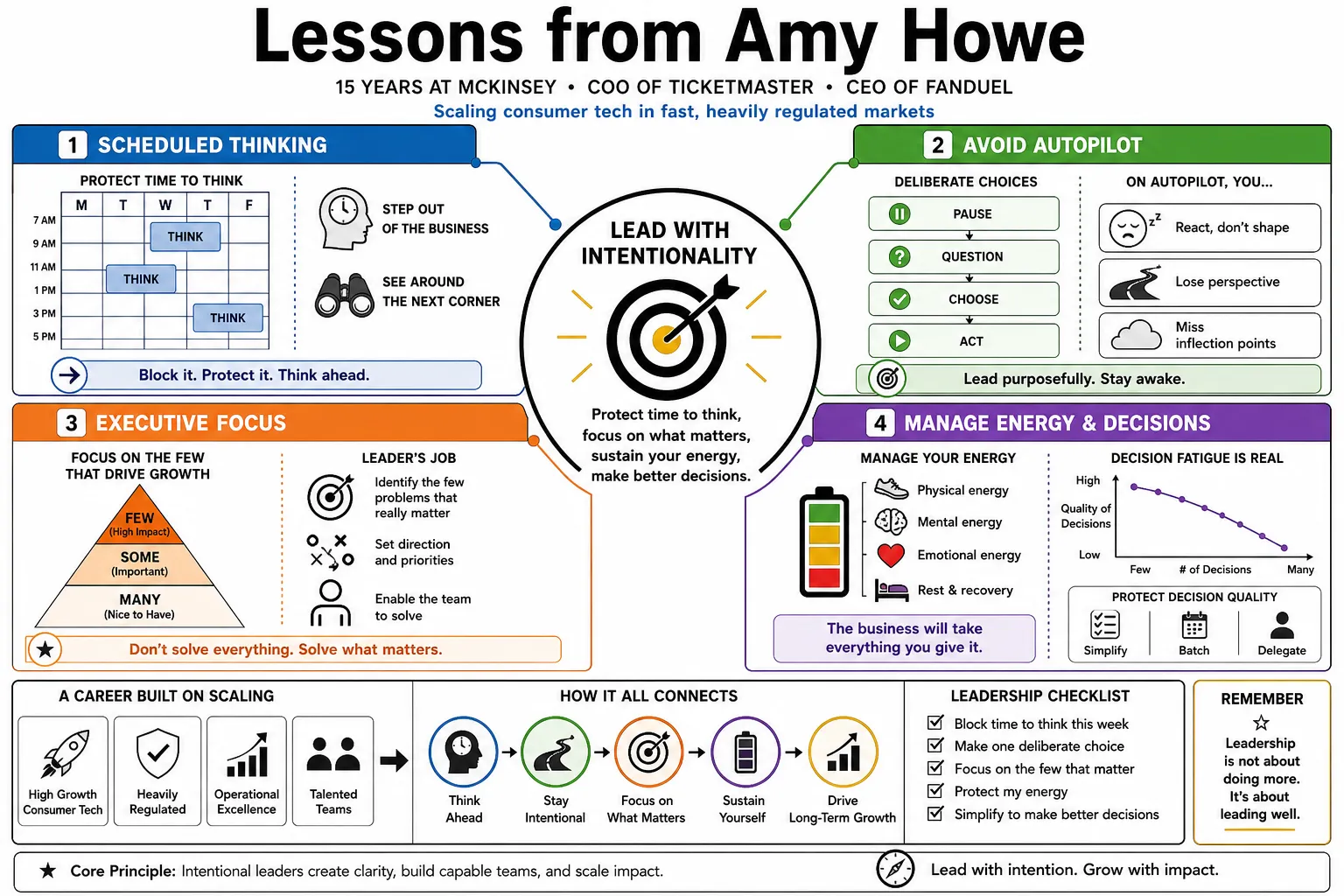
Part 1: Leadership and Intentionality
- Scheduled Thinking: Leaders must deliberately block out white space on their calendars to reflect on long-term strategy rather than allowing daily reactive meetings to dictate their attention. — Chief Executive: FanDuel CEO Amy Howe Asks: Do You Schedule Time To Think?.
- Avoiding Autopilot: Operating on autopilot blinds executives to emerging market shifts; effective leadership demands active, deliberate decision-making regarding where organizational focus and executive time are directed. — Chief Executive: FanDuel CEO Amy Howe Asks: Do You Schedule Time To Think?.
- Executive Focus: Senior leaders create enduring value by narrowing organizational focus to the few critical problems that drive long-term growth rather than attempting to resolve every operational issue directly. — Wharton Magazine: Embrace Ambiguity and Other Lessons Learned by a C-Suite Executive.
- Managing Energy: Sustaining high executive performance requires actively managing mental, emotional, and physical energy alongside the calendar, ensuring adequate recovery so high-growth demands do not lead to burnout. — Chief Executive: FanDuel CEO Amy Howe Asks: Do You Schedule Time To Think?.
- Mitigating Decision Fatigue: In high-growth companies, executive fatigue is mitigated by delegating decision authority to frontline teams closest to the work, preserving executive bandwidth for strategic pivots. — StrategicCHRO360: The CEO of FanDuel on How to Build Strong Teams.
- Ruthless Prioritization: Successful scaling hinges on filtering out dozens of competing initiatives to execute the vital few bets that materially move company performance. — Wharton Magazine: Embrace Ambiguity and Other Lessons Learned by a C-Suite Executive.
- Intentional Culture: High-performance culture must be deliberately designed and reinforced by leadership; without conscious shaping, passive habits and the surrounding environment will define organizational norms. — Chief Executive: FanDuel CEO Amy Howe Asks: Do You Schedule Time To Think?.
- Defining Winning: Teams require an explicit definition of success from leadership; establishing a clear North Star enables cross-functional units to align daily actions with overarching company milestones. — StrategicCHRO360: The CEO of FanDuel on How to Build Strong Teams.
Part 2: Navigating Career Transitions
- Sliding Door Moments: Career trajectories are rarely linear, unfolding instead through unexpected "sliding door" moments that require taking calculated risks when unconventional opportunities appear. — Masters of Scale: Betting on the Super Bowl, with Amy Howe.
- From Advising to Operating: Transitioning from management consulting to executive operations demands learning to navigate ambiguity, moving from structured analytical roadmaps to executing through messy, imperfect real-world conditions. — Wharton Magazine: Embrace Ambiguity and Other Lessons Learned by a C-Suite Executive.
- Embracing Calculated Risk: Leaving an established consulting partnership for operational leadership carries career risk, but staying within a comfortable, predictable environment poses a greater risk to professional growth. — Wharton Magazine: Embrace Ambiguity and Other Lessons Learned by a C-Suite Executive.
- Transferable Problem Solving: Foundational consulting skills—dissecting multi-variable problems, rigorous data synthesis, and structured stakeholder communication—remain directly transferable across distinct verticals like ticketing, media, and digital gaming. — Wharton Magazine: Embrace Ambiguity and Other Lessons Learned by a C-Suite Executive.
- Questioning Industry Assumptions: Entering an unfamiliar industry requires leaders to embrace a beginner’s mindset, asking fundamental questions about customer experience and legacy practices that incumbents take for granted. — Masters of Scale: Betting on the Super Bowl, with Amy Howe.
Part 3: Building a Culture of Endurance
- Foundational Grit: Enduring leadership is rooted in personal grit—developed through early experiences facing harsh conditions and persistent challenges—where commitment to effort remains steady regardless of immediate outcomes. — Chief Executive: FanDuel CEO Amy Howe Asks: Do You Schedule Time To Think?.
- Athletic Accountability and Teamwork: Competitive athletics instills both individual accountability and team interdependence; while individual pursuits demand personal precision, team execution requires total synchronicity where any dropped stunt impacts the entire group. — Chief Executive: FanDuel CEO Amy Howe Asks: Do You Schedule Time To Think?.
- Learning from Crisis: The most defining leadership lessons arise during sudden organizational crises rather than routine quarters, demanding immediate operational stabilization, transparent communication, and rigorous post-crisis dissection. — Wharton Magazine: Embrace Ambiguity and Other Lessons Learned by a C-Suite Executive.
- Pacing and Sustainable Endurance: Hyper-growth tech companies cannot operate at sprint velocity indefinitely; leadership must actively design pacing, recovery, and psychological safety into corporate culture to maintain long-term momentum. — StrategicCHRO360: The CEO of FanDuel on How to Build Strong Teams.
- Psychological Safety and Dissent: Effective corporate cultures require psychological safety where team members feel empowered to challenge leadership consensus, ensuring strategy is thoroughly stress-tested before execution. — StrategicCHRO360: The CEO of FanDuel on How to Build Strong Teams.
- Constructive Accountability: Sustainable execution pairs high accountability with structural support, focusing post-mortems on process improvements and root-cause analysis rather than personal blame. — StrategicCHRO360: The CEO of FanDuel on How to Build Strong Teams.
- Maintaining Coachability: Regardless of executive seniority, leaders must remain actively coachable, seeking constructive criticism and adjusting their operational tactics based on honest feedback. — Chief Executive: FanDuel CEO Amy Howe Asks: Do You Schedule Time To Think?.
Part 4: Strategic Growth and Scale
- Balancing Standardization and Localization: Scaling across fragmented state-level markets requires distinguishing between elements that demand local nuance and the underlying technology platform that must be standardized for scale. — Masters of Scale: Betting on the Super Bowl, with Amy Howe.
- Peak-Event Stress Testing: Massive consumer events like the Super Bowl serve as ultimate stress tests for digital platforms, exposing architectural vulnerabilities and requiring end-to-end resilience from backend infrastructure to live customer operations. — Masters of Scale: Betting on the Super Bowl, with Amy Howe.
- Product Experience Over Pure Acquisition: Rapid customer acquisition delivers no long-term enterprise value without a superior product experience and retention infrastructure to sustain customer lifetime value. — Casino.org: FanDuel CEO Ready for More Competition, Sees Annual Profit.
- Executing Operational Fundamentals: In crowded, fast-moving markets, defensible competitive moats are built by executing core operational fundamentals—speed, uptime, and intuitive user flows—better than competitors rather than relying on promotional subsidies. — Casino.org: FanDuel CEO Ready for More Competition, Sees Annual Profit.
- Brand Trust as a Strategic Asset: When asking consumers to deposit money and personal data, brand reputation and regulatory trust serve as the foundational assets required for sustained customer retention. — Masters of Scale: Betting on the Super Bowl, with Amy Howe.
- Rapid Product Iteration: Developing market-leading consumer products requires releasing iterative features to gather real-world customer usage data rather than delaying deployment in pursuit of theoretical perfection. — StrategicCHRO360: The CEO of FanDuel on How to Build Strong Teams.
- Unit Economics Over Top-Line Handle: While gross revenue captures headlines, the enduring viability of a consumer digital business is determined by underlying unit economics, cost of acquisition, and sustained user engagement. — Casino.org: FanDuel CEO Ready for More Competition, Sees Annual Profit.
- The Imperative of Scale: Achieving operating profitability in digital consumer platforms requires massive scale: "One of the things that we're seeing, which is not dissimilar to many e-commerce industries, is that you've got to have scale." — Casino.org: FanDuel CEO Ready for More Competition, Sees Annual Profit.
Part 5: Navigating Regulatory Environments and Responsibility
- Architectural Responsible Gaming: Consumer protection and responsible gaming safeguards must be engineered directly into core product architecture, utilizing real-time monitoring to detect risky user behaviors proactively. — Masters of Scale: Betting on the Super Bowl, with Amy Howe.
- Regulators as Essential Partners: In heavily scrutinized verticals, leadership must view regulatory bodies as vital partners in constructing an enduring, legitimate commercial ecosystem rather than administrative obstacles. — Masters of Scale: Betting on the Super Bowl, with Amy Howe.
- Prioritizing Long-Term Consumer Health: Building a durable consumer franchise requires turning away short-term revenue derived from unhealthy customer habits, prioritizing long-term market health over temporary gains. — Masters of Scale: Betting on the Super Bowl, with Amy Howe.
- Proactive Stakeholder Education: Expanding into emerging regulated markets demands proactive education of lawmakers and consumers regarding how underlying technology, geolocation, and fraud prevention actually operate. — MIT Sloan Sports Analytics Conference: Amy Howe Speaker Profile.
Part 6: Problem-Solving and Analytics
- Balancing Analytics with Executive Judgment: While predictive analytics and quantitative metrics must inform business strategy, algorithmic models cannot substitute for executive judgment when resolving ambiguous, high-consequence situations. — MIT Sloan Sports Analytics Conference: Amy Howe Speaker Profile.
- Structured Problem Decomposition: Rigorous consulting methodology instills the discipline of taking massive, ambiguous challenges and decomposing them into distinct, structured workstreams that operational teams can systematically address. — Wharton Magazine: Embrace Ambiguity and Other Lessons Learned by a C-Suite Executive.
- Costly vs. Costless Time: Executive efficiency requires distinguishing between "costly time" spent on high-stakes strategic bets and "costless time" on reversible decisions, preventing analysis paralysis when rapid execution is critical. — Wharton Magazine: Embrace Ambiguity and Other Lessons Learned by a C-Suite Executive.
- Hypothesis-Driven Experimentation: Treating strategic initiatives as testable hypotheses rather than rigid dogma enables organizations to deploy rapid pilots, evaluate empirical customer results, and pivot without organizational friction. — StrategicCHRO360: The CEO of FanDuel on How to Build Strong Teams.
- Cross-Functional Metric Alignment: High-velocity organizations avoid departmental silos by forcing engineering, product, and commercial leaders to evaluate a unified set of performance metrics simultaneously. — StrategicCHRO360: The CEO of FanDuel on How to Build Strong Teams.
- Communicating Strategy Simply: Strategic clarity requires translating complex operational architectures into plain, accessible language so frontline employees understand precisely how their efforts contribute to company goals. — Chief Executive: FanDuel CEO Amy Howe Asks: Do You Schedule Time To Think?.
Part 7: Team Dynamics and Talent Management
- Hiring for Resilience and Adaptability: In hyper-growth organizations, hiring must prioritize learning agility, curiosity, and demonstrated resilience over static credentials, as specific job scopes inevitably evolve alongside market demands. — StrategicCHRO360: The CEO of FanDuel on How to Build Strong Teams.
- Complementary Team Composition: High-performing leadership teams avoid homogeneity; rather than staffing an organization entirely with "quarterbacks," resilient companies require complementary roles and diverse backgrounds to uncover blind spots. — StrategicCHRO360: The CEO of FanDuel on How to Build Strong Teams.
- True Decision Autonomy: Scaling executive impact requires delegating genuine decision autonomy to operational leaders, accepting that their choices may differ from the CEO's as long as they advance the shared North Star. — StrategicCHRO360: The CEO of FanDuel on How to Build Strong Teams.
- Checking Ego at the Door: Building an effective leadership culture requires team members to check individual egos at the door, prioritizing collective organizational success over personal validation. — StrategicCHRO360: The CEO of FanDuel on How to Build Strong Teams.
- Mentorship and Executive Sponsorship: Formative mentorship transcends routine guidance, relying on active sponsorship that opens doors to high-visibility operational challenges and advocates for emerging leaders during critical transitions. — Wharton Magazine: Embrace Ambiguity and Other Lessons Learned by a C-Suite Executive.
Part 8: Personal Development and Mindset
- Preparation as the Antidote to Pressure: Intense executive pressure is neutralized through rigorous preparation behind the scenes; mastering foundational details builds the confidence needed to trust intuition during high-stakes moments. — Chief Executive: FanDuel CEO Amy Howe Asks: Do You Schedule Time To Think?.
- Deliberate Work-Life Integration: Recognizing that perfect work-life balance is unrealistic, executives should practice conscious work-life integration, making deliberate choices about energy allocation across demanding professional and personal seasons. — StrategicCHRO360: The CEO of FanDuel on How to Build Strong Teams.
- Staying Grounded Through Family: Personal grounding is reinforced through family ties and trusted relationships—such as having an identical twin sister—ensuring that senior corporate titles never displace humility and self-awareness. — Chief Executive: FanDuel CEO Amy Howe Asks: Do You Schedule Time To Think?.
- Culture and People as Lasting Legacy: Long-term executive legacy is defined not by temporary quarterly milestones, but by the enduring strength of the organizational culture and the next generation of leaders developed along the way. — Chief Executive: FanDuel CEO Amy Howe Asks: Do You Schedule Time To Think?.