Andre Agassi won eight Grand Slam singles titles, later made education a central part of his work, and became Team World captain at the Laver Cup. The lessons below examine his own accounts of a tennis career he did not choose, public identity, and purpose beyond competition. — Stanford Conversation. — Laver Cup Announcement.
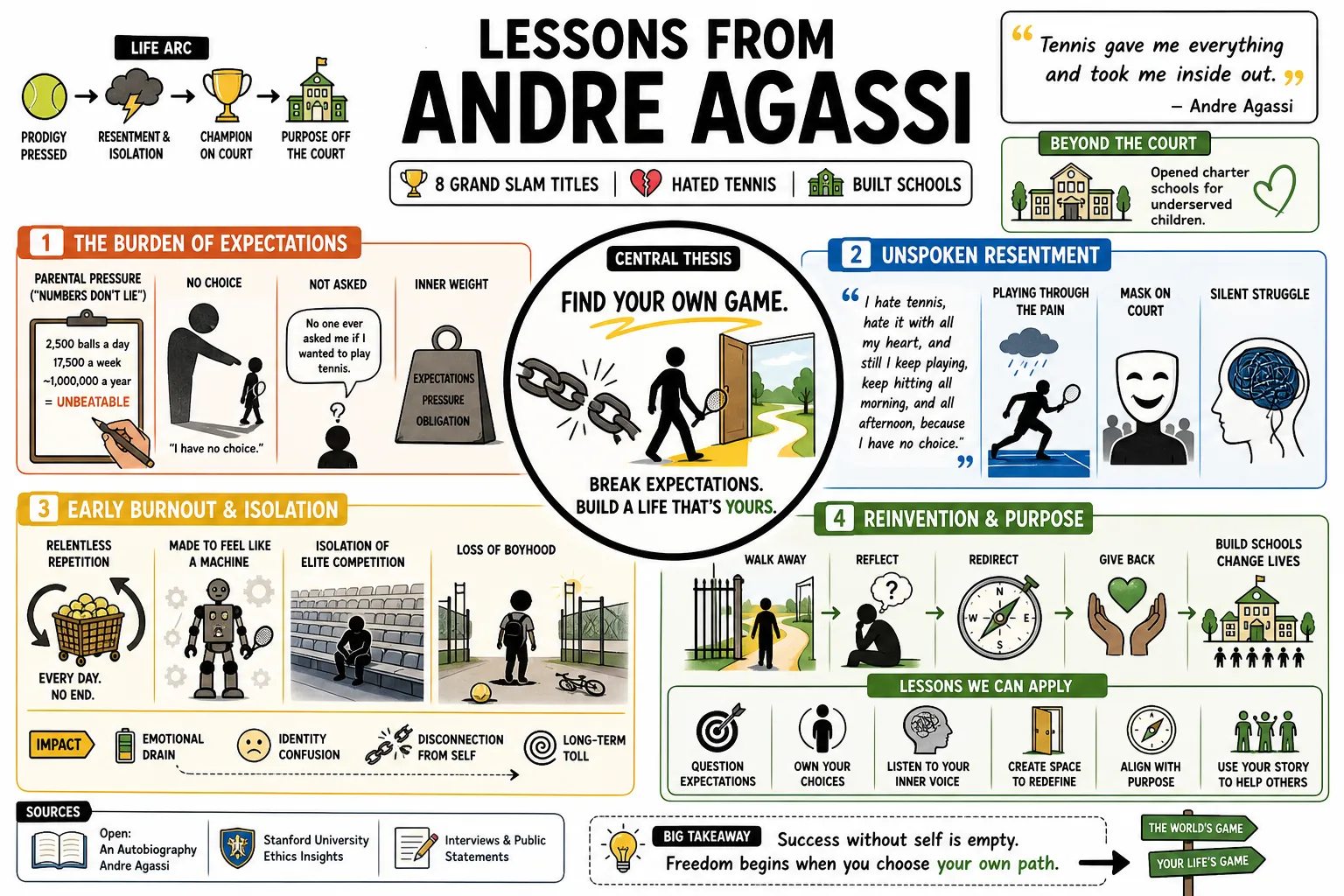
Part 1: The Burden of Expectations
- On parental pressure: Agassi recalls his father reasoning that hitting 2,500 balls a day would add up to nearly a million in a year and make him unbeatable. — Open — Sports Illustrated Excerpt.
- On unspoken resentment: Agassi says he hated tennis as a child yet kept playing because he felt he had no choice. — Open — Sports Illustrated Excerpt.
- On the cost of the academy: Agassi says being sent away at 13 made tennis cost him time at home, much of his schooling and a sense of ordinary childhood. — Fresh Air Interview.
- On the absence of choice: Agassi says his father chose tennis for him and that growing up without that choice left him disconnected from the life he was living. — Oprah.com Interview.
- On the Dragon: Agassi called his father's imposing ball machine the Dragon and recalls facing thousands of balls a day; it became a symbol of a game he had not chosen. — Fresh Air Interview.
- On public rebellion: Agassi says his teenage rebellion at the academy played out before the world, where his appearance attracted attention even as he felt trapped by others' expectations. — Oprah.com Interview.
- On hiding in plain sight: Looking back, Agassi said his conspicuous hair and rebel image were ways of hiding rather than simply attempts to stand out. — Oprah.com Interview.
Part 2: The Illusion of Success
- On winning and losing: Agassi described fearing defeat more than enjoying victory: winning often felt like escaping a loss, while losing damaged his sense of self. — Oprah.com Interview.
- On world number one: Reaching the No. 1 ranking did not resolve the emotional emptiness Agassi felt; he later described feeling nothing at the milestone. — The Guardian Interview.
- On trophies and identity: Agassi says trophies and money felt good but did not define him; he had to look beyond performance to understand who he was. — Stanford Conversation.
- On the weight of fame: Agassi recalls being judged through the public persona attached to him, including the Canon slogan, while privately fearing failure and misunderstanding. — DER SPIEGEL Interview.
- On fear behind the persona: Agassi said he feared failure and embarrassment even while winning major titles, and that the arrogant public image hid how unsure he felt. — DER SPIEGEL Interview.
- On the image slogan: Agassi said the Canon commercial's “Image is everything” slogan stayed attached to him for years, intensifying the public judgment he already found painful. — DER SPIEGEL Interview.
- On choosing his own reason: At his 1997 low point, Agassi asked what would happen if he chose tennis for himself and gave old tasks new meaning; he says that decision changed his relationship with the sport. — Oprah.com Interview.
Part 3: The Psychology of the Game
- On tennis's isolation: Agassi describes the solitude of a tennis match and the need to manage his own thoughts between points without on-court coaching. — Open — NPR Excerpt.
- On self-talk: Agassi describes tennis players talking to themselves and answering back between points, a form of self-coaching in an isolated sport. — Open — NPR Excerpt.
- On the opponent within: Agassi describes perfectionism as fighting an imagined better version of himself, a mental contest that persisted even as his ranking improved. — Served with Andy Roddick Interview.
- On tennis and life: Agassi compares the vocabulary of tennis—advantage, service, fault, break and love—to the elements of ordinary life, treating a match as a miniature life. — Open — NPR Excerpt.
- On the next week: Agassi notes the psychological asymmetry of the tour: a win demands that you prove yourself again the next week, but a loss also brings a chance to respond. — Served with Andy Roddick Interview.
- On reading a serve: Agassi studied Boris Becker's serve and noticed that Becker's tongue position signaled direction; he chose when to use the tell so Becker would not change it. — Agassi on Becker's Serve.
- On character and conditioning: Trainer Gil Reyes distinguished competitive character from physical preparation: tired legs can push a player toward poor shot choices, while trained legs help sustain a match plan. — Gil Reyes — Tennis Australia Interview.
- On Djokovic's competitive edge: Reflecting on coaching Novak Djokovic, Agassi said he was surprised by how much fear or anger seemed to help Djokovic compete at his best. He described this as an observation about Djokovic's mindset, not a rule for every player. — The Wolf in Winter Documentary.
Part 4: Resilience and Reinvention
- On ownership at No. 141: When Agassi fell to No. 141, he considered leaving tennis but chose to begin again on his own terms rather than continue only because others had chosen the game for him. — Oprah.com Interview.
- On playing through pain: Agassi says years of wear left his spine seizing during his final US Open; the pain restricted his movement and changed the decisions he could make on court. — Fresh Air Interview.
- On the slow climb back: After falling near No. 140, Agassi chose to restart on the Challenger Tour, accepting smaller stages to rebuild his game and his relationship with tennis. — Arizona Tennis Classic Q&A.
- On Gil Reyes: Agassi describes trainer Gil Reyes as a friend and surrogate father whose importance extended beyond physical conditioning. — Open — Sports Illustrated Excerpt.
- On the 1999 French Open: Agassi entered the 1999 French Open doubting he was ready, survived several close matches and came back from two sets down in the final; he later recalled how much the victory meant after his ranking collapse. — Served with Andy Roddick Interview.
- On adjusting during a match: Down two sets in the 1999 French Open final, Agassi says Brad Gilbert pushed him to move and choose clearer targets; Agassi returned to court determined to play on his own terms. — Served with Andy Roddick Interview.
- On discovering pickleball: Agassi says he still loves tennis but finds its rotation harder on his body; pickleball offers competition, movement and fun with friends. — Newsweek Interview.
- On retirement's mixed emotions: Agassi described retirement as liberation from pressure and physical pain, while also acknowledging sadness at the end of his playing career. — DER SPIEGEL Interview.
Part 5: Perfectionism and Process
- On the trap of perfection: Agassi later described perfectionism as a destination one never reaches, rather than a standard that makes every performance meaningful. — Stanford Conversation.
- On preparation over results: Agassi says he came to value doing the preparation and following a plan more than defining himself solely by a match's scoreboard. — The Guardian Interview.
- On acting after an insight: Agassi says the thought that he could choose tennis for himself did not change his life on its own; the work he did after that realization gave it force. — Served with Andy Roddick Interview.
- On pre-match preparation: In the final-US-Open chapter of Open, Agassi describes using hot showers, physical loosening and self-talk to prepare his hurting body and mind for a late match. — Open — Publisher Excerpt.
- On match-play strategy: Brad Gilbert says coaching Agassi involved scouting opponents and building a strategy, not relying on beautiful shotmaking alone. — Brad Gilbert Interview.
- On helping others: Agassi came to see helping others as the kind of perfection that could have lasting meaning, a change from measuring himself only by tennis results. — Stanford Conversation.
- On preparation for a major: Gil Reyes says Agassi treated the Australian Open's preceding weeks as a preseason, maintaining demanding training even over holidays so he arrived physically ready. — Gil Reyes — Tennis Australia Interview.
Part 6: Education and Philanthropy
- On education and choice: Agassi says losing much of his formal education restricted his own choices; he wanted schooling to give children more freedom to shape their futures. — TIME Interview.
- On moving past temporary fixes: The Agassi Foundation says its early broad programs offered temporary relief, prompting a shift toward longer-lasting improvements in public education. — Agassi Foundation FAQ.
- On high expectations and resources: Agassi argues that high expectations for students must be paired with adequate school resources and accountability, rather than treating aspiration alone as enough. — Andre's Foundation Perspective.
- On scaling schools: Agassi expanded beyond his Las Vegas school through a joint venture with Turner Impact Capital that develops facilities for charter-school operators. — Turner Impact — Education.
- On off-court impact: Agassi contrasts the short-lived experience he could give spectators with education work that can affect children and future generations. — TIME Interview.
- On why he built schools: Agassi says he used education to create choices for children who reminded him of his younger self, after tennis had crowded out his own schooling. — TIME Interview.
- On financing school facilities: The Turner–Agassi fund develops facilities for charter-school operators, leases them to schools and allows operators to purchase sites as they grow; this is a specific funding model, not proof that every impact investment earns a return. — Turner–Agassi Education Fund.
- On school accountability: Agassi pairs better resources for public schools with accountability, saying both are needed to deliver the education children deserve. — Andre's Foundation Perspective.
Part 7: Fatherhood and Family
- On parenting after a pressured childhood: Agassi says he wanted his children to have a safe place while still holding them to high expectations, rather than repeating the tennis pressure he experienced as a child. — TIME Interview.
- On his children's own ambitions: Agassi says he wants to guide his children in their own dreams; he points to his son's interest in baseball rather than demanding they follow him into tennis. — TIME Interview.
- On Steffi Graf's influence: Agassi admired how Graf met intense external pressure with grace. Her response to his conflicted feelings about tennis helped him see that a different relationship with the sport was possible. — Oprah.com Interview.
- On trust in a private marriage: Agassi says Graf supported his decision to write Open while trusting him to protect what mattered to her privacy; he did not present marriage as a generic trauma prescription. — DER SPIEGEL Interview.
- On the difference between a hotel and home: Agassi calls the hotel suites of his playing years a kind of “Not Home,” contrasting that athlete's non-place with the nearby presence of his wife and children. — Open — Publisher Excerpt.
- On what he hoped his children would learn: Agassi hoped his children would read his memoir as a story about mistakes, second chances and the possibility of taking ownership of their own lives. — Oprah.com Interview.
- On seeing fame from home: Agassi says his children first knew him and Graf as parents. As public attention became understandable, they learned to distinguish celebrity from ordinary family life. — PEOPLE Interview.
- On family after tennis: Agassi said retirement freed him from constant competition and physical pain and let him be more present as his children grew, though he also found the end of his career sad. — DER SPIEGEL Interview.
Part 8: Identity and Authenticity
- On shedding the image: Agassi says concealing his hair loss behind a hairpiece made him feel fraudulent; shaving his head ended that particular charade. — The Guardian First-Person Essay.
- On not knowing himself: Agassi said public labels arrived before he understood himself, and that he wrote his memoir in part to make sense of the contradictions in his own life. — Oprah.com Interview.
- On writing Open: Agassi says he wrote his memoir to understand the story behind his life's contradictions, accepting that its candor could provoke negative reactions. — Oprah.com Interview.
- On finding a larger reason: Agassi says building a school for children with fewer options gave him a reason to keep using tennis, connecting his effort to a purpose larger than his results. — Served with Andy Roddick Interview.
- On the final goodbye: After his last US Open match, Agassi said fans' embrace and his fellow players' applause were among the memories he would carry; he saw the farewell as a goodbye they got through together. — US Open Post-Match Transcript.
- On returning to commentary: As he prepared for TNT's French Open coverage, Agassi said he wanted to contribute to the broadcast and do the work well; he also had more room for tennis projects as his children grew older. — Served with Andy Roddick Interview.