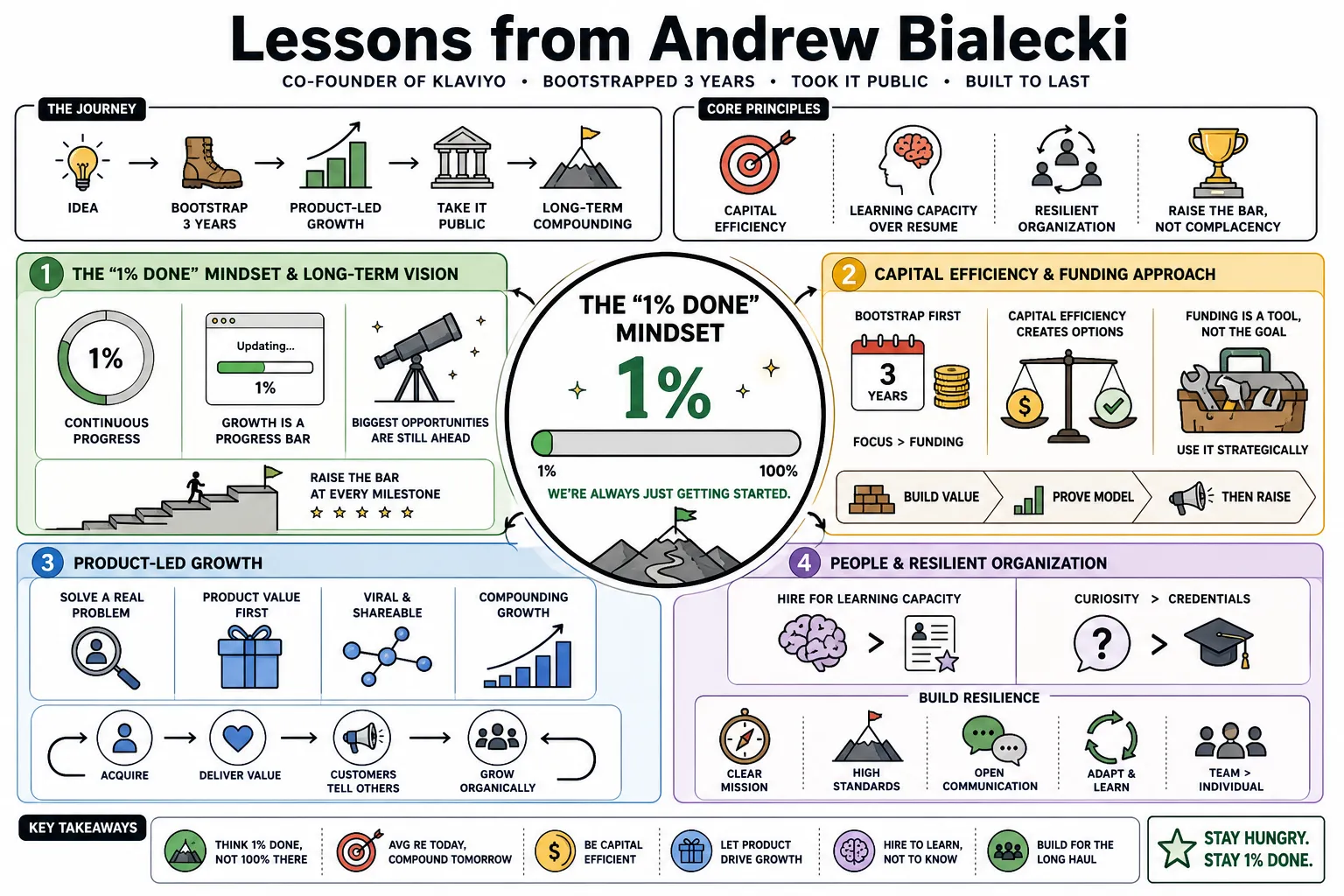
Lessons from Andrew Bialecki
Andrew Bialecki co-founded Klaviyo, bootstrapping the marketing platform past $1M in annual revenue and later taking it public in 2023. As CEO, he prioritizes capital efficiency, hires for learning capacity over polished resumes, and maintains that the company is only ever "1% done." This collection covers his advice on funding, product-led growth, and building resilient organizations. — Logan Bartlett Show EP 101 with Andrew Bialecki (2024).
Part 1: The "1% Done" Mindset and Long-Term Vision
- On Continuous Progress: "A dangerous thing that happens is if a person or a team or whole company starts to feel like, well, we're kind of 60% of the way there or 70%, you start to feel a little protective of what you've got. You start to get a little risk-averse." — Reference: Business Insider, "Klaviyo CEO Andrew Bialecki explains why the company is only '1% done'" (2024).
- On the Software Progress Bar: He compares "we're 1% done" to a software-update progress bar: at 1% you don't worry about stopping and trying again, because you haven't lost much. — Reference: Business Insider, "Klaviyo CEO Andrew Bialecki explains why the company is only '1% done'" (2024).
- On Avoiding Complacency: "You just need that mentality that, the best things you're going to accomplish are still in front of you." — Reference: Business Insider, "Klaviyo CEO Andrew Bialecki explains why the company is only '1% done'" (2024).
- On Raising the Bar: Celebrate milestones, then raise the bar. After each holiday season Klaviyo hangs a banner for customers' results and asks, "what would it mean to do 100x that?" — Reference: Business Insider, "Klaviyo CEO Andrew Bialecki explains why the company is only '1% done'" (2024).
- On Long-Term Thinking: In Practical Ecommerce, Bialecki described Klaviyo's mission as empowering creators to own their destinies, a broad enough ambition to require patient company building rather than short campaign thinking. — Reference: Practical Ecommerce interview with Andrew Bialecki
- On the Future of Software: His Logan Bartlett interview closes on the future of software, framing Klaviyo as software that lets businesses scale their best customer experiences. — Reference: Logan Bartlett Show EP 101 with Andrew Bialecki (2024).
Part 2: Bootstrapping, Capital Efficiency, and Funding
- On building it himself: He did all of Klaviyo's engineering himself for the first two or three years, before building a team that now runs to hundreds of engineers. — Reference: Practical Ecommerce interview with Andrew Bialecki.
- On the founding premise: Klaviyo started from a simple belief: "if we found a customer problem and we could build software to solve it for enough people who would pay for a solution, we could build a sustainable business." — Reference: Klaviyo Form S-1, "Letter from Andrew Bialecki and Ed Hallen, Co-Founders" (2023).
- On Raising Capital: Raise only what you need. Of Klaviyo's first round he says, "I made a big mistake. We didn't need the money. Still, we decided to raise a million bucks." — Reference: Practical Ecommerce interview with Andrew Bialecki.
Part 3: Hiring for "High Slope" and Curiosity
- On "High Slope" Individuals: "We look for people that are high slope. We don't care about the skills and experience you come in with. We look for people whose trajectory and ability to learn is really steep." — Reference: Shopify Beyond the Build interview with Andrew Bialecki.
- On learning speed: One of Klaviyo's values: "how fast you can learn new skills and absorb new information is as important, if not more, than the skills you have today." — Reference: Klaviyo Form S-1, "Letter from Andrew Bialecki and Ed Hallen, Co-Founders" (2023).
- On Fixed Mindsets: In Grit's episode notes, Bialecki says Klaviyo looks for high-slope people and is turned off by candidates who declare they were never good at writing, numbers, or another learnable skill. — Reference: Grit episode with Andrew Bialecki
- On Compounding Curiosity: The Grit episode describes Klaviyo's preference for high-slope candidates who are curious and able to keep learning, treating learning velocity as more important than static skill lists. — Reference: Apple Podcasts listing for Grit with Andrew Bialecki
- On Interviewing for Curiosity: His interview question: "Tell me about something hard you've learned in the last year." People who are high slope "gush about it, because they're so interested and curious." — Reference: Shopify Beyond the Build interview with Andrew Bialecki.
- On Career Consistency: He interviews with chronological resumes, using the story of a candidate's whole career to understand them rather than only their latest role. — Reference: Logan Bartlett Show EP 101 with Andrew Bialecki (2024).
Part 4: Product-Led Growth and Customer Focus
- On data silos: Years of building business intelligence software showed the founders that data always sat in silos. Klaviyo began as a unified customer data store and only then added email, so the data could drive action. — Reference: Klaviyo Form S-1, "Letter from Andrew Bialecki and Ed Hallen, Co-Founders" (2023).
- On Solving Specific Problems: "The reason that we got all this love in the early days was everybody said, look, I have all this information, I just want to put it to work." — Reference: SaaStr Annual conversation with Andrew Bialecki (2024).
Part 5: Creating the Klaviyo Culture and Internal Education
- On living the values: "Values alone are just words, what matters is how intensely we live them." Klaviyo pairs that with "small teams and remarkable peers." — Reference: Klaviyo Form S-1, "Letter from Andrew Bialecki and Ed Hallen, Co-Founders" (2023).
- On Building Future Founders: The Logan Bartlett episode explicitly covers cultivating entrepreneurship inside Klaviyo, Klaviyo University, and training future founders and leaders as part of the company's culture. — Reference: Apple Podcasts listing for the Logan Bartlett episode
- On the Importance of Writing: Logan Bartlett's episode notes call out a dedicated segment on the art and science of effective business writing, tying writing to Klaviyo's internal training and leadership culture. — Reference: Apple Podcasts listing for the Logan Bartlett episode
- On Constant Experimentation: The Logan Bartlett episode highlights Klaviyo's culture of experimentation and entrepreneurship, along with faster cycle times and more shots on goal as a practical operating advantage. — Reference: Apple Podcasts listing for the Logan Bartlett episode
- On Knowledge Sharing: The Logan Bartlett episode includes Klaviyo University, core curriculum, electives, onboarding, and learning programs, showing how the company institutionalizes knowledge as it scales. — Reference: Apple Podcasts listing for the Logan Bartlett episode
Part 6: Artificial Intelligence and the Future of Commerce
- On AI as Logic Engines: He believes that if you study marketing hard enough, you can figure out the decision trees and "if this, then that" logic humans use (which customers, what words, when) and encode it in software. — Reference: PNC C-Speak interview transcript with Andrew Bialecki (2024).
- On Autonomous CX: Klaviyo's Google partnership announcement frames the company around autonomous customer experiences powered by real-time customer data, messaging, AI, and decisioning. — Reference: Klaviyo newsroom announcement on autonomous customer experiences
- On Decision-Making Software: "Commerce is entering a phase where software doesn't just execute tasks, it makes decisions." — Reference: Klaviyo newsroom: strategic partnership with Google (2026).
- On intelligent applications: "We're moving from the era of software as primarily productivity tools to an era of intelligent applications" that know the business's goals and devise a strategy from its data. — Reference: Klaviyo Form S-1, "Letter from Andrew Bialecki and Ed Hallen, Co-Founders" (2023).
- On Personalized Agents: PYMNTS reports that Klaviyo and Google aim to replace static campaigns with experiences that automatically adapt to consumer behavior and intent using real-time customer profiles. — Reference: PYMNTS coverage of the Klaviyo-Google partnership
- On Integrating AI: Accel's Spotlight On episode includes a section on Klaviyo AI and the impact Bialecki expects from the technology, placing AI inside the evolving CEO and product operating model. — Reference: Accel Spotlight On episode with Andrew Bialecki
- On the Future of Marketing: In PYMNTS's coverage, Bialecki says software is moving from executing tasks to making decisions, with AI and customer data powering commerce, messaging, and real-world interactions. — Reference: PYMNTS coverage of the Klaviyo-Google partnership
Part 7: Partnerships, Ecosystems, and "Unsexy" Work
- On Eating Your Vegetables: Do the "unsexy" work. Building Klaviyo's own data connectors looked like grunt work, but it gave deep insight into data structure and customer behavior and became a lasting advantage. — Reference: SaaStr, "5 Keys Behind Klaviyo's Path to $1B+ ARR" (2025).
- On Ecosystems: The Shopify partnership started with Shopify's support team, not its partnership team. By the time Klaviyo approached partnerships, support was already recommending it. — Reference: SaaStr, "5 Keys Behind Klaviyo's Path to $1B+ ARR" (2025).
- On Platform Strategy: A partnership is like a rope: "if you're going to keep it tight, you need both sides pulling on it." Expect to do much of the legwork yourself at the start. — Reference: SaaStr Annual conversation with Andrew Bialecki (2024).
- On Second Acts: Think about the second act sooner than feels comfortable: plan the next product expansion while the first product is still scaling. — Reference: SaaStr, "5 Keys Behind Klaviyo's Path to $1B+ ARR" (2025).
- On Geographic Hubs: Klaviyo is his proof that a major tech company can be built outside a traditional tech hub. He built it in Boston. — Reference: Accel Spotlight On episode with Andrew Bialecki.
- On Vertical Products: In Shopify's Beyond the Build interview, Bialecki explains how Klaviyo moved from a general customer-data idea to Shopify merchants by studying APIs, workflows, and the data retailers needed to personalize experiences. — Reference: Shopify Beyond the Build interview with Andrew Bialecki
Part 8: Founder Evolution and Leadership Lessons
- On Learning by Doing: When they started Klaviyo, they did not know everything about building a business but were confident they could figure it out, and that willingness to learn and be wrong remains core advice internally. — Reference: PNC C-Speak interview transcript with Andrew Bialecki (2024).
- On the Evolving CEO Role: The CEO role changes at every stage, from the hustle of winning early customers to operating as a public company. — Reference: Accel Spotlight On episode with Andrew Bialecki.
- On being a public company: He does not see being public as dramatically different from being private, but he values "the rigor of every few months having to show how you're doing." — Reference: SaaStr, "4 Unexpected Learnings from Klaviyo".
- On Staying Grounded: Accel describes the episode as an open look at how Klaviyo and Bialecki's CEO role changed from the earliest stages to operating as a public company, keeping learning and self-assessment in the foreground. — Reference: Accel Spotlight On episode with Andrew Bialecki