Andrew Chen is a General Partner at Andreessen Horowitz and the author of The Cold Start Problem. He is known for defining the transition from traditional marketing to engineering-driven growth and for his frameworks on network effects. This profile collects his specific strategies for solving marketplace supply constraints, measuring real user retention, and scaling consumer products. — Andrew Chen, The Cold Start Problem (2021), full text on andrewchen.com.
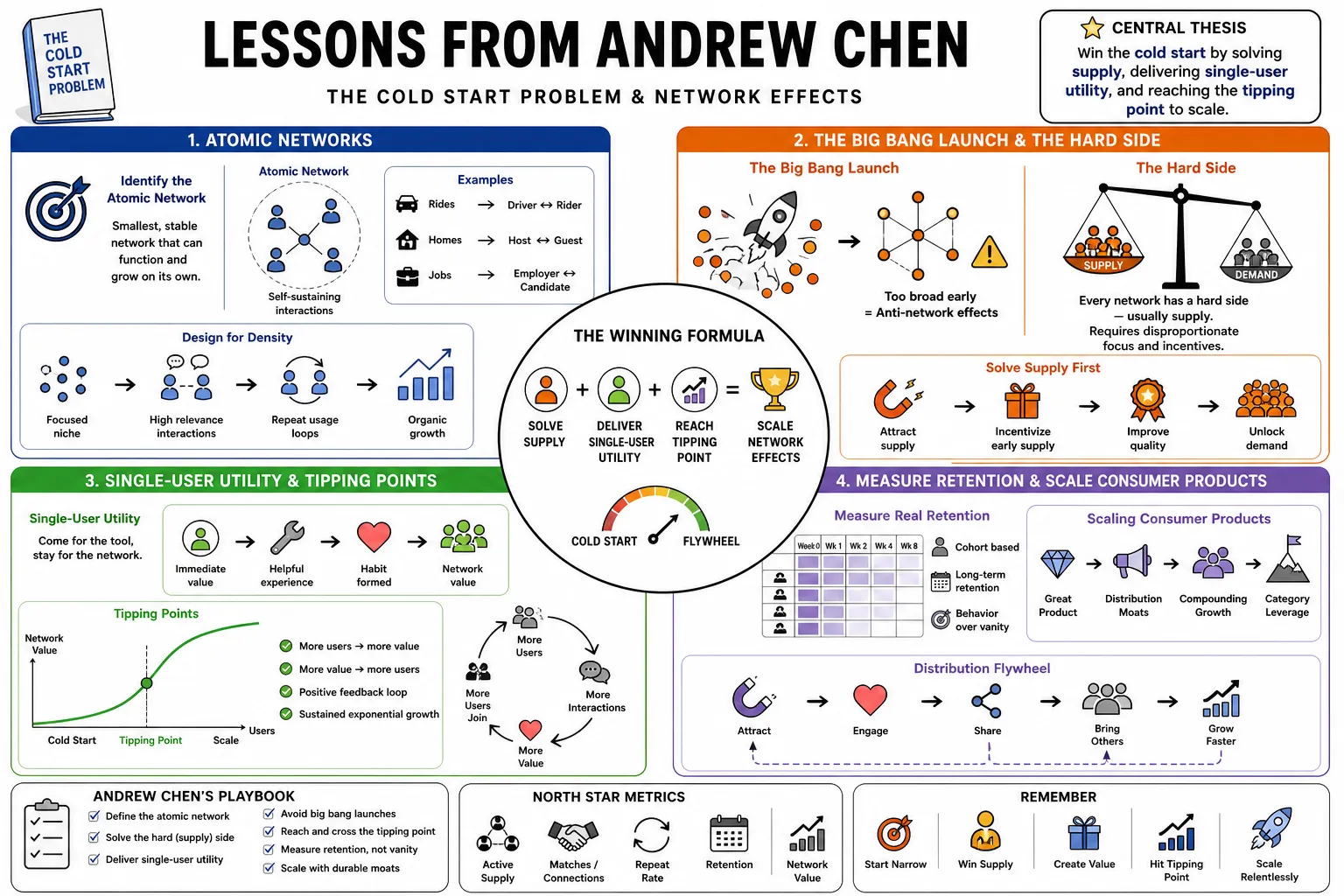
Part 1: The Cold Start Problem & Network Effects
- On Atomic Networks: Start with the atomic network: "the smallest possible network that is stable and can grow on its own." Zoom's can work with two people; Airbnb's needs hundreds of listings in one market. — Reference: Andrew Chen, The Cold Start Problem (2021), full text on andrewchen.com.
- On The Big Bang Launch: Most new networks fail at the start: if users don't find who or what they want, they churn. That is why invite-only launches can beat a Big Bang Launch; they make sure new users are properly connected. — Reference: Andrew Chen, The Cold Start Problem (2021), full text on andrewchen.com.
- On The Hard Side: Every network has an easy side and a hard side, and acquiring the hard side and keeping it happy "is paramount to standing up an atomic network." — Reference: Andrew Chen, The Cold Start Problem (2021), full text on andrewchen.com.
- On Single-User Utility: "Come for the tool, stay for the network" (a phrase from his a16z colleague Chris Dixon): a single-player tool can attract users before the network exists, as Instagram did with filters. — Reference: Andrew Chen, The Cold Start Problem (2021), full text on andrewchen.com.
- On Tipping Points: After the first atomic network, the Tipping Point comes when each new network starts to tip "faster and faster," so the whole market is easier to capture. — Reference: Andrew Chen, The Cold Start Problem (2021), full text on andrewchen.com.
- On Escape Velocity: Escape Velocity is the stage of working furiously to strengthen network effects through three forces: the acquisition effect, the engagement effect and the economic effect. — Reference: Andrew Chen, The Cold Start Problem (2021), full text on andrewchen.com.
- On Network Defensibility: The final stage, The Moat, is about using network effects to fend off competitors, which is tricky when every rival in the category can harness the same dynamics. — Reference: Andrew Chen, The Cold Start Problem (2021), full text on andrewchen.com.
- On Meerkat's Law: Metcalfe's Law "fails the test of real-life messiness." His alternative, Meerkat's Law, borrows from the mathematics of animal populations, where networks can also suffer from overcrowding. — Reference: Andrew Chen, The Cold Start Problem (2021), full text on andrewchen.com.
- On Flintstoning: Flintstoning: like Reddit's founders posting content themselves, teams can fill in the hard side of a network by hand until organic users arrive. — Reference: Andrew Chen, The Cold Start Problem (2021), full text on andrewchen.com.
- On Product Superiority: Network effects and distribution can't rescue a weak product: "The distribution advantages don't win when the product is inferior." — Reference: Andrew Chen, The Cold Start Problem (2021), full text on andrewchen.com.
Part 2: Growth Strategy & Systems
- On Growth Hackers: "Growth hackers are a hybrid of marketer and coder," answering how to get customers "with A/B tests, landing pages, viral factor, email deliverability, and Open Graph." — Reference: Andrew Chen, "Growth Hacker is the new VP Marketing".
- On Distribution: "The fastest way to spread your product is by distributing it on a platform using APIs, not MBAs." — Reference: Andrew Chen, "Growth Hacker is the new VP Marketing".
- On Systems Over Tactics: Growth is not a set of small tactical hacks ("make a button this color"). It is a full model and system of linked parts and loops, and the model has to be understood before tactics can optimize it. — Reference: Andrew Chen, "Growth is a system, not a bag of tricks" (Manifesto Q&A).
- On Amplification: "Growth is a magnifying glass. If you have a tiny diamond and you put it under a magnifying glass, then you'll make something big and great. But if it's just kind of a tiny piece of shit, then it's just going to be a big piece of shit." — Reference: Mixpanel interview with Andrew Chen, "The state of growth hacking".
- On The Product Death Cycle: Beware the Product Death Cycle (from a diagram by David Bland): no one uses the product, so the team asks users what is missing, builds it, and still no one uses it. — Reference: Andrew Chen, "This is the Product Death Cycle".
- On Continuous Momentum: Launches have changed: rather than one Big Bang spike of attention, Always Be Launching means "nonstop/constant talk about your product, its capabilities, case studies, and achievements." — Reference: Andrew Chen, "Always Be Launching" (Substack).
- On Cross-Functional Teams: Growth is a product discipline: growth teams, like core product teams, need engineers, designers and PMs. Product teams create the core value; growth teams get that value "out there to the world." — Reference: Andrew Chen, "How to build a growth team" (andrewchen.com).
Part 3: Metrics & Retention
- On Real Fit: Look for hard signals of product/market fit: cohort retention curves that flatten, actives/registered above 25%, viral factor above 0.5 and DAU/MAU above 50%. — Reference: Andrew Chen, "My product went viral on social media but all I got were these shitty users" (Substack).
- On Leaky Buckets: Think of a product as a leaky bucket: users pour in at the top and constantly leak out, so rolled-up totals hide whether anyone is actually retained. — Reference: Andrew Chen, "Is your website a leaky bucket? 4 scenarios for user retention".
- On The Traction Treadmill: Scaling before retention is fixed creates the Traction Treadmill: you buy new users just to replace the ones who churn, "running hard and just staying in one place." — Reference: Andrew Chen, "Why premature scaling fails: The Traction Treadmill".
- On Virality vs. Retention: Viral growth without retention doesn't last; his early models showed "how poor retention eventually cancels out viral acquisition." — Reference: Andrew Chen, "Why the best way to drive viral growth is to increase retention and engagement".
- On Vanity Data: At Uber, aggregate numbers like total trips "were regarded as mostly meaningless"; the focus was on each individual network, which could be nudged up or down on its own. — Reference: Andrew Chen, The Cold Start Problem (2021), full text on andrewchen.com.
- On Stickiness: For DAU/MAU, apps over 20% are usually considered good and 50%+ world class. — Reference: Andrew Chen, "DAU/MAU is an important metric to measure engagement, but here's where it fails".
- On Fighting Nature: DAU/MAU doesn't fit every product. Travel is booked about twice a year and Uber's most profitable rides are episodic; for such high-value, low-frequency products, "DAU/MAU isn't the right metric." — Reference: Andrew Chen, "DAU/MAU is an important metric to measure engagement, but here's where it fails".
Part 4: Marketplaces & The Hard Side
- On Supply Constraints: In marketplaces the supply side is king: many "Uber for X" startups failed because they could not build the harder supply side. — Reference: Andrew Chen, "Why 'Uber for X' startups failed: The supply side is king".
- On Targeted Subsidies: Paying Up for Launch: networked products can subsidize the market, such as driver earnings in rideshare or payments to creators, to stimulate early activity. — Reference: Andrew Chen, The Cold Start Problem (2021), full text on andrewchen.com.
- On Manual Recruitment: The first stage needs a lot of elbow grease: founders are "very involved onboarding users, sometimes one-by-one." — Reference: Andrew Chen, "What to look for when you're hiring a Head of Growth".
- On Market Saturation: Success brings market saturation. Once nearly everyone in the target market has joined, the focus has to shift from adding new customers to layering on more (the eBay case). — Reference: Andrew Chen, The Cold Start Problem (2021), full text on andrewchen.com.
Part 5: The Decay of Marketing
- On Marketing Attrition: The Law of Shitty Clickthroughs: "Over time, all marketing strategies result in shitty clickthrough rates." — Reference: Andrew Chen, "The Law of Shitty Clickthroughs".
- On Format Satiation: One driver is that customers respond to novelty, "which inevitably fades." — Reference: Andrew Chen, "The Law of Shitty Clickthroughs".
- On First-Mover Advantage: "First-to-market never lasts": once a channel works, competitors quickly follow and copy it. — Reference: Andrew Chen, "The Law of Shitty Clickthroughs".
- On Audience Dilution: "More scale means less qualified customers": as a channel scales, it reaches less-interested audiences. — Reference: Andrew Chen, "The Law of Shitty Clickthroughs".
- On Banner Ads: The first banner ad, on HotWired in 1994, drew a 78% clickthrough rate, against 0.05% for Facebook banner ads in 2011. — Reference: Andrew Chen, "The Law of Shitty Clickthroughs".
- On Fresh Powder: Tips and tricks aren't enough, but proven growth techniques combined "with a new platform that's all fresh powder" can be explosive. — Reference: Andrew Chen, "What's next in growth?".
- On Influencer Exhaustion: Influencer marketing brings a traffic spike that often doesn't convert, fades within days, and big creators are expensive. — Reference: Andrew Chen, "Every marketing channel sucks right now" (Substack).
- On Search Vulnerability: Search is fragile too: SEO is slow, Google can change the rules, and "maybe AI one boxing will kill your traffic next year anyway." — Reference: Andrew Chen, "Every marketing channel sucks right now" (Substack).
Part 6: Consumer Social Startups
- On Unfortunate Pivots: If retention is bad, adding chat, social features or notifications rarely helps, "no matter how buzzy the features are." — Reference: Andrew Chen, "Unfortunate startup pivots (a short list)" (Substack).
- On Misplaced Innovation: "If your core experience isn't working, adding AI or web3 as an additional complication won't fix retention." — Reference: Andrew Chen, "Unfortunate startup pivots (a short list)" (Substack).
- On User Ambivalence: "The opposite of love is ambivalence, not hate, and similarly the opposite of PMF is low retention." — Reference: Andrew Chen, "Unfortunate startup pivots (a short list)" (Substack).
- On Prioritizing Scale: It is "very smart and rational" for consumer startups to focus on getting millions of users first and make money later. — Reference: Andrew Chen, "Why it's smart for consumer startups to grow first and make money later".
Part 7: Hiring & Building Growth Teams
- On Specialized Hiring: Hire a head of growth for your stage: each stage of a product's life calls for different skills, and the earliest is "the most generalist and entrepreneurial." — Reference: Andrew Chen, "What to look for when you're hiring a Head of Growth".
Part 8: Gaming & The Metaverse
- On Rebranding Technology: "3D, GPUs, and virtual items all came from games, though we might re-label them as metaverse, or NFTs." — Reference: Andrew Chen, "One year after launching a16z Games Fund One – here's the pitch deck".
- On Games as Social Platforms: Games have moved from buying cartridges one at a time to "decade-plus long-running games where friends come together as a next gen social network." — Reference: Andrew Chen, "One year after launching a16z Games Fund One – here's the pitch deck".
- On the Killer App: "Games are often the killer app for new technologies." — Reference: Andrew Chen, "One year after launching a16z Games Fund One – here's the pitch deck".