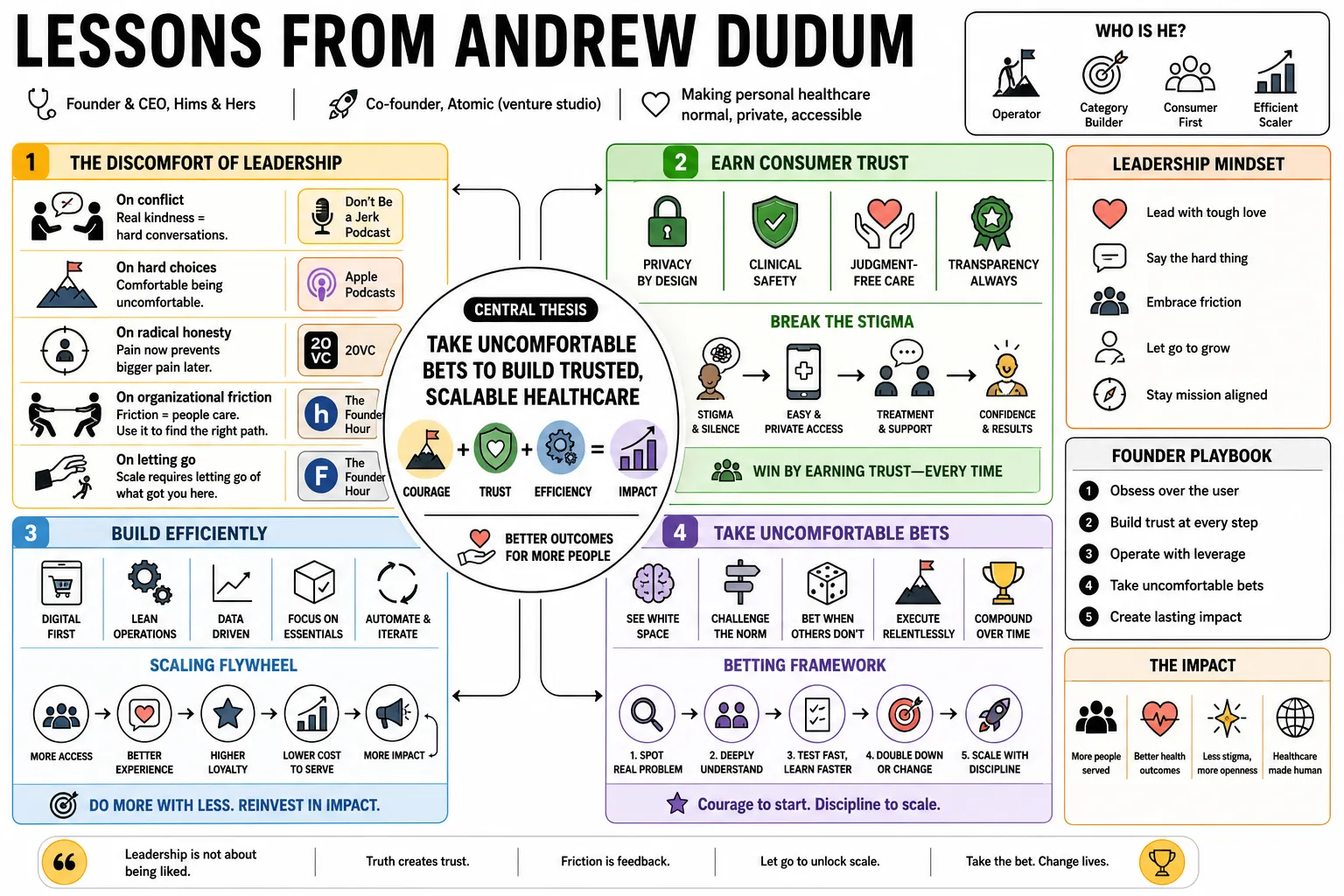
Lessons from Andrew Dudum
Andrew Dudum is the founder and CEO of Hims & Hers, a telehealth company that made it normal to treat conditions like hair loss and erectile dysfunction. Before taking the company public, he co-founded the venture studio Atomic. This collection details his approach to taking uncomfortable bets, earning consumer trust, and scaling healthcare businesses efficiently. — The Kara Goldin Show, Andrew Dudum episode transcript (2020).
Part 1: The Discomfort of Leadership
- On managing experts: Hire experts, then let them do their job, but know when your own context means you need to step in and help. — Reference: Redpoint Founder Series interview with Andrew Dudum (Medium, 2019).
- On letting go: As Hims & Hers scaled, Dudum had to move from generalist company-building into a more specialized leadership system, with stronger operators owning the work. — Reference: 20VC notes on specialization versus generalization
- On personal endurance: Dudum treats hypergrowth as emotionally and operationally demanding: the job is to keep managing time, crises, and people as the company changes around you. — Reference: 20VC notes on hypergrowth and crisis moments
- On the burden of leadership: Going public raised the operating bar for Hims & Hers: Dudum had to keep growth, profitability, customer experience, and market scrutiny in view at the same time. — Reference: 20VC notes on going public and public-market expectations
- On facing failure: In a crisis, people are "scared for themselves because they don't know if they were directly responsible." He tries to keep the team energized, solve the problem first and hold the retrospective once things are stable. — Reference: 20VC with Andrew Dudum on taking Hims public (episode notes and transcript excerpts).
Part 2: Modernizing Healthcare
- On patient access: The old system made care slow: an average 23-day wait for an appointment, then two hours in a waiting room "to have a two-minute conversation with a doctor." A regulatory change letting patients see physicians by phone made rebuilding it possible. — Reference: Redpoint Founder Series interview with Andrew Dudum (Medium, 2019).
- On breaking stigmas: Hims' advertising was designed "to make people giggle, and to break the ice around the fact that we're talking about things that are often exceptionally uncomfortable to deal with." — Reference: Digiday, "Hims' Andrew Dudum: A DTC shake out is coming" (2019).
- On consumer expectations: A generation raised on the iPhone found the existing system "clinical, and cold, and sterile," with three to four weeks to schedule a doctor's appointment. — Reference: The Kara Goldin Show, Andrew Dudum episode transcript (2020).
- On preventative care: Dudum links the Hims & Hers model to broader access: better digital care should make quality, affordability, and primary-care entry points easier for more people. — Reference: The Pulse by Wharton Digital Health episode page
- On silent suffering: Dudum built Hims & Hers around the idea that stigma blocks care; reducing shame and friction can help people ask for help earlier. — Reference: The Pulse by Wharton Digital Health episode page
- On telemedicine's role: He expects that many, if not most, reasons people go to the hospital can be handled through digital health, and predicted in 2019 that within five years most access would be from a phone or computer. — Reference: Redpoint Founder Series interview with Andrew Dudum (Medium, 2019).
- On the healthcare system: He approaches healthcare consumer-first because, in the system's financial incentives, "so many people are making money and being optimized except for the consumer." — Reference: Fitt Insider Podcast #32 with Andrew Dudum (2020).
- On price transparency: Dudum sees consumer trust as part of the product: healthcare should feel simple, accessible, affordable, and transparent enough that people understand what they are choosing. — Reference: Kara Goldin transcript on rebuilding healthcare around the consumer
- On long-term vision: Dudum chose healthcare because it looked like a once-in-a-lifetime operating problem: a huge market where technology could improve the consumer experience over decades. — Reference: Kara Goldin transcript on the 10- to 20-year healthcare opportunity
Part 3: Building Consumer-Obsessed Brands
- On aesthetic details: Details carry the brand: products that taste good, shampoos that lather and bottles attractive enough for the counter, so customers are not embarrassed that it is a medical treatment. — Reference: The Kara Goldin Show, Andrew Dudum episode transcript (2020).
- On brand trust: Trust compounds through outcomes: if a first condition is treated well, he hopes that success leads customers to come back to Hims & Hers for the next issue. — Reference: The Kara Goldin Show, Andrew Dudum episode transcript (2020).
- On authentic marketing: The brand spoke to men "directly and bluntly," like "their spunky younger sister," and came from the founders' own voice rather than from big design agencies. — Reference: The Kara Goldin Show, Andrew Dudum episode transcript (2020).
- On packaging design: Dudum thinks brand can make hard health decisions feel approachable: the product experience should lower fear instead of making care feel clinical or shameful. — Reference: Kara Goldin transcript on brand trust and lowering fear
- On digital acquisition: D2C needs a proprietary distribution channel: anyone can run Facebook ads, "but because everybody else can, really nobody can." — Reference: Redpoint Founder Series interview with Andrew Dudum (Medium, 2019).
- On product iteration: Launch outcomes aren't binary: Hims "launched, and everything broke," and success came from "really, really tiny decisions, compounding over many years." — Reference: Redpoint Founder Series interview with Andrew Dudum (Medium, 2019).
- On owning the narrative: Early advice from Kirsten Green: a brand will only be authentic if it reflects how the founder feels, even if that means overruling expensive advisors. — Reference: The Kara Goldin Show, Andrew Dudum episode transcript (2020).
- On emotional connection: Dudum saw an emotional gap in healthcare: people wanted a trusted relationship with someone who could help them take the first step toward care. — Reference: Kara Goldin transcript on the emotional gap in healthcare
- On simplicity: Dudum wants the healthcare experience stripped of unnecessary friction: the closer it is to clean, simple, affordable, and easy, the more likely people are to use it. — Reference: Kara Goldin transcript on simple consumer healthcare
Part 4: Capital Efficiency and Constraints
- On valuations: The valuation investors offer "very rarely matters"; a few points of dilution usually wash out. Be "long-term greedy" and pick partners for when things get hard. — Reference: Redpoint Founder Series interview with Andrew Dudum (Medium, 2019).
- On artificial constraints: Dudum learned through Atomic to value efficient company-building: better pattern recognition should let a team build larger, more useful companies with less wasted capital. — Reference: Kara Goldin transcript on Atomic and efficient company-building
- On fundraising: Dudum used financing as an operating tool, taking Hims & Hers from private venture backing into public markets while thinking through the tradeoffs of the SPAC path. — Reference: 20VC notes on funding and the SPAC process
- On capital allocation: Dudum learned capital discipline through Atomic: investor money was entrusted to the team so they could test ideas, build companies from scratch, and earn returns through execution. — Reference: Wharton Global Youth interview on Atomic capital and company building
- On unit economics: "You cannot grow endlessly and burn money at an increasing pace. It's not a good business." — Reference: 20VC with Andrew Dudum on taking Hims public (episode notes and transcript excerpts).
- On public markets: Dudum treats the public-company transition as an operating shift: it changes financing, scrutiny, and how the business has to explain growth and profitability. — Reference: 20VC notes on going public and the SPAC process
- On spending discipline: Raise money well before you need it; if he reaches month 12 of runway with no new cash coming in, that becomes the only thing that matters. Founders should also own their financial model rather than outsourcing it to a CFO. — Reference: Redpoint Founder Series interview with Andrew Dudum (Medium, 2019).
Part 5: Team Building and Accountability
- On hiring talent: Dudum sets a high hiring bar: every new specialist should be better at that job than the person hiring them, which requires managers to control their ego. — Reference: 20VC notes on hiring stronger specialists
- On cultural fit: Dudum ties culture to ego management and team quality: a smaller team only works when people are strong, autonomous, and able to let better specialists lead. — Reference: 20VC notes on ego management and high-quality teams
- On accountability: Make sure everyone knows "the game they're playing and how to keep score," so daily decisions connect to the number or product that matters. — Reference: Redpoint Founder Series interview with Andrew Dudum (Medium, 2019).
- On interviewing: Even at scale he still interviewed nearly every senior candidate, so they could hear directly why he was passionate about the company. — Reference: 20VC with Andrew Dudum on taking Hims public (episode notes and transcript excerpts).
Part 6: Operating in Founder Mode
- On focusing energy: Dudum treats time management as part of the CEO job: public-company growth, team quality, and crisis response all compete for limited leadership attention. — Reference: 20VC notes on time management and leadership focus
- On identifying breakage: Breakage is usually obvious. At launch "we couldn't ship packages," with phone calls at six in the morning; fix it fast, then build systems so it doesn't recur. — Reference: 20VC with Andrew Dudum on taking Hims public (episode notes and transcript excerpts).
- On repeating the values: Repeat the values "over and over and over again" (on the walls, in weekly emails, every time you speak) until they become habit. — Reference: Redpoint Founder Series interview with Andrew Dudum (Medium, 2019).
- On questioning everything: He was raised to "question everything" and asks "why" two or three hundred times a day, respectfully, to reach real conviction. — Reference: Redpoint Founder Series interview with Andrew Dudum (Medium, 2019).
- On staying grounded: Dudum keeps public success in perspective by separating company milestones from personal identity, money, and the kind of life he wants to build around family. — Reference: 20VC notes on money, parenthood, and perspective
- On trusting your gut: Dudum values pattern recognition, especially the kind operators build by working through company-building problems with strong mentors and investors. — Reference: Kara Goldin transcript on operator pattern recognition
Part 7: Venture Building and Speed
- On competitive moats: "It's never been easier to start a company. It's never been harder to build a brand." He looks for truly differentiated products that can grow into platforms. — Reference: Redpoint Founder Series interview with Andrew Dudum (Medium, 2019).
- On spotting trends: Dudum looks for large markets where consumer expectations have changed faster than the incumbent system, as happened with mobile-era healthcare access. — Reference: Kara Goldin transcript on technology shifts in healthcare
Part 8: Long-term Thinking and Mindset
- On the discipline of practice: Dudum brought a creative background into company building: years as a cellist gave him an early relationship with craft before he moved into startups. — Reference: Kara Goldin transcript on cello, Carnegie Hall, and craft
- On crisis management: Choose investors as a support group: things will get "very ugly" (a lost co-founder, a failed launch) and you will need them for guidance and encouragement. — Reference: Redpoint Founder Series interview with Andrew Dudum (Medium, 2019).
- On continuous learning: Dudum used Wharton less as a traditional finance track and more as a way to learn venture capital, entrepreneurship, pitching, and how startups actually get built. — Reference: Wharton Global Youth interview on entrepreneurial learning
- On managing stress: Protect yourself deliberately: keep a support network and a "safe space" (for him, tending fruit trees) and sleep eight or nine hours. — Reference: Redpoint Founder Series interview with Andrew Dudum (Medium, 2019).
- On intrinsic motivation: He tells most would-be founders not to start unless they have no choice but to build it, because the role is "brutal." — Reference: Redpoint Founder Series interview with Andrew Dudum (Medium, 2019).
- On legacy: Dudum’s larger healthcare ambition is to change the patient experience: easier access, less stigma, better primary-care entry points, and more affordable care. — Reference: The Pulse by Wharton Digital Health episode page