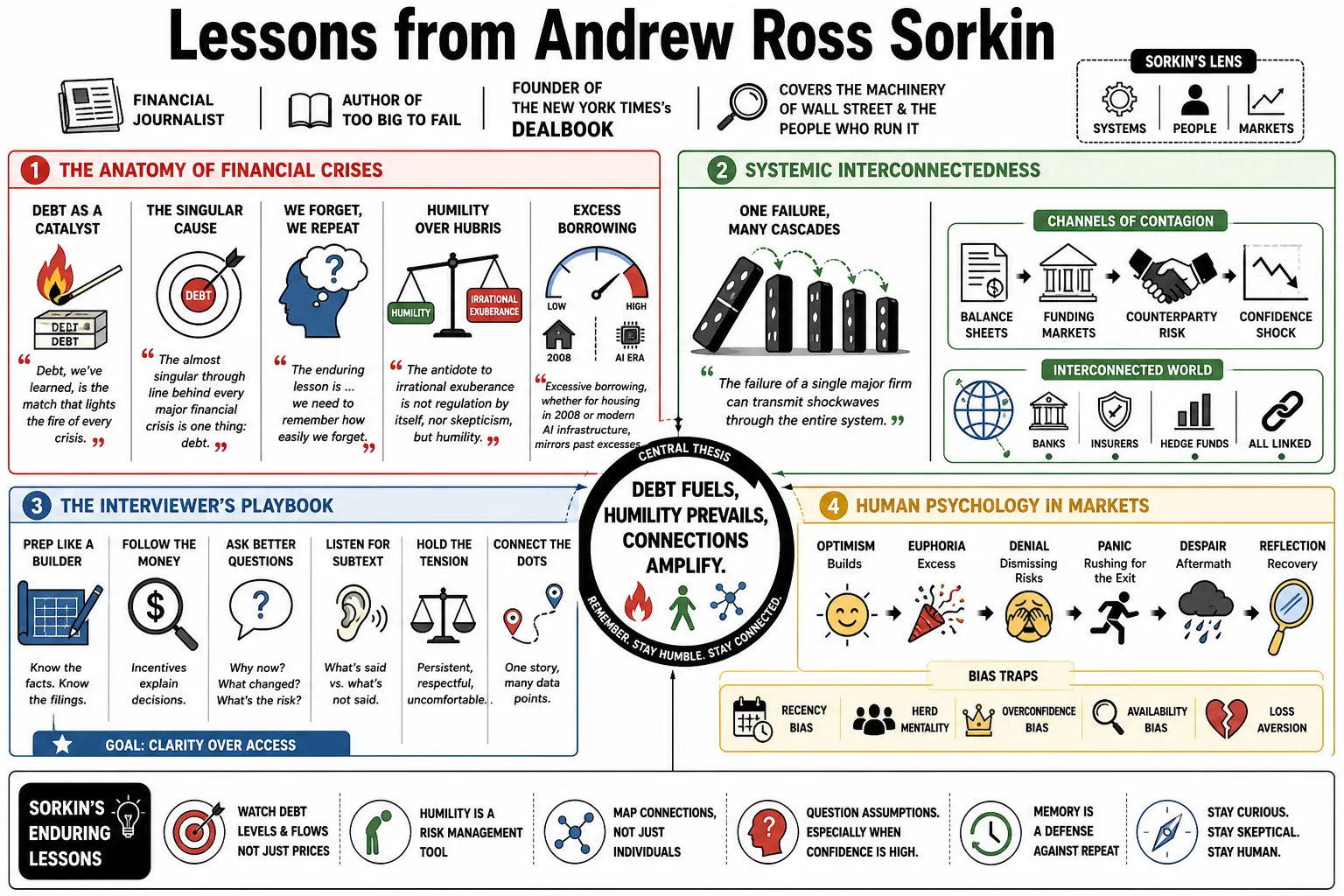
Visual summary of operating lessons from Andrew Ross Sorkin.

Lessons from Andrew Ross Sorkin

Andrew Ross Sorkin is a financial journalist, the author of Too Big to Fail, and the founder of The New York Times's DealBook. He covers both the machinery of Wall Street and the personalities of the executives who run it. This profile gathers his specific observations on market crises, interview tactics, and human psychology.

Part 1: The Anatomy of Financial Crises

  1. On Debt as a Catalyst: "Debt, we’ve learned, is the match that lights the fire of every crisis." — Source: [Goodreads]
  2. On the Singular Cause: "The almost singular through line behind every major financial crisis is one thing: debt." — Source: [Goodreads]
  3. On Forgetting: "The enduring lesson is not that booms can be prevented or that busts can be fully averted. It is that we need to remember how easily we forget." — Source: [SuperSummary]
  4. On Humility vs. Regulation: "The antidote to irrational exuberance is not regulation by itself, nor skepticism, but humility." — Source: [SuperSummary]
  5. On Borrowing: "Excessive borrowing, whether for housing in 2008 or modern AI infrastructure, often mirrors the speculative excesses that historically precipitate market crashes." — Source: [Conversations with Tyler]
  6. On Systemic Interconnectedness: "The failure of a single major firm can act as a domino, threatening the stability of the entire global financial system." — Source: [Too Big to Fail]
  7. On Moral Hazard: "When financial institutions become so integrated that their collapse is an unacceptable risk to the economy, it creates a dangerous environment where extreme risk-taking is subsidized by implicit government backing." — Source: [IMF Publications]
  8. On the Other Side of the Cliff: "The public frequently fails to appreciate how close the global economy came to total catastrophe during banking panics, which often makes necessary government interventions highly unpopular." — Source: [Stanford Daily]
  9. On Regulatory Complacency: "Market crises are frequently fueled by a culture of hubris and relaxed oversight, particularly when complex financial products obscure the underlying risks." — Source: [Shortform]

Part 2: The Art of the Interview

  1. On Empathy: "The goal of an interview is not to strike out the guest, but to foster a productive conversation by showing empathy and encouraging them to hit the ball back." — Source: [Boardroom]
  2. On Active Listening: "An effective interviewer must prioritize listening over sticking to a script, recognizing the exact moment to pivot based on the subject's immediate response." — Source: [Acquired Podcast]
  3. On Preparation: "Deep, rigorous preparation and maintaining an intense information diet are essential for engaging high-profile guests on a deeper, more informed level." — Source: [Acquired Podcast]
  4. On Understanding Decisions: "The best interviews focus beyond the daily headlines to understand the underlying psychology and decision-making frameworks of leaders." — Source: [Acquired Podcast]
  5. On Bridging Worlds: "A skilled interviewer acts as a translator between Wall Street and Main Street, making complex financial decisions accessible to the broader public." — Source: [Boardroom]
  6. On Confrontation: "Hostile questioning often causes subjects to retreat to talking points; genuine curiosity is a more effective tool for eliciting candor." — Source: [ReThinking with Adam Grant]
  7. On Finding the Psyche: "Shifting the focus from purely technical or financial questions to emotional states helps reveal the true motivations of powerful people." — Source: [Squawk Pod]
  8. On Handling Evasion: "When a guest attempts to spin an answer, calmly returning to the core logic of their decision often forces a more honest reckoning." — Source: [CNBC Squawk Box]
  9. On the Long Game: "Building trust with interview subjects over years allows for more nuanced and revealing conversations when crises eventually hit." — Source: [The New York Times DealBook]

Part 3: Human Psychology on Wall Street

  1. On Temptation: "We all love an easy buck. Temptation has driven human folly for centuries, whether the serpent in the Garden of Eden or the market manias of cryptocurrency or artificial intelligence." — Source: [Goodreads]
  2. On Historical Amnesia: "And no one, it seems, can benefit by the experiences of others. Being both a father and teacher, I know we can teach our children nothing… Each must learn its lesson anew." — Source: [Goodreads]
  3. On Following the Money: "I always thought if you could follow the money, it explained everything. And I don’t say that cynically... it explained not just business, it explained politics, it explained sports." — Source: [Andrew Ross Sorkin Substack]
  4. On Hubris: "The culture of high finance often rewards extreme confidence, which can easily calcify into a hubris that blinds executives to existential risks." — Source: [Too Big to Fail]
  5. On Panic: "Market panics are rarely driven by data alone; they are driven by the sudden, collective realization that the narrative everyone agreed upon is false." — Source: [CNBC]
  6. On Incentive Structures: "People on Wall Street generally act exactly as they are incentivized to act; flawed compensation models are the root of most systemic failures." — Source: [The New York Times]
  7. On the Fear of Missing Out: "Institutional investors are just as susceptible to FOMO as retail investors, often abandoning their risk models when they see peers getting rich." — Source: [The Compound and Friends]
  8. On Rationalizing Risk: "When there is too much money to be made, highly intelligent people will construct elaborate mathematical models to justify irrational behavior." — Source: [Too Big to Fail]
  9. On the Illusion of Control: "The greatest danger in modern finance is the belief that complex algorithms have successfully tamed human unpredictability." — Source: [Conversations with Tyler]

Part 4: Journalism and the Story of Money

  1. On Character-Driven Stories: "Financial history is fundamentally about people and their motivations, conflicts, and the psychological burdens they carry." — Source: [Talking Biz News]
  2. On Nuance in Media: "The modern media environment heavily incentivizes speed and absolute certainty, which actively degrades the public's understanding of nuanced economic realities." — Source: [Andrew Ross Sorkin Substack]
  3. On Sitting with Uncertainty: "An essential skill for modern journalists is the ability to sit with incomplete information rather than forcing complex events into simple narratives of clear villains and clear lessons." — Source: [Andrew Ross Sorkin Substack]
  4. On Innovation in News: "Creating DealBook was driven by the realization that readers wanted financial news delivered with the urgency and insider tone of an email newsletter, long before newsletters were a dominant format." — Source: [Acquired Podcast]
  5. On Business Acumen for Writers: "Journalists must understand the business side of media, including how to build something and reach an audience, if they want to protect their editorial independence." — Source: [Acquired Podcast]
  6. On Speaking Truth to Power: "Maintaining objectivity does not mean abandoning judgment; it means arriving at that judgment through rigorous, unbiased reporting." — Source: [Reddit AMAs]
  7. On the Cinematic Reality of Finance: "The best business stories are structured like cinema, introducing disparate characters whose lives eventually collide during a market event." — Source: [Reddit AMAs]
  8. On Access Journalism: "True access shouldn't be about trading favorable coverage for quotes, but about proving you understand the subject matter well enough that leaders feel compelled to talk to you." — Source: [ReThinking with Adam Grant]
  9. On Explaining Complexity: "If you cannot explain a multi-billion dollar derivative trade in a way that a general audience can grasp the stakes, you don't fully understand it yourself." — Source: [CNBC Squawk Box]
  10. On the Lens of Commerce: "Business journalism serves as a central lens to view geopolitical power struggles rather than a niche beat." — Source: [Leaders Magazine]

Part 5: Lessons from 2008 and "Too Big to Fail"

  1. On the Boardroom Pressure Cooker: "During the peak of the 2008 crisis, the most powerful people in the world were acting in an environment of extreme uncertainty with absolutely no historical roadmap." — Source: [Inceptone]
  2. On Improvised Rescues: "The government's response to the financial crisis was less of a master plan and more of a desperate, weekend-by-weekend improvisation to plug holes in a sinking ship." — Source: [Stanford Daily]
  3. On the Lehman Mistake: "Allowing Lehman Brothers to fail was a catastrophic miscalculation of how deeply intertwined the firm's obligations were with the rest of the global economy." — Source: [Too Big to Fail]
  4. On the Failure of Communication: "A primary failure of the government during 2008 was its inability to effectively communicate to the public why bailing out Wall Street was necessary to save Main Street." — Source: [Stanford Daily]
  5. On Systemic Blind Spots: "Regulators were focused on the health of individual institutions, completely missing the systemic contagion risk building up in the shadow banking system." — Source: [Shortform]
  6. On the Speed of Contagion: "In an era of digital trading and interconnected balance sheets, a crisis of confidence can destroy a century-old institution in a matter of hours." — Source: [Too Big to Fail]
  7. On Executive Denial: "Many banking CEOs spent the early days of the crisis aggressively denying their vulnerability, right up until the moment they needed a government lifeline." — Source: [Too Big to Fail]
  8. On the Role of the Fed: "The crisis permanently altered the role of the Federal Reserve, forcing it to act as the lender of last resort to the entire financial system instead of solely commercial banks." — Source: [IMF Publications]
  9. On the Illusion of Liquidity: "The crisis proved that an asset is only worth what someone is willing to pay for it in a panic; theoretical liquidity models are useless when the market freezes." — Source: [Too Big to Fail]
  10. On the Legacy of Bailouts: "The rescue of the banks, while necessary to prevent a depression, sowed the seeds of a deep public distrust in institutions that still defines modern politics." — Source: [The New York Times DealBook]

Part 6: Parallels Between 1929 and Today

  1. On Transformative Technologies: "There are eerie parallels between the 1920s boom driven by radio and electrification, and today’s market surge heavily reliant on the promise of artificial intelligence." — Source: [PBS NewsHour]
  2. On Retail Participation: "The massive influx of retail investors into the stock market today mirrors the democratization of stock ownership that occurred just before the 1929 crash." — Source: [Andrew Ross Sorkin on 1929]
  3. On Regulatory Loosening: "A persistent trend preceding major crashes, both in 1929 and modern eras, is the systematic dismantling or ignoring of financial regulations in the name of economic growth." — Source: [WNYC Studios]
  4. On Margin and Borrowing: "Modern forms of hidden borrowing, such as private credit and complex derivatives, serve the same dangerous function as the rampant margin lending of the late 1920s." — Source: [Conversations with Tyler]
  5. On Market Concentration: "Just as a handful of trusts and syndicates dominated the 1929 market, today's indices are heavily skewed by the performance of a few massive tech conglomerates." — Source: [Big Technology Podcast]
  6. On the Psychology of Eras: "The belief that this time is different due to a new paradigm of productivity is a psychological trap that ensnared investors in 1929 and continues to do so today." — Source: [Armchair Expert Podcast]
  7. On Institutional Gatekeepers: "In both eras, the trusted financial institutions that were supposed to serve as the adults in the room eventually succumbed to the temptation to participate in the mania." — Source: [Squawk Pod]
  8. On the Warning Signs: "Crashes are rarely truly sudden; they are preceded by months of extreme volatility and ignored warning signs that the underlying structure is cracking." — Source: [The New Yorker Radio Hour]
  9. On Post-Crash Reality: "The aftermath of 1929 teaches us that the economic damage of a crash is often compounded by the subsequent loss of faith in the capitalist system itself." — Source: [Armchair Expert Podcast]

Part 7: Leadership, Accountability, and Ethics

  1. On True Apologies: "In truth, a leader should either apologize, mean it and do something about it — or not apologize at all." — Source: [AZQuotes]
  2. On Corporate Silence: "We are in a moment that business executives feel like they can't say what they think. Nobody's going to be willing to speak out. That to me is the true danger." — Source: [The Independent]
  3. On Hiring Practices: "Hiring a family member simply for a relationship can be troubling... But by and large, financial firms in particular commonly hire people who have certain connections." — Source: [Medium]
  4. On the Responsibility of Platforms: "Corporate leaders of massive tech platforms can no longer claim to be neutral arbiters; their algorithms make active editorial choices that shape society." — Source: [CNBC Squawk Box]
  5. On Short-Termism: "The tyranny of quarterly earnings reports forces CEOs to make decisions that boost immediate stock prices at the expense of long-term corporate health." — Source: [The New York Times DealBook]
  6. On Board Oversight: "Corporate boards frequently fail in their primary duty of oversight because they prioritize collegiality with the CEO over asking difficult, adversarial questions." — Source: [The New York Times DealBook]
  7. On Crisis Management: "A leader's true character is revealed not during a period of sustained growth, but in the first 48 hours of a sudden, existential corporate crisis." — Source: [ReThinking with Adam Grant]
  8. On Purpose vs. Profit: "The ongoing debate about stakeholder capitalism highlights the tension between maximizing shareholder value and acknowledging a corporation's broader social footprint." — Source: [The New York Times DealBook]
  9. On Executive Compensation: "Disconnects between CEO pay and median worker salary do more to erode corporate culture and public trust than almost any other metric." — Source: [CNBC]

Part 8: The Intersection of Business, Policy, and Society

  1. On Capital and Washington: "The relationship between Wall Street and Washington is less about ideological alignment and more about a mutual, deeply entrenched dependency on capital flows." — Source: [The New York Times DealBook]
  2. On the Weaponization of Finance: "Economic sanctions and the control of payment networks have replaced traditional military action as the primary tool of modern geopolitics." — Source: [CNBC Squawk Box]
  3. On Inequality: "A booming stock market is a poor metric for the health of a society when the vast majority of equity is owned by a tiny fraction of the population." — Source: [The New York Times DealBook]
  4. On Regulatory Capture: "The revolving door between regulatory agencies and the financial institutions they oversee creates an environment where rules are written by the regulated." — Source: [Too Big to Fail]
  5. On Antitrust in the Digital Age: "Traditional antitrust frameworks, designed for railroads and oil monopolies, struggle to accurately assess the monopolistic power of modern data-driven tech giants." — Source: [The New York Times DealBook]
  6. On Global Supply Chains: "The prioritization of hyper-efficiency and just-in-time logistics created a fragile global business ecosystem deeply vulnerable to geopolitical shocks." — Source: [CNBC Squawk Box]
  7. On the Privatization of Space: "The reliance on private companies for space exploration marks a fundamental shift in how humanity approaches projects previously deemed the exclusive domain of nation-states." — Source: [Big Technology Podcast]
  8. On Labor Movements: "The resurgence of unionization efforts at major corporations reflects a breaking point in the modern social contract between labor and capital." — Source: [The New York Times DealBook]
  9. On ESG Investing: "The attempt to quantify environmental and social governance has exposed the deep difficulty of applying rigid metrics to fluid moral and political questions." — Source: [CNBC]
  10. On the Future of Work: "The shift toward remote and hybrid work acts as a fundamental renegotiation of the boundaries between corporate control and personal autonomy, beyond a simple real estate crisis." — Source: [The New York Times DealBook]