
Lessons from Andrew Sullivan
Andrew Sullivan edited The New Republic in the early 1990s before launching The Daily Dish, one of the first mainstream political blogs. As a moderate conservative, he made an early case for marriage equality from the right and consistently opposes both religious fundamentalism and identity politics. These excerpts track his work across several decades of journalism on faith, political tribalism, and the media.
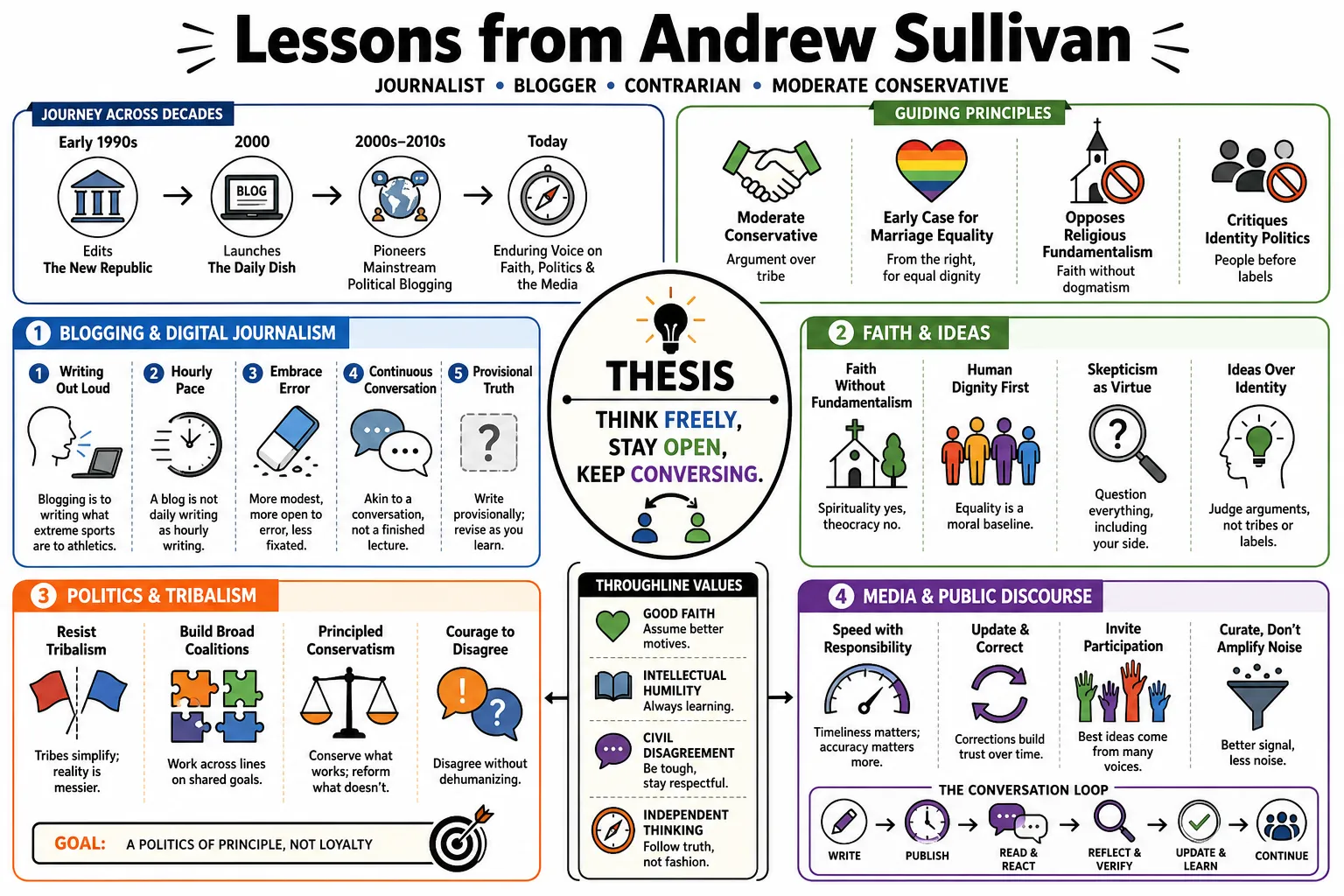
Part 1: Blogging and Digital Journalism
- On the nature of blogging: "Blogging is to writing what extreme sports are to athletics: more free-form, more accident-prone, less formal, more alive. It is, in many ways, writing out loud." — Source: [The Atlantic]
- On pacing: "A blog is not so much daily writing as hourly writing. And with that level of timeliness, the provisionality of every word is even more pressing." — Source: [The Atlantic]
- On correction: "Blogging makes you more modest as a thinker, more open to error, less fixated on what you do know, and more respectful of what you don’t." — Source: [The Atlantic]
- On reader interaction: "The relationship between a blogger and a reader is akin to a continuous, unresolved conversation rather than a finished lecture." — Source: [The Atlantic]
- On provisional truth: "To blog is to hold your writing at arm's length and allow others to guide you toward a relative truth over time." — Source: [The Atlantic]
- On digital burnout: "The constant barrage of the internet and the demand to have a take on everything can slowly erode one's capacity for deep, quiet contemplation." — Source: [New York Magazine]
- On independent publishing: "True blogging requires a direct, unmediated connection with the audience, free from the constraints of traditional editorial hierarchies." — Source: [The Weekly Dish]
- On the medium's evolution: "What began as a rebellious alternative to mainstream media eventually became co-opted by it, losing some of its wild, unpolished charm in the process." — Source: [The Weekly Dish]
- On self-correction: "A blogger's credibility stems not from infallibility, but from the willingness to publicly correct mistakes in real-time." — Source: [The Atlantic]
Part 2: Conservatism and Politics
- On defining conservatism: "True conservatism is not about ideological purity, but about a disposition toward reality that values stability, tradition, and incremental change." — Source: [The Conservative Soul]
- On fundamentalism: "It is the great lie of our time that all religious faith has to be fundamentalist to be valid." — Source: [The Conservative Soul]
- On doubt in politics: "A conservatism without doubt morphs into authoritarianism; it is the capacity to admit uncertainty that keeps political movements tethered to reality." — Source: [The Conservative Soul]
- On the Iraq War: "Admitting error in supporting the Iraq War requires recognizing how neoconservative hubris blinded proponents to the complexities of the Middle East." — Source: [The Daily Dish]
- On Trumpism: "Donald Trump represents an extinction-level event for traditional, constitutional conservatism, replacing it with a personality cult rooted in grievance." — Source: [New York Magazine]
- On freedom: "Liberty is the cultivation of a society where individuals are trusted to navigate their own moral lives, rather than merely the absence of state control." — Source: [The Conservative Soul]
- On political discourse: "What modernity requires is not that you abandon your faith, but that you use a reasonable, accessible discourse in the public square." — Source: [The Conservative Soul]
- On the right's evolution: "The American Right has largely traded the philosophy of limited government and institutional respect for the raw exercise of populist power." — Source: [The Weekly Dish]
- On institutions: "Conserving institutions means protecting them from both radical dismantling on the left and cynical erosion on the right." — Source: [The Weekly Dish]
- On the Tea Party: "Movements fueled entirely by negative partisanship and ideological purity tests inevitably consume themselves and damage the republic." — Source: [The Daily Dish]
Part 3: Faith, Religion, and Catholicism
- On the nature of faith: "If we have never doubted, how can we say we have really believed? Doubt, in other words, can feed faith, rather than destroy it." — Source: [The Conservative Soul]
- On the mystery of God: "If God exists, by definition God is beyond our understanding. Claiming absolute knowledge of God's will is a form of spiritual arrogance." — Source: [The Conservative Soul]
- On Christianism: "The politicization of Christianity turns a religion of grace and mystery into a rigid ideology concerned primarily with worldly power." — Source: [Time Magazine]
- On being a gay Catholic: "The tension between one's sexual identity and the Church's teachings requires a personal reconciliation that institutions often fail to provide." — Source: [Virtually Normal]
- On Jesus's teachings: "The core message of the Gospels is a radical, unsettling love for the marginalized, not a blueprint for state morality." — Source: [The Conservative Soul]
- On spiritual silence: "The modern world's endless noise starves the human soul of the silence necessary to hear the divine." — Source: [New York Magazine]
- On clericalism: "The Catholic Church's crisis stems deeply from a protective, secretive clerical culture that prioritized the institution over its vulnerable flock." — Source: [The Daily Dish]
- On grace: "Grace is the unearned, sudden intrusion of God's love into an imperfect human life, often arriving in moments of deep suffering." — Source: [Out on a Limb]
- On secularism: "A completely secular society risks losing the moral vocabulary needed to articulate human dignity and the tragedy of the human condition." — Source: [The Weekly Dish]
- On religious freedom: "True religious freedom protects the right to worship without imposing the tenets of that worship on the broader pluralistic society." — Source: [The Conservative Soul]
Part 4: Marriage and LGBTQ Rights
- On the case for marriage: "Gay marriage is not a radical reimagining of society, but a conservative integration of gay people into a central civilizing institution." — Source: [The New Republic]
- On friendship in marriage: "The most successful marriages, gay or straight, even if they begin in romantic love, often become friendships. It's the ones that become the friendships that last." — Source: [Love Undetectable]
- On equality: "True equality means asking nothing more, and nothing less, of the state than the exact same rights and responsibilities granted to heterosexual citizens." — Source: [Virtually Normal]
- On the HIV/AIDS crisis: "Surviving the plague years forces a reckoning with mortality and heightens the urgency of securing lasting legal and social dignity." — Source: [Love Undetectable]
- On family: "Allowing gay couples to marry strengthens the concept of family by recognizing that commitment and care are not exclusive to heterosexuals." — Source: [The New Republic]
- On the closet: "The closet is a spiritual and psychological prison that forces individuals to live a bifurcated life, destroying authenticity." — Source: [Virtually Normal]
- On queer identity: "While assimilation into mainstream institutions is important for civil rights, the distinct cultural experiences of the gay community remain a source of unique vitality." — Source: [Love Undetectable]
- On the end of the marriage debate: "The rapid shift in public opinion on marriage equality demonstrated how personal exposure to gay lives effectively dismantled abstract prejudices." — Source: [The Daily Dish]
- On trans rights discourse: "The debate over transgender issues should be rooted in medical reality and compassionate accommodation, avoiding rigid ideological extremes on either side." — Source: [The Weekly Dish]
- On normal: "Being virtually normal means accepting that gay people are indistinguishable from their straight peers in their capacity for love, work, and civic duty." — Source: [Virtually Normal]
Part 5: Tribalism and Polarization
- On the new tribalism: "American politics has regressed from a debate over policy to a primitive tribal clash where defeating the enemy supersedes governing." — Source: [New York Magazine]
- On the decline of religion: "As traditional religious observance declines, Americans have transferred their innate religious impulses into ferocious political tribalism." — Source: [New York Magazine]
- On identity politics: "Grouping individuals solely by race, gender, or orientation flattens human complexity and undermines the liberal ideal of the individual." — Source: [The Weekly Dish]
- On mutual contempt: "The greatest threat to a republic is the pervasive belief that the opposing side is fundamentally evil and illegitimate." — Source: [The Weekly Dish]
- On woke ideology: "The social justice movement operates with the zeal, dogma, and excommunication rituals of a fundamentalist religion, brooking no dissent." — Source: [The Weekly Dish]
- On the loss of a shared reality: "When citizens no longer share a baseline set of facts, democratic deliberation becomes impossible, replaced entirely by power struggles." — Source: [The Daily Dish]
- On echo chambers: "The internet algorithmically encourages us to retreat into ideological silos, making the act of engaging with opposing views feel like a betrayal." — Source: [New York Magazine]
- On moderate voices: "In a highly polarized environment, the moderate is hated by both extremes because they expose the fanaticism of the fringes." — Source: [The Weekly Dish]
- On national identity: "A coherent nation requires some level of shared cultural narrative; without it, we are merely disparate tribes sharing geography." — Source: [The Weekly Dish]
Part 6: Media, Writing, and Free Speech
- On the craft of journalism: "The dirty little secret of journalism is that it really isn't a profession, it's a craft. All you need is a telephone and a conscience and you're all set." — Source: [The New Republic]
- On intellectual honesty: "A writer's first loyalty must be to the truth as they see it, even if it means alienating their own audience or political allies." — Source: [The Weekly Dish]
- On cancel culture: "The impulse to silence and ostracize dissenting voices within institutions is a profound betrayal of the liberal project of free inquiry." — Source: [The Weekly Dish]
- On narrative journalism: "The mainstream media's shift from objective reporting to moral clarity narrative-building often obscures the messy reality of the world." — Source: [The Weekly Dish]
- On Substack and independence: "True freedom for a writer today is found in direct support from readers, bypassing editors who are terrified of Twitter mobs." — Source: [The Weekly Dish]
- On reading broadly: "To write well, one must read widely across the ideological spectrum, actively seeking out the smartest arguments against one's own positions." — Source: [The Daily Dish]
- On the role of an essayist: "The essay is an attempt to figure something out in real-time on the page, inviting the reader into the process of thought rather than delivering a final verdict." — Source: [Out on a Limb]
- On bad faith reading: "Modern internet culture excels at uncharitable reading, actively seeking the worst possible interpretation of an author's words to score points." — Source: [The Weekly Dish]
- On the value of debate: "We defend free speech not because the speaker is always right, but because the process of open debate is the only reliable engine for discovering the truth." — Source: [The Weekly Dish]
Part 7: Life, Illness, and Health
- On living with HIV: "Confronting a terminal diagnosis in one's twenties rearranges every priority, transforming a normal life into a daily meditation on borrowed time." — Source: [Love Undetectable]
- On medical miracles: "The arrival of protease inhibitors was a profound psychological shock, requiring one to learn to live after spending years preparing to die." — Source: [New York Times Magazine]
- On the body: "Illness teaches us that we are not entirely the masters of our fate; our bodies have their own logic and limitations that demand respect." — Source: [Love Undetectable]
- On grief: "The AIDS epidemic created a generation of gay men who experienced the concentrated grief and loss typically reserved for war zones." — Source: [Love Undetectable]
- On testosterone: "Hormones profoundly shape our mood, energy, and behavior, revealing how deeply our consciousness is tied to biology." — Source: [The New York Times Magazine]
- On mindfulness and meditation: "Escaping the relentless hum of the web requires a deliberate practice of silence, stepping away from the screen to reconnect with reality." — Source: [New York Magazine]
- On dogs: "The steady, uncomplicated affection of a dog offers a profound anchor of sanity and grace in an otherwise chaotic world." — Source: [The Daily Dish]
- On aging: "Growing older brings a necessary detachment from the urgent battles of youth, allowing for a broader, more forgiving perspective on human folly." — Source: [The Weekly Dish]
- On human fragility: "A society that ignores the reality of suffering and physical decline is fundamentally ill-equipped to understand the depth of the human condition." — Source: [Love Undetectable]
Part 8: America and Culture
- On the American experiment: "America's unique brilliance lies in its constitutional design, which assumes human imperfection and pits ambition against ambition." — Source: [The Conservative Soul]
- On Obama: "Barack Obama's presidency offered a nuanced, pragmatic liberalism that understood the tragic constraints of history better than the utopian left." — Source: [The Atlantic]
- On torture: "The adoption of state-sanctioned torture under the Bush administration was a moral stain that fundamentally contradicted the core values of the American republic." — Source: [The Daily Dish]
- On humanizing enemies: "Monsters remain human beings. In fact, to reduce them to a subhuman level is to exonerate them of their acts of terrorism and mass murder." — Source: [The Daily Dish]
- On cannabis legalization: "Ending the drug war, starting with marijuana, is a moral imperative that restores personal liberty and curtails a massive engine of state injustice." — Source: [The Daily Dish]
- On the nature of freedom: "Real freedom is terrifying because it places the burden of meaning and responsibility squarely on the individual's shoulders." — Source: [The Conservative Soul]
- On pop culture: "The elevation of constant entertainment and celebrity worship distracts the populace from the serious duties of citizenship." — Source: [The Weekly Dish]
- On immigration: "A sustainable immigration policy must balance compassion for the migrant with the practical necessity of maintaining borders and national cohesion." — Source: [The Weekly Dish]
- On hope versus optimism: "Optimism assumes things will simply get better, while hope is the grittier virtue of striving for the good even when the evidence points to decline." — Source: [Out on a Limb]