Andrey Khusid started Miro (originally RealtimeBoard) because he was frustrated by the inability to brainstorm with remote clients at his design agency. He grew the company from a basic Flash-based tool into a visual collaboration platform used by over 100 million people. This profile outlines his practical approaches to product development, scaling an organization, and adapting to new technologies. — Inside Intercom, "Miro's Andrey Khusid on the art of distributed teamwork" (2019).
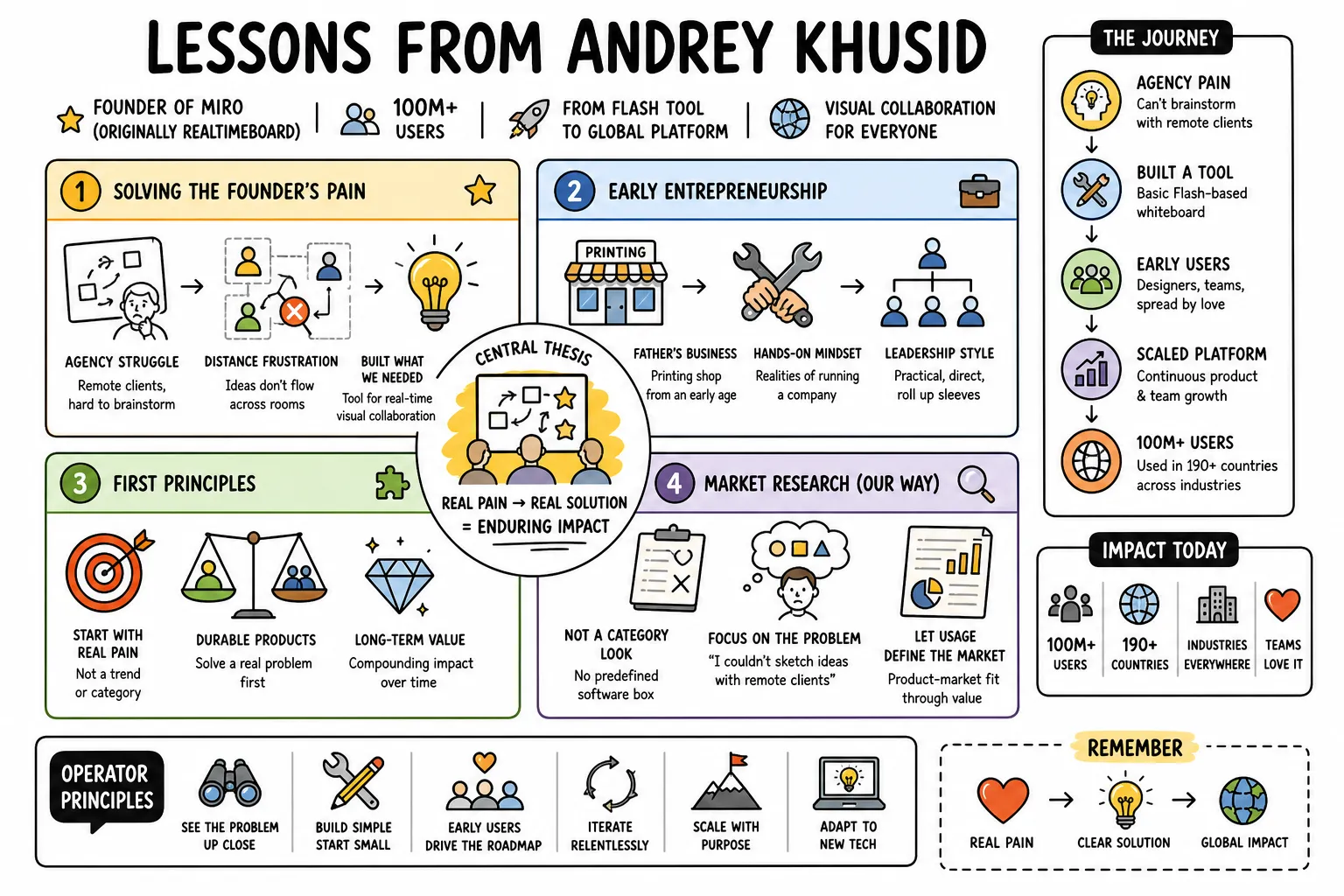
Part 1: Solving the Founder's Pain
- On the Real Need: Miro began at their design agency: "we noticed a persistent problem in communicating ideas to remote clients," so they built "something like a whiteboard but online." — Reference: Inside Intercom, "Miro's Andrey Khusid on the art of distributed teamwork" (2019).
- On Early Funding: Khusid kept Miro capital-efficient for years before larger venture rounds, using product-led traction to prove the company before scaling resources more aggressively. — Reference: High Flyers episode notes on Miro capital efficiency and product-led growth
Part 2: Designing the Product Experience
- On iterating the solution: If the problem is real and solvable, keep iterating on the solution: "We redesigned our onboarding I don't know, maybe hundreds of times." — Reference: Silicon Valley Girl Podcast, "How to Build a Million-Dollar Business in the Age of AI | Andrey Khusid, Miro" transcript (2025).
- On Team Adoption: Around 2015 Miro moved from a personal to a team subscription, seeing that people collaborate and it is easier when a whole team signs up as one entity. — Reference: Inside Intercom, "Miro's Andrey Khusid on the art of distributed teamwork" (2019).
- On Re-earning Fit: Khusid treats fit as something a scaling product has to keep revalidating through user data, support signals, interviews, education, and repeated product iteration. — Reference: SaaStr interview notes on Miro using feedback loops to build durable product value
- On Listening to Users: "We try to continuously learn from what people are doing with our product," which is how they discovered consultants using Miro with clients and doubled down with a dedicated plan. — Reference: Inside Intercom, "Miro's Andrey Khusid on the art of distributed teamwork" (2019).
Part 3: Managing Rapid Growth
- On Moving Upmarket: Khusid did not replace product-led growth with enterprise sales; Miro layered marketing, sales, and customer success around users and accounts already showing product pull. — Reference: McKinsey interview on Miro integrating product-led growth with sales and customer success
- On Pricing Models: Khusid sees monetization as part of the product system: free adoption, easy sharing, activation, engagement, referral, and sales motion all shape how value eventually converts. — Reference: McKinsey interview on Miro product-led monetization and experimentation
- On Capital Allocation: Khusid learned that hypergrowth requires spending ahead on foundations, including product-engineering capacity, infrastructure, hubs, systems, processes, and senior people. — Reference: Accel interview on building the foundations for Miro hypergrowth
- On Maintaining Momentum: His stated aim: "Everything I do is designed to try and make Miro a spherical company." — Reference: Accel, "Everything I do is designed to try and make Miro a spherical company" (2021).
- On Brand Evolution: The rebrand from RealtimeBoard to Miro aimed for a "love mark" to accelerate word of mouth, inspired by the artist Joan Miró's bright shapes, which their boards resembled. — Reference: Inside Intercom, "Miro's Andrey Khusid on the art of distributed teamwork" (2019).
Part 4: Evolving from Founder to CEO
- On "Founder Mode": Khusid keeps founder energy pointed at customer love: the metrics, viral loops, product taste, and design bar all have to reinforce why people spread the product. — Reference: Accel interview on customer love, viral loops, and product taste at Miro
- On "CEO Mode": As Miro scaled, Khusid's job shifted toward building the operating system around the product: leaders, onboarding, middle management, and processes that could handle growth. — Reference: SaaStr interview notes on Miro adding leadership and processes during rapid growth
- On Balancing the Two: Khusid's AI-era challenge is to keep the core business strong while still acting with day-one urgency about how Miro must reinvent its product strategy. — Reference: Product School episode on Miro AI strategy and product reinvention
- On Conviction vs. Consensus: Khusid's platform bet required directional conviction: Miro could not build every workflow itself, so it opened APIs, integrations, embeds, plugins, and partner channels around the core product. — Reference: Intercom podcast on Miro moving from product to platform
- On Relinquishing Control: Moving Miro from product to platform meant giving customers and partners more room to extend the workspace while the company curated the ecosystem around it. — Reference: Intercom podcast on Miro APIs, plugins, marketplace, and ecosystem
- On Founder-Team Fit: Khusid looks for leaders who earn trust from the team, not just leaders with impressive resumes; team feedback and followership matter in executive fit. — Reference: Accel interview on hiring trusted leaders as Miro scaled
- On Time Management: Khusid keeps executive attention tied to the value streams that matter, using cross-functional pods and leadership sponsorship to focus teams around durable metrics. — Reference: McKinsey interview on Miro growth pods and company-leader sponsorship
Part 5: Cultivating a High-Performing Culture
- On culture as outcomes: "Culture defines outcomes." The sweet spot between a cozy family and a pure performance machine is "a high-performing sports team with strong standards, its own culture, and the ability to make changes when needed." — Reference: In Founders' Words, "Miro's Culture: Wins, Failures and Lessons — from Founder Andrey Khusid" (2025).
- On spelling out behaviors: Values alone get interpreted differently. Miro introduced "Miro Behaviors" to show how values look in day-to-day work: "I definitely regret that we didn't do it that way earlier in our journey." — Reference: In Founders' Words, "Miro's Culture: Wins, Failures and Lessons — from Founder Andrey Khusid" (2025).
- On mindset before experience: After Series A, Miro hired for experience and things started to break. His order now: "1. Mindset, 2. Skills, 3. Experience." — Reference: In Founders' Words, "Miro's Culture: Wins, Failures and Lessons — from Founder Andrey Khusid" (2025).
- On Hiring for Potential: "When you're growing fast, you shouldn't pass up on brilliant talent, even if you have to create a new role to accommodate someone." — Reference: Accel, "Everything I do is designed to try and make Miro a spherical company" (2021).
- On culture that evolves: "Culture should reflect the stage of the company. You can't set it and forget it." The way you run a 20-person team is not the way you run a 2,000-person team. — Reference: In Founders' Words, "Miro's Culture: Wins, Failures and Lessons — from Founder Andrey Khusid" (2025).
- On Cultural Entropy: Khusid treats culture as something that has to be operationalized during hypergrowth through hiring standards, bar raisers, candidate experience, systems, and process. — Reference: Accel interview on Miro hiring standards and hypergrowth foundations
- On the "Invisible Manager": Khusid relies on culture as a distributed decision standard: strong values, bar-raising hiring, and product-quality expectations guide choices beyond the founder's direct reach. — Reference: Accel interview on culture and decision standards at Miro
- On Maintaining Standards: Keep the hiring bar high during hypergrowth: "Everyone we recruit should be a bar raiser," always "hiring above the mean." — Reference: Accel, "Everything I do is designed to try and make Miro a spherical company" (2021).
Part 6: AI and the Future of Work
- On short planning horizons: "You can't predict more than 12 months now." Miro commits to six-month plans inside a 12-month vision because model changes can reshape the product that fast. — Reference: Silicon Valley Girl Podcast, "How to Build a Million-Dollar Business in the Age of AI | Andrey Khusid, Miro" transcript (2025).
- On team productivity: AI has mostly raised individual productivity, but "if you increase your individual productivity but the project takes the same 6 months, it doesn't increase the output or outcome of the project." — Reference: Silicon Valley Girl Podcast, "How to Build a Million-Dollar Business in the Age of AI | Andrey Khusid, Miro" transcript (2025).
- On day-one thinking: "If I were starting this company today, what would the product look like?" He asks it every day to decide between a small evolution and a critical rebuild. — Reference: The Product Podcast (Product School), Andrey Khusid at ProductCon transcript (2025).
- On the speed-of-learning moat: "The number one competitive moat every company has is the speed of learning"—how fast you recognize a signal, separate it from noise and act on it. Data isn't a moat, because "customers hate vendor lock-in." — Reference: The Product Podcast (Product School), Andrey Khusid at ProductCon transcript (2025).
- On AI in the context of work: "AI should not be a net new thing, AI should not be a sidebar, AI should be in the context of work"—summarizing a workshop and turning it into tasks in one click. — Reference: SiliconANGLE theCUBE, "Andrey Khusid, Miro | Raise Summit 2025".
- On Legacy Disruption: Khusid sees AI as a chance to move Miro beyond the browser whiteboard into an innovation workspace where humans and AI can work together through the whole product cycle. — Reference: Product School episode on Miro AI strategy and innovation workspace reinvention
Part 7: Navigating the Competitive Landscape
- On permission to win: In a crowded AI race, understand "where you have permission to play, but also where you have permission to win"—then go fast, "because speed matters now." — Reference: SiliconANGLE theCUBE, "Andrey Khusid, Miro | Raise Summit 2025".
- On Strategic Patience: Khusid's long game was to build product love and habit before over-optimizing revenue, then use that adoption base to support enterprise expansion later. — Reference: High Flyers episode notes on Miro taking the long game before enterprise expansion
- On Platform Ecosystems: Miro shifted "from product to platform": it built core integrations itself but opened an API and embeds so customers and partners could extend the product, with a curated marketplace. — Reference: Inside Intercom, "Miro's Andrey Khusid on the art of distributed teamwork" (2019).
- On Customer Retention: Khusid looks at retention through the inputs that create it: customer interviews, support tickets, product feedback, education, self-service, and the product experience itself. — Reference: SaaStr interview notes on Miro feedback, education, support, and community
Part 8: Personal Philosophy and Tactics
- On Founder Stamina: Khusid's path required staying with the company through several different jobs, from agency problem and digital whiteboard to global enterprise platform and multi-hub organization. — Reference: High Flyers episode notes on Miro scaling from digital whiteboard to global company
- On Humility: Khusid describes scale as a reason to hire beyond his own comfort zone, especially people with market expertise, customer knowledge, and perspectives the founder does not already have. — Reference: Accel interview on hiring beyond the founder comfort zone
- On Founder-Led Sales: Khusid's sales motion grew out of user pull: first make the product spread on its own, then identify hand-raisers and bring sales and customer success into the accounts where adoption is already real. — Reference: McKinsey interview on Miro hand-raisers and integrated B2C2B sales motion