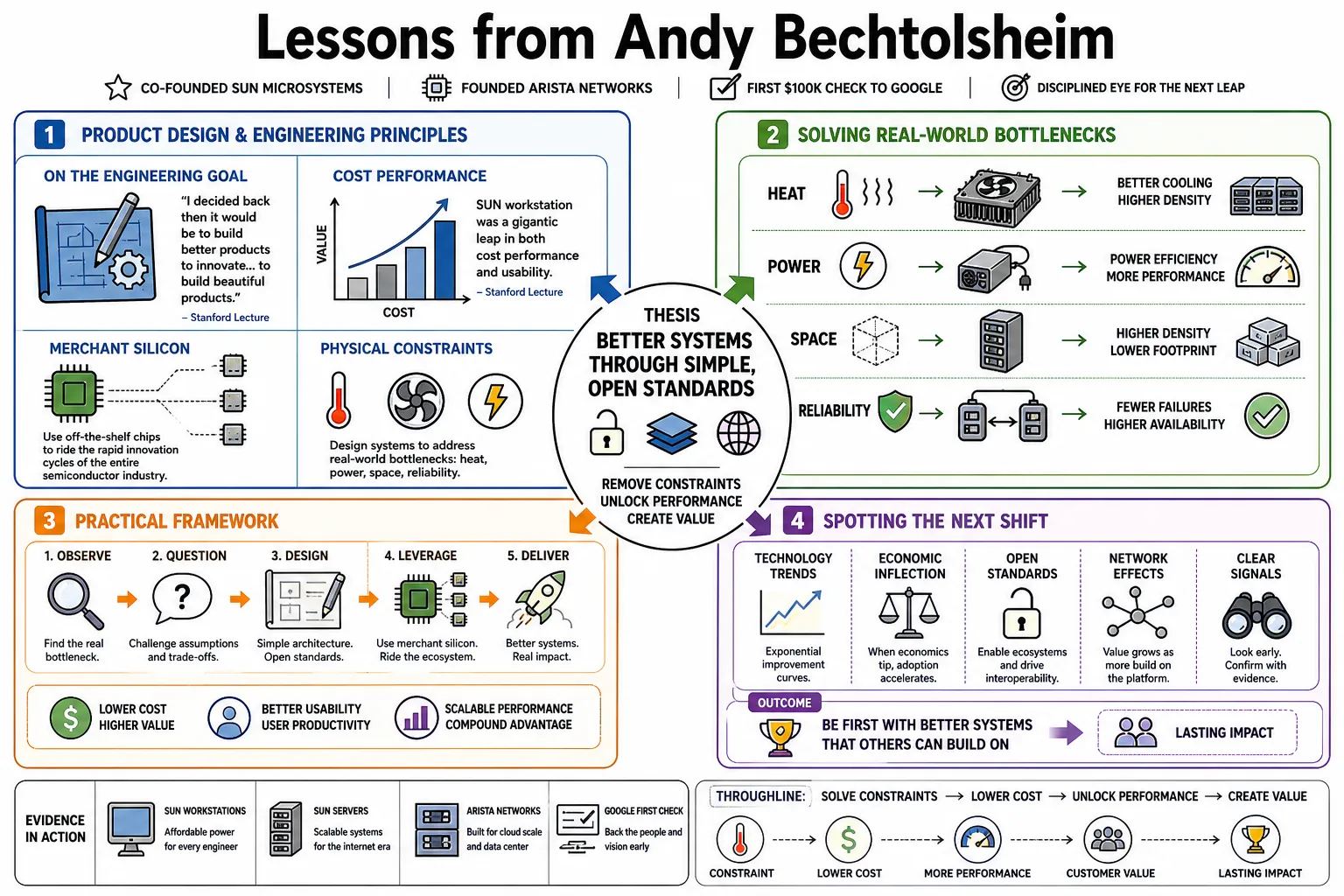
Lessons from Andy Bechtolsheim
Andy Bechtolsheim co-founded Sun Microsystems and Arista Networks by solving the physical and economic bottlenecks of computing through simple, open standards. While famous for writing Google’s first $100,000 check, his more enduring skill is a disciplined eye for identifying the next leap in technology. These lessons break down his framework for designing systems and spotting the next shift in the market. — Computer History Museum, "Oral History of Andreas 'Andy' Bechtolsheim" (2015).
Part 1: Product Design & Engineering Principles
- On the Engineering Goal: "I decided that it would be to build better products, to innovate, to build beautiful products." — Reference: Stanford Engineering, "Andy Bechtolsheim: Hero talks innovation, success and engineering" (2012).
- On Merchant Silicon: Sun's founding plan used off-the-shelf parts: a merchant microprocessor, a standard bus, a version of Unix and a bitmapped display, rather than proprietary components. — Reference: Computer History Museum oral history video with Andy Bechtolsheim.
- On economics winning: On custom versus merchant switch chips: "even I could not design better silicon switch chips than what is available now on the merchant market… over the long term, economics always wins." — Reference: Andy Bechtolsheim, "The Silicon Choice for Cloud Networking" (Arista blog, 2009)
- On fewer chips: A single merchant chip replaced a chassis full of proprietary ones: "Fewer chips means faster speeds, lower latency, less power consumption, lower cost, and higher reliability." — Reference: Andy Bechtolsheim, "The March to Merchant Silicon in 10GbE Cloud Networking" (Arista blog, 2011)
- On volume and chip design: With advanced chips costing about $20 million to design, "if you can't sell 100,000 chips, it's hardly worth doing." — Reference: Light Reading, "Why Arista Doesn't Like ASICs" (2012)
- On being a software company: Arista sells boxes, but "over 90 percent of our R&D headcount is in software… we are a software company, not really a hardware company." — Reference: SiliconANGLE, "The network may end up deciding who wins in the multicloud era" (2018)
- On 32-Bit Computing: In 1979 he built his own workstation at Stanford on the Motorola 68000, the first 32-bit microprocessor, adding Ethernet and bitmap graphics boards. — Reference: Computer History Museum, "Oral History of Andreas 'Andy' Bechtolsheim" (2015).
Part 2: The Art of Innovation
- On the Essence of Innovation: "Over the years, the content changes but the underlying processes of how to focus on innovation… don't really change." — Reference: Stanford Engineering, "Andy Bechtolsheim: Hero talks innovation, success and engineering" (2012).
- On Innovation vs. R&D: Innovation is not about R&D or even marketing; it is about bringing a needed product to customers. — Reference: Hervé Lebret, notes on Andy Bechtolsheim's "Process of Innovation" talk at Stanford (2012).
- On the Five Flavors of Failure: Failure comes in five flavors: the idea is too early, too late, not relevant, too expensive, or without clear value. — Reference: Stanford Engineering, "Andy Bechtolsheim: Hero talks innovation, success and engineering" (2012).
- On Solving the Right Problem: "It comes down to solving the right problem… but if you're lucky, and not too early or too late with just the right value proposition, start-ups will usually succeed." — Reference: Stanford Engineering, "Andy Bechtolsheim: Hero talks innovation, success and engineering" (2012).
Part 3: Building and Leading Companies
- On Speed as Strategy: Vinod Khosla convinced him he could "always finish my PhD later, but you can only start this company now, because if we don't do it now, there are going to be five other people that will do this in the next six months." — Reference: Computer History Museum, "Oral History of Andreas 'Andy' Bechtolsheim" (2015).
- On Corporate Evolution: Big companies are about evolution, not revolution. — Reference: Hervé Lebret, notes on Andy Bechtolsheim's "Process of Innovation" talk at Stanford (2012).
- On Focusing: Timing is critical, so focus. — Reference: Hervé Lebret, notes on Andy Bechtolsheim's "Process of Innovation" talk at Stanford (2012).
Part 4: The Strategic Use of Standards
- On Open Systems: Sun positioned itself against Apollo's proprietary stack as open versus closed: "we're the open company and they're the closed company." — Reference: Computer History Museum oral history video with Andy Bechtolsheim.
- On Unix: Running Berkeley Unix on the workstation was a key goal, though they had to wait for Motorola's next chip to support virtual memory. — Reference: Computer History Museum, "Oral History of Andreas 'Andy' Bechtolsheim" (2015).
- On openness as an advantage: Berkeley Unix was "essentially the first open-source operating system," and not keeping Solaris open "was basically a sort of mistake." — Reference: InfoWorld, "Interview: Bechtolsheim hails open-source moves" (2007)
- On cloud adoption curves: Cloud buyers "will not buy the new thing unless it is cheaper than the old thing," but "the moment it's cheaper than the old stuff, nobody wants the old stuff any more." — Reference: SDxCentral, "Arista Founder: Networking Standards Move Too Slowly for Cloud Giants" (2017)
Part 5: Investing and Identifying Talent
- On the Google Check: After a quick demo, he wrote Larry Page and Sergey Brin a $100,000 check made out to "Google Inc.", a company that did not yet exist. — Reference: Acquired, "Google" episode.
- On doing the math quickly: On Google's five-cents-a-click model: "I did the math … a million clicks a day, they can't go broke … and I said, okay, let's get going." — Reference: Stanford Engineering, "Andy Bechtolsheim: Hero talks innovation, success and engineering" (2012)
Part 6: Navigating the Market and Timing
- On Risk in the Valley: In Silicon Valley, not trying is the risk, not failing. — Reference: Hervé Lebret, notes on Andy Bechtolsheim's "Process of Innovation" talk at Stanford (2012).
- On Failing Fast: Failure is not an issue in Silicon Valley, but fail fast; outside the Valley, "you may have to hide for 30 years when you fail." — Reference: Hervé Lebret, notes on Andy Bechtolsheim's "Process of Innovation" talk at Stanford (2012).
- On Market Windows: Timing made Sun: "we couldn't have started the company any earlier because the Berkeley Unix wasn't ready… And we couldn't have started any later because we would have missed the boat." — Reference: Computer History Museum oral history video with Andy Bechtolsheim.
- On luck versus timing: "I don't think it's really luck so much as timing, meaning doing the right product for the right market at the right time… When Sun started, we had great timing." — Reference: Red Herring interview with Andy Bechtolsheim (1996, archived)
Part 8: Personal Philosophy & The Silicon Valley Way
- On Early Self-Reliance: He grew up on a farm in Bavaria, a mile from the next village, where "we couldn't see another house from our house." — Reference: Computer History Museum, "Oral History of Andreas 'Andy' Bechtolsheim" (2015).
- On Binary Programming: As a teenager he built a machine controller from scratch and programmed it in binary, keying in code one command at a time. — Reference: Computer History Museum, "Oral History of Andreas 'Andy' Bechtolsheim" (2015).