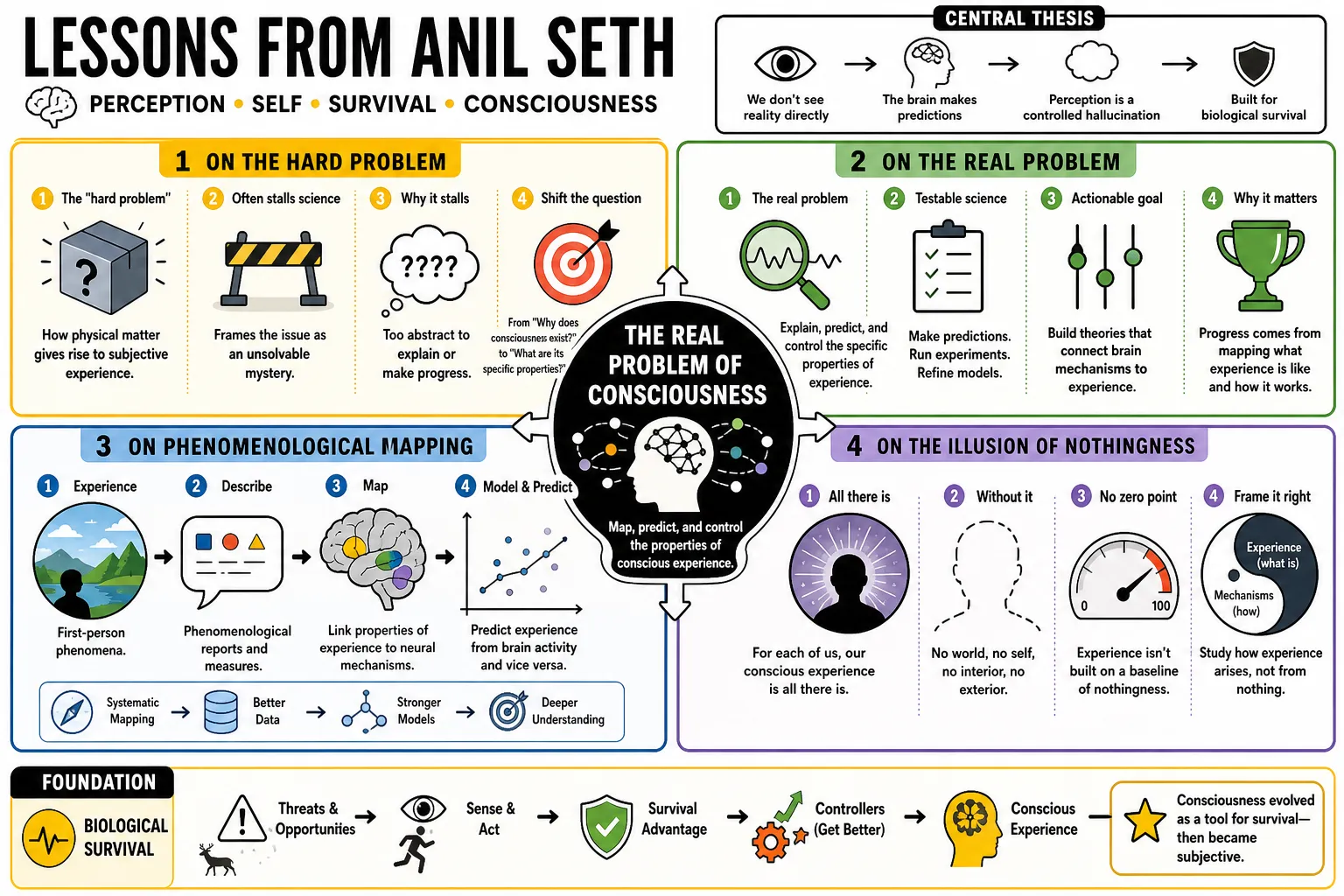
Lessons from Anil Seth
Neuroscientist Anil Seth studies how the brain constructs our conscious experience. He argues that perception is a "controlled hallucination" driven by internal predictions rather than a direct window into outside reality. This collection outlines his arguments on perception, the self, and why biological survival is the foundation of consciousness.
Part 1: The Real Problem of Consciousness
- On The Hard Problem: "The 'hard problem' of consciousness—how physical matter gives rise to subjective experience—often stalls scientific progress by framing the issue as an unsolvable mystery." — Source: Being You
- On The Real Problem: "Instead of trying to explain why consciousness exists at all, the 'real problem' focuses on explaining, predicting, and controlling the specific properties of conscious experience." — Source: Being You
- On Phenomenological Mapping: "The goal of consciousness research is to map the phenomenal properties of experience directly onto biological and neural mechanisms." — Source: TED
- On The Illusion of Nothingness: "For each of us, our conscious experience is all there is. Without it there is nothing at all: no world, no self, no interior and no exterior." — Source: Being You
- On Dissolving the Mystery: "By incrementally solving the real problem, the hard problem may not be solved, but it might eventually dissolve, much like the mystery of 'life' did in biology." — Source: Quanta Magazine
- On Brain Complexity: "Consciousness is not a single, monolithic phenomenon; it is a complex tapestry woven from many different threads of neural activity." — Source: Making Sense Podcast
- On Subjectivity: "Science must acknowledge subjectivity as a core aspect of nature, rather than something that needs to be explained away." — Source: Mindscape Podcast
- On The Limits of Observation: "We cannot directly observe the consciousness of another, which forces us to rely on neurobiological markers and behavioral correlations." — Source: Being You
- On Scientific Humility: "Our understanding of consciousness is still in its infancy, and we must remain open to the possibility that our current frameworks are fundamentally incomplete." — Source: 80,000 Hours
Part 2: Controlled Hallucination
- On Reality: "We’re all hallucinating all the time; when we agree about our hallucinations, that’s what we call 'reality'." — Source: TED
- On The Prediction Machine: "The brain is an isolated organ locked in a dark, silent skull; it must constantly guess what is happening outside based on indirect sensory signals." — Source: Being You
- On Top-Down Processing: "Perception is not a bottom-up process of reading the world; it is a top-down process of the brain projecting its predictions outward." — Source: Being You
- On Sensory Constraints: "Sensory inputs do not shape perception directly; rather, they serve as error signals to update and constrain the brain's internal predictions." — Source: TED
- On Colors and Sounds: "The brain doesn’t hear sound or see light. What we perceive is our best guess of what’s out there in the world." — Source: 80,000 Hours
- On Visual Illusions: "Optical illusions are not failures of perception, but windows into the exact predictive mechanisms the brain uses to construct reality." — Source: Mindscape Podcast
- On Hallucinations: "When the brain's predictions become untethered from sensory error signals, we experience what we commonly call hallucinations." — Source: Being You
- On Perception as Action: "Perception and action are deeply intertwined; we perceive the world in order to act effectively within it, not to create a passive, accurate map." — Source: Making Sense Podcast
- On The Subjective World: "We do not see things as they are, we see them as we are." — Source: Being You
- On The Precision of Predictions: "Our experience of clarity or ambiguity in perception depends entirely on how much precision the brain assigns to its own sensory predictions." — Source: Being You
Part 3: The Construction of Self
- On The Illusion of Self: "It may seem as though the self—your self—is the ‘thing’ that does the perceiving. But this is not how things are. The self is another perception." — Source: Being You
- On The Self as a Process: "There is no static 'you' sitting inside the brain; the self is a continuous, dynamic process of predictive inference." — Source: TED
- On The Assemblage of Identity: "The 'you' in question is the assemblage of self-related prior beliefs, values, goals, memories, and perceptual best guesses that collectively make up the experience of being you." — Source: Being You
- On Embodiment: "Our most fundamental sense of self is the experience of being a physical body situated in space and time." — Source: Making Sense Podcast
- On Autobiographical Memory: "The narrative self is constructed from memories, but these memories are themselves predictive reconstructions, not exact recordings of the past." — Source: Mindscape Podcast
- On The Social Self: "Part of our self-perception is heavily dictated by how we predict other people are perceiving us." — Source: 80,000 Hours
- On Self-Prediction: "I predict myself, therefore I am." — Source: Skeptic's Path
- On Ego Dissolution: "Experiences like deep meditation or the use of psychedelics can temporarily dismantle the brain's predictive models of the self, leading to a feeling of ego dissolution." — Source: Being You
- On The Continuity of Self: "The feeling that we are the same person over time is a useful hallucination that helps organismal survival." — Source: Quanta Magazine
- On Mental Illness and the Self: "Many psychiatric conditions can be understood as disruptions in the way the brain forms predictions about the self and its relation to the world." — Source: Being You
Part 4: The Beast Machine and Interoception
- On Biological Roots: "We are conscious not because we are highly intelligent, but because we are biological organisms driven to stay alive." — Source: TED
- On Interoception: "Our deepest level of conscious experience is interoception—the brain's perception of the internal state of the body." — Source: Being You
- On Emotion: "Emotions are the brain's predictive best guesses about the physiological state of the body in relation to survival." — Source: Being You
- On Homeostasis: "The core imperative of the brain is homeostasis; all perceptions, including conscious experience, are ultimately in service of keeping biological variables within narrow survival bounds." — Source: Mindscape Podcast
- On The Flesh and Blood: "We experience the world around us with, and through, our living, breathing bodies." — Source: Making Sense Podcast
- On The Beast Machine: "We are 'beast machines'—our conscious experiences are deeply rooted in our flesh-and-blood nature, distinct from any purely computational system." — Source: Being You
- On Pain: "Pain is not a signal sent directly from tissue damage; it is the brain's prediction that the body's integrity is under threat." — Source: 80,000 Hours
- On The Feeling of Life: "The sheer feeling of being alive is the most basic form of conscious perception, functioning as an ongoing status report on the body's viability." — Source: Being You
- On Evolution's Purpose: "Consciousness did not evolve to do abstract math; it evolved to help a biological organism regulate its internal environment in a complex world." — Source: Quanta Magazine
Part 5: Artificial Intelligence and Machine Consciousness
- On Intelligence vs. Sentience: "Intelligence is the ability to do the right thing at the right time; consciousness is the capacity for subjective experience. They are not the same thing." — Source: Being You
- On AI Sophistication: "A highly sophisticated artificial intelligence could effortlessly pass a Turing test without possessing a single spark of inner experience." — Source: 80,000 Hours
- On Silicon Constraints: "Because consciousness is intimately tied to biological survival and homeostasis, I am highly skeptical that a purely silicon-based computational system can ever be conscious." — Source: Making Sense Podcast
- On Information Processing: "Consciousness is not merely a matter of processing complex information; it is fundamentally about the biological substrate that is doing the processing." — Source: Mindscape Podcast
- On Simulation vs. Reality: "Simulating a weather system on a computer doesn't make it rain inside the computer. Similarly, simulating brain processes doesn't necessarily create consciousness." — Source: Being You
- On The Danger of Projection: "We are heavily biased to project consciousness onto anything that behaves somewhat like us, which makes assessing true AI consciousness incredibly difficult." — Source: Quanta Magazine
- On Functionalism: "The functionalist view—that if a machine acts conscious, it is conscious—ignores the fundamental role of biological flesh in generating subjective feeling." — Source: Being You
- On Ethical Implications: "If we mistakenly grant machines consciousness, we risk misallocating our ethical resources and failing to recognize the unique value of biological life." — Source: 80,000 Hours
- On Machine Motivation: "Unlike animals, machines have no innate drive to survive, no precarious biological balance to maintain, and therefore lack the foundation upon which consciousness is built." — Source: TED
Part 6: Animal Minds and the Diversity of Consciousness
- On The Human Center: "Human consciousness is just a tiny region in a vast space of possible consciousnesses." — Source: Being You
- On Non-Human Perception: "Other animals have entirely different sensory systems and predictive models, meaning they live in fundamentally different conscious realities." — Source: Mindscape Podcast
- On Octopus Intelligence: "The decentralized nervous system of an octopus suggests that conscious experience can take structural forms entirely alien to the vertebrate brain." — Source: Being You
- On The Continuity of Life: "Consciousness likely exists on a spectrum across the animal kingdom, shaped by the specific evolutionary and ecological needs of each species." — Source: 80,000 Hours
- On Pain in Animals: "Recognizing the biological basis of our own pain forces us to take seriously the capacity for suffering in other animals." — Source: Making Sense Podcast
- On Avian Brains: "Birds, despite lacking a neocortex, exhibit complex behaviors and problem-solving skills that strongly imply rich subjective inner lives." — Source: Being You
- On Anthropomorphism: "We must avoid judging animal consciousness solely by how closely it resembles human thought; language is not a prerequisite for experience." — Source: Quanta Magazine
- On Ecological Niches: "An animal's conscious experience is perfectly tuned to highlight the features of the environment that matter most for its specific survival." — Source: Being You
- On Shared Biology: "The fact that we share core brainstem structures related to interoception with many animals suggests they share the fundamental 'feeling of life' with us." — Source: Skeptic's Path
Part 7: Free Will and Agency
- On Voluntary Action: "The feeling of agency—that 'I' caused an action—is the brain's way of tracking and predicting the consequences of its own internally generated motor commands." — Source: Being You
- On The Purpose of Regret: "The usefulness of feeling 'I could have done otherwise' is that, next time, you might." — Source: Being You
- On Determinism: "Even in a deterministic universe where our actions are strictly caused by prior brain states, the subjective feeling of free will remains a crucial and real perceptual experience." — Source: Making Sense Podcast
- On Conscious Control: "Consciousness does not necessarily initiate actions, but it provides the necessary feedback loop to modify and adapt future behavior." — Source: Mindscape Podcast
- On The Illusion of Authorship: "We often act first and then retrospectively generate a narrative that 'we' decided to perform that action." — Source: Being You
- On Habit vs. Choice: "The distinction between a habit and a deliberate choice lies in the precision and complexity of the brain's predictive models during the action." — Source: 80,000 Hours
- On Moral Responsibility: "Understanding the mechanistic basis of behavior does not eliminate moral responsibility; rather, it forces us to locate responsibility in the functional capacities of the organism." — Source: Quanta Magazine
- On The Experience of Intention: "Intention is a specific kind of perception: it is the perception of an action about to happen, generated from within." — Source: Being You
- On Agency as Prediction: "We feel in control when the sensory outcomes of our actions match the precise predictions our motor systems generated just before the movement." — Source: TED
Part 8: Science, Philosophy, and Anesthesia
- On General Anesthesia: "General anesthesia is not like sleep; it is a profound interruption of consciousness, a total absence of experience." — Source: TED
- On The Fragility of Experience: "The ease with which anesthetics erase the self is a stark reminder that consciousness is entirely dependent on specific neurochemical states." — Source: Being You
- On Measuring Complexity: "We can measure the level of consciousness not by looking for a single switch, but by analyzing the informational complexity and integration of brain networks." — Source: Mindscape Podcast
- On The Philosophical Gap: "Philosophy helps us frame the right questions, but it is empirical neuroscience that will ultimately provide the detailed mechanisms." — Source: Making Sense Podcast
- On Psychedelics in Research: "Psychedelics offer a unique scientific tool by predictably altering the brain's reality-testing mechanisms, allowing us to observe how perception is constructed." — Source: Being You
- On Sleep and Dreams: "Dreaming is a state where the brain continues to generate predictive hallucinations, but without the corrective constraint of external sensory input." — Source: 80,000 Hours
- On The Limits of Science: "We may never bridge the gap between objective measurement and subjective feeling completely, but we can narrow it enough to make it scientifically irrelevant." — Source: Quanta Magazine
- On Scientific Interdisciplinarity: "To truly understand consciousness, we need to bridge the gaps between biology, physics, computer science, and philosophy." — Source: Being You
- On The Measurement Problem: "The search for a 'consciousness meter' requires us to move beyond simple behavioral tests and directly measure the causal density of the brain." — Source: Mindscape Podcast
- On The Wonder of Being: "Understanding the biological machinery of consciousness does not strip away its mystery; it deepens our appreciation for the sheer improbable wonder of being alive." — Source: Being You