Anjali Sud is the CEO of Tubi and the former CEO of Vimeo, recognized for transforming Vimeo from a consumer video site into a B2B software platform. She is known for her willingness to make unpopular strategic pivots and for advocating a highly proactive, explicit approach to career growth. This collection organizes her insights on strategy, navigating failure, and leading through industry transitions.
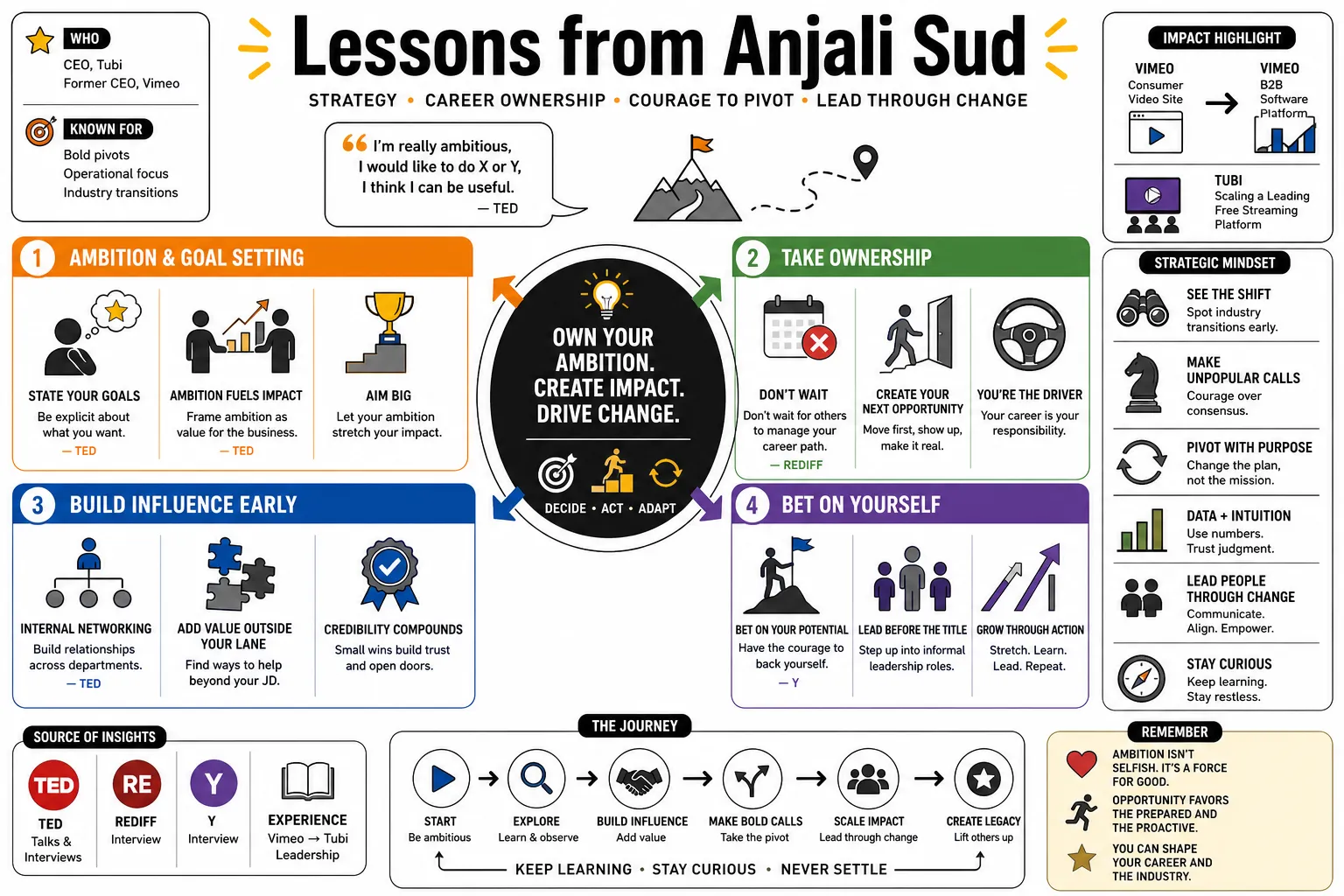
Part 1: Ambition and Career Ownership
- On stating your goals: Be explicit with managers: "I'm really ambitious, I would like to do X or Y, I think I can be useful. I want you to keep me in mind when this opportunity comes up." — Reference: TED Ideas, "Want to be a leader someday? 9 tips from Vimeo CEO Anjali Sud" (2021).
- On destigmatizing ambition: Break the stigma around ambition by turning the conversation "away from being a personal one and into a constructive, productive one about how that [ambition] helps the business." — Reference: TED Ideas, "Want to be a leader someday? 9 tips from Vimeo CEO Anjali Sud" (2021).
- On internal networking: Early in her career, "I went out of my way to be useful and helpful to a lot of the other functions that weren't exactly my job," which built informal credibility. — Reference: TED Ideas, "Want to be a leader someday? 9 tips from Vimeo CEO Anjali Sud" (2021).
- On betting on yourself: Sud told CNBC that nobody has all the answers, everyone has impostor syndrome, and the practical answer is to bet on yourself and use uncertainty to move forward. — Reference: CNBC Make It interview with Anjali Sud
- On seeking fluency: Her path was "winding": investment banking, then Time Warner, then Amazon, where she "got to experience many different functions and jobs," before running marketing at Vimeo. — Reference: McKinsey, "The Committed Innovator: An interview with Anjali Sud" (2020).
- On removing the onus from managers: "Instead of relying on my manager to just magically manage my career for me, I really put the onus on myself." — Reference: TED Ideas, "Want to be a leader someday? 9 tips from Vimeo CEO Anjali Sud" (2021).
Part 2: Leading Through Uncertainty
- On leading with humanity: In her TED conversation, Sud argues that leaders cannot give employees perfect certainty in a changing world, so they have to lead with humanity and flexibility. — Reference: TED conversation on leading through uncertainty
- On filtering noise: Sud's Lattice interview emphasizes giving teams context, objectives, and repeated strategic framing so a fast-growing company can keep attention on the work that matters. — Reference: Lattice article on Anjali Sud and people success
- On the burden of pressure: Sud told Lattice that leaders need to explain the why, share as much context as possible, and normalize hard conversations so pressure does not turn into organizational confusion. — Reference: Lattice article on Anjali Sud and people success
- On leading without authority: "A lot of people feel like they need formal authority to lead, but I think the best leaders and best CEOs in the world don't ever rely on formal authority. They win trust, and they inspire and empower people." — Reference: TED Ideas, "Want to be a leader someday? 9 tips from Vimeo CEO Anjali Sud" (2021).
- On agility: Sud describes adaptability as a competitive advantage and says Vimeo adjusts organization, culture, and processes based on what is right for the business and users. — Reference: Lattice article on Anjali Sud and people success
- On maintaining alignment: Vimeo built OKRs that work top-down and bottom-up, and she opens every meeting with the same one-page strategy summary to keep teams aligned. — Reference: Lattice, "Vimeo's Anjali Sud on Why People Success Is Crucial for Business Success".
- On the necessity of change: Sud's TED talk frames uncertainty as a standing leadership condition, not a temporary exception; leaders have to guide people through change without pretending certainty exists. — Reference: TED conversation on leading through uncertainty
Part 3: The Vimeo Pivot Strategy
- On redefining the company: "We're really transitioning Vimeo from being a content company to a technology company." — Reference: Marketplace Tech, "Vimeo pivots from a place for watching, to tools for making video" (2018).
- On observing user behavior: The B2B pivot came from signals on the platform, including small businesses and marketers arriving and shorter business videos. "It was those signals that led Vimeo to double down." — Reference: SaaStr, "From B2C to Billions: How Vimeo Executed a B2B Pivot" (2022).
- On identifying market gaps: "What Squarespace and GoDaddy did for websites, we could do with video." — Reference: Forbes, "How A Young Outsider Turned Failing Vimeo Into A Billion-Dollar Company" (2021).
- On picking battles: She pivoted Vimeo "away from being a viewing destination or media platform, like Facebook or YouTube or Netflix, and really into a video SaaS or software company for businesses." — Reference: The Verge Decoder, "How Anjali Sud reinvented Vimeo" (2021).
- On Focus: Focus matters: "when you try and serve everybody, you end up serving no one well." — Reference: Marketplace Tech, "Vimeo pivots from a place for watching, to tools for making video" (2018).
- On Getting Buy-In: She de-risked the pivot for the board: "If I had said, 'make this the company strategy from day one,' the board would have said no." Breaking it into smaller bets made it possible. — Reference: McKinsey, "The Committed Innovator: An interview with Anjali Sud" (2020).
Part 5: Authentic Leadership
- On finding strength in differences: Lattice notes that Sud's non-linear path, internal promotion, and non-founder perspective helped her see Vimeo clearly enough to champion a new strategy. — Reference: Lattice article on Anjali Sud and people success
- On self-doubt: Sud told CNBC that impostor syndrome still shows up, but she tries to turn the feeling that something is hard or scary into fuel for growth. — Reference: CNBC Make It interview with Anjali Sud
- On communicating the why: "You have to give people that context if you really want them to imbibe the strategy and be the right stewards of the strategy." — Reference: Lattice, "Vimeo's Anjali Sud on Why People Success Is Crucial for Business Success".
- On maintaining humanity: The TED conversation centers Sud's answer to turbulence on humanity and flexibility, especially when employees want certainty leaders cannot honestly provide. — Reference: TED conversation on leading through uncertainty
Part 6: Failure and Resilience
- On rejecting perfectionism: Sud's CNBC advice is that nobody is perfect and nobody has everything figured out, which turns leadership away from flawless performance and toward honest progress. — Reference: CNBC Make It interview with Anjali Sud
Part 7: Team Building and Culture
- On the core skill of management: "Leadership is empowering people to do their best work and driving positive outcomes; those are the two skill sets you want to develop." — Reference: TED Ideas, "Want to be a leader someday? 9 tips from Vimeo CEO Anjali Sud" (2021).
- On hiring for adaptability: Sud told Lattice that business success depends on bringing in incredible people, giving them influence, and building a team that can adapt as the company changes. — Reference: Lattice article on Anjali Sud and people success