Anna Bateson is the CEO of Guardian Media Group, having previously held senior marketing roles at YouTube, MTV, and Josh Wood Colour. She is known for executing a reader-revenue business model that secures editorial independence without a hard paywall. This profile outlines her approach to adaptable leadership, the balance between commercial reality and purpose, and navigating transitions in modern media.
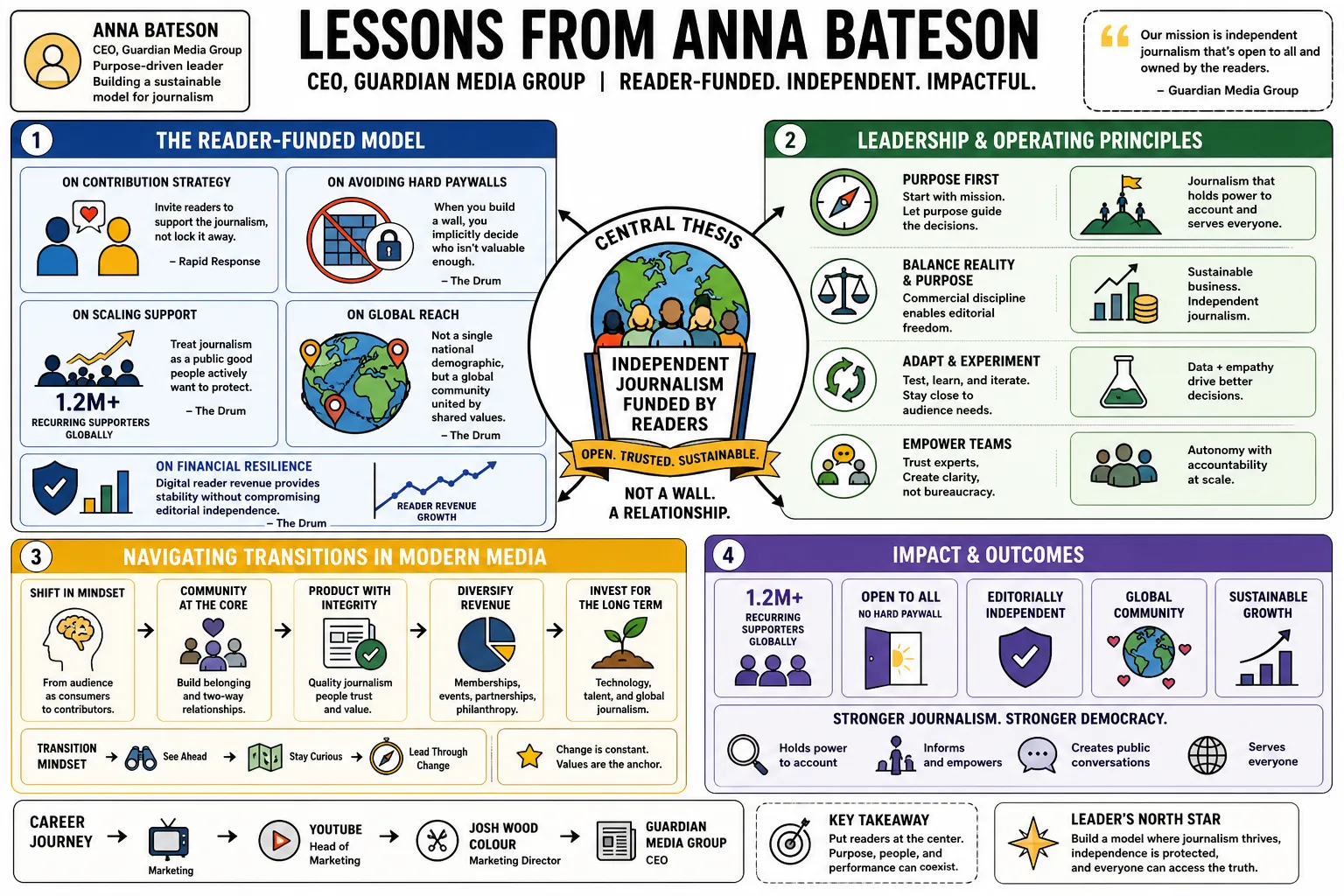
Visual summary of operating lessons from Anna Bateson.

Part 1: The Reader-Funded Model

  1. On the contribution strategy: "Inviting readers to support the journalism rather than locking it away changes the fundamental relationship between a publisher and its audience." — Source: Rapid Response
  2. On avoiding hard paywalls: "When you build a wall, you implicitly decide who isn't valuable enough to access your product." — Source: The Drum
  3. On scaling support: "Growing to over 1.2 million recurring supporters globally required treating our journalism as a public good that people actively want to protect." — Source: The Drum
  4. On global reach: "A reader-funded model works best when you view your audience not as a single national demographic, but as a global community united by shared values." — Source: The Drum
  5. On financial resilience: "Digital reader revenue has grown to become the primary pillar of our financial stability, proving that trust monetizes better than pure clicks." — Source: The Drum
  6. On continuous engagement: "A subscription is a transaction; a contribution is a relationship. You have to continually prove your worth to maintain the latter." — Source: The Guardian
  7. On expanding formats: "We introduced products like the Feast app and The Filter because deepening engagement requires diversifying the ways we provide value." — Source: The Drum
  8. On editorial independence: "The financial model exists to serve the journalism, ensuring our newsroom remains free from commercial or political pressure." — Source: The Guardian
  9. On reader motivations: "People contribute because they want to live in a world where independent, investigative reporting exists, whether they read every article or not." — Source: Rapid Response
  10. On shifting metrics: "Success is no longer purely about pageviews; it is about measuring the depth of connection and the willingness of readers to voluntarily fund our work." — Source: The Guardian

Part 2: Managing Legacy Media

  1. On the Scott Trust: "Our unique ownership structure allows us to think in generations rather than fiscal quarters, which is a rare privilege in modern media." — Source: The Guardian
  2. On industry decline: "While much of the legacy news industry is contracting, survival depends on fundamentally reimagining how you generate revenue." — Source: Rapid Response
  3. On structural advantages: "Not having private shareholders demanding immediate returns gives us the breathing room to build sustainable long-term strategies." — Source: Flashes & Flames
  4. On the creator economy: "News organizations must understand that they are competing for attention alongside individual creators who have built massive native audiences." — Source: Mi3
  5. On tech platform relationships: "Navigating our strategic relationships with platforms like Google requires balancing the need for distribution with the necessity of protecting our independent business model." — Source: Mi3
  6. On internal culture: "Legacy media companies often have deep-seated cultures; changing the business model means you also have to change how the newsroom understands its own commercial reality." — Source: Business Leader
  7. On institutional trust: "As trust in broad institutions declines, media brands have to actively prove their reliability on a daily basis." — Source: Mi3
  8. On balancing priorities: "The constant challenge is maintaining the delicate balance between the editor-in-chief's independence and the commercial engine needed to fund it." — Source: Business Leader
  9. On heritage vs. innovation: "You cannot rely on your heritage to save you; history gets you in the door, but continuous innovation keeps the lights on." — Source: The Drum

Part 3: Adaptation Over Prediction

  1. On the five-year plan: Bateson’s media-leadership posture is less about pretending the next five years can be mapped perfectly and more about staying ready for the pressures already reshaping news. — Reference: Rapid Response episode listing on Bateson and the future of news
  2. On the pace of change: The Guardian’s environment is moving through simultaneous shifts in legacy media, AI, audience habits, and distribution, which makes adaptability more useful than fixed roadmaps. — Reference: Rapid Response episode listing on media pressure, AI, and the future of news
  3. On organizational agility: Bateson connects resilience to structure: the Guardian’s ownership model and multi-revenue base give it more room to respond when the news business changes. — Reference: Rapid Response episode listing on ownership structure and revenue resilience
  4. On situational intelligence: "Leaders need the capacity to make sense of complex, fast-moving markets rather than relying on historical playbooks." — Source: CTTG
  5. On abandoning rigidity: In Bateson’s context, rigidity is dangerous because the Guardian has to navigate AI, platform shifts, business-model pressure, and audience change at the same time. — Reference: Rapid Response episode listing on Guardian growth amid media disruption
  6. On real-time learning: The lesson from Bateson’s Rapid Response appearance is to treat strategy as live learning: today’s audience, technology, and revenue signals matter because the future is forming through them. — Reference: Rapid Response RSS description on leaders navigating real-time challenges
  7. On strategic flexibility: Bateson’s strategic flexibility shows up in balancing a reader-funded model, multiple revenue streams, AI risk, and the Guardian’s public role without reducing the company to one bet. — Reference: Rapid Response episode listing on multi-revenue resilience and AI
  8. On managing uncertainty: "You have to get comfortable leading through periods where the final destination isn't entirely clear." — Source: CTTG
  9. On responsive structures: Bateson treats structure as strategy: ownership, revenue diversity, and audience engagement shape how quickly a media organization can respond. — Reference: Rapid Response episode listing on Guardian structure and resilience
  10. On letting go: Bateson’s operating context suggests that media leaders have to let go of inherited assumptions when legacy models stumble and newer reader, platform, and AI realities take over. — Reference: Rapid Response episode listing on legacy media pressure and Guardian growth

Part 4: Leading Through Transitions

  1. On the CMO to CEO shift: Bateson’s transition shows that the CEO role requires a different operating identity: marketing judgment still matters, but the accountability expands to the whole business. — Reference: Beyond the X episode description on Bateson moving from CMO to CEO
  2. On changing mindsets: The marketer-to-CEO jump is a mindset shift from representing a function to carrying the system-level consequences of the company’s choices. — Reference: Beyond the X episode description on the marketer-to-CEO jump
  3. On the desire to be liked: Bateson names a hard leadership transition: senior roles require moving from wanting approval to being effective for the organization. — Reference: Beyond the X episode description on moving from liked to effective
  4. On broad visibility: Bateson treats CEO visibility as part of the job: the role brings performative pressure, emotional shock, and a wider audience for every leadership signal. — Reference: Beyond the X episode description on CEO visibility and pressure
  5. On retaining audience focus: Bateson’s audience focus survived the move upward: at the Guardian, reader relationships, membership, subscriptions, contributions, and events were central to the commercial engine. — Reference: Reuters Institute bio on Bateson driving customer demand at the Guardian
  6. On stepping out of tech: "Moving from the scale of Google to legacy media required learning how to drive change in environments that weren't born digital." — Source: Masters of Scale
  7. On leading a beauty brand: "Going to Josh Wood Colour was about wanting to build something from the ground up and engaging with a product that could transform a dusty category." — Source: Forbes
  8. On founder relationships: "Working effectively with founders means understanding their vision deeply while bringing the operational rigor needed to scale it." — Source: Forbes
  9. On career transitions: Bateson’s career argues for range: moving across Guardian, Google, YouTube, ITV, and MTV gave her a broader view of audiences, platforms, and media businesses. — Reference: Reuters Institute bio on Bateson’s varied media and marketing career

Part 5: Purpose and Commercial Reality

  1. On ethical advertising: "Stopping the acceptance of fossil fuel and gambling advertisements was a commercial decision that directly aligned with our publication's core purpose." — Source: WAN-IFRA
  2. On business values: "Your business model is the truest reflection of your organizational values; how you make money speaks louder than any mission statement." — Source: WAN-IFRA
  3. On B Corp accreditation: "Achieving B Corp status was a way to bake sustainability and ethical standards into the very architecture of our operations." — Source: Oxford University
  4. On revenue vs. ethics: "There are times when you have to turn away short-term revenue to protect the long-term integrity of the brand." — Source: WAN-IFRA
  5. On reader alignment: "Our readers support us financially because they trust that our commercial operations share their ethical concerns about the world." — Source: Oxford University
  6. On sustainability: "Sustainability is more than an editorial beat; it has to be reflected in the supply chain and commercial partnerships of the media company itself." — Source: Oxford University
  7. On purpose as a differentiator: "In a crowded market, having a clear, demonstrable purpose is one of the strongest competitive advantages a media brand can have." — Source: WAN-IFRA
  8. On internal alignment: "When the commercial side of the business shares the ethical framework of the newsroom, it reduces internal friction and accelerates growth." — Source: WAN-IFRA
  9. On defining success: "Profitability is essential, but it is the means to an end. The end is securing the future of independent journalism." — Source: The Guardian

Part 6: Navigating the Age of AI

  1. On the AI threat: "The emergence of AI chatbots presents a fundamental challenge to how audiences find and consume news, requiring publishers to rethink distribution." — Source: Rapid Response
  2. On AI opportunities: "While AI threatens traditional search traffic, it also offers tools to improve our own products and create more personalized reader experiences." — Source: Rapid Response
  3. On content scraping: "Publishers must take a firm stance on protecting their intellectual property from being ingested by AI models without compensation or permission." — Source: Rapid Response
  4. On the value of reporting: "In a world flooded with synthetic content, the premium on human, on-the-ground investigative journalism will only increase." — Source: Rapid Response
  5. On search evolution: "As search engines transition into answer engines, media companies have to find new ways to pull audiences directly to their owned platforms." — Source: Rapid Response
  6. On AI regulation: "There needs to be a transparent framework for how generative AI interacts with the news ecosystem, otherwise the economics of reporting will break." — Source: Rapid Response
  7. On the speed of adoption: "We cannot afford to wait and see how AI develops; we have to actively experiment with it while maintaining our editorial guardrails." — Source: Rapid Response
  8. On human curation: "Algorithmic generation will make human editorial judgment a distinct luxury and a core part of our value proposition." — Source: Rapid Response
  9. On AI in operations: "Beyond content creation, AI presents massive opportunities for operational efficiency, allowing us to direct more resources toward actual reporting." — Source: Rapid Response

Part 7: Brand, Trust, and Authority

  1. On the nature of authority: "Without my job title, my network, and my presence here, would you still trust me? True authority has to be earned independent of your label." — Source: Oxford University
  2. On building trust: "Trust is not a marketing campaign; it is the cumulative result of thousands of small decisions made consistently over time." — Source: Oxford University
  3. On truth in 2025: "Navigating truth today requires a deep commitment to nuance and curiosity, qualities that are often punished by algorithmic media." — Source: Oxford University
  4. On brand community: "A strong brand moves beyond broadcasting to an audience by building a community around shared beliefs and collective action." — Source: Forbes
  5. On transparency: "When you make mistakes, handling them with absolute transparency is often the fastest way to reinforce your trustworthiness." — Source: Oxford University
  6. On the role of marketing: "Marketing at its best focuses on building genuine customer trust over optimizing a conversion funnel." — Source: Forbes
  7. On modern authenticity: "Authenticity isn't about oversharing; it's about an alignment between what an organization promises and how it actually behaves when no one is watching." — Source: Oxford University
  8. On institutional voice: "A media brand's voice must reflect the diversity and complexity of its readership if it hopes to maintain its relevance." — Source: Oxford University
  9. On protecting the brand: "The most important job of any media executive is acting as the steward of the brand's long-term credibility." — Source: Oxford University

Part 8: Marketing in Tech

  1. On scaling YouTube: Bateson’s YouTube experience was global consumer marketing at platform scale, where the work was less about a single campaign and more about growing demand around a living media ecosystem. — Reference: Reuters Institute bio on Bateson’s Google and YouTube marketing roles
  2. On global campaigns: "Running consumer marketing from San Francisco taught me how to build campaigns that resonate globally while feeling culturally specific locally." — Source: Oxford University
  3. On breaking into the industry: Bateson’s career-advice material points aspiring marketers toward curiosity, learning the business, and understanding audiences rather than treating marketing as a narrow technical craft. — Reference: Making it in Marketing video description with Bateson career advice
  4. On platform ecosystems: Bateson’s Google and YouTube years placed her inside the platform layer of media, where audience growth, distribution, and advertising infrastructure are tightly connected. — Reference: Reuters Institute bio on Bateson at Google and YouTube
  5. On MTV’s influence: Bateson’s MTV Networks role gave her early experience with media brands built on audience identity, cultural positioning, and entertainment marketing. — Reference: Reuters Institute bio on Bateson as VP of Marketing at MTV Networks
  6. On the tech mindset: "Silicon Valley instilled a belief in the necessity of speed and scale, which I had to later adapt for more traditional legacy environments." — Source: Masters of Scale
  7. On creators vs. publishers: "Understanding the creator ecosystem at YouTube provided an early look at how fragmented and decentralized media influence would become." — Source: Mi3
  8. On user-generated content: Marketing YouTube meant working with a product shaped by creators and viewers, so the brand had to grow with the community rather than simply broadcast at it. — Reference: Reuters Institute bio on Bateson’s YouTube marketing career
  9. On data and intuition: Bateson’s path across Google, YouTube, and the Guardian suggests the marketer’s job is to connect data-rich demand signals with a human understanding of audiences. — Reference: Reuters Institute bio on Bateson driving customer demand across media and tech
  10. On cross-channel marketing: Bateson’s ITV and MTV roles gave her practice managing media brands across channels, where the challenge is keeping a coherent identity while adapting to each audience context. — Reference: Reuters Institute bio on Bateson’s ITV and MTV marketing roles