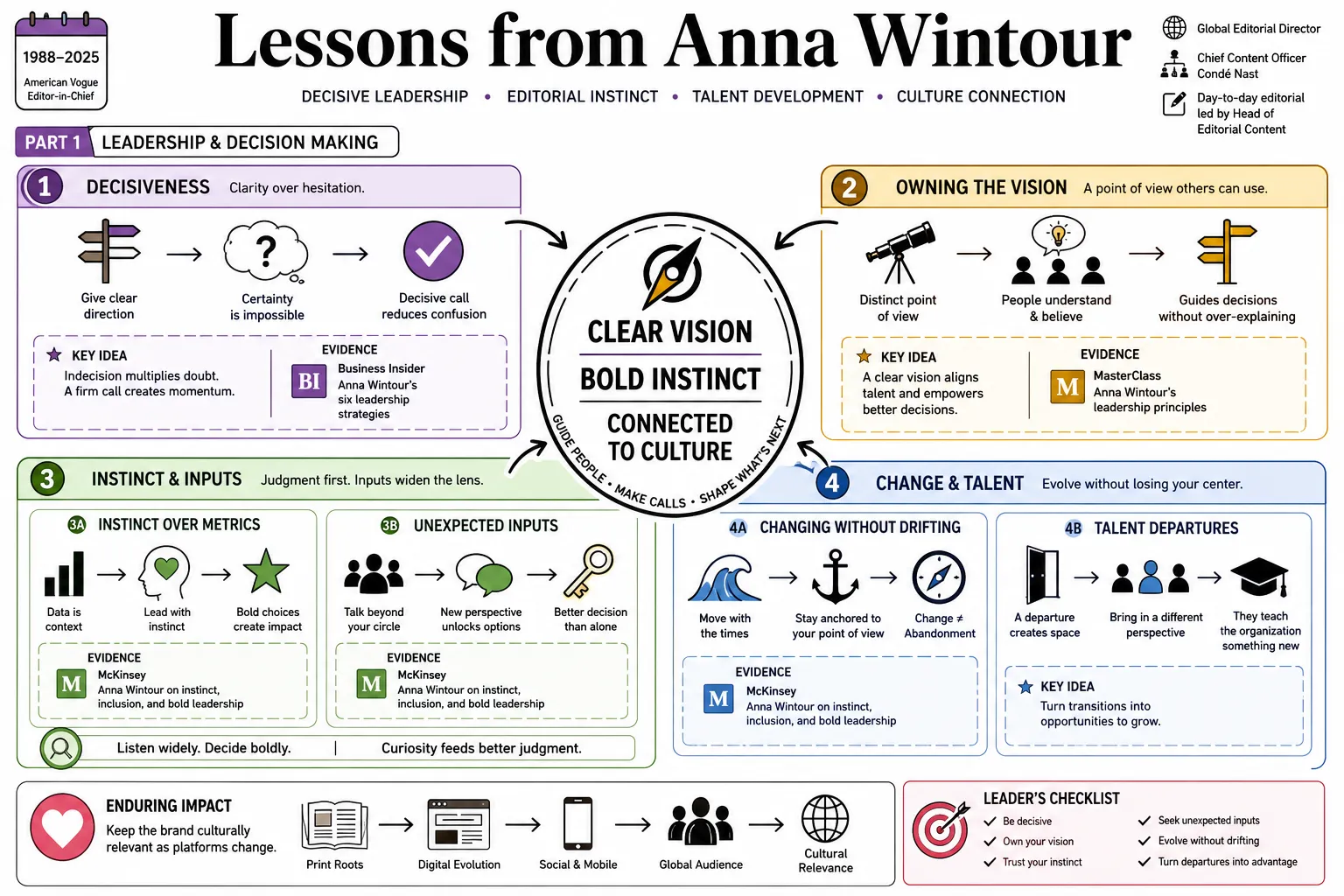
Lessons from Anna Wintour
Anna Wintour led American Vogue as editor-in-chief from 1988 until 2025. She remains Condé Nast's chief content officer and Vogue's global editorial director, while the US title's day-to-day editorial operation is led by a head of editorial content. Her career offers a useful study in decisive leadership, editorial instinct, talent development, and keeping a legacy media brand connected to culture as its platforms change.
Part 1: Leadership and Decision Making
- On Decisiveness: Give people a clear direction even when certainty is impossible; prolonged indecision creates more confusion than a firm call. — Reference: Business Insider — Anna Wintour's six leadership strategies
- On Owning the Vision: A leader needs a point of view that others can understand, believe in, and use to make decisions without constant interpretation. — Reference: MasterClass — Anna Wintour's leadership principles
- On Instinct Over Metrics: Use data as context, not as a substitute for judgment; Wintour credits instinct for her most consequential editorial choices. — Reference: McKinsey — Anna Wintour on instinct, inclusion, and bold leadership
- On Unexpected Inputs: Talk with people outside your normal circle because an unfamiliar perspective can unlock a decision you would not have reached alone. — Reference: McKinsey — Anna Wintour on instinct, inclusion, and bold leadership
- On Changing Without Drifting: Move with the times while remaining anchored to a recognizable point of view; change is not the same as abandoning direction. — Reference: McKinsey — Anna Wintour on instinct, inclusion, and bold leadership
- On Talent Departures: Treat the departure of a strong colleague as a chance to add a different perspective and bring in someone who can teach the organization something new. — Reference: Business Insider — Anna Wintour's six leadership strategies
- On Forward Motion: Learn quickly from a finished project, then turn attention to the next one instead of getting trapped in prolonged post-mortems. — Reference: Business Insider — Anna Wintour's six leadership strategies
- On Patient Institution Building: Cultural institutions are built through patience and listening, not one spectacular moment; the Met Gala's reach accumulated over years. — Reference: McKinsey — Anna Wintour on instinct, inclusion, and bold leadership
- On Using the Platform: When conditions are difficult, use institutional reach to help others rather than treating influence as an end in itself. — Reference: McKinsey — Anna Wintour on instinct, inclusion, and bold leadership
- On Audience Conviction: Know and care about the audience, but do not confuse service with timidity; a strong editorial brand sometimes has to make an unexpected choice. — Reference: MasterClass — Anna Wintour's leadership principles
Part 2: Fashion, Editing, and Media
- On Fashion in Context: Fashion matters when it is connected to art, film, theatre, politics, and the way people actually live—not when it is sealed inside its own industry. — Reference: McKinsey — Anna Wintour on instinct, inclusion, and bold leadership
- On Real-Life Observation: Editors should keep exposing themselves to streets, people, and culture because observation continually supplies ideas that desk-bound analysis misses. — Reference: McKinsey — Anna Wintour on instinct, inclusion, and bold leadership
- On Relatability Over Convention: The 1988 Vogue cover worked because it reflected women Wintour saw on the street, even though its mix of couture and inexpensive denim violated expectations. — Reference: McKinsey — Anna Wintour on instinct, inclusion, and bold leadership
- On Purposeful Rule-Breaking: Break a convention when the unexpected choice advances the brand and makes the work culturally relevant, not merely to manufacture attention. — Reference: MasterClass — Anna Wintour's leadership principles
- On Strong Creative Points of View: Look for designers and collaborators whose work expresses a distinct point of view rather than a diluted attempt to please everyone. — Reference: McKinsey — Anna Wintour on instinct, inclusion, and bold leadership
- On Creative Orchestration: An editor does not need to make every artifact; the job can be to assemble exceptional creative people, support them, and make the combination work. — Reference: McKinsey — Anna Wintour on instinct, inclusion, and bold leadership
- On Audience Access: Showing the audience how the work gets made can deepen trust in an editorial brand when that access is deliberate and revealing. — Reference: MasterClass — Anna Wintour's leadership principles
- On Authority in the AI Era: As AI makes content abundant and easily accessible, editors need to uphold standards more rigorously and make their authority legible to readers. — Reference: Suggest — Anna Wintour on editorial authority in the AI era
Part 3: Managing People and Talent
- On Delegation: Give capable people real responsibility, agree on the outcome, and avoid repeatedly checking work they already own. — Reference: Business Insider — Anna Wintour's six leadership strategies
- On Avoiding Micromanagement: You can remain exacting about the final product while still empowering editors to make decisions on behalf of the brand. — Reference: MasterClass — Anna Wintour's leadership principles
- On Diverse Teams: Build teams across backgrounds, ages, experiences, and opinions so their different perspectives cover the leader's blind spots. — Reference: MasterClass — Anna Wintour's leadership principles
- On Cultivating New Leaders: Developing emerging talent strengthens the future of the field and gives established leaders new ideas in return. — Reference: MasterClass — Anna Wintour's leadership principles
- On Reciprocal Mentorship: Mentorship should run both ways: younger colleagues learn the craft while the senior leader stays connected to new perspectives. — Reference: McKinsey — Anna Wintour on instinct, inclusion, and bold leadership
- On Humanity in Hiring: Beyond credentials, ask whether a candidate is someone you will be genuinely pleased to work with every day. — Reference: McKinsey — Anna Wintour on instinct, inclusion, and bold leadership
- On Leading with Values: True leadership requires clear values and a commitment to helping the people on the team reach their highest potential. — Reference: CFDA — Tory Burch Foundation Founders Breakfast
- On The Joy of Mentorship: One of the most rewarding parts of leadership is helping other people learn their craft and grow into what they can become. — Reference: CFDA — Tory Burch Foundation Founders Breakfast
- On Interview Preparation: Research the role, interviewer, culture, and contribution you can make; preparation should go beyond rehearsing standard questions. — Reference: MasterClass — Anna Wintour's career and interview advice
- On Interview Authenticity: Do not posture or borrow interests to impress an interviewer; be direct about what you want and honest about who you are. — Reference: MasterClass — Anna Wintour's career and interview advice
Part 4: Career Growth and Sustainable Routines
- On Learning from Setbacks: A firing or other setback can force an honest self-review and become useful when it changes how you approach the next opportunity. — Reference: Business Insider — Anna Wintour's six leadership strategies
- On Career Experimentation: Early in a career, trying work you do not ultimately want can clarify the work you do want. — Reference: MasterClass — Anna Wintour's career and interview advice
- On Building Range: Use early roles to diversify your skills, build confidence, and become more willing to take creative risks. — Reference: MasterClass — Anna Wintour's career and interview advice
- On Choosing a Mentor: At the beginning of a career, working for someone you respect and can learn from may matter as much as the job title itself. — Reference: MasterClass — Anna Wintour's career and interview advice
- On Learning from Every Role: Even when a boss is not an ideal mentor, extract the useful knowledge from the role and carry it into the next one. — Reference: MasterClass — Anna Wintour's career and interview advice
- On Morning Observation: Use the quiet early hours to read widely, walk, and connect with colleagues across time zones before the day's meetings narrow your attention. — Reference: McKinsey — Anna Wintour on instinct, inclusion, and bold leadership
- On Protected Recovery: A demanding routine is more sustainable when it also protects reasonable stopping times, relationships, and quiet time away from the work. — Reference: McKinsey — Anna Wintour on instinct, inclusion, and bold leadership
- On Creating Through Difficulty: In a crisis, sustain creative energy by caring for the people doing the work and giving them a concrete symbol of hope and a future beyond the disruption. — Reference: McKinsey — Anna Wintour on instinct, inclusion, and bold leadership