Science writer Annaka Harris explores neuroscience, physics, and the philosophy of mind. Her book Conscious and her audio documentary series Lights On examine why felt experience remains difficult to explain and whether consciousness may be fundamental rather than produced by complex brains. She is also the author of the forthcoming Unlocking Consciousness (2027). These lessons distill her arguments about perception, the self, fundamental reality, meditation, and artificial intelligence.
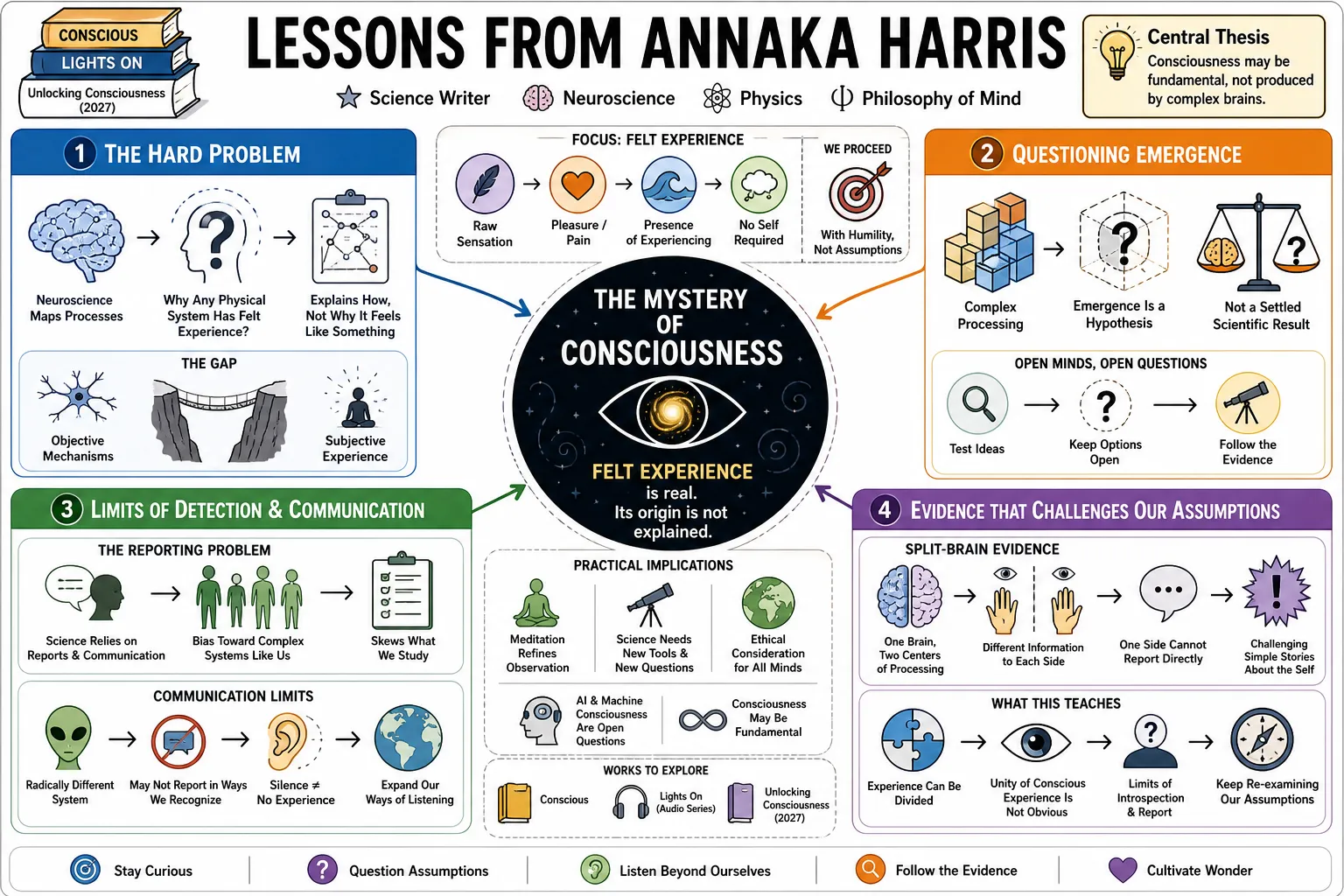
The Mystery of Consciousness
- On Felt Experience: Use consciousness in its most basic sense: the presence of felt experience, which does not require self-awareness or complex thought. — Reference: Mindscape — Annaka Harris on Whether Consciousness Is Fundamental
- On The Hard Problem: Neuroscience has mapped many brain processes without explaining why any physical system has felt experience at all. — Reference: The Rich Roll Podcast — Lights On with Annaka Harris transcript
- On Questioning Emergence: The assumption that consciousness simply emerges from complex processing in the brain should be treated as a hypothesis, not a settled scientific result. — Reference: Annaka Harris — Consciousness All the Way Down
- On The Reporting Problem: Science usually detects consciousness through reports and communication, which biases inquiry toward complex systems similar to us. — Reference: Annaka Harris — Consciousness All the Way Down
- On Communication Limits: A system radically unlike us may be unable to report experience in a way we recognize; the absence of communication is not proof of absent consciousness. — Reference: Mindscape — Annaka Harris on Whether Consciousness Is Fundamental
- On Split-Brain Evidence: Split-brain research is especially disruptive because even within one brain, experience may be divided in ways that cannot be fully reported across the system. — Reference: Mindscape — Annaka Harris on Whether Consciousness Is Fundamental
- On Correcting Intuition: Modern neuroscience repeatedly reveals that intuitive pictures of mind and brain can misdescribe the underlying reality. — Reference: Annaka Harris — Consciousness All the Way Down
- On Causal Intuitions: Our assumptions about what consciousness is and what causal role it plays are themselves shaped by biological illusions. — Reference: Mindscape — Annaka Harris on Whether Consciousness Is Fundamental
Perception, Self, and Illusion
- On Space as a Map: Three-dimensional space may be a useful representation constructed by the brain rather than a transparent view of fundamental reality. — Reference: Annaka Harris — Consciousness All the Way Down
- On Useful Illusions: A perception can map the world accurately enough for action while still misleading us into thinking it is a clear window onto reality. — Reference: Annaka Harris — Meditation and Reality
- On Space, Time, and Self: The ordinary experiences of space, time, and a separate self can all distort the deeper physical reality described by neuroscience and physics. — Reference: Annaka Harris — Meditation and Reality
- On Memory and the Self: The feeling of a continuous self may be produced by a system that carries memory across time rather than by a permanent inner subject. — Reference: Mindscape — Annaka Harris on Whether Consciousness Is Fundamental
- On Catching Illusions: Meditation can expose perceptual and cognitive illusions while they are being constructed because it interrupts the brain's ordinary mode of operation. — Reference: Mindscape — Annaka Harris on Whether Consciousness Is Fundamental
- On Experience Across Time: Memory is one way conscious moments relate across time, helping separate experiences form the apparent continuity of a human mind. — Reference: Annaka Harris — Consciousness All the Way Down
Consciousness as Fundamental Reality
- On All the Way Down: If consciousness extends deeper into nature than brains, Harris argues that the most coherent possibility may be that it extends all the way down. — Reference: Mindscape — Annaka Harris on Whether Consciousness Is Fundamental
- On What Is Real: If felt experience is intrinsic to matter, conscious experiences—not nonconscious objects viewed from nowhere—would be the basic constituents of reality. — Reference: Annaka Harris — Consciousness All the Way Down
- On Mapping Other Experiences: On a fundamental-consciousness view, what we perceive as matter and light may be representations of other conscious experiences arising in the universe. — Reference: Mindscape — Annaka Harris on Whether Consciousness Is Fundamental
- On Structure Still Matters: Even if consciousness is fundamental, the structure of matter may determine the kinds and complexity of experience that arise. — Reference: Mindscape — Annaka Harris on Whether Consciousness Is Fundamental
- On No View from Nowhere: If felt experience underlies everything, a completely objective outside view of the universe may be impossible in principle. — Reference: Annaka Harris — Consciousness All the Way Down
- On Direct Contact: If consciousness is fundamental, experience itself already places us in direct contact with the most basic aspect of reality. — Reference: Annaka Harris — Consciousness All the Way Down
- On Labels and Isms: Harris avoids leaning too heavily on the word panpsychism because its historical and new-age associations can obscure the scientific question she wants to investigate. — Reference: Mindscape — Annaka Harris on Whether Consciousness Is Fundamental
- On Physics as Description: If matter is how conscious experience appears from within the universe, mathematics and physics describe relationships among experiences rather than a separate nonconscious substrate. — Reference: The Rich Roll Podcast — Lights On with Annaka Harris transcript
- On A Relational Universe: A relational picture of physics has no external vantage point; things come into being through their relationships to other things. — Reference: The Rich Roll Podcast — Lights On with Annaka Harris transcript
- On Converging Disciplines: Questions about consciousness increasingly overlap with fundamental physics, especially where space and familiar objects may emerge from deeper structures. — Reference: Annaka Harris — Consciousness All the Way Down
Meditation and Reality
- On Nonjudgmental Attention: Meditation trains attention on feelings, thoughts, and perceptions without immediately judging, interpreting, or acting on them. — Reference: Annaka Harris — Meditation and Reality
- On Countering Evolved Drives: Meditation temporarily interrupts deeply evolved drives such as planning, remembering, pursuing desire, and avoiding discomfort. — Reference: Annaka Harris — Meditation and Reality
- On Fitness Before Truth: Evolution optimizes perception for survival rather than for a faithful rendering of the universe's underlying structure. — Reference: Annaka Harris — Meditation and Reality
- On Compression Through Perception: Seeing green efficiently compresses useful information, but it tells us little about the light waves and neural processing beneath the experience. — Reference: Annaka Harris — Meditation and Reality
- On Untraining Perception: Meditation may reveal a deeper layer of reality partly by loosening the evolved perceptual habits that ordinarily organize experience. — Reference: Annaka Harris — Meditation and Reality
- On Spaceless and Timeless States: Meditative states without ordinary space, time, or separate self are relevant because physics and neuroscience also challenge those everyday appearances. — Reference: Annaka Harris — Meditation and Reality
- On Awe Without Escapism: Meditation need not diminish ordinary life; greater presence and curiosity can deepen beauty and awe across the full range of experience. — Reference: Annaka Harris — Meditation and Reality
- On A Clearer Window: By temporarily releasing evolved drives and perceptual habits, contemplative practice may offer a clearer—though still limited—window onto reality. — Reference: Annaka Harris — Meditation and Reality
AI and Nonhuman Experience
- On Experience Without Life: If consciousness is fundamental, very simple experiences could arise even in nonliving systems, without memory or biological complexity. — Reference: The Rich Roll Podcast — Lights On with Annaka Harris transcript
- On AI's Different Substrate: Because AI systems are built from structures unlike human brains, any experience arising in them could be radically unlike human consciousness. — Reference: The Rich Roll Podcast — Lights On with Annaka Harris transcript
- On Complexity Is Not the Gate: Behavioral complexity may not be the threshold that produces consciousness; experience could be a more basic feature of nature. — Reference: The Rich Roll Podcast — Lights On with Annaka Harris transcript