Lessons from Anne Applebaum
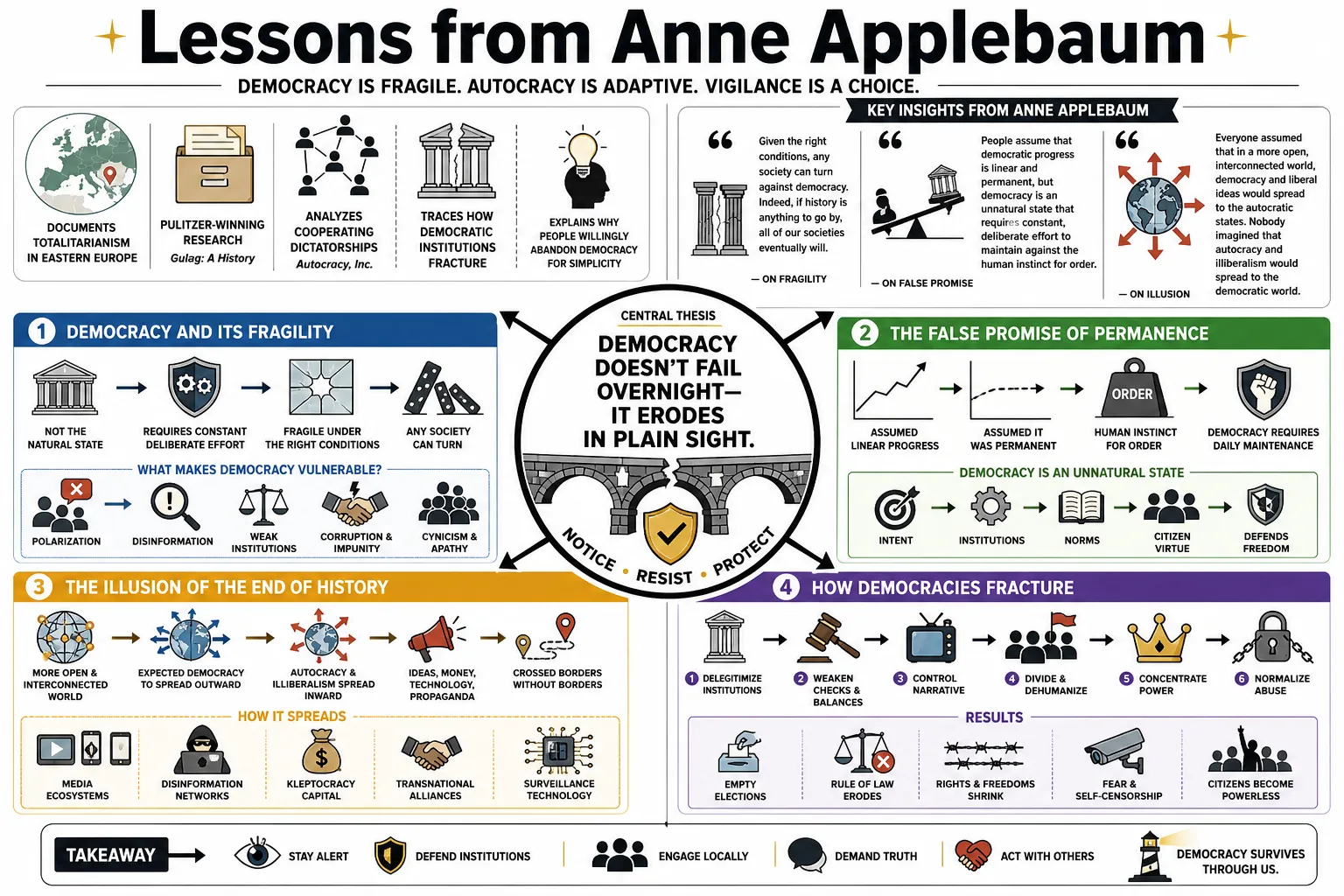
Anne Applebaum is an American historian and journalist who documents totalitarianism in Eastern Europe and the modern rise of autocratic networks. Best known for her Pulitzer-winning archival research in Gulag: A History and her analysis of cooperating dictatorships in Autocracy, Inc., she traces exactly how democratic institutions fracture. Her work explains why people willingly abandon democracy for the simplicity of authoritarian rule. — Anne Applebaum, "The West Has to Believe That Democracy Will Prevail" (Peace Prize lecture, 2024).
Part 1: Democracy and Its Fragility
- On the fragility of democratic systems: "Given the right conditions, any society can turn against democracy. Indeed, if history is anything to go by, all of our societies eventually will." — Reference: CBC Ideas, "Pulitzer Prize-winning historian explains the lure of authoritarianism" (2020).
- On the false promise of permanence: Democracies are historically weak: they "have almost all fallen and almost all been undermined, sooner or later, in predictable and repetitive ways," so nothing about them is inevitable. — Reference: CBC Ideas, "Pulitzer Prize-winning historian explains the lure of authoritarianism" (2020).
- On the illusion of the end of history: "Everyone assumed that in a more open, interconnected world, democracy and liberal ideas would spread to the autocratic states." Nobody imagined that autocratic and illiberal ideas "would spread to the democratic world instead." — Reference: The New York Times Book Review on Autocracy, Inc. (2024).
- On polarization and institutions: "There can be no neutrality in a polarized world because there can be no nonpartisan or apolitical institutions." — Reference: Juridice.ro review of Twilight of Democracy, quoting p. 114 (2021).
- On the shattering of consensus: When Poland was on the cusp of joining the West, "it felt as if we were all on the same team. We agreed about democracy, about the road to prosperity… That moment has passed." — Reference: Anne Applebaum, "A Warning From Europe: The Worst Is Yet to Come" (The Atlantic, 2018).
- On the exhaustion of freedom: Democracy "requires a lot of its citizens"—parties, civic organizations, voting—and for many people it is "a difficult and exasperating, and even enervating form of politics." — Reference: CBC Ideas, "Pulitzer Prize-winning historian explains the lure of authoritarianism" (2020).
Part 2: The Network of Modern Autocracy
- On the business model of autocracy: "Unlike the fascist and communist leaders of the past, who had party machines behind them and did not showcase their greed, the leaders of Autocracy, Inc., often maintain opulent residences and structure much of their collaboration as for-profit ventures." — Reference: Anne Applebaum, "Autocracy Inc" (Open Letters excerpt, 2024).
- On autocratic alliances: "Nowadays, autocracies are run not by one bad guy but by sophisticated networks relying on kleptocratic financial structures, a complex of security services… and technological experts who provide surveillance, propaganda, and disinformation." — Reference: Anne Applebaum, "Autocracy Inc" (Open Letters excerpt, 2024).
- On the absence of shared ideology: Modern autocracies share no unifying ideology; their bonds are "cemented not through ideals but through deals—deals designed to take the edge off sanctions, to exchange surveillance technology, to help one another get rich." — Reference: Anne Applebaum, "Autocracy Inc" (Open Letters excerpt, 2024).
- On impunity as a service: "Autocracy, Inc., offers its members not only money and security but also something less tangible: impunity." — Reference: Anne Applebaum, "Autocracy Inc" (Open Letters excerpt, 2024).
- On ignoring international norms: "Today, the members of Autocracy, Inc., no longer care if they or their countries are criticized or by whom," and China and Russia have convinced many that concepts such as "civil liberties" and "the rule of law" embody Western ideas that don't apply to them. — Reference: Anne Applebaum, "Autocracy Inc" (Open Letters excerpt, 2024).
- On the global autocratic narrative: Autocratic propaganda tells citizens: "You may not like our society, but at least we are strong. The democratic world is weak, degenerate, divided, dying." — Reference: Anne Applebaum, "Democracy Is Losing the Propaganda War" (The Atlantic, 2024).
- On the myth of the isolated dictator: Autocrats are networked, not isolated: "Oligarchs from multiple countries all use the same accountants and lawyers to hide their money in Europe and America." — Reference: Anne Applebaum, "The West Should Stop Doing Global Kleptocrats So Many Favors" (2022).
Part 3: The Mechanics of Disinformation
- On the death of shared reality: "In many advanced democracies there is now no common debate, let alone a common narrative. People have always had different opinions. Now they have different facts." — Reference: The American Scholar, "Creeping Illiberalism" review of Twilight of Democracy (2020).
- On the limits of fact-checking: "No one who studies autocratic propaganda believes that fact-checking or even swift reactions are sufficient. By the time the correction is made, the falsehood has already traveled around the world." — Reference: The Kyiv Independent on Autocracy, Inc. (2024).
- On the medium lie: Illiberal movements depend, if not on a Big Lie, then on what the historian Timothy Snyder called the "Medium-Size Lie": an alternative reality their followers engage with at least part of the time. — Reference: Anne Applebaum, "A Warning From Europe: The Worst Is Yet to Come" (The Atlantic, 2018).
- On the goal of cynicism: Most modern autocrats don't offer a vision of utopia; instead "they teach people to be cynical and passive, apathetic and afraid," to keep them out of politics. — Reference: Anne Applebaum, "Democracy Is Losing the Propaganda War" (The Atlantic, 2024).
Part 4: The Allure of Illiberalism
- On the appeal of authoritarianism: "Authoritarianism appeals, simply, to people who cannot tolerate complexity: there is nothing intrinsically 'left-wing' or 'right-wing' about this instinct at all." — Reference: The New York Review of Books, Jackson Lears on Twilight of Democracy (2021).
- On the attraction of belonging: Market competition, even when it rewards talent, doesn't "answer deeper questions about national identity, or satisfy the human desire to belong to a moral community"—which illiberal one-party states promise to do. — Reference: Anne Applebaum, "A Warning From Europe: The Worst Is Yet to Come" (The Atlantic, 2018).
- On the rejection of meritocracy: Democracy and free markets can produce unsatisfying outcomes: "Sooner or later, the losers of the competition were always going to challenge the value of the competition itself." — Reference: Anne Applebaum, "A Warning From Europe: The Worst Is Yet to Come" (The Atlantic, 2018).
- On the transformation of identity: Of Mihail Sebastian's friends: "In his journal, he described how, one by one, they were drawn to fascist ideology, like a flock of moths to an inescapable flame… and instead began to call themselves blood-and-soil Romanians." — Reference: Anne Applebaum, "A Warning From Europe: The Worst Is Yet to Come" (The Atlantic, 2018).
- On the pleasure of conformity: Following Czesław Miłosz, she notes "the pleasure of conformity, the lightness of heart that it grants, the way that it solves so many personal and professional dilemmas." — Reference: Anne Applebaum, "History Will Judge the Complicit" (The Atlantic, 2020)
- On the many kinds of collaboration: Collaborators rationalize in many ways—from "national interest" to ideological sympathy; as Stanley Hoffmann put it, "there seem to have been almost as many collaborationisms as there were proponents or practitioners of collaboration." — Reference: Anne Applebaum, "History Will Judge the Complicit" (The Atlantic, 2020)
- On nihilism as an excuse: "LOL nothing matters. Cynicism, nihilism, relativism, amorality, irony, sarcasm, boredom, amusement—these are all reasons to collaborate, and always have been." — Reference: Anne Applebaum, "History Will Judge the Complicit" (The Atlantic, 2020)
- On Vichy logic: A recurring justification: "The nation is dead or dying—so anything you can do to restore it is justified." — Reference: Anne Applebaum, "History Will Judge the Complicit" (The Atlantic, 2020)
- On how dissidents emerge: Dissidence also comes in "dissidences": people can change sides through sudden revelation or through events, as when an East German border guard opened the Berlin Wall because "their will was so great… there was no other alternative." — Reference: Anne Applebaum, "History Will Judge the Complicit" (The Atlantic, 2020)
Part 5: Soviet History and Totalitarianism
- On the definition of a totalitarian regime: "Strictly defined, a totalitarian regime is one that bans all institutions apart from those it has officially approved. A totalitarian regime thus has one political party, one educational system, one artistic creed, one centrally planned economy, one unified media, and one moral code." — Reference: The Atlantic, "The Meaning of 'Totalitarian'" (2014), quoting Iron Curtain.
- On Western hypocrisy regarding Soviet symbols: "Most of the people buying the Soviet paraphernalia were Americans and West Europeans. All would be sickened by the thought of wearing a swastika. None objected, however, to wearing the hammer and sickle on a T-shirt or a hat." — Reference: Anne Applebaum, Gulag: A History, Introduction (2003).
- On the recurring threat of totalitarianism: "This book was not written 'so that it will not happen again', as the cliché would have it. This book was written because it almost certainly will happen again." — Reference: "Honouring souls lost in history" review of Gulag: A History (2003).
Part 6: The Tragedy of Ukraine
- On the manufactured nature of the Holodomor: "Neither crop failure nor bad weather caused the famine in Ukraine… Starvation was the result, rather, of the forcible removal of food from people's homes… and the vicious propaganda campaign designed to persuade Ukrainians to watch, unmoved, as their neighbours died of hunger." — Reference: Harvard Ukrainian Research Institute on Red Famine (2017).
Part 7: The Role of the West and Alliances
- On the illusion of pacifism: "A demand for pacifism in the face of an aggressive, advancing dictatorship can simply represent the appeasement and acceptance of that dictatorship." — Reference: Anne Applebaum, "The West Has to Believe That Democracy Will Prevail" (Peace Prize lecture, 2024).
- On confronting kleptocracy: Democracies can destroy the kleptocrats' business model: make real-estate transactions "totally transparent" and require "all companies, trusts, and investment funds to be registered in the name of their real owners." — Reference: Anne Applebaum, "The West Should Stop Doing Global Kleptocrats So Many Favors" (2022).
- On the cost of neutrality: Those who neither support nor condemn Putin's aggression but "pretend to stand above the argument and declare 'I want peace'" miss that "'I want peace' is not always a moral argument." — Reference: Anne Applebaum, "The West Has to Believe That Democracy Will Prevail" (Peace Prize lecture, 2024).
- On the importance of democratic solidarity: Just as the West once built an anti-communist alliance, "we can build an international anti-corruption alliance, organized around the idea of transparency, accountability, and fairness." — Reference: Anne Applebaum, "The West Should Stop Doing Global Kleptocrats So Many Favors" (2022).
Part 8: Memory, History, and Human Nature
- On the burden of historians: "No historian of tragedy ever wants to look up, turn on the television, and find that their work has come to life." — Reference: Anne Applebaum, "The West Has to Believe That Democracy Will Prevail" (Peace Prize lecture, 2024).
- On hope and agency: "History is not a progressive straight line, always moving onward and upward. It's cyclical and you can go backwards as well as forwards." — Reference: CBC Ideas, "Pulitzer Prize-winning historian explains the lure of authoritarianism" (2020).