Anne Wojcicki founded 23andMe to move medicine away from reactive treatment and toward maintaining health. By selling genetic tests directly to people, she challenged traditional gatekeeping around health data and built a large participant-powered research platform. After 23andMe entered bankruptcy in 2025, she stepped down as CEO, then regained its assets through the nonprofit bid vehicle TTAM Research Institute; the organization later relaunched as the nonprofit 23andMe Research Institute. These lessons examine patient agency, prevention, genetic research at scale, privacy, and rebuilding around the mission.
Mission, Access, and Stewardship
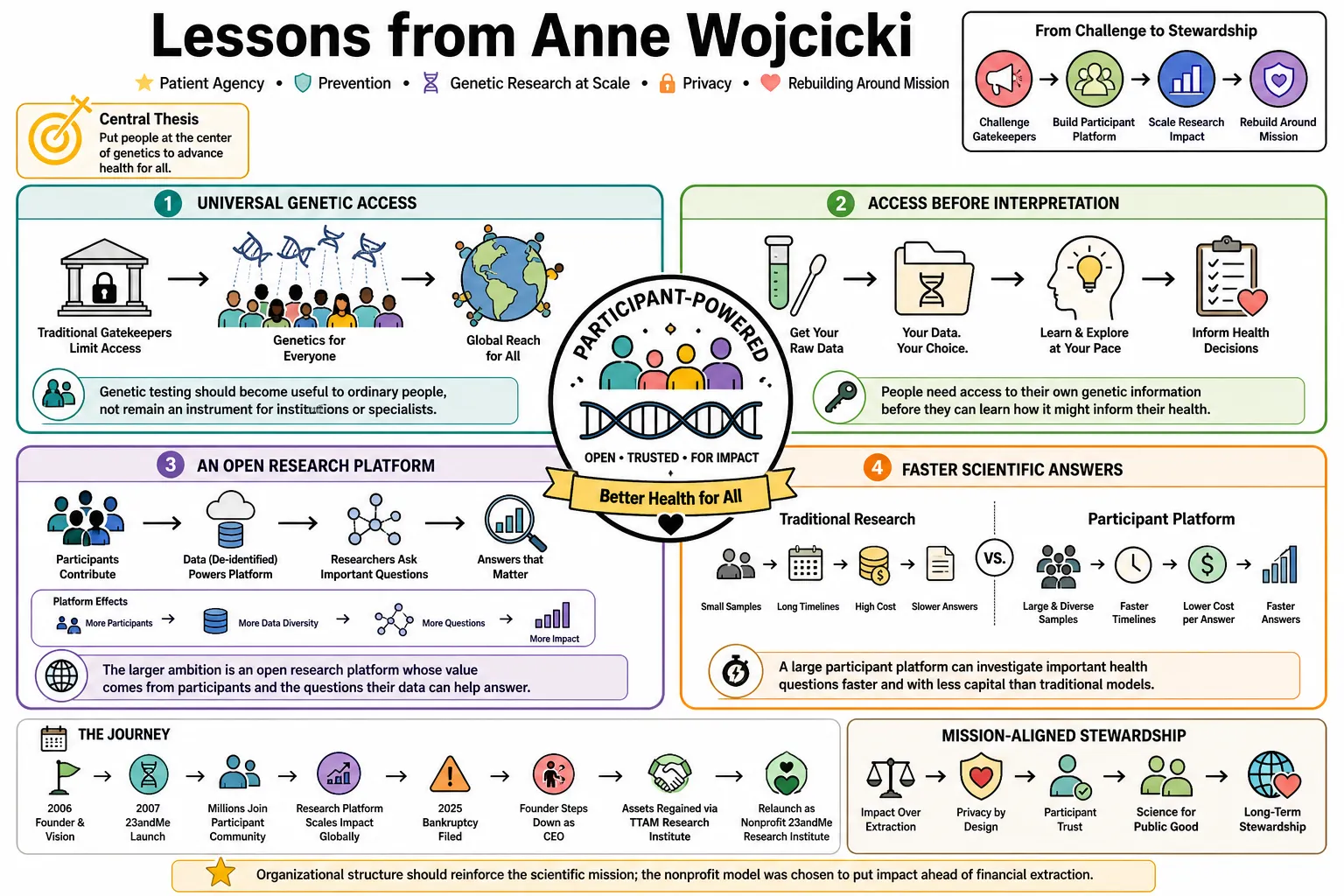
- On Universal Genetic Access: Genetic testing should become useful to ordinary people, not remain an instrument available only through institutions or specialists. — Reference: Observer — Anne Wojcicki on 23andMe's nonprofit mission
- On Access Before Interpretation: People need access to their own genetic information before they can learn how it might inform their health decisions. — Reference: Silicon Valley Girl — Anne Wojcicki interview transcript
- On An Open Research Platform: The larger ambition is an open research platform whose value comes from participants and the questions their data can help answer. — Reference: Observer — Anne Wojcicki on 23andMe's nonprofit mission
- On Faster Scientific Answers: A large participant platform can investigate important health questions faster and with less capital than traditional research structures. — Reference: Observer — Anne Wojcicki on 23andMe's nonprofit mission
- On Mission-Aligned Structure: Organizational structure should reinforce the scientific mission; the nonprofit model was chosen to put impact ahead of financial extraction. — Reference: Observer — Anne Wojcicki on 23andMe's nonprofit mission
- On Neutral Ownership: A steward of genetic information should remain neutral rather than becoming an asset controlled by one pharmaceutical company. — Reference: Silicon Valley Girl — Anne Wojcicki interview transcript
- On No Single-Company Control: The nonprofit restructuring was intended to prevent any single pharmaceutical company from owning the genetic database. — Reference: Silicon Valley Girl — Anne Wojcicki interview transcript
- On Customer Choice: Trust depends on preserving customer choice about whether and how personal genetic information participates in research. — Reference: Observer — Anne Wojcicki on 23andMe's nonprofit mission
- On Insights Rather Than Personal Data: Research partnerships should share scientific insights rather than sell identifiable customer data. — Reference: Observer — Anne Wojcicki on 23andMe's nonprofit mission
Rebuilding Through Crisis
- On Mission Through Bankruptcy: A bankruptcy can change ownership and structure without erasing the underlying mission that brought customers and employees together. — Reference: Silicon Valley Girl — Anne Wojcicki interview transcript
- On Responsibility to Participants: When millions of people have entrusted a company with sensitive data, leaders carry a responsibility that extends beyond ordinary shareholders. — Reference: Silicon Valley Girl — Anne Wojcicki interview transcript
- On Responsibility to Employees: A founder's crisis decisions must account for promises made to employees as well as obligations to customers. — Reference: Silicon Valley Girl — Anne Wojcicki interview transcript
- On Persevering Through Hardship: Persistence is not the absence of doubt; Wojcicki considered giving up repeatedly during bankruptcy and kept working through it. — Reference: Silicon Valley Girl — Anne Wojcicki interview transcript
- On Try Despite Long Odds: Some missions are worth pursuing even when failure appears to be the most likely outcome. — Reference: Silicon Valley Girl — Anne Wojcicki interview transcript
- On Trust Is Fragile: The deletion of roughly two million customer records during bankruptcy shows how quickly uncertainty can damage participation and trust. — Reference: Los Angeles Times — 23andMe's nonprofit moonshot
- On Constraints Can Rebuild Confidence: New limits on the use of sensitive genetic data can be part of restoring confidence after an ownership crisis. — Reference: Los Angeles Times — 23andMe's nonprofit moonshot
- On Structure Can Change While Purpose Endures: The company emerged from bankruptcy as a nonprofit while retaining its aim of using genetic research to improve health. — Reference: Los Angeles Times — 23andMe's nonprofit moonshot
Research Scale and AI
- On Scale for the AI Era: Health research built for AI needs data from hundreds of millions of people rather than a merely large conventional cohort. — Reference: Los Angeles Times — 23andMe's nonprofit moonshot
- On A Hundred-Million-Person Goal: The target of one hundred million participants is meant to create enough breadth for more useful health discovery and personalization. — Reference: Los Angeles Times — 23andMe's nonprofit moonshot
- On Know the Starting Scale: A base of about thirteen million genetic profiles is substantial, but it remains far below the scale Wojcicki believes AI-enabled health research requires. — Reference: Los Angeles Times — 23andMe's nonprofit moonshot
- On Data Created the AI Advantage: The largest technology companies gained an AI advantage partly because they had accumulated data at enormous scale. — Reference: Silicon Valley Girl — Anne Wojcicki interview transcript
- On Combine Multiple Health Signals: Personalized prevention becomes more useful when genetics is combined with medical records, blood values, and continuous sensor data. — Reference: Silicon Valley Girl — Anne Wojcicki interview transcript
- On Wearables at Research Scale: Hundreds of thousands of consenting participants can turn wearable streams into a meaningful longitudinal research resource. — Reference: Silicon Valley Girl — Anne Wojcicki interview transcript
- On Medical Records Add Context: Consented medical records add clinical context that self-reported surveys and genetic results cannot provide alone. — Reference: Silicon Valley Girl — Anne Wojcicki interview transcript
- On Self-Reported Data Still Matters: Participant-reported information remains a valuable layer when it is combined with genetics, records, and sensor measurements. — Reference: Silicon Valley Girl — Anne Wojcicki interview transcript
- On Longitudinal Trends: Health data becomes more informative when researchers can see trends over time instead of isolated snapshots. — Reference: Silicon Valley Girl — Anne Wojcicki interview transcript
Prevention and Personal Agency
- On Prevention Versus Treatment: Healthcare incentives often reward treating disease after it appears rather than helping people prevent it. — Reference: Silicon Valley Girl — Anne Wojcicki interview transcript
- On Genetics Powers Customization: Genetic information can help customize health guidance by identifying where an individual may benefit most from intervention. — Reference: Silicon Valley Girl — Anne Wojcicki interview transcript
- On Individual Risk Can Defy Averages: Population averages may obscure a powerful single-gene risk that changes what one person should do. — Reference: Silicon Valley Girl — Anne Wojcicki interview transcript
- On Polygenic Risk: Many common risks emerge from the combined effect of hundreds or thousands of genetic variants rather than one decisive mutation. — Reference: Silicon Valley Girl — Anne Wojcicki interview transcript
- On Intervene Before Symptoms: The practical value of genetics is identifying where someone can intervene today, before a predicted risk becomes disease. — Reference: Silicon Valley Girl — Anne Wojcicki interview transcript
- On Manage the Environment: Genetic risk is not always destiny; people can sometimes reduce it by changing environmental exposure and daily behavior. — Reference: Silicon Valley Girl — Anne Wojcicki interview transcript
- On Exercise as Prevention: Regular activity has an outsized effect on long-term health and should be treated as a core preventive habit. — Reference: Silicon Valley Girl — Anne Wojcicki interview transcript
- On Small Habits Accumulate: Short bouts of movement, including burpees and squats, make prevention easier to integrate into a normal day. — Reference: Silicon Valley Girl — Anne Wojcicki interview transcript
- On Design Movement Into the Day: Taking stairs, walking, and using a standing desk turn ordinary routines into repeated opportunities for activity. — Reference: Silicon Valley Girl — Anne Wojcicki interview transcript
- On Reduce Avoidable Sugar: Simple dietary guardrails, such as avoiding excess sugar, can be easier to sustain than elaborate health regimes. — Reference: Silicon Valley Girl — Anne Wojcicki interview transcript