Annie Jacobsen is an investigative journalist and author who reports on classified U.S. military and intelligence programs, nuclear command, covert operations, surveillance, and defense technology. Her 2026 book Biological War: A Scenario extends that work to engineered pathogens and catastrophic biological threats. Drawing on declassified records and interviews with senior officials, scientists, intelligence officers, and veterans, she examines how secret systems operate and what happens when deterrence, institutional judgment, or public trust fails.
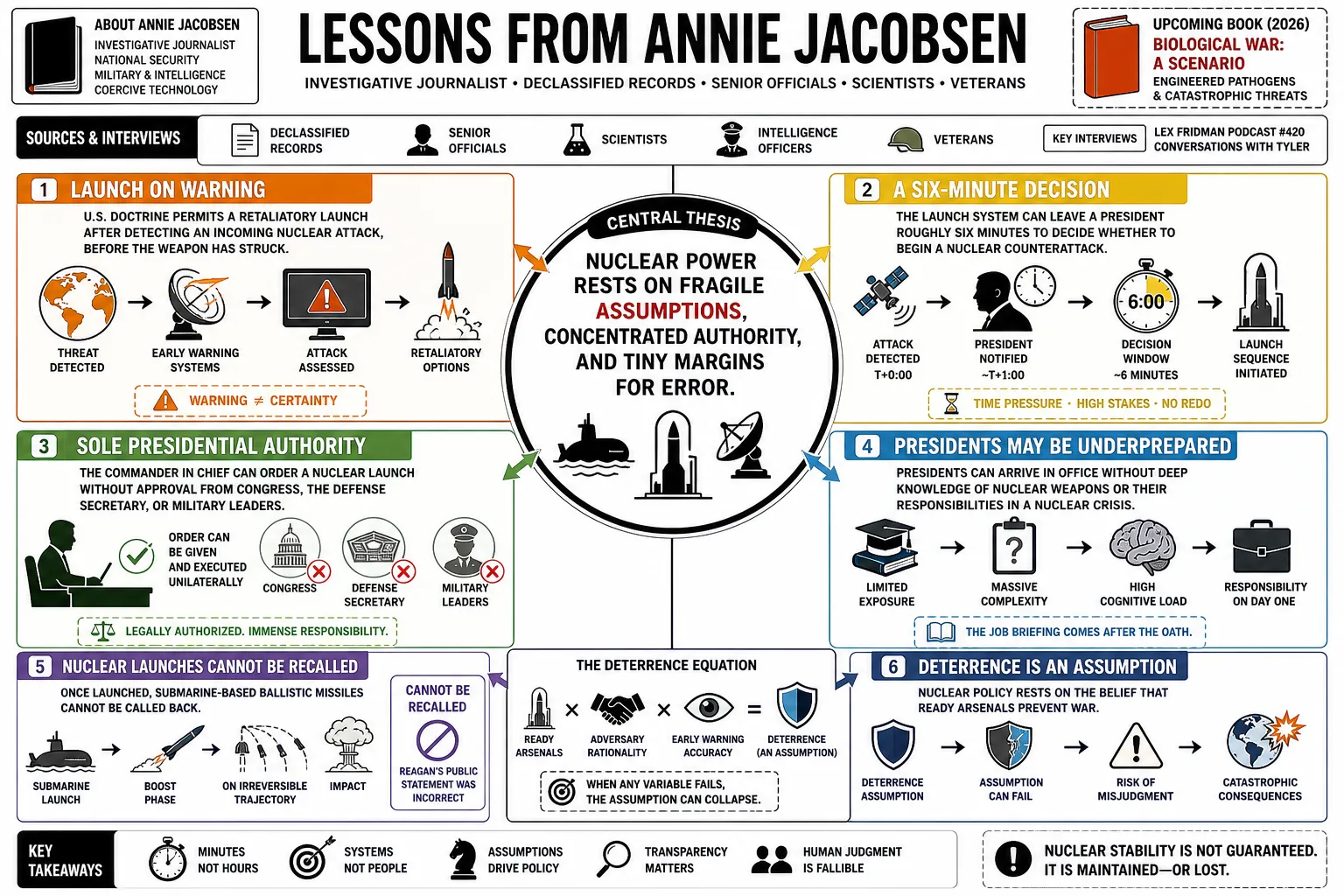
Nuclear Command and Deterrence
- On Launch on Warning: U.S. doctrine permits a retaliatory launch after detecting an incoming nuclear attack, before the weapon has struck. — Reference: Lex Fridman Podcast 420 — Annie Jacobsen transcript
- On A Six-Minute Decision: The launch system can leave a president roughly six minutes to decide whether to begin a nuclear counterattack. — Reference: Lex Fridman Podcast 420 — Annie Jacobsen transcript
- On Sole Presidential Authority: The commander in chief can order a nuclear launch without approval from Congress, the defense secretary, or military leaders. — Reference: Lex Fridman Podcast 420 — Annie Jacobsen transcript
- On Presidents May Be Underprepared: Jacobsen found that presidents can arrive in office without deep knowledge of nuclear weapons or their responsibilities in a nuclear crisis. — Reference: Conversations with Tyler — Annie Jacobsen interview
- On Nuclear Launches Cannot Be Recalled: Once launched, submarine-based ballistic missiles cannot be called back, despite President Reagan once publicly suggesting otherwise. — Reference: Lex Fridman Podcast 420 — Annie Jacobsen transcript
- On Deterrence Is an Assumption: Nuclear policy rests on the belief that ready arsenals prevent war, but the system offers no safe fallback if deterrence fails. — Reference: Lex Fridman Podcast 420 — Annie Jacobsen transcript
- On Failure Unravels the System: Officials repeatedly insist that deterrence will hold, while senior strategic-command leaders acknowledge that its failure causes the entire logic to unravel. — Reference: Conversations with Tyler — Annie Jacobsen interview
- On Missile Defense Has Hard Limits: Current interceptor systems cannot reliably destroy an incoming intercontinental warhead merely because enormous sums have been invested in them. — Reference: Conversations with Tyler — Annie Jacobsen interview
- On Nuclear War Moves Faster Than Politics: Jacobsen's scenario moves from launch to nuclear winter in 72 minutes, compressing civilization-scale consequences into less time than an ordinary meeting. — Reference: Conversations with Tyler — Annie Jacobsen interview
- On The Largest Death Toll Comes Later: The initial blasts kill millions, but nuclear winter and starvation could account for deaths in the billions. — Reference: Lex Fridman Podcast 420 — Annie Jacobsen transcript
- On Continuity Competes with Response: During a warning, senior advisers must consider not only retaliation but also the separate machinery for continuity of government. — Reference: Lex Fridman Podcast 420 — Annie Jacobsen transcript
- On Turn Enemies into Adversaries: Risk reduction requires treating another nuclear power as an adversary with whom communication remains possible, not only as an enemy to destroy. — Reference: Conversations with Tyler — Annie Jacobsen interview
Biological Warfare and Societal Risk
- On A Living Munition: A pathogen differs from a conventional weapon because it is alive, replicates, and can continue spreading after release. — Reference: Modern Wisdom 1127 — Annie Jacobsen transcript
- On Biological Weapons Are a Near-Term Threat: Jacobsen places biological weapons just behind nuclear arms in destructive potential and argues that their likelihood makes them especially dangerous. — Reference: Modern Wisdom 1127 — Annie Jacobsen transcript
- On No Missile Is Required: A biological weapon does not require a state arsenal, missile, or submarine; a human carrier can become the delivery system. — Reference: No Small Endeavor — Annie Jacobsen interview
- On The Delivery System Can Be Human: The low barrier to delivery changes who can create a catastrophic threat and makes containment much harder. — Reference: No Small Endeavor — Annie Jacobsen interview
- On Illegal Weapons Still Exist: International prohibition has not eliminated biological weapons, including engineered pathogens designed for transmission, virulence, and resistance to countermeasures. — Reference: Modern Wisdom 1127 — Annie Jacobsen transcript
- On Synthetic Biology Creates Novel Threats: Modern gene-editing methods can create biological agents that do not exist in nature. — Reference: Modern Wisdom 1127 — Annie Jacobsen transcript
- On Gain of Function Contains a Paradox: Defensive research may modify pathogens to anticipate future threats, creating the very enhanced capabilities it is meant to counter. — Reference: Modern Wisdom 1127 — Annie Jacobsen transcript
- On Bioweapons Can Defeat Defenses: Contemporary biological weapons can be designed for extreme transmission, high virulence, and resistance to existing vaccines or countermeasures. — Reference: Modern Wisdom 1127 — Annie Jacobsen transcript
- On Engineered Behavior Can Accelerate Spread: Jacobsen reports that Soviet researchers explored adding euphoria to plague bacteria so infected people would seek crowds and spread disease. — Reference: Modern Wisdom 1127 — Annie Jacobsen transcript
- On Continuity Plans Protect Government: Biological-war continuity plans prioritize a small group of officials rather than protection for the general population. — Reference: Modern Wisdom 1127 — Annie Jacobsen transcript
- On Accidents Matter Too: Continuity planning must account for laboratory accidents as well as deliberate attacks. — Reference: Modern Wisdom 1127 — Annie Jacobsen transcript
- On Public Trust Is Critical Infrastructure: The pandemic showed that fractured trust in science, public health, and political leadership can become a lasting societal injury. — Reference: Modern Wisdom 1127 — Annie Jacobsen transcript
Secrecy, Surveillance, and Military Systems
- On Commercial Data Enables State Surveillance: Publicly shared facial images have helped private companies build capabilities that can serve government biometric surveillance. — Reference: Lex Fridman Podcast 420 — Annie Jacobsen transcript
- On Biometrics Can Expand Quietly: Soldiers sent to Afghanistan became part of an effort to capture biometric data on most of the country's population without initially understanding the program's scale. — Reference: Lex Fridman Podcast 420 — Annie Jacobsen transcript
- On Surveillance Models Travel: A biometric-surveillance program developed in one conflict can become a model for other states. — Reference: Lex Fridman Podcast 420 — Annie Jacobsen transcript
- On Targeting Becomes a Pipeline: Biometric identification can feed a find-fix-finish process that links identity, location, movement, and remote lethal force. — Reference: Lex Fridman Podcast 420 — Annie Jacobsen transcript
- On Secrecy Can Be Partially Opened: Persistent reporting can cause institutions to declassify origin stories and documents specifically so the public record becomes more complete. — Reference: Lex Fridman Podcast 420 — Annie Jacobsen transcript
- On Command Systems Stay Continuously Ready: Although most citizens rarely think about nuclear war, large command-and-control organizations remain constantly prepared to execute it. — Reference: Lex Fridman Podcast 420 — Annie Jacobsen transcript
- On Catastrophic Systems Can Be Accidental: A system designed for rapid response must also guard against beginning a nuclear war through error or misinterpretation. — Reference: Lex Fridman Podcast 420 — Annie Jacobsen transcript
- On Conspiracy Claims Need Source Discipline: A dramatic claim becomes usable only when it can be traced to a legitimate source rather than repeated because it is intriguing. — Reference: Conversations with Tyler — Annie Jacobsen interview
Investigative Reporting and Human Judgment
- On Experts Do Not Own Wisdom: Technical expertise matters, but accumulated wisdom can outperform narrow expertise when consequences are moral and human as well as technical. — Reference: Conversations with Tyler — Annie Jacobsen interview
- On Older Sources May Speak More Freely: People approaching the end of their lives may finally put classified or painful experiences on the record. — Reference: Lex Fridman Podcast 420 — Annie Jacobsen transcript
- On Age Changes the Meaning of Service: Sources in their 80s or 90s, still thinking about friends who died at 19, bring "a wisdom, a compassion, an empathy, and an ability to communicate that comes with that." — Reference: No Small Endeavor, "Annie Jacobsen: Why Biological War Scares Her More Than Nuclear".
- On Face the Problem Before Solving It: Public problems cannot be repaired until their mechanisms and consequences are described clearly enough to confront. — Reference: No Small Endeavor — Annie Jacobsen interview
- On Human Problems Permit Human Solutions: A catastrophe created through human decisions remains open, at least in principle, to solutions created through better human decisions. — Reference: No Small Endeavor — Annie Jacobsen interview
- On Report Scenarios as War Games: Scenario reporting can present expert facts in the structured way institutions use war games, letting readers follow consequences step by step. — Reference: No Small Endeavor — Annie Jacobsen interview