Anthony Tan co-founded Grab with Tan Hooi Ling. It began as MyTeksi, a Malaysian taxi-booking service, in 2012 and acquired Uber's Southeast Asia operations in 2018. This collection examines his approach to personal grounding, leadership, capital stewardship, and technology built around users' needs. — Grab — How We Started. — Grab — Uber Southeast Asia Acquisition.
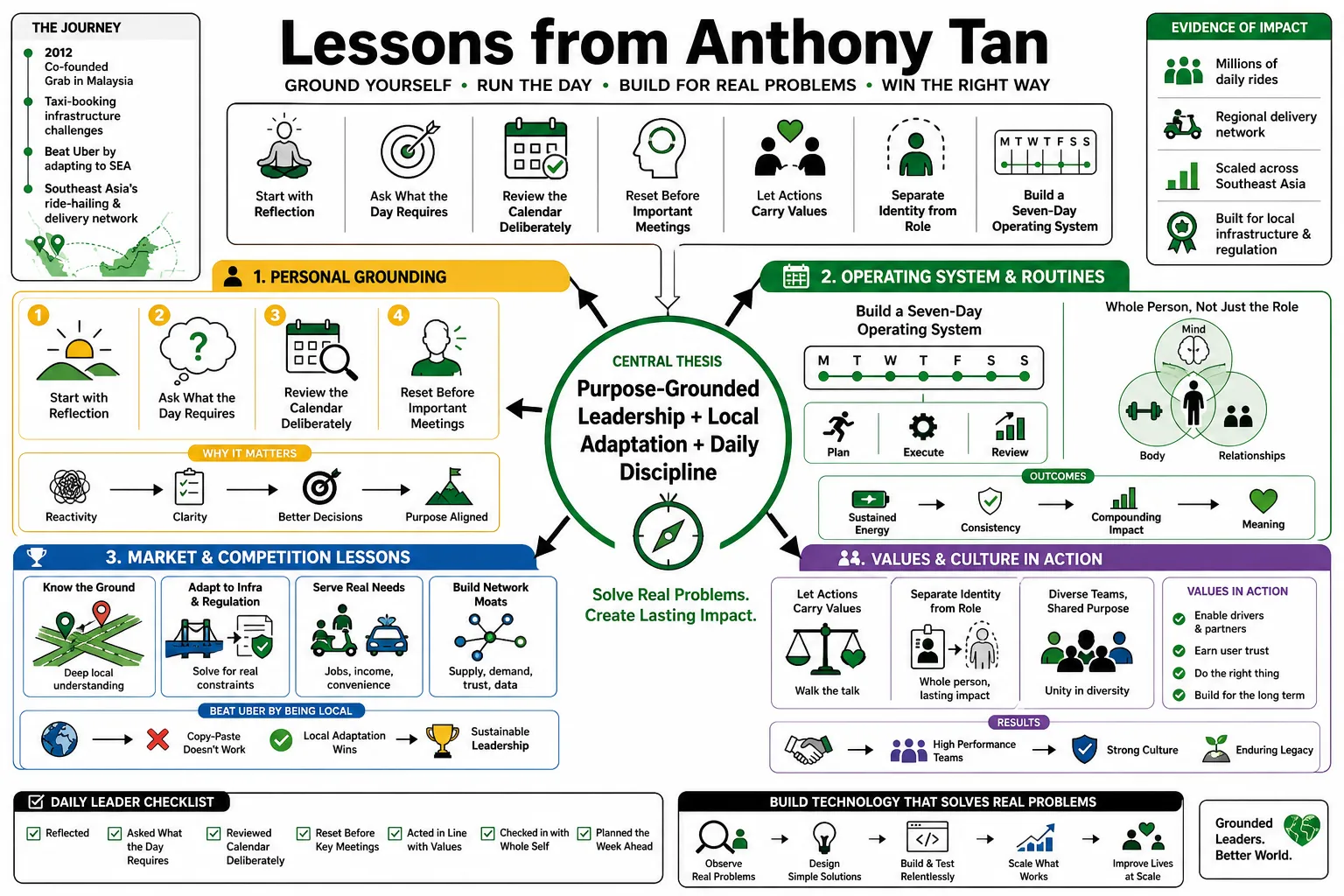
Personal Grounding and Purpose
- On Start with Reflection: Tan said he starts weekdays by opening his Bible before his laptop, making reflection and prayer part of his routine before work begins. — Salt&Light — Alpha Workplace Interview.
- On Ask What the Day Requires: In his morning prayer, Tan asks what God expects of him that day. He described this question as helping centre his day. — Salt&Light — Alpha Workplace Interview.
- On Review the Calendar Deliberately: Tan said he goes through his calendar item by item and surrenders each commitment to God, linking his schedule to his faith rather than treating it only as a list of tasks. — Salt&Light — Alpha Workplace Interview.
- On Reset Before Important Meetings: Tan described finding a quiet place to pray before large meetings, sometimes praying with his wife when they are together. — Salt&Light — Alpha Workplace Interview.
- On Let Actions Carry Values: Tan described Grab as a secular, diverse workplace. He said he tries to express his Christian values through his actions rather than preaching to employees. — Salt&Light — Alpha Workplace Interview.
- On Separate Identity from Role: Tan said his morning prayer is not only about his role as Grab CEO but about him as a person, keeping his identity broader than his executive position. — Salt&Light — Alpha Workplace Interview.
- On Build a Seven-Day Operating System: Tan used a seven-day operating-system metaphor to describe his effort to live out his faith in daily routines, rather than confining it to a separate part of the week. — Salt&Light — Alpha Workplace Interview.
Servant Leadership and Feedback
- On Make Humility Operational: Tan explained Grab's humility principle as being willing to receive feedback, connecting a stated company value to how leaders listen. — Salt&Light — Alpha Workplace Interview.
- On Compensate with Hunger: Tan described hunger as a commitment to work hard and pursue excellent work, rather than assuming the team will always be the smartest in the room. — Salt&Light — Alpha Workplace Interview.
- On Make Commitments Credible: Tan defined honour as doing what the team says it will do, making follow-through part of Grab's stated operating values. — Salt&Light — Alpha Workplace Interview.
- On Keep Service at the Center: Tan described heart as serving others and linked Grab's guiding philosophy to servant leadership. — Salt&Light — Alpha Workplace Interview.
- On Institutionalize Feedback: Tan said Grab runs company-wide 360-degree feedback sessions that include him, placing the chief executive within the same feedback process as other employees. — Salt&Light — Alpha Workplace Interview.
- On Use the Product as a Customer: Tan said he uses Grab as a passenger and also spends time as a driver and delivery partner, gathering feedback from different sides of the service. — Salt&Light — Alpha Workplace Interview.
- On Invite Unfiltered Feedback: Tan recalled asking a driver who did not recognize him about his experience. The driver openly explained why he preferred another navigation app. — Salt&Light — Alpha Workplace Interview.
- On Turn Complaints into Features: After a driver said Grab Maps lacked camera-location information, Tan said the company was developing that feature. The anecdote connects a specific field complaint with a planned improvement. — Salt&Light — Alpha Workplace Interview.
Resilience, Stewardship, and Long-Term Execution
- On Expect to Eat Bitter: Tan described the Hokkien idea of eating bitter as being able to endure pain and keep working through a startup's difficult years. — Inside Grab — Capital and Growth Podcast.
- On Back Teams That Can Endure: Tan said early investors looked for a founder they could trust to adapt and persist, while later diligence also examined whether the surrounding team could execute. — Inside Grab — Capital and Growth Podcast.
- On Ideas Need Execution: Tan argued that a business idea and a forecast are not enough: investors also need confidence that the founder and team can adapt the plan and carry it out. — Inside Grab — Capital and Growth Podcast.
- On Treat Investor Capital as Public Money: Tan emphasized that investor capital belongs to other people, including those whose pensions and endowments fund investment firms, and should be treated with that responsibility. — Inside Grab — Capital and Growth Podcast.
- On Let Principles Clarify Spending: Tan connected stewardship to explaining how investor money is spent, including sharing the reasoning behind decisions after Grab became publicly listed. — Inside Grab — Capital and Growth Podcast.
- On Governance Can Decide Survival: Tan recalled a narrowly won board vote during a driver-supply shortage and believed a different decision could have jeopardized Grab's future. The episode shows how operating needs and investor priorities can collide. — Inside Grab — Capital and Growth Podcast.
- On Stay Steady in Extremes: Tan attributed his steadiness during both successes and cash shortages to his faith and to support from his wife, rather than treating confidence as something he maintained alone. — Salt&Light — Alpha Workplace Interview.
AI-First Product Building
- On Choose Self-Disruption: Tan said Grab chose to disrupt itself through a company-wide generative-AI initiative, rather than wait for external competition to force the change. — GrabX — AI-First with Heart.
- On Create Protected Learning Time: Tan said Grab paused business as usual for nine weeks during its G/AI Sprint, creating dedicated time for employees to learn and build with generative AI. — GrabX — AI-First with Heart.
- On Train the Whole Company: Tan described training every Grab employee during the AI sprint and clearing space for experimentation across the organization, not just specialist teams. — GrabX — AI-First with Heart.
- On Build Alongside the Team: Tan said he helped build the AI Merchant Assistant with the team during the sprint, participating directly in the product work behind Grab's AI initiative. — GrabX — AI-First with Heart.
- On Lead with the User Problem: Tan framed Grab's AI strategy around problems its communities face and how AI might solve them better, rather than beginning only with a resource-efficiency target. — GrabX — AI-First with Heart.
- On Pair AI with Heart: Tan said putting AI at the core of work and products should not mean losing sight of the people those products serve. — GrabX — AI-First with Heart.
- On Move Beyond Backend Metrics: Tan described an ambition to use real-time audio and sentiment signals to help respond to an individual in distress, extending safety work beyond aggregate backend metrics. — GrabX — AI-First with Heart.
- On Study Rare Failures: Tan said Grab examines incidents for warning signs and uses those insights to train AI models to recognize potential trouble in a ride. — GrabX — AI-First with Heart.
- On Know What Not to Build: Tan said Grab was not building foundational AI models, choosing instead to apply its regional expertise and data to models developed by external partners. — GrabX — AI-First with Heart.
Regional Advantage and Ground Truth
- On Bring Regional Context to Models: Tan argued that AI models need knowledge of Southeast Asia and described using Grab's regional expertise and data to make applications relevant to its users and partners. — GrabX — AI-First with Heart.
- On Partner for Frontier Capability: Tan announced deeper collaboration with OpenAI and a new partnership with Anthropic, combining external AI research with Grab's knowledge of Southeast Asian users. — GrabX — AI-First with Heart.
- On Give Small Merchants Executive Leverage: Tan presented the AI Merchant Assistant as a way to give small merchants on-demand help resembling executive functions such as operations, finance, and marketing. — GrabX — AI-First with Heart.
- On Immerse in Ground Truth: Tan described looking for user problems in wet markets, on local motorbike transport, and in smaller cities that require difficult journeys to reach. — GrabX — AI-First with Heart.
- On Build Close to the People Served: Tan emphasized listening to users and getting close to the people Grab serves, rather than treating product building as work done entirely behind a screen. — GrabX — AI-First with Heart.