Historian Anton Howes researches the causes of the British Industrial Revolution. He argues that invention is not an innate human trait, but a transmitted cultural practice rooted in an "improving mentality." This collection outlines his work on historical transparency and early machinery, ultimately asking why progress accelerated when it did.
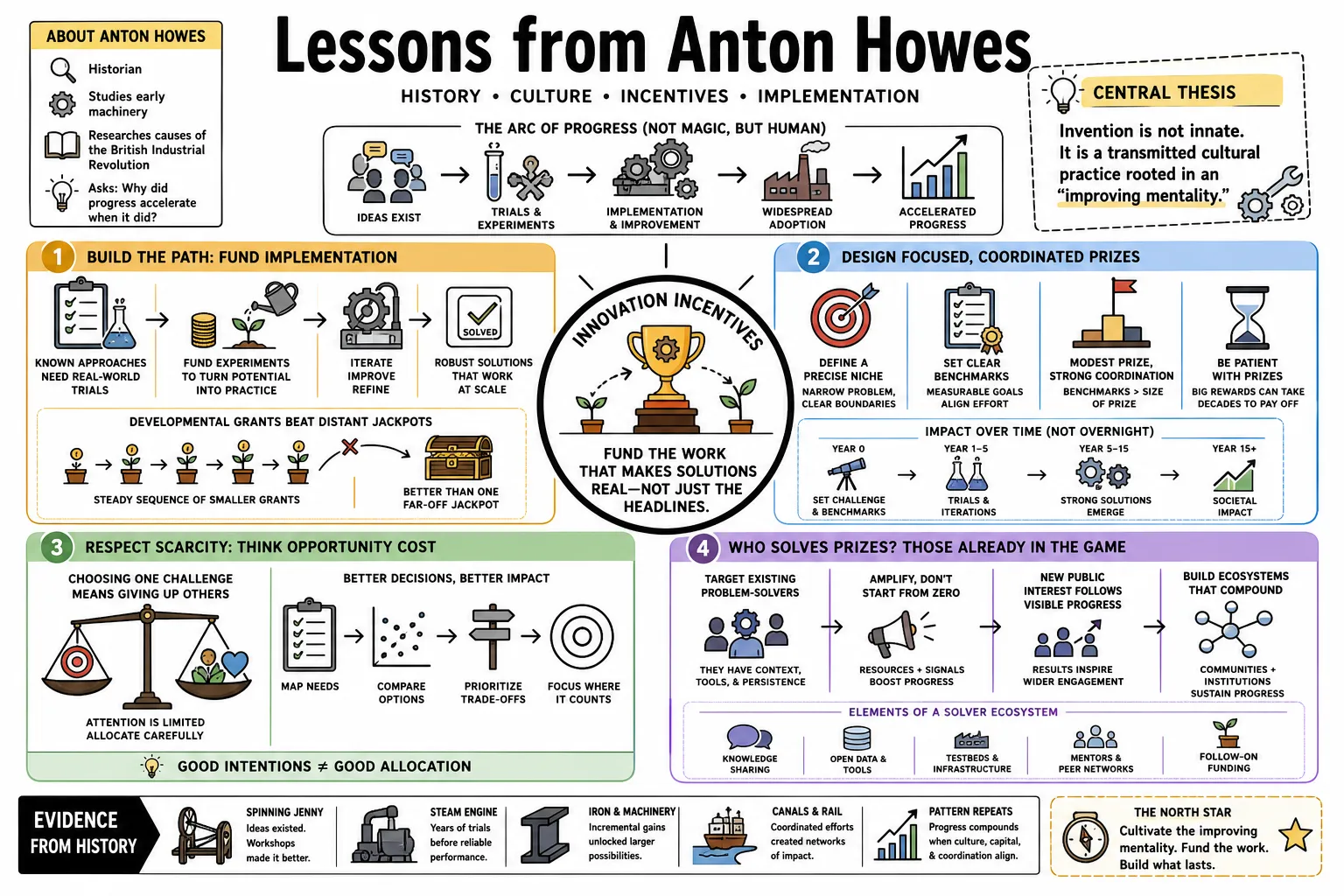
Designing Innovation Incentives
- On Implementation Before Headlines: Innovation rewards work best when they fund the trials and experiments needed to turn known approaches into practical solutions. — Reference: Works in Progress — Why Innovation Prizes Fail
- On Developmental Grants: A steady sequence of smaller development grants can matter more than a distant promise of a spectacular jackpot. — Reference: Works in Progress — Why Innovation Prizes Fail
- On Define a Precise Niche: Competitions are more effective when they target a narrow implementation problem rather than asking vaguely for radical ideas. — Reference: Works in Progress — Why Innovation Prizes Fail
- On Set Clear Benchmarks: A well-defined benchmark can coordinate progress even when the monetary prize is modest. — Reference: Works in Progress — Why Innovation Prizes Fail
- On Be Patient with Prizes: Large headline rewards may take decades to attract a worthy solution, so sponsors should not confuse publicity with impact. — Reference: Works in Progress — Why Innovation Prizes Fail
- On Account for Opportunity Cost: Directing innovators toward one challenge necessarily pulls scarce attention away from other problems. — Reference: Works in Progress — Why Innovation Prizes Fail
- On Target Existing Problem-Solvers: Prize winners usually emerge from people already working on related technical problems, not from a newly inspired general public. — Reference: Works in Progress — Why Innovation Prizes Fail
- On Complement Patents: Prizes should fill incentive gaps left by patents instead of paying again for inventions the patent system already rewards. — Reference: Works in Progress — Why Innovation Prizes Fail
- On Reward Neglected Value: Useful prizes can support advances that are not patentable or profitable enough to attract private investment. — Reference: Works in Progress — Why Innovation Prizes Fail
- On Optimize for Social Benefit: Innovation support is especially valuable for life-saving or socially useful inventions whose financial returns are weak. — Reference: Works in Progress — Why Innovation Prizes Fail
Building State Capacity
- On See Bureaucracy as an Invention: The administrative state is historically recent; earlier rulers lacked the personnel and machinery needed to execute even benevolent policies. — Reference: Works in Progress — How to Build a State
- On Recognize the Cost of Collection: Raising revenue requires manpower, while collection agents create leakage and incentives to divert public funds. — Reference: Works in Progress — How to Build a State
- On Delegate When Capacity Is Thin: Without a professional bureaucracy, rulers had to delegate taxation and administration to local agents. — Reference: Works in Progress — How to Build a State
- On Use Local Knowledge Carefully: Local tax farmers knew the land and its output, but their informational advantage came with corruption and control risks. — Reference: Works in Progress — How to Build a State
- On Keep Essential Agents Aligned: Authority depends on enforcers and legitimizers, so rulers historically traded exemptions and privileges for continued cooperation. — Reference: Works in Progress — How to Build a State
- On Break the Capacity Catch-22: Policy requires money and revenue collection requires policy capacity, making institutional development a long compounding process. — Reference: Works in Progress — How to Build a State
- On Fund the State Through Bargains: Before reliable taxation, monarchs raised cash through monopolies, titles, and other bargains that look corrupt by modern standards. — Reference: Works in Progress — How to Build a State
Capital, Institutions, and Scottish Growth
- On Test the Education Story: A national school system did not immediately produce a large literacy advantage, so education alone cannot explain Scotland's exceptional output. — Reference: Age of Invention — Why Scotland Succeeded
- On Follow Structural Transformation: Scotland's rise appeared in rapid urbanization, industrial employment, and a growing share of British output. — Reference: Age of Invention — Why Scotland Succeeded
- On Encourage Banking Competition: Multiple chartered banks and large regional partnerships created a more competitive financial system than England had at the time. — Reference: Age of Invention — Why Scotland Succeeded
- On Let Firms Outlast Founders: Legal entities that survive partner death or bankruptcy can accumulate capabilities and capital across generations. — Reference: Age of Invention — Why Scotland Succeeded
- On Lend Against Reputation and Skill: Short-term credit based on personal security can finance capable people who do not yet own substantial land. — Reference: Age of Invention — Why Scotland Succeeded
- On Open Saving to Workers: Paying interest on tiny deposits allowed artisans and labourers to participate in and strengthen the financial system. — Reference: Age of Invention — Why Scotland Succeeded
- On Provide Usable Currency: Small-denomination banknotes can relieve coin shortages and make capital circulate through everyday commerce. — Reference: Age of Invention — Why Scotland Succeeded
- On Make Credit Enforcement Credible: Faster debt enforcement increases lender confidence and expands the pool of capital available for commerce and invention. — Reference: Age of Invention — Why Scotland Succeeded
- On Back the Ambitious Artisan: A financial system becomes innovation infrastructure when reputation, skill, and acumen are enough to raise capital for a new idea. — Reference: Age of Invention — Why Scotland Succeeded
Energy Transitions and Historical Explanation
- On Treat Managed Wood as Renewable: Fuel wood was typically coppiced and regrown, so it should not be modeled like an exhaustible mineral deposit. — Reference: Age of Invention — The Coal Conquest
- On Expect Supply to Respond to Price: When a renewable product becomes more valuable, producers tend to expand its supply rather than destroy the productive base. — Reference: Age of Invention — The Coal Conquest
- On Look Beyond Shortage Narratives: Rising wood prices and complaints about disappearing woods do not by themselves prove that fuel demand caused deforestation. — Reference: Age of Invention — The Coal Conquest
- On Test the Resource Base: Evidence that woodlands near London remained intact challenges simple stories of fuel exhaustion before coal's rise. — Reference: Age of Invention — The Coal Conquest
- On Measure Competing Demands: English woodland sustained growing exports and an expanding iron industry at the same time. — Reference: Age of Invention — The Coal Conquest
- On Follow Industry to Cheap Inputs: Ironmaking moved inland when necessary because valuable iron could bear transport costs that bulky wood could not. — Reference: Age of Invention — The Coal Conquest
- On Distinguish Timber Policy from Fuel Scarcity: Strategic rules preserving mature timber for ships are not evidence that renewable fuel wood had run out. — Reference: Age of Invention — The Coal Conquest
- On Separate Deforestation from Fuel Demand: Landowners often cleared woods for more profitable agriculture, making food and land values a different causal story from fuel shortage. — Reference: Age of Invention — The Coal Conquest
- On Find the Price Break: Coal spread rapidly after it became much cheaper in the 1570s, making it attractive even far from the mines. — Reference: Age of Invention — The Coal Conquest