Ariel Cohen co-founded Navan to improve corporate travel and expense management and led it through its October 2025 IPO. His founders' letter emphasizes the traveler's experience and describes AI-enabled support for trip changes and administrative tasks. These lessons draw on his interviews, keynote, and writing with co-founder Ilan Twig. — Navan — Founders' Letter. — Navan — Closing of the Initial Public Offering.
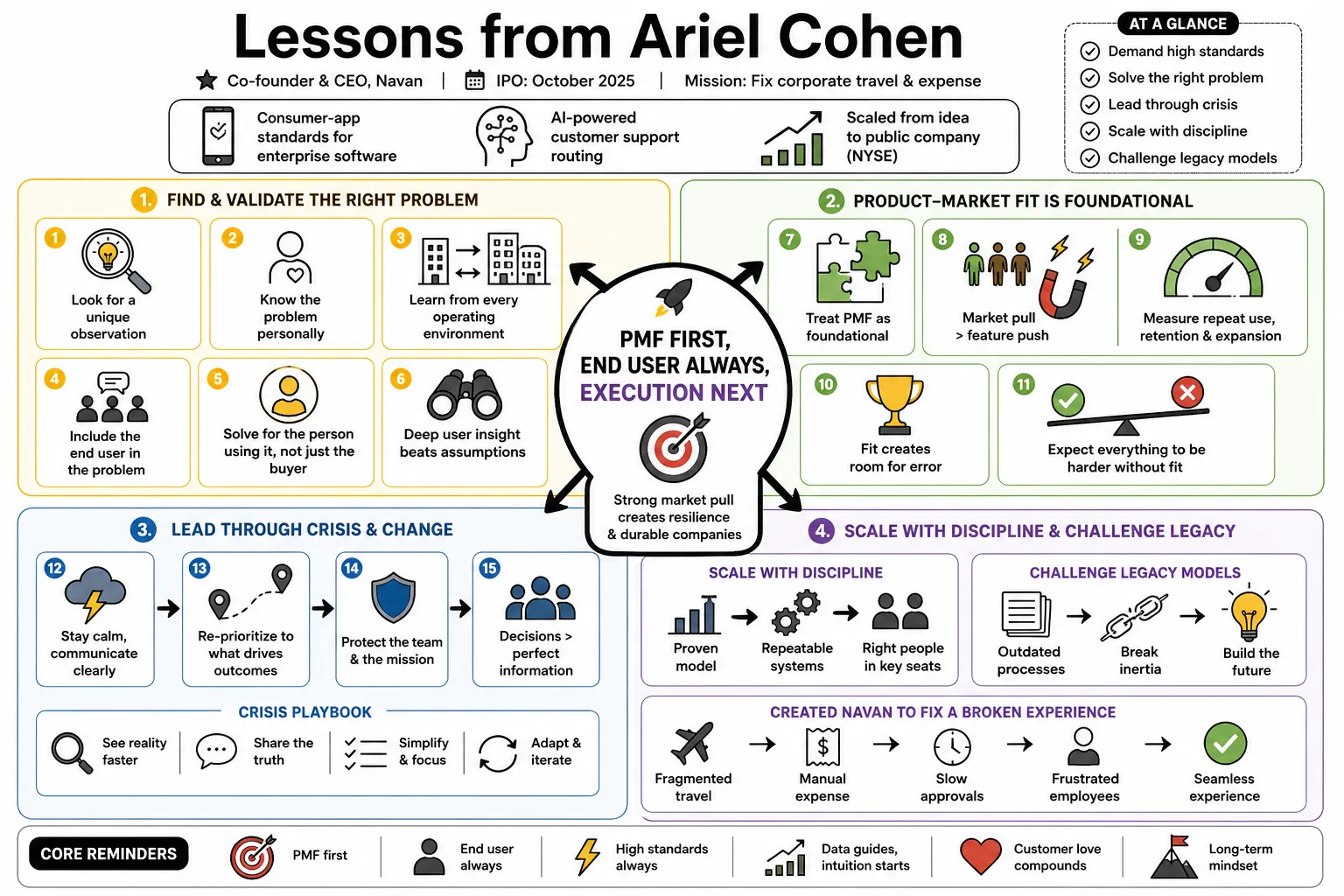
Product-Market Fit and Choosing the Problem
- On Learn from Every Operating Environment: Even a company unlike the one you want to build can teach you how enterprise customers buy, how channels work, and how products reach the market. — DealMakers — Ariel Cohen Founder Interview
- On Include the End User in the Problem: Enterprise software must solve for the person using it, not only for the executive or department buying it. — DealMakers — Ariel Cohen Founder Interview
- On Treat Product-Market Fit as Foundational: Cohen treats product-market fit as a founder's central priority when trying to build a lasting company, not as something a good idea alone establishes. — DealMakers — Ariel Cohen Founder Interview.
- On Expect Everything to Be Harder Without Fit: A good observation is not enough when the company cannot consistently find customers who need the product. — DealMakers — Ariel Cohen Founder Interview
- On Fit Creates Room for Error: In Cohen's experience, product-market fit gives a startup room to make execution mistakes; without it, even finding the right customers becomes difficult. — DealMakers — Ariel Cohen Founder Interview.
- On Look for a Unique Observation: A promising startup begins with an insight about the market that is both differentiated and useful. — DealMakers — Ariel Cohen Founder Interview
- On Know the Problem Personally: Founder conviction is stronger when it comes from direct experience of the problem rather than detached market analysis. — DealMakers — Ariel Cohen Founder Interview
- On Check Whether the Market Is Ready: Timing and market size matter alongside the quality of the idea; a product can arrive before buyers are ready to adopt it. — DealMakers — Ariel Cohen Founder Interview
- On Begin with Why the Company Should Exist: Before choosing a product, decide why the company is worth building and what meaningful change it should create. — DealMakers — Ariel Cohen Founder Interview
- On Define the Criteria Before the Product: Set the conditions a company and market must satisfy before falling in love with a particular solution. — DealMakers — Ariel Cohen Founder Interview
Product Design and Customer Value
- On Let Travelers Focus on the Purpose of the Trip: Travel technology should minimize logistics so people can concentrate on the work and relationships that required the trip. — Navan — Founders' Letter
- On Value Users' Time Explicitly: A product earns its place when it gives meaningful time back to the people who use it. — Navan — Founders' Letter
- On Reimagine Instead of Digitizing Old Workflows: A modern product should rethink the experience around new capabilities rather than put a digital skin on a broken process. — Navan — Founders' Letter
- On Design for the Whole Network: A durable travel platform has to create value for travelers, company stakeholders, and suppliers at the same time. — Navan — Founders' Letter
- On Make the Frequent User the Priority: When tradeoffs arise, optimize first for the person who repeatedly bears the friction of the workflow. — Navan — Founders' Letter
- On Use Real-Time Data Preventively: Operational data is most valuable when it identifies spending problems before they require cleanup. — Navan — Founders' Letter
- On Build AI into the Architecture: Cohen and Twig describe AI as part of Navan's platform architecture rather than an add-on, with the aim of making the travel experience more integrated and responsive. — Navan — Founders' Letter.
- On Anticipate Needs Rather Than Wait for Requests: Intelligent software should remove predictable friction before the user has to ask for help. — Navan — Founders' Letter
- On Create Freedom to Build from Scratch: Recruit strong people and give them enough autonomy to bypass legacy assumptions and redesign the experience. — Navan — Founders' Letter
- On Remove Guesswork with Personalization: Cohen uses his own hotel preferences to explain the purpose of Concierge: reduce the work of finding suitable options so travelers can focus on the trip itself. — Navan — Hotel Concierge by Ava.
Crisis Leadership and Resilience
- On Give People a Mission Worth Staying For: A clear mission helps employees and customers remain committed when the operating environment becomes frightening or uncertain. — SaaStr — Ariel Cohen on a Revenue-Zero Crisis
- On Define the Crisis Precisely: Before responding, determine how the crisis specifically affects your business rather than reacting to the broad label alone. — SaaStr — Ariel Cohen on a Revenue-Zero Crisis
- On Use Precedent to Bound the Problem: Historical data and comparable cases help estimate the likely scope of a shock before decisions are made. — SaaStr — Ariel Cohen on a Revenue-Zero Crisis
- On Act Swiftly Once the Situation Is Understood: Cohen recalls recognizing that pandemic travel restrictions made the existing growth plan irrelevant and acting quickly to change it, rather than waiting for revenue to disappear. — SaaStr — Ariel Cohen on a Revenue-Zero Crisis.
- On Build Flexibility into the Core Plan: Cohen favors a strong team and an organization able to respond quickly over trying to predict every crisis in a fixed backup plan. His keynote presents this as a preference, not a ban on contingency planning. — SaaStr — Ariel Cohen on a Revenue-Zero Crisis.
- On Invest in a Resilient Team: The organization needs people who can work through unexpected challenges without losing the mission. — SaaStr — Ariel Cohen on a Revenue-Zero Crisis
- On Put Employees and Customers First: Crisis decisions should protect the relationships on which the company will depend after the shock passes. — SaaStr — Ariel Cohen on a Revenue-Zero Crisis
- On Keep Innovating for Changed Needs: A crisis changes what customers need, so the product roadmap should respond to the new environment rather than freeze. — SaaStr — Ariel Cohen on a Revenue-Zero Crisis
- On Plan for Long-Term Stability: Cohen says TripActions mobilized its support team to work from home while helping stranded customers return home. Putting those needs first did not mean it could avoid layoffs. — SaaStr — Ariel Cohen on a Revenue-Zero Crisis.
- On Combine Customer Focus with Data: Customer-centered judgment and evidence-based decisions can reveal new products and revenue paths during a downturn. — SaaStr — Ariel Cohen on a Revenue-Zero Crisis
- On Give People Hope and Community: A resilient culture helps employees and customers see themselves as participants in a shared future, not isolated victims of the crisis. — SaaStr — Ariel Cohen on a Revenue-Zero Crisis
Scaling, Culture, and Business Models
- On Align Payment with Delivered Value: Cohen describes a platform fee plus per-trip booking fees, using the usage-linked component to keep TripActions focused on delivering value. He also acknowledges how sharply that model exposed revenue to the pandemic travel collapse. — DealMakers — Ariel Cohen Founder Interview.
- On Use Acquisitions When Distribution Is the Constraint: Joining a larger platform can be rational when it will bring the product to more customers than the startup can reach alone. — DealMakers — Ariel Cohen Founder Interview
- On Double Down on the Enduring Need: When demand temporarily vanished during the pandemic, Navan invested behind the belief that in-person connection and travel would return. — Navan — Founders' Letter
- On Expand the Product During the Downturn: A severe contraction can be used to enrich the offering and win customers dissatisfied with legacy alternatives. — Navan — Founders' Letter
- On Let Roles Fade During a Crisis: When survival is at stake, titles should become less important than solving the customer's immediate problems. — Navan — Reflecting on the Last Decade
- On Treat Customer Feedback as a Compass: As the company scales, repeated customer feedback and loyalty should continue to guide what gets built next. — Navan — Reflecting on the Last Decade
AI, Efficiency, and the Public-Company Chapter
- On Measure AI by Time Returned: In their October 2025 letter, Cohen and Twig report an average Navan booking time of seven minutes against a claimed industry average of 45. It is a company-reported comparison, not a measured before-and-after improvement for the same users. — Navan — Founders' Letter.
- On Automate the Follow-Through: Useful AI should handle changes, receipts, and coordination work, not merely generate recommendations. — Navan — Founders' Letter
- On Keep Evolving with Customer Needs: A product cannot stop at a milestone; changing business needs and technology should drive the next set of improvements. — Navan — Founders' Letter
- On Engage Regulators Constructively: Cohen credits advisers and discussions with the SEC for helping Navan proceed with its 2025 IPO during the government shutdown. The lesson is to assess readiness and regulatory constraints with expert help, not assume that dialogue guarantees approval. — Semafor — Navan's Shutdown-Era IPO.