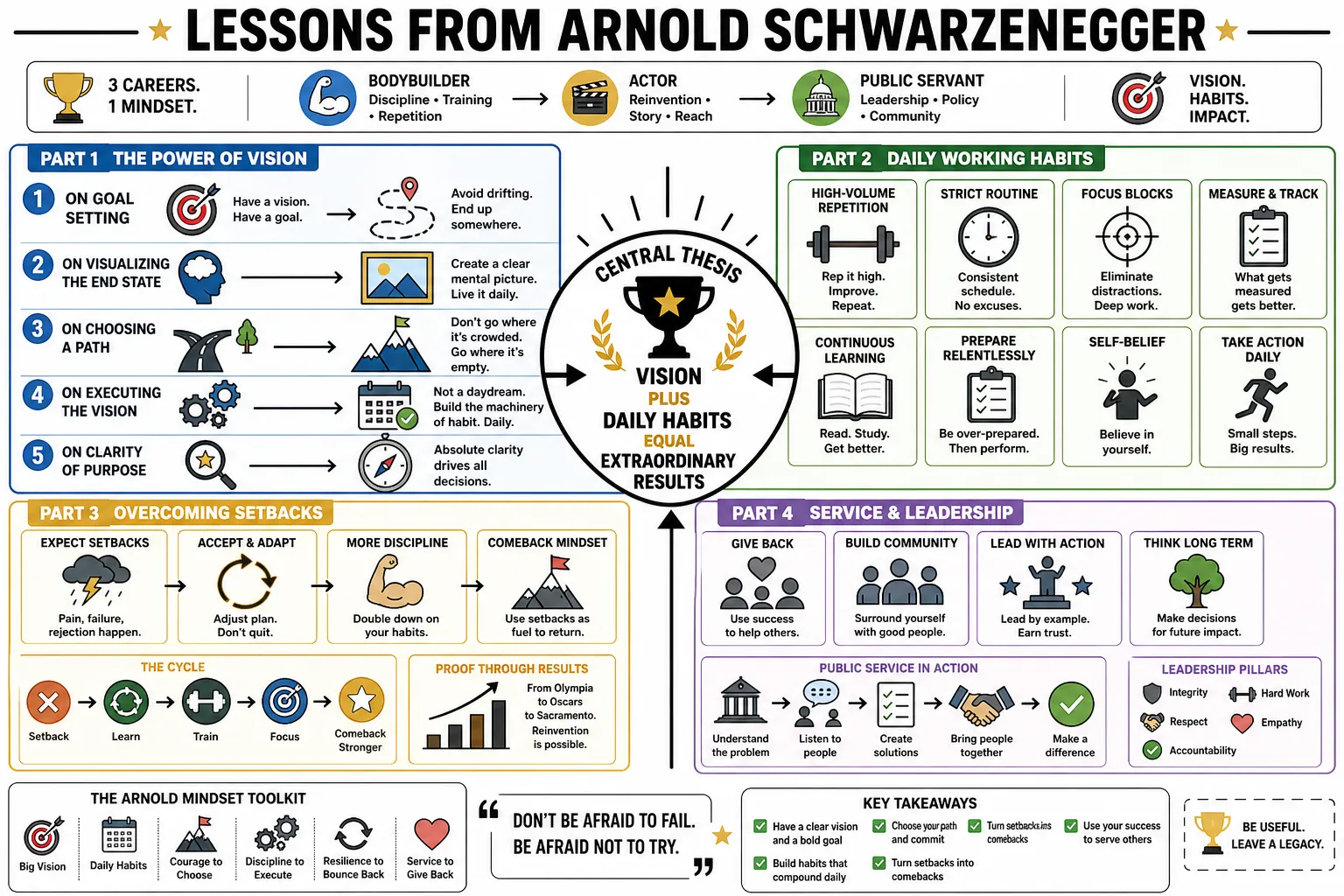
Lessons from Arnold Schwarzenegger
Arnold Schwarzenegger is a former professional bodybuilder and actor who served as California’s 38th governor. Across those careers, he has described a practical approach built around clear goals, hard work, adaptation, and service to others. — The Tim Ferriss Show — Be Useful (#696).
Part 1: The Power of Vision
- Goal Setting: Choose a clear goal and direction so your effort does not drift. — The Tim Ferriss Show — Be Useful (#696).
- Visualizing the End State: Visualize the result clearly enough that daily work feels like progress toward it. — The Tim Ferriss Show — Arnold Schwarzenegger (#60).
- Clarity of Purpose: A clear vision makes the reason for hard, disciplined work easier to understand. — The Tim Ferriss Show — Arnold Schwarzenegger (#60).
- Thinking Big: Schwarzenegger recalls pursuing a larger competition goal while training as hard as his peers; he uses that experience to argue for thinking bigger. — The Tim Ferriss Show — Be Useful (#696).
- The Mind-Muscle Connection: Schwarzenegger describes concentrating on the muscle he is training as a personal form of meditation. — The Tim Ferriss Show — Arnold Schwarzenegger (#60).
- Self-Belief: Build confidence from a clear vision of where you want to go. — The Tim Ferriss Show — Arnold Schwarzenegger (#60).
- Defining Success: Give getting up, struggling, resting, and starting again a clear purpose. — The Tim Ferriss Show — Be Useful (#696).
Part 2: The Discipline of Repetitions
- Doing the Work: Hard work can accomplish a great deal. — The Tim Ferriss Show — Be Useful (#696).
- Incremental Progress: During his own recovery, Schwarzenegger set small walking goals and expanded them as he regained strength. — The Tim Ferriss Show — Be Useful (#696).
Part 3: Embracing Pain and Discomfort
- The Pain Barrier: Schwarzenegger uses demanding bodybuilding repetitions as a metaphor for sustained effort, not a general instruction to ignore pain. — The Tim Ferriss Show — Be Useful (#696).
- Leaving the Comfort Zone: He connects personal growth with discipline and difficult work rather than with staying comfortable. — The Tim Ferriss Show — Be Useful (#696).
- Facing Failure in the Gym: He describes regularly encountering failure in bodybuilding as practice for becoming less afraid of attempting difficult things. — The Tim Ferriss Show — Be Useful (#696).
Part 4: Ignoring the Naysayers
- Skepticism: Hear the naysayers, then keep working toward the vision. — The Tim Ferriss Show — Be Useful (#696).
- Breaking the Rules: Challenge rules that block originality while continuing to respect the law. — USC Commencement Address (2009).
- Turning Liabilities into Assets: A supposed obstacle can become an asset when it makes your contribution unmistakable. — The Tim Ferriss Show — Arnold Schwarzenegger (#60).
Part 5: Reinvention and Selling Yourself
- The Importance of Promotion: Promotion matters because even strong work has little value if the right people never learn about it. — The Tim Ferriss Show — Be Useful (#696).
- Finding a Niche: Choose a niche that uses what is distinctive about you instead of competing for a conventional part. — The Tim Ferriss Show — Arnold Schwarzenegger (#60).
- Wealth Building: Schwarzenegger says financial independence let him turn down acting roles he did not want rather than accepting them to make a living. — The Tim Ferriss Show — Arnold Schwarzenegger (#60).
Part 6: Politics, Leadership, and Pragmatism
- Centrist Politics: A centrist can seek consensus without surrendering every principle. — USC — Bridging the Political Divide (2007).
- Environmentalism: AB 32, signed during his governorship, paired a statutory emissions target with a scoping plan and enforceable regulations. — California Air Resources Board — AB 32.
- Building Coalitions: Build coalitions around common bonds instead of deepening partisan division. — USC — Bridging the Political Divide (2007).
- Public Service: Judge political leadership by service to the public rather than service to a party. — USC — Bridging the Political Divide (2007).
- Admitting Mistakes: When an approach divides people, admit that it was the wrong way and change it. — USC — Bridging the Political Divide (2007).
Part 7: Resilience and Coming Back
- Failing Well: Accept failure to become less afraid of attempting difficult things. — The Tim Ferriss Show — Be Useful (#696).
- Recovering from Surgery: Following his doctors' direction after surgery, Schwarzenegger gradually increased his walking; this is his recovery account, not a universal rehabilitation plan. — The Tim Ferriss Show — Be Useful (#696).
- Adapting Training to Age: He describes adapting his training to medical limits and deliberately maintaining movement as aging made it less automatic. — The Tim Ferriss Show — Be Useful (#696).
Part 8: Giving Back and Being Useful
- The Myth of the Self-Made Man: Drop the myth of being self-made; parents, mentors, teachers, coaches, voters, and many others make achievement possible. — The Tim Ferriss Show — Be Useful (#696).
- Being Useful: Use your talent to help people, not only to advance yourself. — The Tim Ferriss Show — Be Useful (#696).
- Helping Others: Repay the help you received by helping someone else. — The Tim Ferriss Show — Be Useful (#696).
- Tearing Down Your Mirrors: Schwarzenegger credits Sargent Shriver's mirror metaphor: look beyond self-absorption to recognize people who need help. — The Tim Ferriss Show — Be Useful (#696).
- Immigrant Gratitude: Be grateful to America for the opportunities it made possible. — The Tim Ferriss Show — Be Useful (#696).