Arvind Krishna is IBM’s chairman, president and CEO. He joined IBM in 1990 and went on to lead IBM Research and the company’s Cloud and Cognitive Software business; he also helped drive IBM’s $34 billion acquisition of Red Hat. He holds an undergraduate degree from IIT Kanpur and a Ph.D. from the University of Illinois Urbana-Champaign. This profile examines his approach to AI, hybrid cloud, quantum computing, open technology, leadership, and long-term capital allocation — IBM Biography; IIT Kanpur Biography; Illinois Alumni Biography.
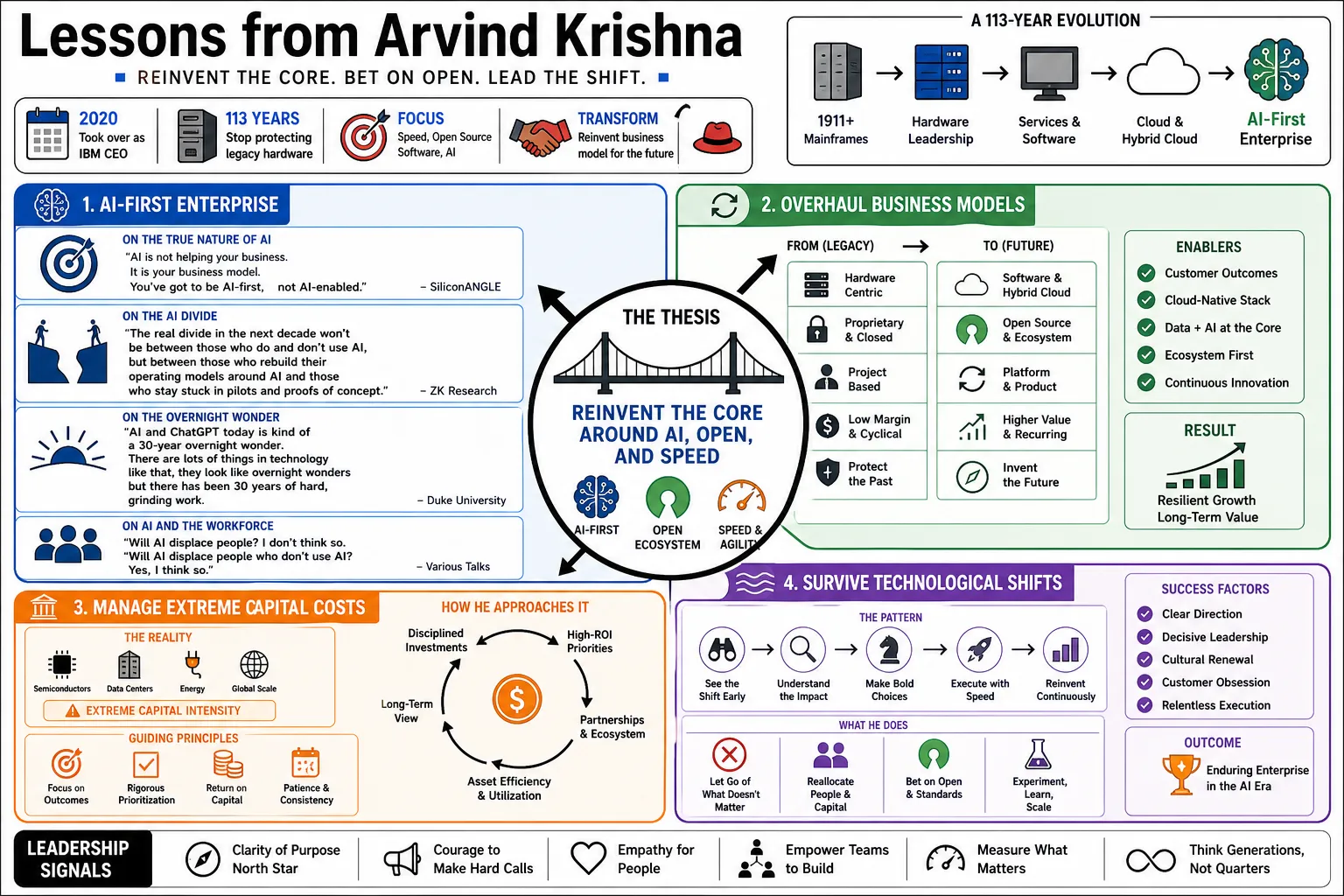
Part 1: The AI-First Enterprise
- On the True Nature of AI: Choose a few important workflows and change how they operate with AI, rather than treating scattered experiments as enterprise adoption. — Masters of Scale.
- On the AI Divide: Krishna’s 2026 outlook urges partners to start enterprise AI adoption early and connect practical applications to business processes. This is a competitive judgment, not proof that every late adopter will fail. — CRN CEO Outlook Q&A.
- On the Overnight Wonder: AI’s apparent overnight breakthrough rests on decades of research and difficult engineering. Krishna described ChatGPT’s emergence as the visible result of roughly thirty years of work. — Duke Fuqua Interview.
- On AI and the Workforce: Learn to use AI, but do not confuse that advice with a promise that no jobs will disappear. Krishna’s later account acknowledges displacement in some back-office work while describing new demand for value-creating roles. — Masters of Scale.
- On Early Innings: In his 2026 CEO Outlook responses, Krishna described enterprise AI adoption as being in its early innings and urged partners to begin with practical use cases. — CRN CEO Outlook Q&A.
- On Productivity Expectations: Krishna predicted in 2026 that AI could drive a tenfold productivity revolution over the following decade. Treat that as his ambitious forecast, not an established result or guaranteed return. — CRN CEO Outlook Q&A.
- On Exploding Usage: Krishna expects improvements in chips, computing architectures and deployment software to make AI substantially cheaper over a multi-year horizon. Lower operating costs could make more applications economical, despite today’s large infrastructure commitments. — Decoder Interview.
- On Getting Started with AI: Begin with workflows where mistakes can be detected and corrected, such as customer-service tasks with checks and human escalation. Customer-facing AI is not inherently risk-free; the ability to catch errors matters. — Masters of Scale.
- On Enterprise Platforms: Build enterprise AI and hybrid cloud on open, flexible, secure platforms that can operate across on-premises, private-cloud and public-cloud environments. — IBM Shareholder Remarks.
- On Artificial General Intelligence: In his December 2025 interview, Krishna put the odds of current known technologies reaching AGI at 0–1 percent. He argued that progress would require more than the current LLM path, including ways to combine models with broader knowledge; this is his technical assessment, not a measured probability. — Decoder Interview.
Part 2: Hybrid Cloud and the Red Hat Bet
- On the Necessity of Hybrid Architecture: In his first CEO letter, Krishna positioned hybrid cloud as IBM’s next major platform, following earlier eras in mainframes, services and middleware. The aim was an essential platform for clients’ critical work. — My First Day as CEO.
- On Market Skepticism: A strategic acquisition may face market skepticism and take years to prove its value. Krishna describes Red Hat as a way to obtain cross-cloud capabilities faster than IBM could build them internally, not as an instant payoff. — Semafor — The CEO Signal.
- On Strategic Conviction: Strategic conviction must come with personal accountability and the actions needed to make a bet work. Krishna describes accepting responsibility for the Red Hat acquisition rather than treating the initial decision alone as success. — Decoder Interview.
- On Open Source: Make openness part of the strategy, not merely a product feature. Krishna’s 2021 letter connected IBM’s Red Hat-centered hybrid-cloud approach with open systems and partnerships across the technology ecosystem. — Today’s IBM — Open Letter.
- On Reorienting the Portfolio: IBM’s 2021 portfolio changes centered its strategy on hybrid cloud and AI. Krishna described the Red Hat acquisition and Kyndryl separation as parts of that reorientation. — Today’s IBM — Open Letter.
- On Architectural Flexibility: Choose deployment architecture for flexibility and long-term economics rather than assuming everything belongs in one location. Krishna’s hybrid-cloud vision included resilience and the ability to work across existing infrastructure. — My First Day as CEO.
- On the Future of Containers: Use Linux and OpenShift as a common foundation for applications across deployment environments. Krishna’s shareholder remarks presented them as the basis of IBM’s open hybrid-cloud platform. — IBM Shareholder Remarks.
- On AI Delivery: Deliver AI where clients already work: on premises, in private clouds or in public clouds. Platform design should accommodate those environments rather than force a single destination. — IBM Shareholder Remarks.
- On Multi-Cloud Commitment: A hybrid-cloud strategy must accommodate clients using several clouds alongside existing systems. Krishna explains Red Hat’s strategic value in supplying tools across those environments rather than requiring customers to choose one cloud. — Semafor — The CEO Signal.
- On Avoiding Vendor Lock-In: Preserve options across clouds and AI models instead of making the enterprise dependent on one provider. Krishna’s hybrid strategy emphasizes accommodating the mix clients use. — Semafor — The CEO Signal.
Part 3: Quantum Computing
- On the Convergence with AI: Plan for quantum computing to complement AI rather than assume one replaces the other. Krishna distinguishes AI’s use of learned patterns from quantum’s potential to address different computational problems; that is his outlook, not proof of universal quantum superiority. — McKinsey CEO Interview.
- On Quantum Urgency: Start quantum preparation before fully mature systems arrive. Krishna recommends identifying use cases and building a small base of expertise, then increasing investment as progress and value become clearer. — Semafor — The CEO Signal.
- On a Different Computing Paradigm: Evaluate quantum computing for problem classes that classical methods cannot solve economically. Krishna frames quantum as a different computing capability, not simply a faster replacement for every existing task. — Decoder Interview.
- On Timelines to Advantage: IBM’s June 2025 roadmap expected demonstrations of quantum advantage by the end of 2026. That is a dated development target, not evidence that the milestone has already been achieved. — IBM Quantum Roadmap.
- On Fault Tolerance: IBM’s June 2025 roadmap planned Quantum Starling for 2029, designed to execute 100 million gates on 200 logical qubits. Those are planned fault-tolerant capabilities, not delivered specifications. — IBM Quantum Roadmap.
- On Government Collaboration: Government can help advance quantum development through investment and coordination. At the signing event, Krishna explicitly welcomed that role in supporting industry’s work. — Official Quantum Signing Remarks.
- On Confidence to Invest: Government funding and coordination can give companies greater confidence to invest. Krishna used the quantum initiative to explain how public support could encourage additional private commitment. — Official Quantum Signing Remarks.
- On Evolving Architectures: Design quantum systems to work with classical computing at scale. IBM’s roadmap describes modular quantum hardware and supporting classical computation, rather than treating a quantum processor as a self-contained substitute for the rest of the system. — IBM Quantum Roadmap.
Part 4: Leadership and Action
- On Uncertainty and Opportunity: Use uncertainty to look for opportunities and help people act. Krishna argues that competitors face many of the same headwinds, so leadership is about guiding teams and clients through them. — McKinsey CEO Interview.
- On the Bias Toward Action: Be willing to act before someone else disrupts the business. Krishna connects that bias toward action with reimagining work and making difficult portfolio decisions, not merely cutting costs. — McKinsey CEO Interview.
- On Boardroom Priorities: Give technology the same board-level seriousness as the balance sheet. Krishna argues that its effect on a company’s future makes it a core leadership concern, not a matter to delegate entirely to specialists. — Semafor — The CEO Signal.
- On Defining the Role: Technical leadership also requires understanding clients, distribution and how products reach the market. Krishna describes learning those business dimensions and relying on people with complementary expertise. — Semafor — The CEO Signal.
- On Delegation: Help people do what they do best and surround them with complementary skills. Krishna’s leadership advice emphasizes enabling the team to succeed rather than expecting every individual to supply every capability. — Leadership Insights Podcast.
- On Integrity in Leadership: Advocate for what benefits the organization even when the position is unpopular. Krishna distinguishes that integrity from pursuing personal gain or managing appearances. — Duke Fuqua Interview.
- On the Modern Leadership Triad: Krishna identifies curiosity, grit and followership as qualities he looks for in leaders. His account links leadership fit to the ability to learn, persist and bring others along. — Leadership Insights Podcast.
Part 5: Curiosity and Continuous Learning
- On Learning as a Career Engine: Curiosity about how products succeed can expand a technical career into business leadership. Krishna describes moving from research toward management as he learned how innovations reach the market. — Duke Fuqua Interview.
- On the Evolutionary Journey: A career does not have to follow a fully designed route. Krishna describes his path to CEO as an evolutionary journey rather than a sequence planned in advance. — Duke Fuqua Interview.
- On the Compounding Nature of Curiosity: Curiosity may pay off long after the original question is asked. In his first-job essay, Krishna describes technical knowledge becoming useful later and argues for pursuing worthwhile questions without demanding immediate results. — Krishna — Lessons from His First Job.
- On Mental Flexibility: Treat learning as a continuous process rather than an occasional event. Krishna’s first CEO letter links that habit to curiosity and a continuing search for knowledge. — My First Day as CEO.
- On the Growth Mindset: Build a culture that assumes people have substantial capacity to grow. Krishna’s letter presents that growth mindset as part of how IBM should learn and adapt. — My First Day as CEO.
- On Intellectual Resourcefulness: When an effort fails, question the structure and market assumptions before simply demanding more effort. Krishna’s digital-sales example shows repeated attempts guided by diagnosing what was wrong. — Masters of Scale.
- On Early Education: Krishna’s technical education included an undergraduate degree at IIT Kanpur and a Ph.D. at the University of Illinois Urbana-Champaign. His subsequent roles spanned IBM Research, cloud software and enterprise leadership. — IBM — Arvind Krishna.
- On Continuous Adaptation: Become comfortable with ambiguity and adapt as circumstances change. Krishna presents that flexibility as part of the entrepreneurial culture IBM needs. — My First Day as CEO.
Part 6: Corporate Culture and Agility
- On Speed Over Elegance: Favor pragmatic, timely action over unnecessary elegance. Krishna’s letter calls for an entrepreneurial culture that is nimble and able to move quickly. — My First Day as CEO.
- On Shifting the Operating Model: Concentrate enterprise AI adoption on a few high-impact workflows and invest enough to change how they run. Krishna emphasizes scale and change management rather than distributing attention across many disconnected experiments. — Masters of Scale.
- On the Purpose of Technology: Use technology to reimagine how the business works, not just to remove costs from the existing model. Krishna describes AI-enabled work redesign alongside shifting resources toward higher-value activity. — McKinsey CEO Interview.
- On Institutional Reinvention: Reinvention requires portfolio choices as well as investment. Krishna describes exiting declining, commoditized businesses while investing in research, software and capabilities that can create future value. — McKinsey CEO Interview.
- On Client-Relevant Innovation: Innovate around what clients need and use interactions to deliver useful value. Krishna’s letter makes client relevance the test for the company’s work. — My First Day as CEO.
- On Managing Risk-Aversion: Reduce approval layers that repeatedly stop ideas in the name of avoiding risk. Krishna argues for accepting some failure and giving teams resources and support to move faster. — McKinsey CEO Interview.
- On Developing Ecosystems: Work with an ecosystem rather than assume one company can provide every capability. Krishna’s letter emphasizes partnerships, including with companies that also compete with IBM. — Today’s IBM — Open Letter.
Part 7: Infrastructure, Capital, and Strategy
- On Infrastructure Economics: Krishna questioned the economics of announced AI infrastructure spending using an $8 trillion capital-expenditure scenario and roughly $800 billion in annual profit needed for interest. These are his December 2025 assumptions and argument, not a verified industry forecast. — Decoder Interview.
- On Hardware Depreciation: Include recurring compute replacement in infrastructure economics. Krishna discusses a roughly five-year replacement horizon for accelerator hardware while distinguishing it from longer-lived facilities and other infrastructure. — Decoder Interview.
- On the Role of Software: Reinvent while clients still value the business and cash flow can fund change. Krishna’s account stresses software’s value to clients and investors rather than waiting for older businesses to deteriorate completely. — McKinsey CEO Interview.
- On Prudent Investment: Measure AI investment against the full initial cost, including engineering, infrastructure and opportunity costs. Krishna explains that returns may lag early spending and depend on making useful workflows repeatable at scale. — Masters of Scale.
- On Chip Innovation: IBM Research’s 2 nm chip work illustrates how long-term semiconductor research can feed future product roadmaps. The article describes exploration toward 1 nm and beyond; process-node names are not literal measurements of every feature, and research progress is not the same as commercial delivery. — IBM Research — 2 nm Chip.
- On the Value of Open Standards: Use open technologies and standards to make a hybrid platform interoperable. Krishna’s letter points to Linux, containers, Kubernetes and OpenShift as foundations for that approach. — My First Day as CEO.
- On Capital Allocation: Concentrate investment in arenas where the company has credibility and clients need its capabilities. Krishna describes focusing IBM on software, quantum and hybrid infrastructure instead of trying to compete in every AI market. — Decoder Interview.
Part 8: Security, Trust, and Sovereignty
- On Technological Competitiveness: In his Think 2026 opening statement, Krishna placed technology alongside finance and defense in national competitiveness and argued that nations and enterprises need control of their AI and cloud infrastructure. This is his strategic position, not an assertion that one architecture satisfies every sovereignty requirement. — IBM — Digital Sovereignty at Think.
- On Securing the Foundation: Secure the open-source foundations on which businesses and AI systems depend. In the IBM/Red Hat announcement, Krishna connects open source with the need to improve how it is built, secured and scaled; the commitment does not establish that supply-chain risk has been eliminated. — IBM and Red Hat — Open Source Commitment.
- On Built-in Sovereignty: IBM’s Think 2026 sovereignty account describes architectures with customer-operated controls, compliance monitoring and governed AI execution. These are company design examples reported by Anne Robinson, not independently verified outcomes or Krishna’s own detailed instructions. — IBM — Digital Sovereignty at Think.
- On Post-Quantum Threats: The quantum initiative Krishna welcomed paired innovation with government discussion of protecting systems through post-quantum security. The security direction comes from the government speakers at the event; it should not be presented as Krishna’s personal regulatory instruction. — Official Quantum Signing Remarks.
- On Demonstrable Control: Anne Robinson’s IBM account frames digital sovereignty as demonstrable authority over systems, technology and data, not simply where equipment is located. Treat this as IBM’s governance guidance, not a blanket compliance guarantee. — IBM — Digital Sovereignty at Think.
- On the Dual Nature of Tech: Quantum computing creates both research opportunities and security concerns. Krishna describes possible applications in areas such as materials and warns about implications for encryption; those possibilities are not proof of demonstrated medical effectiveness. — Duke Fuqua Interview.
- On Avoiding Lock-In: Ana Paula Assis argues that open, hybrid environments can support sovereignty by preserving provider choice and the ability to switch. Her IBM essay distinguishes that flexibility from isolating infrastructure or relying on data location alone. — Ana Paula Assis — Digital Sovereignty.
- On the Future of Compliance: IBM’s technical guidance argues for security, governance and compliance to be built into AI and hybrid-cloud architecture from the outset. This is Nataraj Nagaratnam’s guidance, not a verified promise of compliance or a quotation from Krishna. — IBM — The Control Imperative.
Learn more
- IBM — Arvind Krishna, Chairman, President and CEO
- IIT Kanpur — Dr Arvind Krishna
- Grainger College of Engineering — Arvind Krishna
- Masters of Scale — IBM’s $10 Billion Bet on What Comes After AI
- Duke Fuqua — IBM CEO on Doing What’s Right and the Future of Technology
- Ellig Group — Leadership Insights with Arvind Krishna, IBM CEO (Episode 70)
- CRN — IBM CEO on How AI Will ‘Surpass the Boldest Expectations’ Over the Next Decade and Why Partners Need to ‘Start Early’
- The Verge / Decoder — IBM CEO Arvind Krishna Says There Is No AI Bubble After All
- IBM — Arvind Krishna’s 2021 Annual Shareholder Meeting Remarks
- Arvind Krishna — My First Day as CEO: Our Journey Together (6 April 2020)
- Semafor / The CEO Signal — Arvind Krishna, IBM CEO, on Big Bets, AI, and Quantum
- Today’s IBM — An Open Letter from Chairman and CEO Arvind Krishna (4 November 2021)
- McKinsey — ‘You’ve Got to Be Willing to Do, as Opposed to Getting Disrupted by Somebody Else’: A Conversation with IBM CEO Arvind Krishna
- IBM Quantum — How IBM Will Build the World’s First Large-Scale, Fault-Tolerant Quantum Computer
- GovInfo — Remarks on Signing Executive Orders on Quantum Technologies and an Exchange With Reporters (22 June 2026)
- Fast Company — IBM CEO Arvind Krishna on His First Job and the Lessons He Learned from It
- IBM Research — Introducing the World’s First 2 nm Node Chip
- IBM and Red Hat Commit $5 Billion to Redefine the Future of Open Source in the AI Era
- IBM Think — How IBM Shaped the Digital Sovereignty Agenda at Think 2026
- Ana Paula Assis — Digital Sovereignty Expectations Soar, but Can Rhetoric Meet Reality?
- IBM Think — The Control Imperative: Why Security, Sovereignty and AI Governance Matter in a Hybrid World