Ashley Mayer is a co-founder and general partner at Coalition. She previously led communications at Box through its IPO, worked as Social Capital’s first marketing partner, and led communications at Glossier. Her investing work combines founder storytelling with access to operating expertise. — Coalition — Team and Operating Approach.
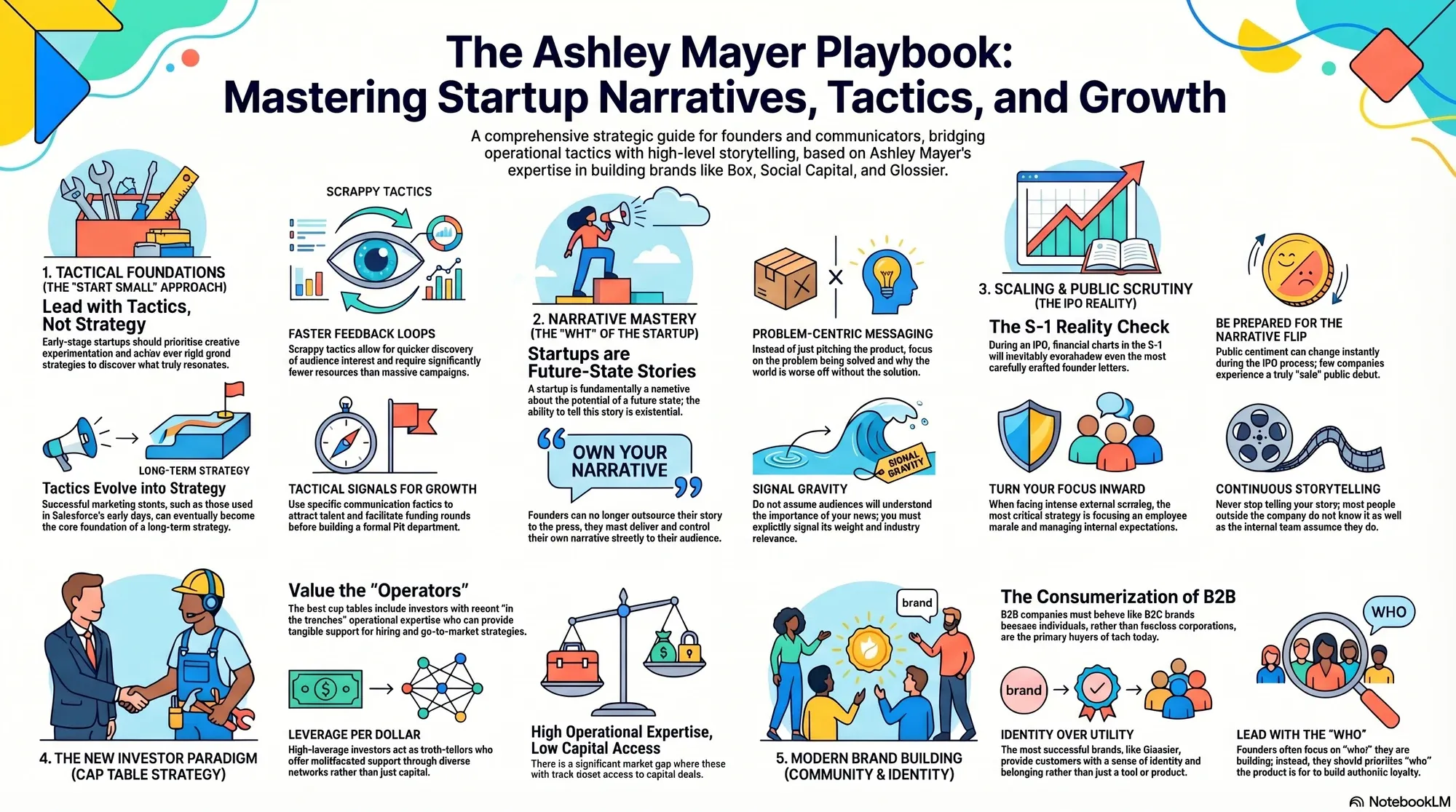
Part 1: The Tactical Genesis of Strategy
- On the Priority of Action: Start with concrete communications tactics when a complete strategy is not yet clear. Use those efforts to learn what works rather than waiting for a perfect plan. — Ashley Mayer — Communications Strategy.
- On Creative Freedom: Tactical work leaves room for creativity and experimentation. Mayer warns against treating strategy as the intellectually important work and execution as something less valuable. — Ashley Mayer — Communications Strategy.
- On Feedback Loops: Small communications experiments provide faster feedback about what resonates. Use what you learn to refine the next effort. — Ashley Mayer — Communications Strategy.
- On Strategy Evolution: Successful tactics can become enduring strategy. Mayer uses Salesforce’s marketing stunts and her own Box experience to illustrate that progression, rather than requiring strategy to be settled first. — Ashley Mayer — Communications Strategy.
- On Identifying Resonances: Test your narrative with people both inside and outside the company. Their reactions help reveal which parts are compelling and which depend on knowledge your audience does not have. — Ashley Mayer — Communications Strategy.
- On Resource Efficiency: Choose tactics suited to near-term goals and the resources you actually have. Getting started does not require first building a large communications operation. — Ashley Mayer — Communications Strategy.
- On Winning Attention: You compete with far more than direct business rivals for attention. Creativity can help a resource-constrained startup stand out, rather than making a large budget the prerequisite for trying. — Ashley Mayer — Communications Strategy.
- On Business Alignment: Check that communications tactics serve the business strategy. A bold publicity move can be counterproductive if it conflicts with the relationships or positioning the company needs. — Ashley Mayer — Communications Strategy.
- On Signals of Growth: Tie a communications effort to a concrete business need, such as hiring or fundraising. Plan around relevant milestones rather than treating press coverage as an end in itself. — Ashley Mayer — Communications Strategy.
Part 2: The Art of the Narrative
- On the Nature of Startups: An early startup asks people to believe in a future that does not yet exist. Its story needs to explain that future, not merely describe the current product. — The Rise — Story as Leverage.
- On Existential Storytelling: When an early company has little proof, a compelling story helps earn belief from prospective employees, investors and customers. That makes storytelling part of building the company, not just promoting it. — The Rise — Story as Leverage.
- On Problem-Centric Messaging: Explain the problem, why existing approaches have not solved it, and why your solution is timely before listing product features. That gives outsiders a reason to care. — Ashley Mayer — Communications Strategy.
- On Signaling Gravity: Do not assume other people will recognise why an announcement matters. Show its significance and timeliness through concrete supporting signals and thoughtful coordination. — Ashley Mayer — Communications Strategy.
- On Defining Your 'Why': Lead with the reason the company exists and connect it to something the audience already cares about. Mayer stresses the founder’s underlying motivation rather than a rehearsed product pitch. — Mercury — The New Rules of Startup Brand Building.
- On Audience-First Comms: Make sure the audiences that matter to the business understand who you are and who you are for. Clear communications starts with those audiences, not a generic desire for publicity. — The Rise — Story as Leverage.
- On Controlling the Story: Take responsibility for telling the company’s story rather than relying entirely on the press to do it. Mayer describes direct storytelling as a responsibility, not a guarantee of complete control over public coverage. — Mercury — The New Rules of Startup Brand Building.
- On Breaking Through Noise: When many companies repeat the same tactics, there is room for more original, sharper storytelling. Mayer sees creativity as an opportunity to break through the noise. — Mercury — The New Rules of Startup Brand Building.
- On the 30,000-Foot View: A broader category story can help when the industry is changing, the company embodies that change, and the founder wants and is able to speak for it. Not every founder or business has those ingredients. — Mixing Board — Getting Comms Leaders onto Cap Tables.
- On Authentic Insights: Give outsiders context: what is happening in the world, what remains broken, and why earlier solutions fell short. That makes the company’s insight legible beyond people already familiar with its product. — The Rise — Story as Leverage.
Part 3: Mastering the IPO & Public Scrutiny
- On the IPO Narrative: An IPO reduces a company’s ability to steer its public story: quiet-period restrictions limit responses while outsiders focus on financial results. Prepare for that loss of narrative control. — Ashley Mayer — Five IPO Communications Lessons.
- On S-1 Reality: Do not assume a founder’s letter will define the IPO story. Surprising or disappointing financial disclosures can dominate coverage, so outsiders need clear context for the business model. — Ashley Mayer — Five IPO Communications Lessons.
- On Internal Focus: During the pressure and distraction of an IPO, give employees focused internal communications. Mayer calls that work especially important even when external coverage demands attention. — Ashley Mayer — Five IPO Communications Lessons.
- On Managing Excitement: Celebrate the IPO without presenting it as the finish line. Box’s internal message emphasised that the work and opportunity ahead mattered more than the listing itself. — Ashley Mayer — Five IPO Communications Lessons.
- On Narrative Flips: Prepare for a favourable private-company narrative to reverse during an IPO. Mayer recalls Josh Stein warning that companies rising on momentum can face an equally forceful reversal. — Ashley Mayer — Five IPO Communications Lessons.
- On Continuous Storytelling: Keep explaining the business to new audiences. Familiarity inside the company does not mean the broader public understands its story, especially when an IPO attracts first-time observers. — Ashley Mayer — Five IPO Communications Lessons.
- On Resilience Through Failure: Mayer’s own theory is that a difficult IPO can leave a team better prepared for public-company pressure. She frames this as a reflection on Box’s experience, not a universal result. — Ashley Mayer — Five IPO Communications Lessons.
- On Rebuilding Trust: After Box’s difficult path to listing, rebuilding trust was an ongoing, quarter-by-quarter task. The debut did not automatically restore confidence or settle the company’s story. — Ashley Mayer — Five IPO Communications Lessons.
- On Enterprise Transformation: At Box, the story went beyond file sharing to the shift toward cloud software and the changing role of IT. Connecting the product to that transformation gave the company a larger narrative. — Mixing Board — Getting Comms Leaders onto Cap Tables.
Part 4: The Operator-Investor Nexus
- On Cap Table Design: Build a cap table whose members contribute different networks and relevant expertise. Mayer describes Coalition’s approach as matching founders with people who can help with their particular challenges. — The Rise — Story as Leverage.
- On Unfair Advantages: Pair capital with operating expertise relevant to the startup’s actual needs. Mayer describes that combination as a way to give founders an advantage, not proof that every operator investor produces better outcomes. — The Rise — Story as Leverage.
- On Intentional Investing: When you have the time and access to choose, be intentional about investors who can help with hiring, go-to-market work or other needs. Mayer also acknowledges that simply completing a difficult fundraise can take priority. — The Rise — Story as Leverage.
- On the Value of Operators: Active operators can contribute current, practical knowledge alongside an investor’s broader perspective. The useful match depends on the founder’s sector and problem, not the operator label alone. — The Rise — Story as Leverage.
- On Radical Pragmatism: Coalition describes its approach as combining empathy with practical help. The firm aims to be useful both when founders have doubts and when they need answers to specific operating questions. — Coalition — Team and Operating Approach.
- On Tangible Support: Pair specific operating help with honest judgment about what will move the business. Mayer tells founders when communications is unlikely to be a useful lever and prioritises product-market fit over publicity. — Mixing Board — Getting Comms Leaders onto Cap Tables.
- On High-Leverage Investing: A smaller investment can still come with useful expertise and introductions. Mayer describes Coalition’s flexible, non-lead model as pairing capital with practical help instead of competing to own the largest stake. — The Rise — Story as Leverage.
- On Seeing the Future: Seeing an ambitious future can help an investor connect with a founder, but it can also encourage overenthusiasm. Mayer calls this both a strength and a weakness in her own investing. — Mixing Board — Getting Comms Leaders onto Cap Tables.
- On Choosing Partners: Founders respond to the people they will actually work with, not just a fund name or an abstract network. Make the relevant partners and their potential contribution concrete. — The Rise — Story as Leverage.
Part 5: Scaling Brands: From Box to Glossier
- On B2B Consumerization: Individuals buy and use technology at work, so business communications can draw on consumer-brand thinking. Mayer describes B2B and B2C approaches as increasingly overlapping, not becoming identical. — Mercury — The New Rules of Startup Brand Building.
- On Earning Trust: Brand can help a company earn trust, capture mindshare and become associated with a particular use case. Mayer argues that those associations can be a competitive advantage. — Ashley Mayer — Brand and Trust.
- On Scaling Storytelling: Mayer joined Glossier to learn how strong consumer storytelling and creative work reach large audiences. Beauty felt more emotional and intimate than the enterprise-software world she had known. — The Rise — Story as Leverage.
Part 6: Career Architecture & Unconventional Paths
- On Discovery Over Strategy: A career can look deliberate in hindsight without having been planned that way. Mayer describes her own path as discovery through interesting opportunities rather than execution of a fixed long-term blueprint. — Mixing Board — Getting Comms Leaders onto Cap Tables.
- On Career Building Blocks: Early in your career, collect useful experiences and reflect on what they teach you. Mayer treats those experiences as building blocks that can be arranged into later opportunities. — Mixing Board — Getting Comms Leaders onto Cap Tables.
- On Unintentional Gateways: For Mayer, angel investing became an unplanned route into full-time venture capital. It let her work with early-stage founders before she decided to build a firm. — Mixing Board — Getting Comms Leaders onto Cap Tables.
- On Avoiding Pigeonholes: Do not let a communications job title define all the work you can do. Advising, investing, writing and side projects can help others recognise a broader professional identity. — Mixing Board — Getting Comms Leaders onto Cap Tables.
- On the Value of Comms Skills: Communications develops strategic skills that can transfer into other work. Mayer also warns that the industry may not readily recognise that range, so demonstrating it takes deliberate effort. — Mixing Board — Getting Comms Leaders onto Cap Tables.
- On Energy Management: Company building is demanding, so pay attention to the people who leave you energised after working through a problem. Mayer values collaborators whose help feels invigorating rather than draining. — The Rise — Story as Leverage.
- On Missing Early-Stage Grit: Mayer enjoyed Glossier’s resources and momentum but missed working with founders at the earliest stages. Angel investing gave her a way to return to that kind of hands-on discovery. — Mixing Board — Getting Comms Leaders onto Cap Tables.
- On Portfolio Careers: Operating roles and portfolio work offer different kinds of depth and variety. Mayer discusses exploring those paths herself before committing to the long-term work of building a fund. — Great Chat — Career Decisions from the Gut.
- On Access to Capital: Access to deals and capital does not always sit with the people whose skills would most help a startup. Mayer describes this as an access problem for both operators and founders. — Mixing Board — Getting Comms Leaders onto Cap Tables.
- On Gut-Led Decisions: Notice whether a career move is mainly a push away from dissatisfaction or a pull toward an opportunity you want. Mayer endorses the gut-decision framing without claiming intuition always beats structured analysis. — Great Chat — Career Decisions from the Gut.
Part 7: Leadership & Operational Pragmatism
- On Building Trust: Openly discussing what is hard can build trust. Assume audiences are intelligent enough to recognise difficulties rather than relying on a relentlessly positive account. — Ashley Mayer — Communications Strategy.
- On Empathy in AI: During rapid AI-driven change, leaders and communications teams still need to understand how different audiences feel. Mayer stresses how difficult reading the room has become when context is shifting and online reactions may not represent employees or the broader public. — Great Chat — Will Empathy Make a Comeback?.
- On Crisis Management: Mayer’s Glossier work spanned expansion and then pandemic-era store closures and supply-chain disruption. She describes both phases as important communications work, rather than offering one fixed crisis playbook. — The Rise — Story as Leverage.
- On Political Discourse: Managing political disagreement at work is difficult when views are strongly held and tied to identity. Mayer describes shifting expectations and the need to make deliberate choices about which beliefs become part of a public professional persona. — Great Chat — Tech Is Getting More Political.
- On Accountability: Reputation and integrity matter over the long term, even when winning an online dispute brings immediate attention. Mayer notes that consequences such as recruiting difficulties may take longer to become visible. — Great Chat — Does Anyone Care about Bad Behavior?.
- On First Principles Thinking: When a founder’s ambitious story excites you, slow down and examine your assumptions. Mayer describes learning to think from first principles so enthusiasm does not substitute for investment judgment. — Mixing Board — Getting Comms Leaders onto Cap Tables.
- On Facing Reality: Employees can recognise when leaders avoid difficult issues or sugar-coat them. Address those realities honestly rather than assuming a polished message will conceal them. — Ashley Mayer — Communications Strategy.
Part 8: The Future of Venture & Network Power
- On Concentrated Capital: Mayer asks what extreme capital concentration means for startups outside the largest funding rounds. She distinguishes her early-stage perspective from growth investing and probes the implications for the broader ecosystem. — Great Chat — Venture’s Growthmaxxing Era.
- On Modern Narratives: Gendered scrutiny can discourage women founders from being visible. Mayer argues against simply staying under the radar: weigh communications choices against business goals and support founders taking ambitious public roles. — Hunter Walk — Five Questions with Ashley Mayer.
- On Building in Public: Building in public can be useful for the right founder and audience, but it is not an industry-wide obligation. Mayer criticises performative launch activity and urges more thought about narrative, customer impressions and the business itself. — Great Chat — Is Building in Public Over?.
- On the Super Bowl AI Hype: Do not treat a Super Bowl appearance as automatically worthwhile for a startup. Mayer questions whether it justifies the money, time and team effort, while recognising that heavily funded companies face different trade-offs. — Great Chat — No One Won the AI Bowl.
- On Finding the Right Channel: Choose a public communications approach that fits the company and its audience rather than following a universal posting playbook. Mayer argues that startups can play to their strengths instead of feeling obliged to post constantly on Twitter or LinkedIn. — Great Chat — Is Building in Public Over?.
- On Backing Big Swings: Coalition backs founders with a vision of what the future should be and helps their stories reach important audiences. Mayer’s communications work is part of that support, not a substitute for building the business. — Coalition — Team and Operating Approach.