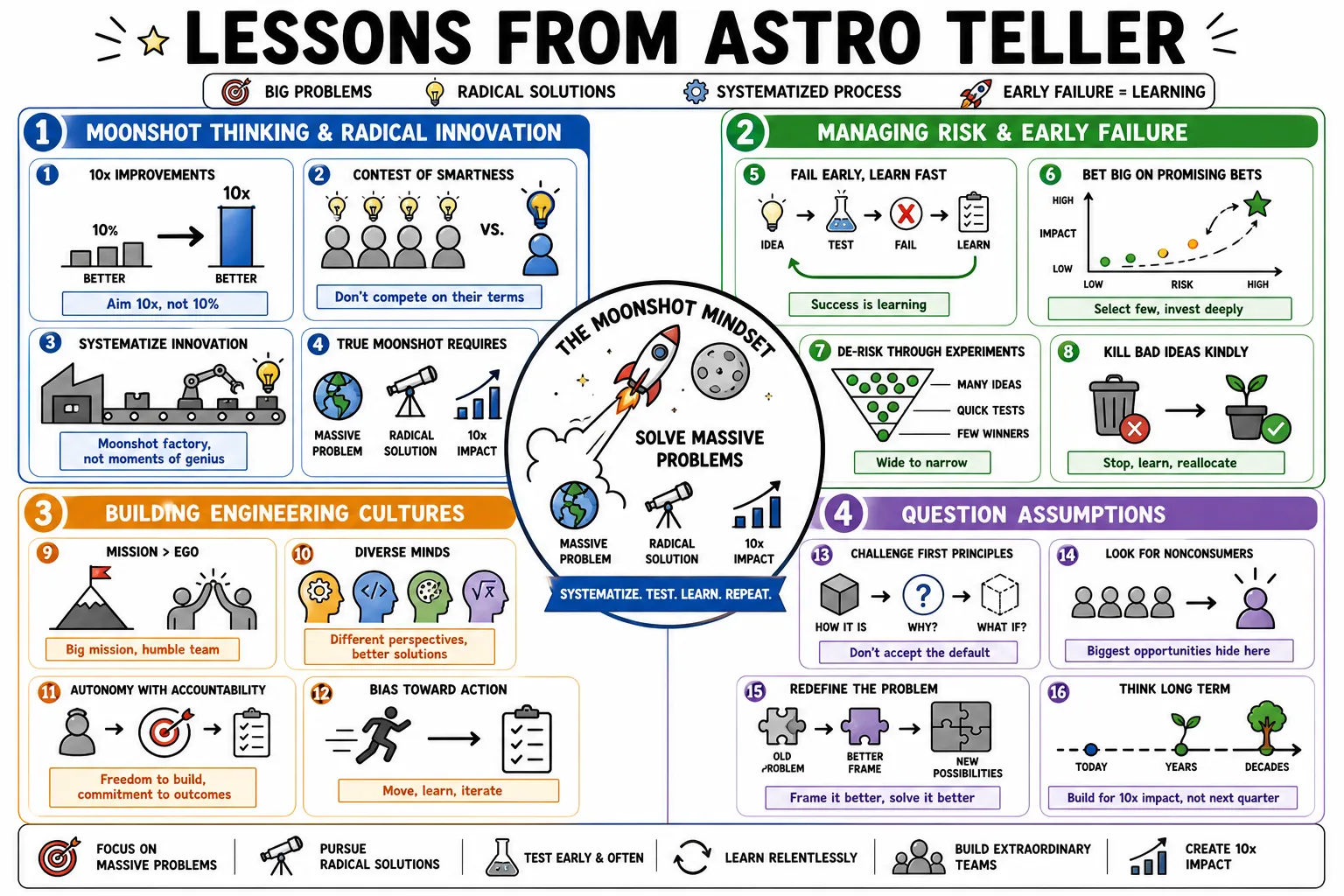
Lessons from Astro Teller
Astro Teller is the co-founder and CEO, or Captain of Moonshots, of X, Alphabet’s moonshot factory. These lessons examine his approach to innovation, learning, leadership, and questioning assumptions. — Astro Teller — About.
Part 1: Moonshot Thinking and Radical Innovation
- On 10x Improvements: A tenfold improvement can be easier than a small one when it forces a change in tools and assumptions. Teller argues that bravery and creativity can unlock possibilities that more effort on the existing solution cannot. — WIRED — 10X Is Easier Than 10 Percent.
- On the Contest of Smartness: Incremental improvement puts a team in competition with everyone already optimizing the same approach. Teller favors changing the perspective and assumptions instead of relying on being smarter than those predecessors. — Tim Ferriss Show #309.
- On Systematizing Innovation: Treat radical innovation as a repeatable discovery process. X tries to organize unconventional ideas, experiments, and evidence-based decisions rather than wait for isolated inspiration. — Jordan Harbinger — Astro Teller.
- On Defining Moonshots: A moonshot combines a huge problem, a radical solution that would address it, and concrete scientific or technological grounds for exploring that solution. The breakthrough must make investigation plausible, not guarantee success on a fixed deadline. — WIRED — 10X Is Easier Than 10 Percent.
- On Audacious Bravery: Audacious projects can require sustained risk-taking before their value is visible. Teller argues for encouraging the people brave enough to begin, rather than celebrating innovation only after it succeeds. — WIRED — 10X Is Easier Than 10 Percent.
- On Rejecting the Status Quo: Before improving a familiar solution, ask whether the problem has been framed correctly. Changing the question can open possibilities that working harder within the old frame will not. — WIRED — 10X Is Easier Than 10 Percent.
- On Unchecked Optimism: Let optimism fuel the vision, then use skeptical experiments to determine whether it can become real. Teller treats enthusiasm and rigorous attempts to disprove an idea as partners. — Celebrating Failure (YouTube).
- On the Need for Big Problems: A large, meaningful challenge can create passion that an incremental target does not. Teller emphasizes the motivating power of important problems, not a rule that every project must affect billions of people. — WIRED — 10X Is Easier Than 10 Percent.
- On Unlearning: Bring the skills that made you effective, but be willing to set aside familiar habits. Radical work needs people who can use their expertise without automatically repeating the methods everyone else has tried. — A Bit of Optimism — Astro Teller (YouTube).
Part 2: The Monkey and the Pedestal
- On Tackling the Hardest Problem: Test the uncertainty that could make the whole project impossible before building the easy parts. A finished pedestal proves nothing if the monkey cannot be taught to recite Shakespeare. — X — Tackle the Monkey First.
- On False Progress: Visible construction can create the appearance of progress without reducing the central risk. Distinguish work that makes a project look advanced from evidence that it can actually succeed. — X — Tackle the Monkey First.
- On Resource Allocation: Consider how much it will cost to learn whether the core idea works. Teller described stopping a cargo-airship project because its first meaningful feedback would require too much investment. — Celebrating Failure (YouTube).
- On Proving Negatives: At the start of an uncertain project, look for the smallest experiment that could show the hypothesis is wrong. Discovery is more useful than spending heavily to defend the initial idea. — Big Technology Live — Astro Teller.
- On Momentum vs. Truth: Managers must reward evidence about difficult risks, not merely something impressive to show at a status meeting. Teams need to trust that honest negative findings will be valued. — X — Tackle the Monkey First.
- On Cheap Discoveries: Test many possibilities inexpensively before committing substantial resources to one. A scrappy experiment should buy useful information, not imitate a finished product. — A Bit of Optimism — Astro Teller (YouTube).
Part 3: Celebrating Failure and Psychological Safety
- On Ending Projects: An experiment that contradicts your expectation can produce valuable learning. The aim is not failure for its own sake, but discovering what should change or stop. — A Bit of Optimism — Astro Teller (YouTube).
- On Rewarding Failure: Reward teams that end their own projects when the evidence warrants it. Teller describes recognition and financial rewards as ways to make honest shutdown decisions easier. — Celebrating Failure (YouTube).
- On Moonshot Compost: When a project ends, preserve useful people, code, patents, partnerships, and knowledge for future attempts. Teller describes this reuse as moonshot compost, rather than treating every shutdown as starting over. — Big Technology Live — Astro Teller.
- On Psychological Safety: Permission to fail must be supported by the organization’s incentives. Recognition, compensation, and promotion should make responsible experimentation safer than concealing evidence that a project will not work. — Celebrating Failure (YouTube).
- On Learning Metrics: Judge early experiments by useful learning relative to their cost. Efficiently finding an answer can be more valuable than producing an impressive-looking output. — Paint & Pipette — Astro Teller.
- On Shifting Perspectives: A serious flaw can reveal that the original objective needs to change. In his 2016 talk, Teller described how difficulties handing control back to drivers pushed the team toward a fully passenger-operated approach. — Celebrating Failure (YouTube).
Part 4: Detaching Identity and Re-evaluating Success
- On Ideas vs. Identity: Do not make an idea the measure of your personal worth. Separating identity from a project makes it easier to assess contrary evidence and redirect your effort. — Jordan Harbinger — Astro Teller.
- On Non-conformity: Channel unconventional thinking toward important, testable problems. Productive nonconformity means questioning assumptions while still using a disciplined discovery process. — Jordan Harbinger — Astro Teller.
- On Visions and Strategies: A compelling vision needs a strategy for testing and realizing it. Dreaming big and making concrete plans are complementary parts of the moonshot approach. — Celebrating Failure (YouTube).
- On Doing Good: Start by solving an important problem rather than demanding a conventional business plan for every early experiment. Teller believes creating substantial value can attract commercial opportunity; that is not a guarantee of revenue. — Tim Ferriss Show #309.
- On Rejecting Perfection: Do not require certainty before beginning an inexpensive investigation. Accept the uncertainty at the start while committing to let later evidence determine whether the project continues. — A Bit of Optimism — Astro Teller (YouTube).
- On Intellectual Honesty: Assess experimental results honestly even when pride or fear makes stopping painful. Refusing to acknowledge a negative finding prevents resources from moving to a better opportunity. — Paint & Pipette — Astro Teller.
- On the Purpose of Business: A working technology is not enough for an enduring business. Teller described Loon as technically successful but commercially unworkable, which led X to close it. — Big Technology Live — Astro Teller.
Part 5: Artificial Intelligence and Technology
- On Dystopian Hysteria: In 2016, Teller argued that panicky rhetoric obstructed useful discussion of AI. His position was to examine opportunities and social impacts without letting fear dominate—not to deny every risk. — Astro Teller — Perspectives on AI.
- On AI as a Tool: Distinguish discovering knowledge from deciding how to deploy it. Teller asks who benefits, who might be harmed, and how real-world feedback can inform a responsible implementation. — Big Technology Live — Astro Teller.
- On Solving Global Challenges: Teller’s 2016 essay identifies potential AI applications in transportation, climate, medicine, and assistive care. These are opportunities he sees, not proof that AI will solve a fixed share of global problems. — Astro Teller — Perspectives on AI.
- On Moving Beyond Hype: In his 2023 interview, Teller prioritized climate change and argued for focusing on problems rather than a fashionable AI technique. This was his judgment about priorities, not a settled ranking of societal risks. — Big Technology Live — Astro Teller.
- On Human-Machine Collaboration: AI can shift people from manually exploring every design toward guiding computational searches. Teller’s example has humans specifying trade-offs while computers explore many possible designs; it does not eliminate human judgment. — Big Technology Live — Astro Teller.
- On Nuanced Conversations: Introduce technology with safeguards and opportunities for people to give feedback. Teller argues for identifying and mitigating unintended consequences before they become serious, rather than waiting for a crisis. — Big Technology Live — Astro Teller.
- On the Future of Robotics: Begin robotics work with the useful task, not the most impressive-looking machine. Teller questions unnecessary complexity when a simpler physical design could solve the problem. — Jordan Harbinger — Astro Teller.
Part 6: Cultural Assumptions and Sacred Cows
- On Sacred Cows: Danielle and Astro Teller argue that inherited assumptions can add guilt and shame to an already difficult divorce. Their invitation is to question those assumptions, not to treat every separation as desirable. — Astro and Danielle Teller — Love and Divorce.
- On Marriage Stigmas: Danielle and Astro Teller reject divorce as a reliable test of someone’s character. They point out that a person may not even choose the separation when a spouse decides to leave. — Astro and Danielle Teller — Love and Divorce.
- On the Selfish Myth: The Tellers challenge the double standard that celebrates seeking happiness before marriage but treats it as selfish afterward. They argue for considering the people involved instead of automatically applying that moral label. — Astro and Danielle Teller — Love and Divorce.
- On Empathy over Tradition: When divorce offers a couple their best chance of future love and happiness, Danielle and Astro Teller argue for empathy and support. Their claim is conditional, not a prescription for every marriage. — Astro and Danielle Teller — Love and Divorce.
- On the Soulmate Fallacy: Teller challenges the inconsistency of treating true love as the highest goal before marriage and dismissing its possibility afterward. He explicitly says he is arguing against hypocrisy, not against belief in love. — Tim Ferriss Show #77 — The Tellers.
- On Freedom of Choice: Choose marriage for reasons you genuinely endorse, rather than social expectations alone. Teller describes his own remarriage as a personal choice, not a rule that everyone should follow. — Tim Ferriss Show #77 — The Tellers.
- On Children and Divorce: In Sacred Cows, Danielle and Astro Teller question blanket assumptions about divorce harming children. This describes their argument, not a guarantee about any child’s outcome or a substitute for individualized advice. — Sacred Cows — Official Book Description.
Part 7: Engineering Culture and Leadership
- On Culture Engineering: Culture needs deliberate reinforcement through incentives, artifacts, and everyday signals. Teller describes his role as culture engineering: making the organization’s stated commitment to learning credible in practice. — Think:Act — Astro Teller.
- On Intentional Constraints: Limit early resources enough to encourage a different approach rather than fund an army working through the conventional one. Teller uses this constraint to promote creativity, not to claim that every larger budget is harmful. — A Bit of Optimism — Astro Teller (YouTube).
- On Hiring for Fearlessness: When hiring for X, Teller looks for fearlessness alongside teamwork and a growth mindset. Candidates need to enjoy investigating unlikely ideas, not merely arrive with impressive technical credentials. — Think:Act — Astro Teller.
- On Hiring for Humility: Pair audacity with humility: start ambitious investigations, but commit to stop when the evidence says the opportunity is wrong. Persistence in a process is not unconditional attachment to a project. — Paint & Pipette — Astro Teller.
- On Regulatory Partnerships: Bring regulators into the conversation early enough to learn from them. Teller favors understanding public concerns and requirements during development rather than treating regulation as a final obstacle. — Jordan Harbinger — Astro Teller.
- On Designing Workplaces: The workplace can signal what the organization values. Teller describes unfinished surfaces and early prototypes as reminders that work in progress is welcome—not proof that architecture determines innovation. — Paint & Pipette — Astro Teller.
- On the Value of Friction: Make it safe to challenge leaders and combine different ideas. Teller values what emerges from ideas meeting and changing, rather than assuming one individual arrives with the answer. — Paint & Pipette — Astro Teller.
- On Shifting Timelines: A long-term project still needs regular evidence of learning. X’s quarterly learning reviews ask what has been discovered and how it changes the opportunity, rather than merely celebrating short-term activity. — Paint & Pipette — Astro Teller.
- On Measuring Innovation: Evaluate how intelligently an experiment was chosen, how efficiently it was run, and how honestly its results were interpreted. A successful outcome alone does not establish a good innovation process. — Paint & Pipette — Astro Teller.
- On Empowering Teams: Give teams genuine organizational support for uncertain, high-potential work. Leaders must make that commitment credible through resources, expectations, and incentives—not simply announce permission and disappear. — Paint & Pipette — Astro Teller.
Part 8: Philosophy of Life, Bravery, and Resilience
- On Human Limitations: Teller argues that bravery and creativity can unlock a perspective shift that extra intelligence or effort alone cannot. The point is to question assumptions, not to claim that ability never matters. — WIRED — 10X Is Easier Than 10 Percent.
- On Life as an Open World: Graduation teaches you the controls; it does not supply a complete life mission. Teller encourages graduates to approach what follows as exploration. — RIT — 2025 Commencement Address.
- On Defining Your Mission: Treat the life ahead as something you help create. Teller encourages deliberate creation rather than waiting for a predetermined path. — RIT — 2025 Commencement Address.
- On the Value of Exploration: Approach the unknown with openness rather than trying to control every outcome. Teller presents uncertainty as a source of possibilities, not a promise of success. — RIT — 2025 Commencement Address.
- On Curiosity: Hold yourself to a high standard of curiosity and learning. Teller describes that focus as more helpful than constantly judging himself by achievement. — RIT — 2025 Commencement Address.
- On Optimism: Bring optimism to an adventure while acknowledging that it may fail. Teller advocates engaged effort and humility, not confidence that everything will work out. — RIT — 2025 Commencement Address.