Ben Chestnut co-founded Mailchimp in 2001 and built a $12 billion marketing platform without taking venture capital. After Intuit acquired the company in 2021, he stepped down as CEO in 2022. He proved a software company can scale by selling to small businesses, staying independent, and putting profits ahead of fast growth. This profile collects his advice on product design, managing team culture, and surviving the pressures of entrepreneurship.
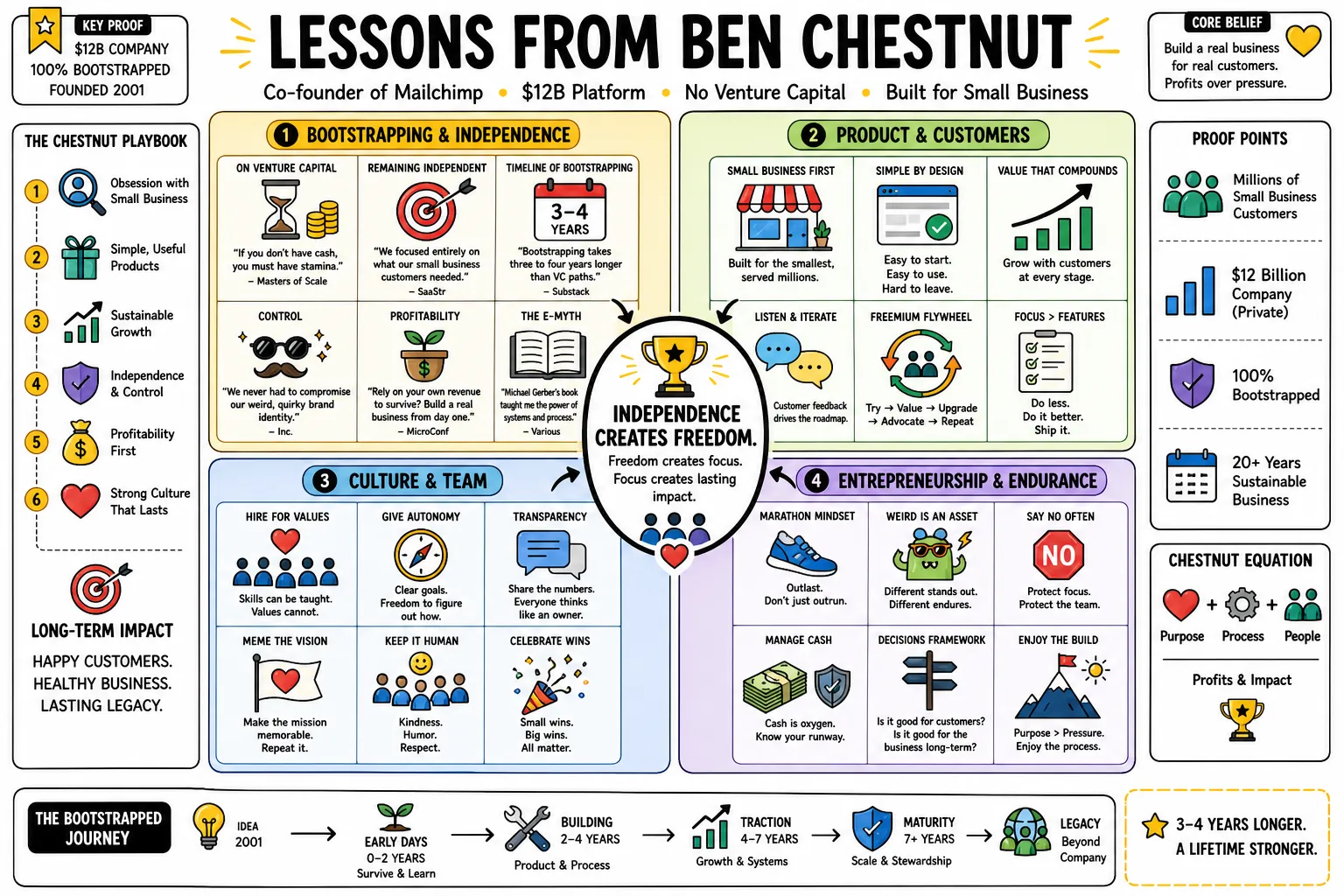
Part 1: Bootstrapping and Independence
- On Venture Capital: "If you don't have cash, you must have stamina." — Source: Masters of Scale
- On Remaining Independent: "By not taking funding, we were able to focus entirely on what our small business customers needed rather than what investors demanded." — Source: SaaStr
- On The Timeline of Bootstrapping: "Bootstrapping takes three to four years longer than VC-funded paths, and you have to be prepared for that reality." — Source: Substack
- On Control: "Avoiding outside investment meant we never had to compromise our weird, quirky brand identity." — Source: Inc.
- On Profitability: "When you rely on your own revenue to survive, you are forced to build a real business from day one." — Source: MicroConf
- On The E-Myth: "Michael Gerber's book taught me the difference between working in my business and working on my business." — Source: Practical Ecommerce
- On Staying the Course: "If the path to the goal does not work, change the path, not your goal. Keep working." — Source: Reddit AMA
- On Alternative Paths: "There is an entire universe of successful companies that never raised a dime. They just don't get the press." — Source: Medium
- On Built to Last: "Jim Collins' work helped me realize that building a truly great company is a long-term project." — Source: Practical Ecommerce
- On Early Survival: "We funded the early days of Mailchimp by running a web design agency and using those profits to pay the server bills." — Source: How I Built This
Part 2: Customer-Centricity and Empathy
- On The Underdog: "My mother ran a hair salon from our kitchen; I saw how hard it was to run a small business, and I wanted to build tools for people like her." — Source: Lifehacker
- On Customer Happiness: "Happiness is a moat. If customers are happy, they won't leave, and you don't need artificial barriers to trap them." — Source: Substack
- On Listening: "I'm never a good enough listener, but I try and listen a little harder every day." — Source: Medium
- On Solving Real Problems: "Mailchimp started because our agency clients kept complaining about how hard it was to send email newsletters." — Source: Medium
- On Competitors: "Ignoring the competition allows you to focus entirely on what your own users are asking for." — Source: Practical Ecommerce
- On Blue Ocean Strategy: "The book 'Blue Ocean Strategy' gave me the vocabulary to justify ignoring our rivals and focusing on our own lane." — Source: Practical Ecommerce
- On Adaptation: "People want what's best for them, and they can switch on a dime. Companies must strive to keep changing and adapting to their customers' needs." — Source: Inc.
- On Freemium: "Giving the product away for free lowered the barrier for small businesses to start communicating professionally." — Source: Forbes
- On Retention: "If a customer isn't getting value, they should be free to go. Forcing them to stay only ruins the relationship." — Source: Substack
Part 3: Company Culture and Leadership
- On The Misfits: "I consider myself a leader of misfits. We attract people who feel a bit out of place in traditional corporate environments." — Source: The Twenty Minute VC
- On Letting Go: "I've learned to take a step back and let others lead. That was a big mindset shift." — Source: Medium
- On Growth: "Early on I thought I had to be a know-it-all. Over time, I realized my job was to create a 'more we, less me' environment." — Source: Inc.
- On The Birkman Method: "Using personality assessments gave our rapidly growing team a shared language to understand each other's working styles." — Source: Birkman
- On Chaos: "Just when you think it couldn't get worse, it's going to get worse... Too much order is really horrible. I think my job is to find ways to create chaos." — Source: SaaStr
- On Asking Questions: "Asking the right questions is often far more valuable to a team than providing the right answers." — Source: A Person You Should Know
- On Constraints: "Take away time. If somebody says it will take three months to build something, tell them they have one month." — Source: Zapier
- On Corporate Culture: "We intentionally pushed back against rigid corporate formulas to keep the workplace feeling human." — Source: Mailchimp
- On Evolution: "As we scaled, we had to confront our cultural failings and commit to measurable improvements in transparency and equity." — Source: Mailchimp
- On Empathy in Management: "Building a company is fundamentally about managing people, and managing people requires radical empathy." — Source: Medium
Part 4: Innovation and Creativity
- On Fearlessness: "Fearlessness begets happiness, which begets creativity, which begets innovation, which begets profits." — Source: AZ Quotes
- On Tinkering: "We want to foster an environment where teams are free to tinker, make small bets, and see what works." — Source: Zapier
- On Quirky Branding: "Embracing a weird, playful brand identity helped us stand out in a sea of boring enterprise software." — Source: Mailchimp
- On Building Things: "A creative environment isn't about office furniture; it's about empowering people to actually make things." — Source: Zapier
- On Agility: "When our software revenue started outpacing our agency work, we followed the data and pivoted completely." — Source: Substack
- On Perfectionism: "Waiting for a feature to be perfect means you are waiting too long to get it in front of users." — Source: Medium
- On Iteration: "Product-market fit isn't a single moment; it's a constant process of iteration that can take years." — Source: Substack
- On Inspiration: "You can find solutions to software problems by looking at entirely different industries, like how an ice cream shop hands out free samples." — Source: Medium
- On Mistakes: "If you aren't making mistakes, you aren't moving fast enough or taking enough risks." — Source: Inc.
Part 5: Product Philosophy and Simplification
- On Design Background: "My industrial design education taught me to prioritize usability and the physical experience of a product." — Source: Medium
- On Complexity: "Early email marketing software was oversized and intimidating. We wanted to build something anyone could use." — Source: Mailchimp
- On Features: "Don't build solutions for problems your customers don't actually have." — Source: Medium
- On Focus: "The secret to building a great product is staying in your lane and doing one thing exceptionally well." — Source: The Twenty Minute VC
- On UX Leadership: "Hiring dedicated design leadership early on allowed me to step back and focus on the wider business." — Source: SaaStr
- On Accessibility: "Software shouldn't require a manual. It should guide the user intuitively from the very first click." — Source: Mailchimp
- On Data: "Let customer usage data resolve product arguments. What people actually do is more important than what they say they want." — Source: Substack
- On The Freemium Funnel: "Freemium isn't just a marketing trick; it's a product philosophy that forces you to make onboarding frictionless." — Source: Hardbacon
- On Technical Debt: "Sometimes you have to rewrite the foundation, but you should only do it when the old code actively prevents you from serving the customer." — Source: Reddit AMA
Part 6: Marketing and Positioning
- On Email's Resilience: "People always predict the death of email, but it remains the most reliable, high-ROI communication channel for businesses." — Source: Forbes
- On Communication Style: "Find a communication format that comes naturally to you—whether it's writing, audio, or video—and lean heavily into that channel." — Source: Entrepreneur
- On Blogging: "In the early days, blogging was our primary growth driver because it allowed us to speak directly to our audience." — Source: Entrepreneur
- On Enterprise Software: "We actively avoided looking like enterprise software because our target audience of small business owners found that aesthetic alienating." — Source: Mailchimp
- On Brand Voice: "A brand's voice should sound like a real person, not a corporate committee." — Source: Mailchimp
- On Sizzle vs Steak: "Email might lack the sizzle of new social networks, but it consistently drives sales and retains customers." — Source: Forbes
- On Market Position: "We didn't want to fight for the enterprise market. We wanted to own the long tail of small businesses." — Source: Medium
- On Customer Acquisition: "When the product is genuinely easy to use, your existing customers become your most effective acquisition channel." — Source: Substack
- On Self-Serve Models: "Building a self-serve product removes friction and allows you to scale marketing globally without a massive sales team." — Source: SaaStr
Part 7: Resilience and Endurance
- On The Hardest Test: "Just when you think about finally throwing in the towel, that is the test all founders face. Before you quit, look at the businesses that inspired you. They stayed." — Source: Reddit AMA
- On Storms: "Running a startup is like being at the front of a ship in a storm. You just have to hold on for survival." — Source: SaaStr
- On Solitude: "There's a point where being a loner is necessary to focus, and then there's a point where being a loner will kill your business." — Source: A Person You Should Know
- On Work-Life Balance: "If you cannot spend at least one hour a day of quality time with the people in your life, the business is not worth it." — Source: Reddit AMA
- On Long Timelines: "It took us years of grinding on the agency side before the software product finally took off." — Source: How I Built This
- On Pressure: "The pressure doesn't go away as you get bigger; it just changes shape and involves more zeroes." — Source: SaaStr
- On Burnout: "You have to pace yourself. Building a generational company is a marathon, not a sprint." — Source: Substack
- On Doubt: "Every founder experiences moments where they believe the whole thing is going to collapse." — Source: Medium
- On Adaptability: "Survival isn't about being the smartest; it's about being the most willing to abandon a failing strategy." — Source: Inc.
- On Unglamorous Work: "The early days aren't about vision; they are about answering support tickets and keeping the servers running." — Source: MicroConf
Part 8: Life, Success, and Perspective
- On Life After Exit: "Reference: The Grit episode notes say Chestnut's post-exit advice for founders is to get a dog, and quote him saying that after the acquisition he mostly walked the dog, which was good therapy with no judgments." — Reference: Grit episode on Ben Chestnut's life after the Mailchimp exit
- On Routine: "Founders lose their sense of structure after stepping away. A pet can provide that necessary daily routine." — Source: SaaStr
- On Post-Exit Stress: "Reference: The Grit episode notes frame the Intuit acquisition as a $12 billion exit, but say Chestnut still needed 6 to 12 months before he stopped checking email, social media, and his calendar with CEO-level stress." — Reference: Grit episode on Ben Chestnut's life after the Mailchimp exit
- On The Sunset Phase: "Reference: The Grit episode notes say Intuit asked Chestnut whether he wanted to stay on as CEO after buying Mailchimp, but he chose to walk off into the sunset and let the new owners take over." — Reference: Grit episode on Ben Chestnut's life after the Mailchimp exit
- On Legacy: "I'm most proud of the fact that we built a massive company in Atlanta, outside the traditional tech hubs." — Source: The Twenty Minute VC
- On Humility: "Growing up in a rural area kept me grounded and gave me a healthy skepticism of Silicon Valley hype." — Source: Substack
- On Walking: "Reference: The Grit episode notes quote Chestnut saying that after the acquisition, walking the dog was what he did, and describe adopting a dog as a way to get comfortable with the voices in his head." — Reference: Grit episode on Ben Chestnut's life after the Mailchimp exit
- On Letting Go of Identity: "When your identity is tied to being a founder for twenty years, selling the company forces a complete personal reinvention." — Source: Grit Podcast
- On Advice to Founders: "Don't obsess over the exit. Obsess over building something that solves a real problem today." — Source: Medium