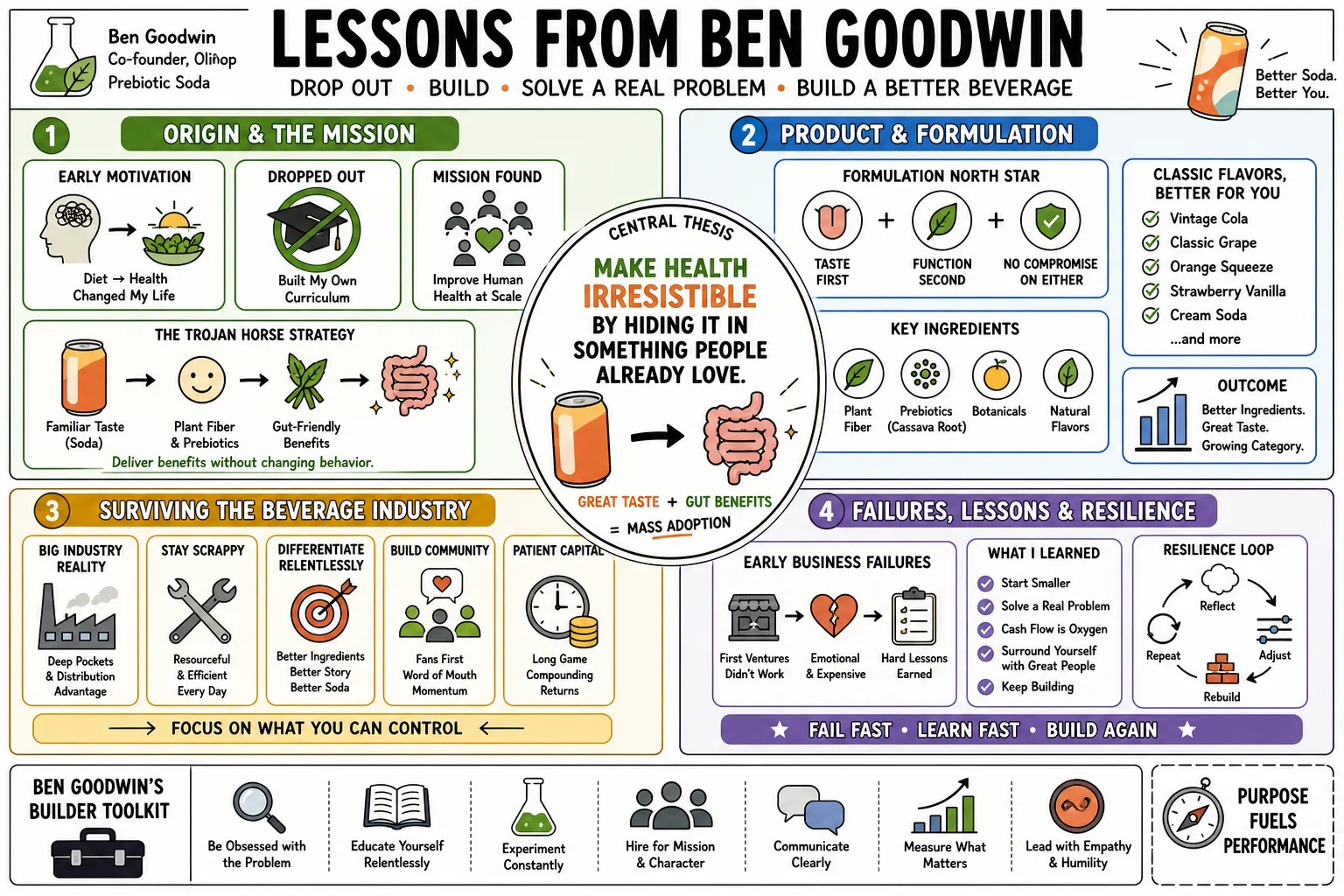
Ben Goodwin co-founded OLIPOP and serves as its Executive Chairman and Head of Innovation. His interest in nutrition helped shape a soda brand built around familiar flavors, plant fiber and prebiotics. This profile explores his approach to formulation, business growth and leadership. — OLIPOP — What Makes It Different.
Part 1: The Origin and the Mission
- On the Trojan Horse strategy: Familiar soda flavors give OLIPOP a way to introduce fiber and prebiotics without asking people to abandon a drink they already enjoy. — The Kara Goldin Show.
- On finding a mission: Goodwin sees a mission people genuinely believe in as an advantage in attracting employees and building a committed team. That mission has to be reflected in how the company operates. — CO— — Scaling OLIPOP Authentically.
- On early motivation: Goodwin recalls feeling better physically and mentally after changing his diet and exercising as a teenager. That personal experience helped motivate his interest in nutrition and product development. — The Kara Goldin Show.
- On dropping out: Goodwin left college to pursue more practical work and learning. He describes fermentation and beverage development as opportunities to investigate questions through hands-on experiments. — The Kara Goldin Show.
- On mass market appeal: Goodwin wanted a product that could appeal beyond a small wellness audience. Meeting mainstream consumers where they are meant taking their tastes and existing habits seriously. — The Kara Goldin Show.
- On starting small: Goodwin developed beverages in a home lab and continued working personally on formulations as OLIPOP grew. A modest workspace did not prevent sustained product experimentation. — Win the Day — Ben Goodwin.
- On category creation: OLIPOP combined the experience of drinking soda with a formulation built around fiber and prebiotics. Goodwin describes that combination as the basis of a different kind of soda category. — Rapid Response — OLIPOP’s Gutsy Play.
Part 2: Formulation and Science
- On scientific backing: OLIPOP works with a scientific advisory board to inform product development. That collaboration reflects a commitment to research-led formulation, not proof of every advertised health benefit. — OLIPOP — Our Story.
- On flavor engineering: Goodwin pays close attention to matching the experience of classic soda while reducing sugar and incorporating fiber and prebiotics. Familiar flavor is central to whether people want to drink the product again. — The Kara Goldin Show.
- On fiber blends: Goodwin’s formulation philosophy favors a variety of fibers, prebiotics and plant ingredients. He approaches the microbiome as an ecosystem rather than assuming one ingredient is a complete answer. — The Microbiome Report — Ben Goodwin.
- On the gut-brain axis: Goodwin’s personal experiences led him to investigate connections between digestion and how he felt mentally. That curiosity helped shape his interest in fermentation and microbiome research. — Win the Day — Ben Goodwin.
- On iterative testing: Goodwin describes spending years on formulation experiments before arriving at workable products. Repeated testing was part of the development process, rather than a single moment of inspiration. — Win the Day — Ben Goodwin.
- On sugar alternatives: OLIPOP uses ingredients such as stevia leaf, fruit juice concentrates and cassava syrup in its approach to sweetness. The formulation aims to deliver a familiar soda taste with less sugar. — OLIPOP — What Makes It Different.
- On continuous improvement: OLIPOP says its formulation approach should adapt as research develops. Product improvement is an ongoing commitment rather than a claim that the original formula is final. — OLIPOP — Our Story.
Part 3: Growth and Scaling
- On rapid expansion: Goodwin recalls that production demands grew as his earlier beverage business gained traction. Scaling required the ability to keep making the product, not just to generate more demand. — The Microbiome Report — Ben Goodwin.
- On retail strategy: Goodwin treated natural-food retail as a starting point, not the final market. He wanted to establish a product that could eventually reach mainstream consumers. — Win the Day — Ben Goodwin.
- On managing cash flow: Goodwin describes growth creating a cash-flow lag: the company had to pay for inventory before collecting money from customers. Strong demand could therefore still require additional capital. — Yahoo Finance — OLIPOP Power Players.
- On brand awareness: Getting stocked is not enough. Goodwin emphasizes consumer education and sampling that help the product sell through, because sales velocity matters to keeping retail shelf space. — FoodBev — OLIPOP Founder Q&A.
- On organizational design: As OLIPOP grew, Goodwin worked on designing systems that helped departments function together and on delegating to specialists. He continued leading formulation rather than giving it up to become CEO. — Rapid Response — OLIPOP’s Gutsy Play.
- On the direct-to-consumer model: When the pandemic disrupted normal channels, OLIPOP expanded its direct-to-consumer business. Goodwin also notes that acquiring customers online can be costly compared with letting people try the product through retail. — The Kara Goldin Show.
- On regional testing: Goodwin favored staged expansion, using performance in smaller retail channels to build confidence before larger rollouts. He describes delaying Walmart until the business was ready. — Win the Day — Ben Goodwin.
- On competing with giants: Goodwin welcomed large soda companies entering the functional-soda market as validation of the category. He still saw authentic branding and product delivery as important ways for OLIPOP to compete. — Rapid Response — OLIPOP’s Gutsy Play.
- On funding decisions: Goodwin looks for investors whose values fit the company’s long-term mission. He warns that misalignment can create serious problems even when the funding itself is attractive. — CO— — Scaling OLIPOP Authentically.
Part 4: Resilience and Learning from Failure
- On early setbacks: Goodwin spent years developing his earlier beverage venture before exiting it in 2016. Experience in formulation, supplier relationships and sales gave him a practical foundation for the next business. — Win the Day — Ben Goodwin.
- On emotional recovery: Goodwin distinguishes mechanical or strategic failures from ethical failures. He encourages learning from what went wrong without letting every business setback become a judgment on personal worth. — Win the Day — Ben Goodwin.
- On applying past lessons: Goodwin’s earlier beverage experience showed him that taste and positioning mattered alongside formulation. OLIPOP’s approach took familiar soda experiences seriously rather than relying on functionality alone. — Yahoo Finance — OLIPOP Power Players.
- On adapting: Goodwin treats adaptability as part of building a company. He emphasizes learning from feedback and hiring people whose strengths fit the stage the business has reached. — Adam Mendler — Ben Goodwin Interview.
- On problem-solving stamina: Goodwin describes resilience as essential when growth becomes difficult. A mission that matters, together with support from mentors and a trusted team, helps him keep working through challenges. — FoodBev — OLIPOP Founder Q&A.
Part 5: Leadership and Team Building
- On hiring for culture: Goodwin looks for people whose abilities fit the role and whose values fit the company. Mission alignment matters alongside the changing skills a growing business needs. — Adam Mendler — Ben Goodwin Interview.
- On co-founder alignment: Goodwin and David Lester brought complementary strengths to their partnership: product development and science on one side, commercial experience on the other. Shared values also mattered to how they worked together. — Win the Day — Ben Goodwin.
- On letting go of control: Goodwin describes learning to relinquish control as the company grew. Hiring capable specialists only helps if the founder gives them room to do their work. — Rapid Response — OLIPOP’s Gutsy Play.
- On setting the pace: Goodwin says rapid growth made it easy for processes and staffing to lag the business. Coaching, mentors and a high-trust culture helped the team recognize problems and make important pivots. — Adam Mendler — Ben Goodwin Interview.
- On managing stress: Goodwin pays attention to the tone and timing of his communication as a leader. His own emotional state can affect how an interaction lands with the team. — Rapid Response — OLIPOP’s Gutsy Play.
- On cross-functional communication: Goodwin approaches leadership partly as systems design: departments need to work in relation to one another, not just perform well separately. He focuses on the connections between teams as the organization grows. — Rapid Response — OLIPOP’s Gutsy Play.
- On self-awareness: Goodwin emphasizes recognizing where other people are stronger than he is and bringing them into the company. Growth requires a founder to become more aware of personal limits. — Rapid Response — OLIPOP’s Gutsy Play.
Part 6: Navigating the Beverage Industry
- On distributor networks: Goodwin describes early distribution as hands-on work: visiting stores, building distributor relationships and getting product into local retail. Expansion depended on those practical relationships. — The Kara Goldin Show.
- On legacy competitors: Goodwin has argued that large beverage companies face constraints when innovating beyond their established businesses. That is his assessment of incumbent incentives, not proof that they cannot enter a new category. — Win the Day — Ben Goodwin.
- On flavor rotation: Goodwin describes flavor collaborations and limited-edition releases as part of OLIPOP’s product approach. Listening to customers helps inform what the company develops next. — FoodBev — OLIPOP Founder Q&A.
- On margins: Goodwin says ingredient sourcing had to support workable margins. The formulation’s ambitions still needed an economic model that could sustain the business. — Win the Day — Ben Goodwin.
Part 7: Personal Health and the Microbiome
- On dietary fiber: Goodwin’s interest in fiber intake helped shape OLIPOP’s mission. He wanted an easy-to-use beverage that could contribute fiber and prebiotics to people’s diets. — The Microbiome Report — Ben Goodwin.
- On self-experimentation: Goodwin used personal experimentation with fermented beverages as a starting point for questions he wanted to investigate. His observations prompted curiosity, but did not by themselves establish effects for other people. — The Microbiome Report — Ben Goodwin.
- On processed food: Goodwin’s study of differences between industrialized and traditional diets influenced his interest in nutritional diversity. He used that research as a starting point for product design, not as proof that one drink can reverse dietary damage. — The Microbiome Report — Ben Goodwin.
- On biological complexity: Goodwin became skeptical of treating the microbiome as a problem solved simply by adding a few organisms. His interest shifted toward the environment those organisms inhabit and the nutrients available to them. — The Microbiome Report — Ben Goodwin.
- On ancestral diets: Research on traditional diets helped inspire Goodwin’s interest in a wider variety of plant ingredients. His aim was to incorporate some of that diversity into a convenient modern beverage. — The Microbiome Report — Ben Goodwin.
- On health equity: Goodwin wanted functional nutrition to reach beyond a small, affluent wellness audience. Taste, affordability and an approachable product experience were part of his accessibility goal. — The Microbiome Report — Ben Goodwin.
Part 8: The Philosophy of Entrepreneurship
- On doing the impossible: Goodwin credits his mentor Edward Lawson with the idea that worthwhile projects can seem impossible at first. He uses that perspective as encouragement when a difficult project has not yet become workable. — Adam Mendler — Ben Goodwin Interview.
- On human capacity: Goodwin sees personal capacity as something that can develop. He encourages people to remain open to possibilities they cannot yet imagine achieving. — Adam Mendler — Ben Goodwin Interview.
- On irrational persistence: Goodwin kept working through years of difficult product experiments before achieving a viable formulation. His story emphasizes sustained persistence, without making stubbornness a universal rule for every business. — Win the Day — Ben Goodwin.
- On continuous learning: Goodwin treats leadership as an ongoing process of personal development. Becoming more effective requires learning about communication, emotional intelligence and how to support other people. — Adam Mendler — Ben Goodwin Interview.
- On defining success: Goodwin wants commercial success to serve the company’s underlying mission. He describes meaningful consumer impact as a reason to build the business, not merely a marketing story around financial results. — The Kara Goldin Show.
- On taking feedback: Goodwin values customer feedback while also wanting to preserve the product’s underlying research and integrity. Growth or a potential acquisition should not quietly strip away what the company set out to build. — Win the Day — Ben Goodwin.
- On patience: Goodwin’s beverage work involved years of experimentation before OLIPOP. The visible success came after a long period of development, rather than an instant breakthrough. — Win the Day — Ben Goodwin.
- On legacy: Goodwin wants to show that a commercially successful beverage company can remain committed to its product mission. Profitability and preserving the research foundation are both part of that ambition. — Win the Day — Ben Goodwin.