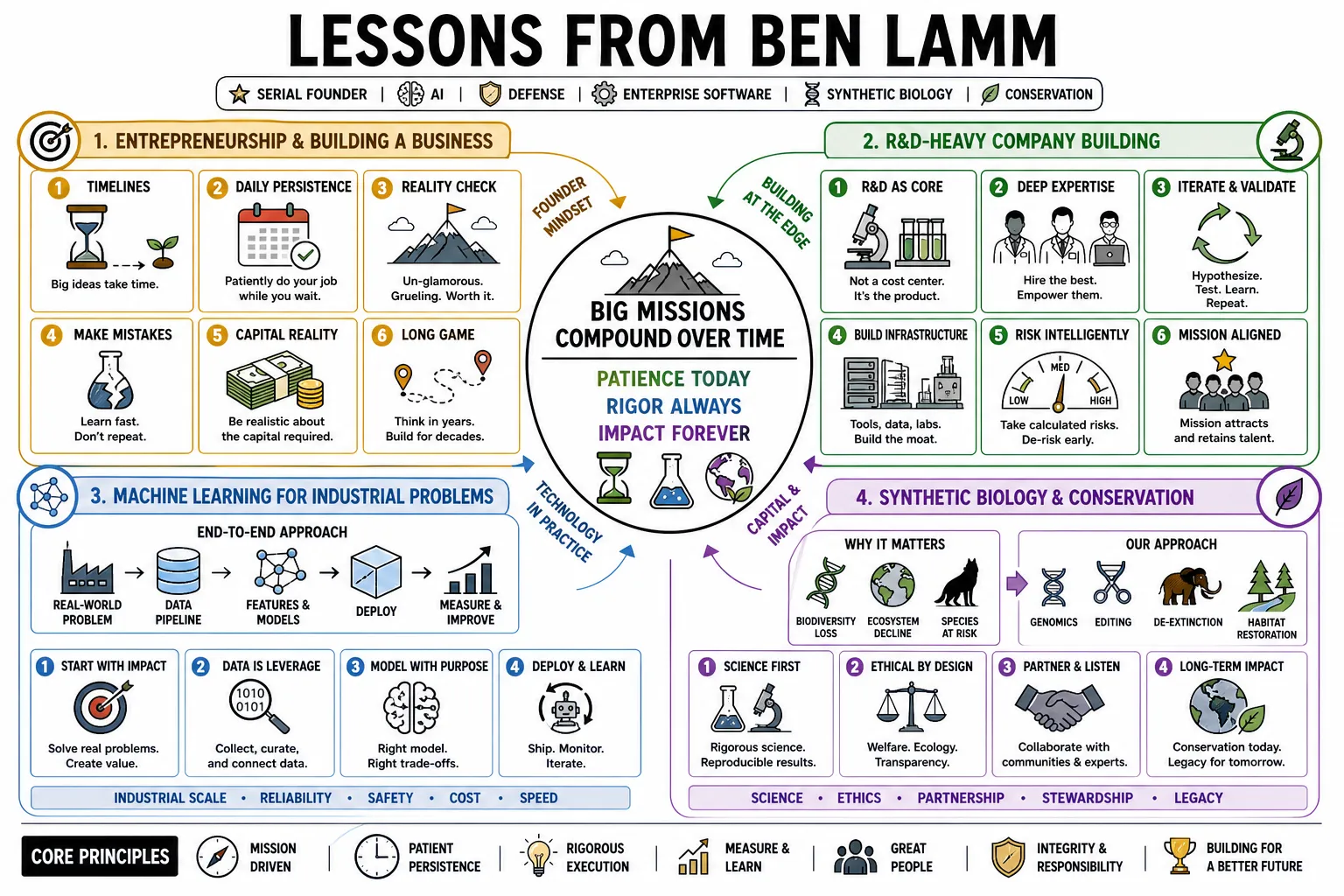
Lessons from Ben Lamm
Ben Lamm is the co-founder and CEO of Colossal Biosciences. He previously founded Hypergiant, Conversable and Chaotic Moon, working across enterprise AI, conversational software and creative technology. This profile examines his perspectives on building companies and developing technology for conservation. — Colossal — Ben Lamm Biography.
Part 1: Entrepreneurship & Building a Business
- On the reality of timelines: Lamm warns that ideas take longer to develop than founders expect; patient day-to-day execution continues while results take shape. — Authority Magazine — Ben Lamm’s Big Idea.
- On founder expectations: Lamm describes entrepreneurship as emotionally demanding and all-consuming, with sacrifices that extend beyond ordinary job responsibilities. — Dallas Innovates — CEO Insider Interview.
- On making mistakes: Lamm says previous ventures provide lessons, credibility and networks, but starting again still requires developing a vision and executing it. — Dallas Innovates — Life as a Serial Entrepreneur.
- On capital requirements: Lamm argues that funding and sustained focus allow a company to build a complete system rather than only a narrow research solution. — Infinite Frontiers — De-Extinction Business.
- On building software vs. hardware: Lamm describes physical size as a major challenge for the Eos Bioreactor; robotics expertise helped adapt the product for commercial buildings. — Arm — Hypergiant’s Eos Bioreactor.
- On market timing: Conversable grew from recognizing a shift in how consumers wanted to communicate with brands, alongside advances in conversational AI. — Dallas Innovates — CEO Insider Interview.
- On early sales: Lamm argues that CEOs must lead by example in sales and build customer relationships, rather than only selling their vision. — Entrepreneur — The Ability to Sell.
- On choosing markets: Lamm evaluates an opportunity’s market size, technical feasibility, competitive advantage, team requirements and risk before committing. — Entrepreneur — Lessons from Seven Companies.
Part 2: Innovation & the "Beginner's Mind"
- On Shoshin (beginner's mind): Lamm approaches a new career direction as a beginner, asking again how he wants to understand the world. — Entrepreneur — Cultivating Curiosity.
- On admitting ignorance: Being willing to say he does not know or understand something helps Lamm stay open to learning. — Entrepreneur — Cultivating Curiosity.
- On internal R&D: Lamm values an innovation hub that gives researchers room to experiment while remaining committed to the company’s core mission. — Infinite Frontiers — De-Extinction Business.
- On blurring disciplines: Lamm draws ideas from technology, science and popular culture, using research and active participation to develop his intuition about their intersection. — Adam Mendler — Serial Tech Entrepreneur Interview.
- On questioning assumptions: Lamm uses a beginner’s mindset to question preconceptions and ask why, deepening curiosity and understanding. — Authority Magazine — Ben Lamm’s Big Idea.
- On designing for the user: Lamm ties a digital experience to a specific use case; his festival bot example helped visitors navigate an in-person event. — MarTech Series — Conversable Interview.
- On iterative development: Lamm advocates starting with a vision, product and growth plan, then adapting that plan to market feedback. — Dallas Innovates — CEO Insider Interview.
- On technological optimism: Lamm describes himself as optimistic about collaborative technological progress while acknowledging mistakes and dual-use risks. — MCJ — De-Extinction as a Platform Business.
Part 3: Managing Failure, Adversity, and Growth
- On dealing with adversity: Lamm treats adversity as a reason to reassess what is working and avoid temporary fixes that constrain later growth. — Dallas Innovates — CEO Insider Interview.
- On public scrutiny: Lamm accepts scientific disagreement while arguing that disputes over terminology should not obscure the team’s technical work. — Masters of Scale — Ben Lamm.
- On founder psychology: Lamm treats mental health as important alongside physical health and recommends finding restorative habits that work personally. — Authority Magazine — Ben Lamm’s Big Idea.
- On pivoting: Lamm distinguishes ordinary adaptation from a fundamental business-model change, warning against celebrating a pivot without examining the original misjudgment. — Entrepreneur — Can We Stop Pivoting Already?.
- On rejection: Lamm advises CEOs to put their ego aside, hear repeated refusals and remain on the front line of customer relationships. — Entrepreneur — The Ability to Sell.
- On resilience: Lamm identifies persistence, continued learning and surrounding himself with more knowledgeable people as important to his entrepreneurial approach. — Colossal — Tony Robbins with Ben Lamm.
Part 4: Leadership, Team Building, and Mentorship
- On listening: Lamm recommends listening without interrupting or preparing a response prematurely, giving employees room to contribute ideas. — Entrepreneur — Lessons from Seven Companies.
- On hiring experts: Lamm emphasizes hiring people with stronger specialist knowledge and allowing them to own the work they do best. — Adam Mendler — Ben Lamm Interview.
- On team alignment: A clear, actionable vision gives talented people something they can understand, get excited about and take ownership of. — Adam Mendler — Ben Lamm Interview.
- On company culture: Lamm found that adding virtual social events could burden employees; Hypergiant shifted toward flexible hours that left room for family responsibilities. — The Business of Business — Hypergiant Interview.
- On cross-disciplinary teams: Lamm recommends hiring people with different talents and perspectives and working through disagreements rather than allowing complacency. — Entrepreneur — Ben Lamm on Inclusive Teams.
- On delegating: Scaling requires accepting that capable colleagues may do things differently from the founder, including allowing room for mistakes. — Adam Mendler — Ben Lamm Interview.
- On transparency: Lamm argues that leaders should acknowledge their difficulties and emotions rather than exaggerating positives to project confidence. — Entrepreneur — How Crying Could Save Your Business.
- On recruiting for hard problems: Lamm sees a compelling scientific mission and cultural relevance as recruiting advantages. — Thought Economics — Ben Lamm Interview.
- On mentorship: Lamm seeks out leading people in unfamiliar fields, asks questions and listens to their advice while developing a business idea. — Adam Mendler — Serial Tech Entrepreneur Interview.
Part 5: Artificial Intelligence & its Applications
- On pragmatic AI: Lamm favors pragmatic AI software addressing present-day problems rather than focusing only on future possibilities. — MarTech Series — Conversable Interview.
- On data infrastructure: Lamm describes a common goal across sensor inputs: bringing the data into an interface people can use, whether it comes from ground systems, satellites or aircraft. — The Business of Business — Hypergiant Interview.
- On AI in defense: Describing Hypergiant’s satellite work with the Air Force, Lamm paired continuous software updates with development in a secure environment meeting Defense Department requirements. — Dallas Innovates — Reconfigurable Satellites.
- On the consumer experience: Lamm starts with customer intent and the channels people already use, designing conversational tools around actual information gaps. — MarTech Series — Conversable Interview.
- On conversational interfaces: Lamm saw messaging and voice interfaces as an entry point for brands to develop broader organizational AI capabilities. — Dallas Innovates — CEO Insider Interview.
- On AI in biology: Lamm describes AI as integrated into Colossal’s work, including ancient-DNA assembly, comparative genomics and bioacoustics. — Thought Economics — Ben Lamm Interview.
- On edge computing: Lamm described processing data within a satellite fleet instead of transmitting it to the ground, where interception was a concern. — Dallas Innovates — Reconfigurable Satellites.
- On human-machine collaboration: Lamm hopes AI can streamline processes that obstruct meaningful work, while recognizing that its social and ethical effects still require attention. — AiThority — Ben Lamm Interview.
- On evaluating AI startups: Lamm recommends asking how a vendor will access data, train models and address a concrete use case rather than accepting an AI label as proof of substance. — BetaNews — AI Reality and Hype.
Part 6: De-Extinction & Synthetic Biology
- On the purpose of de-extinction: Lamm describes Colossal’s aim as creating extinct-species proxies and developing tools for conservation—not merely displaying unusual animals. — Jordan Harbinger — Ben Lamm Interview.
- On preserving biological material: Lamm advocates biobanking blood samples and building biological vaults to preserve material for future conservation work. — Thought Economics — Ben Lamm Interview.
- On the mammoth project: Lamm describes using edited mice as a model-species test of selected traits in Colossal’s mammoth research, not as proof a mammoth has been produced. — CBR — Ben Lamm Interview.
- On transparency in biotech: Lamm describes public updates and educational content as responsibilities, rather than an obligation to persuade everyone to approve the work. — Masters of Scale — Ben Lamm.
- On artificial wombs: Lamm separates planned first-generation births through surrogates from the more uncertain effort to develop artificial wombs, beginning with smaller animals. — CBR — Ben Lamm Interview.
- On spin-off technologies: Lamm describes licensing or spinning out potential human-health applications rather than working on humans at Colossal. — MCJ — De-Extinction as a Platform Business.
- On ethical frameworks: Lamm says Colossal’s work goes through animal-care and ethics review and involves conservation partners. — CBR — Ben Lamm Interview.
- On species preservation: Lamm stresses that conservation applications for endangered species matter even when they attract less attention than de-extinction announcements. — Masters of Scale — Ben Lamm.
- On the timeline of biology: Lamm treats long gestation and endangered-animal surrogacy as constraints that make mammoth experiments harder to iterate than tests in smaller species. — CBR — Ben Lamm Interview.
Part 7: Solving Global Challenges & Conservation
- On leveraging technology for climate: Lamm presents Hypergiant’s algae-bioreactor project as one contribution to a collective climate effort, not a single technology that will solve climate change. — Authority Magazine — Ben Lamm’s Big Idea.
- On plastic degradation: Breaking, co-founded by Lamm, is developing a naturally derived plastic-degradation approach; further enzyme research and engineering remain part of the work. — Wyss Institute — Breaking’s Plastic-Degradation Research.
- On biodiversity loss: Lamm argues for adding technological tools to established conservation, not replacing it; he acknowledges Colossal’s experimental approach may fail. — MCJ — De-Extinction as a Platform Business.
- On open-source conservation: Lamm says Colossal intends to provide conservation applications of its technology for free, including tools being developed for elephant reproduction. — CBR — Ben Lamm Interview.
- On ecosystem restoration: Lamm treats rewilding as a separate planning challenge requiring consultation with governments, Indigenous groups, ecologists and conservationists. — MCJ — De-Extinction as a Platform Business.
- On private-sector involvement: Lamm says free conservation tools are insufficient when partners cannot fund implementation; Colossal’s foundation helps subsidize that work. — Thought Economics — Ben Lamm Interview.
- On government partnerships: Lamm describes paid government implementation projects for existing species, distinguishing them from de-extinction projects. — MCJ — De-Extinction as a Platform Business.
- On long-term thinking: Lamm combines a long-term restoration roadmap with nearer-term tools and spinouts, while acknowledging uncertainty about future business models. — Thought Economics — Ben Lamm Interview.
- On technological intervention: Lamm sees human-caused environmental damage as a reason to use technology responsibly for conservation, not a reason to abandon existing conservation. — Masters of Scale — Ben Lamm.
Part 8: The Future of Technology & Humanity
- On space exploration: Lamm sees orbital sensors as useful for Earth-facing applications, including weather, climate observation, defense and communication. — Dallas Innovates — Reconfigurable Satellites.
- On biological intelligence: Lamm describes understanding how genes translate into physical traits as central to Colossal’s computational analysis and editing work. — Jordan Harbinger — Ben Lamm Interview.
- On regulating deep tech: Lamm favors expert-led ethical guidelines and distinguishes Colossal’s species-focused work from human and non-human-primate applications. — Masters of Scale — Ben Lamm.
- On software eating biology: Lamm says his software background helps him view Colossal as a system and break it into the components needed to make it work. — Infinite Frontiers — De-Extinction Business.
- On the legacy of tech: Lamm advises leaders to consider their actions’ effects on the world and aim to leave it better. — Adam Mendler — Serial Tech Entrepreneur Interview.