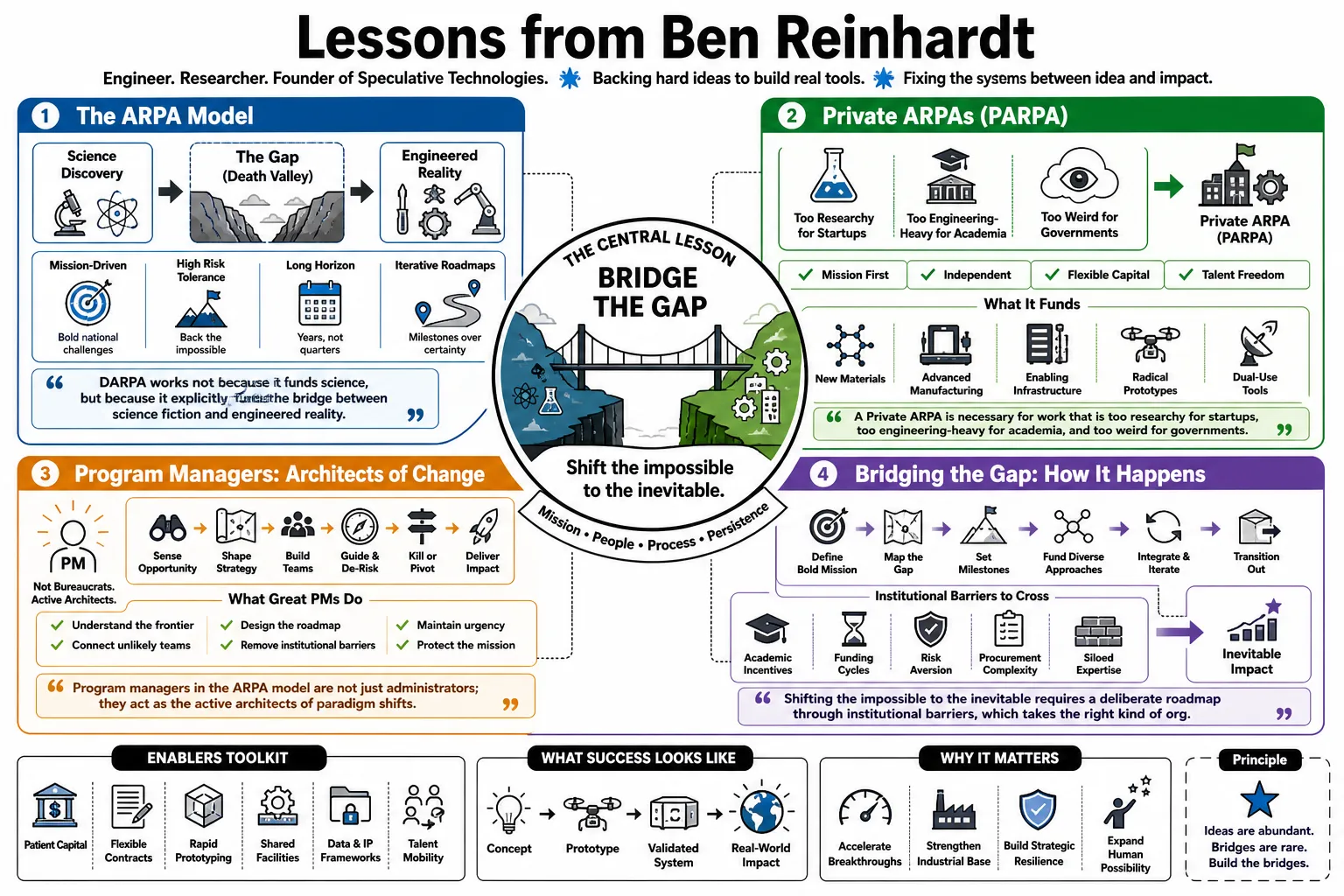
Lessons from Ben Reinhardt
Ben Reinhardt builds Speculative Technologies, a nonprofit industrial research lab focused on technologies that do not fit neatly into existing institutions. He studies how research programs and funding structures can help turn ambitious technical ideas into practical tools. — Ben Reinhardt — About.
Part 1: The ARPA Model and PARPA
- On DARPA's success: Reinhardt studies DARPA as an outlier in turning ambitious technical visions into working systems, with lessons that may apply beyond defense. — Why does DARPA work?.
- On private ARPAs: He proposes DARPA-inspired organizations for solutions R&D that falls between the usual strengths of startups and academic labs. — Shifting the Impossible to the Inevitable.
- On program leaders: Effective ARPA program leaders shape technical visions, assemble collaborators, and direct resources—not merely administer grants. — Why does DARPA work?.
- On turning visions into programs: His proposed private-ARPA path begins by mapping technical obstacles, testing key hypotheses, and coordinating programs around the results. — Shifting the Impossible to the Inevitable.
- On deliberate technology development: Ambitious physical technologies can need institutions willing to organize research and engineering that existing organizations leave undone. — Shifting the Impossible to the Inevitable.
- On program-leader agency: Across varied ARPA programs, Reinhardt identifies the leader's freedom to choose an approach suited to the goal as a recurring factor in success. — The ARPA Model Isn't What You Think It Is.
- On DARPA-inspired institutions: A DARPA-inspired organization can adapt empowered program leadership and coordinated research to fields outside defense without copying DARPA wholesale. — Why does DARPA work?.
- On staged technical bets: ARPA program design moves from a bold vision to evidence that it is technically plausible, then to demonstrations and a path to implementation. — Why does DARPA work?.
- On ideas outside conventional funding: Reinhardt's case for private ARPA-style research includes projects poorly suited to academic labs or startups, even when they could create valuable technology. — Shifting the Impossible to the Inevitable.
- On coordinating technical risk: A private ARPA could design programs that test major technical assumptions before committing to full-scale development. — Shifting the Impossible to the Inevitable.
Part 2: Speculative Technologies & Institutional Design
- On a nonprofit industrial lab: Reinhardt describes Speculative Technologies as a nonprofit industrial research lab for promising technologies that lack a clear home in existing institutions. — Ben Reinhardt — About.
- On gaps between institutions: Reinhardt argues that institutions specialize in different kinds of research work, leaving friction when an idea must move between them. — Research Has Customers.
- On intrinsic motivation: He argues that ambitious research needs intrinsic motivation, while good management can coordinate people without reducing management to commands. — Bottling Lightning.
- On institutional design: An institution's norms, incentives, and resources influence what research ideas people form and which work they pursue. — Bottling Lightning.
- On limits of familiar institutions: Systems research can be hard to fit into academic publishing incentives or company return requirements, especially when integration is slow and uncertain. — Whence Systems Research?.
- On focused research organizations: Reinhardt describes focused research organizations as one way to organize a core team around a specific problem; he says Speculative Technologies helps launch them rather than being one itself. — Complex Systems — Economics of Discovery.
- On organizational fit: Different institutions develop strengths in different kinds of research, so leaders should be explicit about the work their organization can and cannot do. — Research Has Customers.
- On pre-commercial research: Some promising technologies are valuable before they are attractive investments; Reinhardt argues that they may need a different institutional home until commercial development makes sense. — What Makes Research Commercially Viable?.
- On creating conditions for ideas: Research institutions shape the ideas people think to pursue by changing culture, resources, and the perceived paths available to them. — Bottling Lightning.
Part 3: The Gap Between Academia and Startups
- On academic incentives: Reinhardt characterizes academic rewards as centered on papers, citations, and novelty; that can leave less publishable engineering work without a natural home. — Shifting the Impossible to the Inevitable.
- On scientific inquiry and engineering: He distinguishes scientific inquiry's search for general explanations from engineering design's effort to build useful physical systems; neither simply follows the other. — Shifting the Impossible to the Inevitable.
- On the valley of death: Materials and manufacturing ideas can fall into a valley of death when timelines, capital needs, and integration work exceed what existing institutions will support. — Materials and Manufacturing Underpin Civilization.
- On hardware financing: A promising physical technology may need years of research and scale-up before a viable product exists, making an ordinary startup a poor initial home. — Materials and Manufacturing Underpin Civilization.
- On what papers leave out: Reinhardt says a paper can report a result while omitting the process knowledge needed for another lab to reproduce it reliably. — Complex Systems — Economics of Discovery.
- On academic system-building: Academic incentives can reward a novel component more readily than the unglamorous integration work needed to make an entire system function. — Whence Systems Research?.
- On startup risk: Startups may struggle when a new technology combines technical, market, and distribution-channel risk before it has a clear product path. — Shifting the Impossible to the Inevitable.
- On the missing institutional niche: Reinhardt argues that some solutions R&D is too research-intensive for a startup and too engineering-intensive for a conventional academic lab. — Shifting the Impossible to the Inevitable.
- On cross-disciplinary work: Materials breakthroughs can depend on research, prototyping, and manufacturing expertise working together with aligned incentives. — Materials and Manufacturing Underpin Civilization.
- On commercial viability: A technology can create worthwhile value yet be a weak early venture investment when the work takes too long or offers insufficient financial return for the risk. — What Makes Research Commercially Viable?.
Part 4: Process Knowledge and Tacit Expertise
- On process knowledge: A research paper may record the result, while practical know-how remains with the people and lab that made it work. — Complex Systems — Economics of Discovery.
- On transferring tacit know-how: Written instructions alone may not convey the practical adjustments that make an experiment reproducible; working with experienced researchers can matter. — Complex Systems — Economics of Discovery.
- On communities of practice: Reinhardt argues that written knowledge does not guarantee that a society retains the ability to use it; institutions can preserve communities with tacit expertise. — In Defense of Academia.
- On making reliable technologies: Turning a proof of concept into a usable technology can require scale-up and integration work that differs from demonstrating a phenomenon. — Materials and Manufacturing Underpin Civilization.
- On learning by doing: In a proposal for technical education, Reinhardt favors apprentices learning through serious work inside a research lab, with classes serving that practical training. — The Hardcore Institute of Technology.
- On manufacturing expertise: His transistor example shows how a machinist's hands-on skill helped resolve a practical materials problem that the formal research team could not solve alone. — Materials and Manufacturing Underpin Civilization.
Part 5: The Constraints of Venture Capital
- On venture capital's fit: Reinhardt treats venture funding as valuable for some technologies, but argues that it is a poor fit for research whose time, uncertainty, and returns do not meet investors' requirements. — What Makes Research Commercially Viable?.
- On capital-intensive hardware: Physical technologies may carry risk comparable to software while requiring more capital and longer development, which can make them less attractive to venture funds. — Shifting the Impossible to the Inevitable.
- On venture-scale outcomes: A venture-backed project must credibly offer returns large enough to matter to the fund; useful but smaller opportunities may need other financing. — Shifting the Impossible to the Inevitable.
- On compounded technical risk: A new technology that simultaneously faces technical, market, and sales-channel uncertainty can be an especially hard startup investment. — Shifting the Impossible to the Inevitable.
- On investment time horizons: Reinhardt says venture-fund pressure for returns within roughly five to seven years can push projects toward narrow applications or early acquisition. — Shifting the Impossible to the Inevitable.
- On matching funding to public value: When a technology's impact depends on wide diffusion, maximizing private value capture can work against that impact; Reinhardt considers grants, contracts, and other structures alongside equity. — Shifting the Impossible to the Inevitable.
- On modest-scale businesses: Some PARPA spin-offs could be useful small companies without venture-scale growth; Reinhardt proposes profit sharing as one possible alternative to equity ownership. — Shifting the Impossible to the Inevitable.
Part 6: Idea Machines and Navigating the Idea Maze
- On idea machines: In a conversation with Nadia Asparouhova, Reinhardt says they independently arrived at the term idea machines; the episode credits her formulation of organizations that connect ideas to outcomes. — Idea Machines — Nadia Asparouhova.
- On systems behind innovation: Reinhardt argues that culture, available resources, and institutional paths can change which ideas people imagine and pursue. — Bottling Lightning.
- On the institutional idea maze: He compares institution-building to navigating an idea maze: a series of consequential decisions made under uncertainty. — Shifting the Impossible to the Inevitable.
- On technical roadmaps: Program design can map technical assumptions and dependencies, but Reinhardt cautions that roadmaps cannot reveal every unknown before work begins. — Shifting the Impossible to the Inevitable.
- On learning through experiments: His PARPA roadmap calls for stress-testing research programs and using early experiments to reduce uncertainty before expanding them. — Shifting the Impossible to the Inevitable.
Part 7: High-Leverage Research and "Big-if-True" Bets
- On big-if-true research: Reinhardt's Brains program seeks ambitious pre-commercial research that may have large consequences if it works but does not fit a single startup or academic lab. — We Desire Your Brains Once Again.
- On engineering design: Reinhardt distinguishes inquiry that explains the world from engineering design that works toward a useful physical system; neither simply follows the other. — Shifting the Impossible to the Inevitable.
- On small tests of ambitious visions: In the ARPA model he studied, seedling projects test the riskiest parts of a program before the full research effort is launched. — Why does DARPA work?.
- On materials and manufacturing: Reinhardt argues that new materials and manufacturing methods underlie many other advances, but taking a lab result to usable scale needs sustained work. — Materials and Manufacturing Underpin Civilization.
- On tolerating failed bets: Reinhardt notes that many DARPA programs do not yield transformative results; the model's value depends partly on being willing to fund uncertain ideas. — Why does DARPA work?.
- On escaping local optimization: Systems research may initially make an existing technology look worse on standard metrics before it can unlock a different technological path. — Whence Systems Research?.
- On judging research programs: Reinhardt says his Brains program will judge its success by the impact of participants' later coordinated research, not merely by the training process itself. — We Desire Your Brains.
- On manufacturing bottlenecks: Inventing a material is only the beginning: scaling, certification, factory investment, and finding users can each block its adoption. — Getting Materials Out of the Lab.
Part 8: Metascience and the Future of Discovery
- On studying how research is organized: Reinhardt argues that research-funding and management structures influence what gets discovered; he proposes testing alternative institutional models rather than treating the current model as fixed. — Fund Organizations, Not Projects.
- On diversifying research funding: He proposes funding a portfolio of independent research organizations alongside conventional project grants, giving capable teams greater autonomy over uncertain work. — Fund Organizations, Not Projects.
- On incentives in discovery: Milestone-scoped grants and detailed spending rules can constrain high-risk work; Reinhardt favors giving research leaders discretion to adapt as experiments reveal new information. — Fund Organizations, Not Projects.
- On diversity of research approaches: A portfolio of organizations with different constraints may support work that current institutions discourage; Reinhardt cautions against judging all new approaches by the same short-term metrics. — Fund Organizations, Not Projects.
- On the purpose of technology research: Reinhardt's stated aim is to create technologies that expand human capabilities and possibilities, not only to produce papers or immediate revenue. — Shifting the Impossible to the Inevitable.