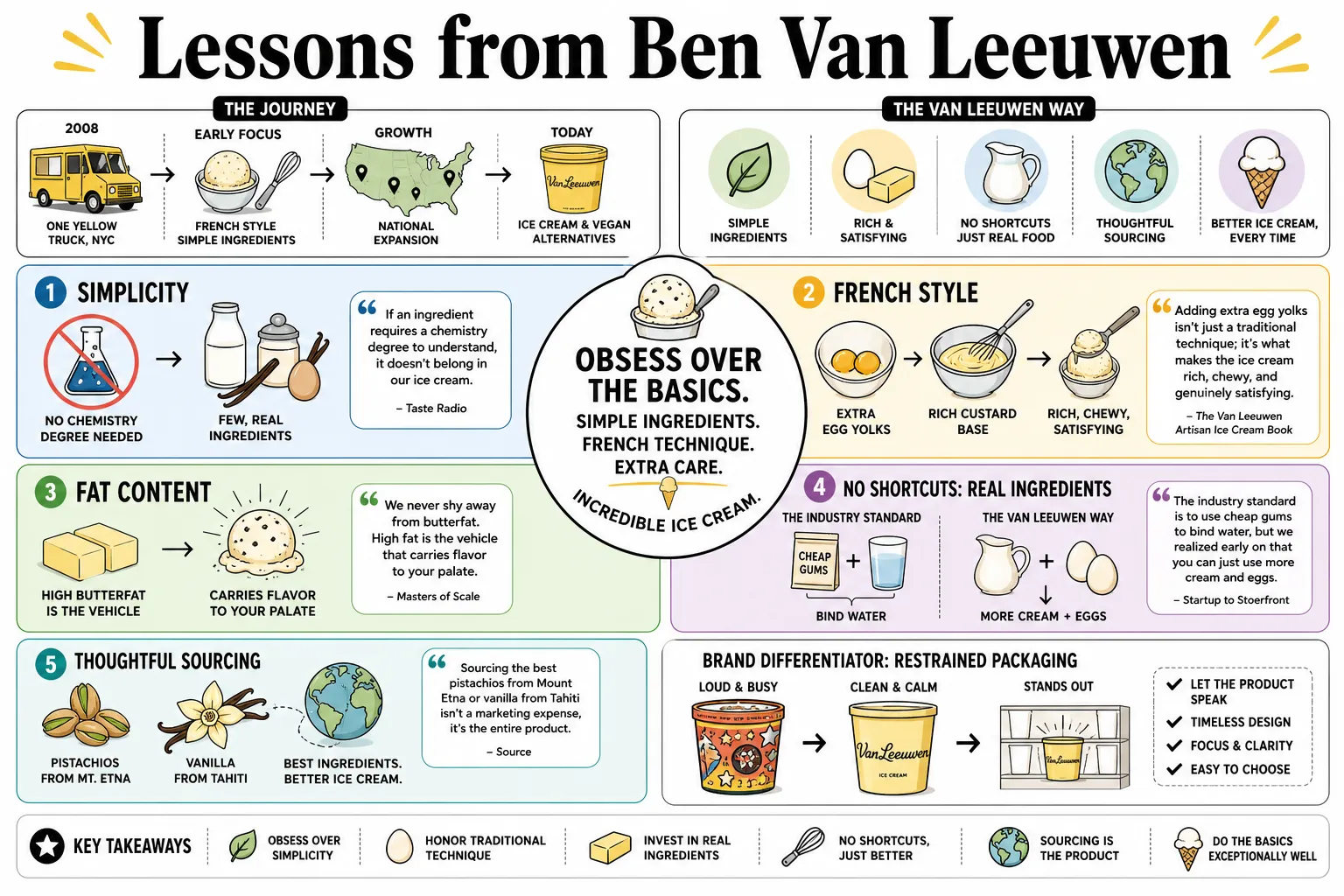
Lessons from Ben Van Leeuwen
Ben Van Leeuwen co-founded Van Leeuwen Ice Cream with Pete Van Leeuwen and Laura O’Neill, starting from a yellow New York City truck in 2008. The company later expanded to scoop shops, grocery pints and vegan ice cream while emphasizing its ingredient-led French-style recipe. — Van Leeuwen FAQ.
Part 1: Product & Ingredients
- Start with a simple base: Van Leeuwen describes the original dairy recipe as milk, cream, sugar and egg yolks, then builds distinctive flavors through careful sourcing. — Cookery by the Book Interview.
- Use egg yolks deliberately: The company says its French-style ice cream uses roughly twice as many egg yolks as standard ice cream; the choice is part of its richness and texture. — Van Leeuwen FAQ.
- Build richness into the formula: Van Leeuwen says the dairy flavors contain about 17–19 percent butterfat, and that substantial egg yolks add chewiness and thickness. — FoodNavigator Interview.
- Let the base do the work: Van Leeuwen describes a high-cream, high-egg-yolk base without stabilizers, rather than relying on additives to create the texture he wanted. — Taste Radio Episode 203.
- Source flavors for taste: The founders sought out chocolate from Michel Cluizel, Sicilian pistachios and Piedmont hazelnuts because those ingredients made the ice cream taste better. — Cookery by the Book Interview.
- Test the ingredient in the product: Before choosing a chocolate, the team tested many batches in actual ice cream and selected the result they preferred, despite advice that premium chocolate would be wasted in the base. — Taste Radio Episode 203.
- Adjust to how guests taste it: After customers said the early formula was not sweet enough, Van Leeuwen's team increased the sugar in the recipe rather than treating its first version as untouchable. — Harvard Crimson Interview.
- Scale can improve quality: Larger-scale production can improve ice cream when better temperature control freezes it faster and produces smaller ice crystals. — Brooklyn Magazine Interview.
- Protect the recipe when costs rise: When cream and egg costs rose, Van Leeuwen says the company kept its formula and absorbed the financial hit instead of reducing those ingredients. — Harvard Crimson Interview.
- Keep product development close: The company says its Brooklyn research-and-development kitchen is led by Van Leeuwen, keeping the founder directly involved in new flavors. — Van Leeuwen FAQ.
Part 2: Early Days & The Yellow Truck
- Spot the mismatch: After seeing a Mister Softee truck, Van Leeuwen wondered why a truck could not serve carefully made ice cream with better ingredients; he called Pete and Laura to start the venture. — Taste Radio Episode 203.
- Learn the craft while starting: Unable to afford their own facility, the founders learned recipes from cookbooks and traveled to a dairy farm to make ice cream as the truck business began. — Skidmore Interview.
- Start lean by necessity: The founders began with about $60,000 from friends and family, converted a used post-office truck and ran early operations from their apartment. — Taste Radio Episode 203.
- The early trucks were hard work: Early truck shifts could end with late-night towing after slashed tires, a generator out of gas, and a frozen espresso machine. — Brooklyn Magazine Interview.
- Parking was a reason to leave the trucks: The first Greenpoint shop eliminated truck hassles over parking spaces, water and power, and the founders stopped adding trucks. — Inc. Founder Interview.
- Share the early shifts: The founders rotated truck, production and business work while holding other jobs; the first phase depended on sustained hands-on labor, not a ready-made organization. — Skidmore Interview.
- Work through the family dynamic: Van Leeuwen says building with his brother Pete and Laura O’Neill meant more unfiltered arguments, but also deep trust and alignment about the company. — Taste Radio Episode 203.
- Grocery success was not automatic: Van Leeuwen initially assumed good ice cream and attractive packaging would sell once placed in a store; crowded shelves taught him that sales velocity mattered. — Brooklyn Magazine Interview.
- Use shops as a test channel: The scoop shops let the team introduce special flavors quickly, observe guest response and decide which deserve a slower grocery-pint rollout. — Taste Radio Episode 203.
- The first shop changed the growth plan: The founders imagined thousands of trucks. After six trucks, they tested a Greenpoint shop and quickly decided not to build more trucks. — Inc. Founder Interview.
Part 3: Scaling & Distribution
- Learn grocery's three hurdles: Van Leeuwen describes wholesale growth as winning shelf placement, generating repeat sell-through and managing distributor chargebacks—different work from operating scoop shops. — Taste Radio Episode 203.
- Bring production in-house for innovation: After roughly two years of co-manufacturing, the founders moved ice cream production into their own small Greenpoint space because the outside arrangement constrained flavor experimentation. — Taste Radio Episode 203.
- Find savings outside the recipe: Van Leeuwen says the team lowered its costs through larger ingredient purchases and distribution changes while leaving the product formula intact. — FoodNavigator Interview.
- Design for frozen delivery: For nationwide shipping, the company uses insulated packaging and dry ice to keep ice cream frozen to the customer's doorstep. — Van Leeuwen FAQ.
- Raise when the growth path is clearer: After years of running lean, the founders accepted outside capital when they better understood the business and could see a clearer route to expansion. — Taste Radio Episode 203.
- Question each store build-out cost: Van Leeuwen recalls contractor bids for one early shop ranging widely, teaching the founders to examine construction expenses before committing scarce capital. — Taste Radio Episode 203.
- Scale production in stages: The company shifted from co-manufacturing to an approximately 800-square-foot Greenpoint operation and later to a 5,000-square-foot factory as volume grew. — Taste Radio Episode 203.
Part 4: Vegan Innovation
- Hold vegan ice cream to the same standard: Van Leeuwen says the team set out to make great ice cream that happened to be vegan, measuring it against the dairy product's texture and richness. — Taste Radio Episode 203.
- Replace dairy fat deliberately: The vegan base uses coconut oil and cocoa butter to create richness and mouthfeel instead of relying on dairy butterfat. — Taste Radio Episode 203.
- Use cashews for body: Van Leeuwen explains that cashews supply some of the solids that help vegan ice cream keep a substantial, chewy texture. — Taste Radio Episode 203.
- Make vegan choice substantive: Van Leeuwen says the vegan range was not a token concession: the team put comparable development effort into it so customers would have genuinely appealing choices. — FoodNavigator Interview.
- Iterate beyond cashews: After the original cashew-based vegan recipe, the team developed an oat-milk version using oat milk, coconut, cocoa butter and coconut oil. — Taste Radio Episode 203.
- Keep vegan and allergy safety distinct: Van Leeuwen offers vegan flavors, but its FAQ warns that products are made in a shared facility handling major allergens; vegan labeling alone is not an allergy-safety guarantee. — Van Leeuwen FAQ.
- Develop quality before cost reductions: Van Leeuwen says the cashew- and cocoa-butter-heavy vegan recipe was expensive, but the team launched it first and looked for later ways to reduce its cost. — Taste Radio Episode 203.
Part 5: Brand & Aesthetics
- Use less to stand out: In the crowded freezer aisle, the team and Pentagram reduced the pint front to color, the logo and the flavor name rather than adding more quality claims. — Taste Radio Episode 203.
- Evolve a recognizable color: Pentagram retained Van Leeuwen's familiar buttercup yellow but shifted it toward a softer pastel tone as the broader identity was refreshed. — Pentagram Case Study.
- Build a consistent type system: Pentagram kept the familiar Van Leeuwen wordmark and introduced Sofia Pro as a supporting sans-serif typeface for print and digital use. — Pentagram Case Study.
- Carry the brand into the shop: For the Nolita location, the store designer used a single pastel blue and the packaging identity to make a modern ice-cream parlor that still reflected the brand's artisanal roots. — Van Leeuwen Nolita Design.
- Let the pint speak at the shelf: Van Leeuwen says packaging may be the only message a shopper sees while deciding in the freezer aisle, so its visual simplicity has to convey the brand quickly. — Taste Radio Episode 203.
- Use color to navigate flavors: Pentagram says the expanded color system helps shoppers identify flavors and tell the classic and vegan lines apart. — Pentagram Case Study.
- Make the identity extensible: The redesigned palette, wordmark and supporting typeface form a system Pentagram says can adapt to future flavors and product lines without losing coherence. — Pentagram Case Study.
Part 6: Leadership & Mindset
- Make feeling good part of the mission: The company's stated mission is to make good ice cream that makes people feel good; it treats enjoyment as a brand value, not a demonstrated health effect. — Van Leeuwen — Our Story.
- Stay close to the enjoyable work: Van Leeuwen describes making and serving ice cream as the most enjoyable parts of the company and central to why he works on it. — Taste Radio Episode 203.
- Hire at a pace the business can carry: Van Leeuwen says the lean early business could not afford hires whose contribution would take years to pay for itself. — Taste Radio Episode 203.
- Question spending against value: Van Leeuwen says the founders examined each expense and asked whether it served customers or the people doing the work. — Taste Radio Episode 203.
- Visit the shops to learn: Van Leeuwen says store visits expose him to guests and employees in ways office data cannot, making in-person observation part of his CEO work. — Harvard Crimson Interview.
Part 7: Unconventional Marketing
- Use surprise only if the flavor works: The Kraft Mac & Cheese collaboration drew attention because the combination was unexpected, but Van Leeuwen says the team still made a flavor they believed tasted good. — Inc. Kraft Collaboration Interview.
- Earn attention when ad spending is limited: With little budget for advertising, Van Leeuwen saw the unexpected Kraft collaboration as a way to make a niche brand visible beyond its existing markets. — Inc. Kraft Collaboration Interview.
- A novelty can miss in either direction: Van Leeuwen says the Grey Poupon flavor tasted good but felt too ordinary, while the Ranch collaboration drew notice without making customers want a full scoop. — Inc. Kraft Collaboration Interview.
- Collaborate after the brand stands on its own: Van Leeuwen says the company waited years before mass-market collaborations and looks for a partner concept that fits the brand and still produces a desirable flavor. — Inc. Kraft Collaboration Interview.
- Keep the founder involved in communication: As the company expanded, Van Leeuwen remained involved in marketing discussions and social-media videos alongside factory and financial work. — Brooklyn Magazine Interview.
- Get new customers to try it: In markets where customers do not yet know the brand, Van Leeuwen says the team uses promotions and discounts to encourage a first taste. — Taste Radio Episode 203.
- Novel flavors still need to taste good: Van Leeuwen says the company will make a surprising flavor only when it can make the result good and distinctive; novelty alone is insufficient. — AP Interview.
Part 8: The Long Game & Resilience
- Different channels respond differently to shocks: During the pandemic, Van Leeuwen reported rising packaged-ice-cream demand but a severe drop in New York scoop-shop revenue, while Los Angeles delivery grew. — FoodNavigator Interview.
- Keep options open about ownership: Van Leeuwen said he would consider selling the company eventually, while emphasizing that the team still had more it wanted to build. — Taste Radio Episode 203.
- Compete on shelf velocity: Crowded grocery shelves mean brands must pay attention to how quickly pints sell; ingredient quality and attractive packaging are not enough on their own. — Brooklyn Magazine Interview.
- Keep the mission durable: The company's stated long-term aim pairs continued invention with its original commitment to simple, carefully chosen ingredients. — Van Leeuwen — Our Story.
- Recognize the cost of relentless bootstrapping: The founders eventually accepted outside investment because financing growth through scrappiness alone had become too stressful. — Brooklyn Magazine Interview.
- Crises demanded concrete fixes: Early years brought slashed tires, frozen truck equipment, and a looming debt shortfall; Van Leeuwen describes taking expensive emergency financing. — Brooklyn Magazine Interview.