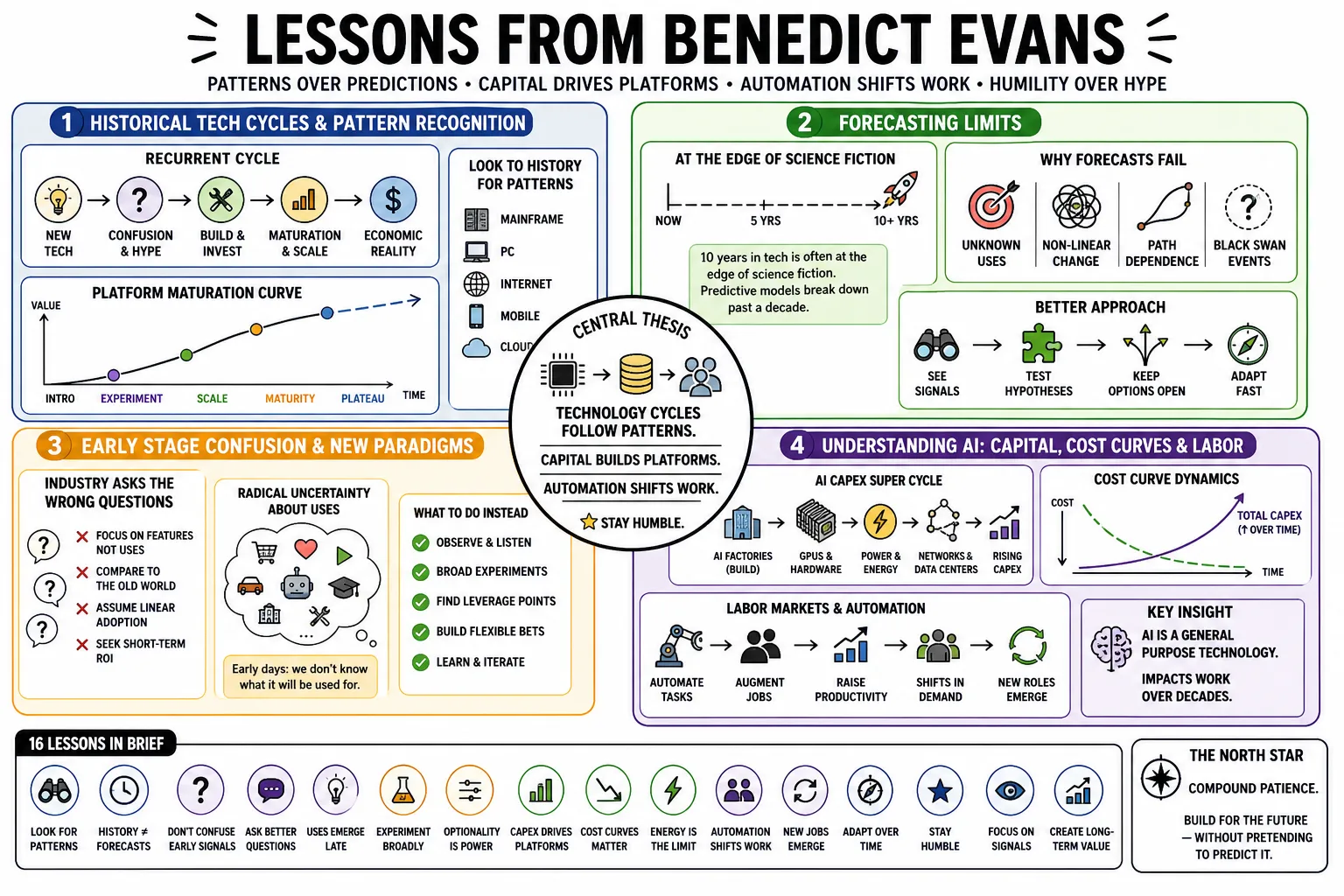
Lessons from Benedict Evans
Benedict Evans is an independent technology analyst who writes about how technology changes products, companies, and industries. The lessons below trace his direct essays on computing platforms and emerging technology; their ideas are paraphrased rather than presented as authenticated verbatim quotations. — Benedict Evans — About & Contact.
Part 1: Historical Tech Cycles & Pattern Recognition
- On Forecasting Limits: Evans argues that forecasts ten or twenty years out can drift toward science fiction; he prefers to examine current technology and concrete roadmaps for what can be built next. — The VR Winter.
- On Using History: Historical examples can expose recurring patterns and useful questions, but an analogy alone cannot predict which new technology will succeed. — Not Even Wrong.
- On Early-Stage Confusion: A platform shift can make forecasts miss the structural change itself: analysts often ask questions framed by the technology and institutions they already know. — Asking the Wrong Questions.
- On New Paradigms: Early in a major technology shift, the important uses and market structure can remain unclear even when its potential is evident. — Ways to Think About Token Pricing.
- On Understanding AI: Giving employees AI tools is not the same as changing enterprise processes, just as providing web browsers in 1997 did not itself rebuild supply chains or retail. — AI, Tools and Transformation.
- On Ubiquity: The significance of mobile was not merely smaller web pages; widespread access to a richer pocket computing platform changed what the internet could be used for. — Forget About the Mobile Internet.
- On Structural Impact: Generational computing shifts can enable new software categories and change how companies operate, not merely replace one technical stack with another. — Mainframes, ML and Digital Transformation.
- On Business Models: In the AI infrastructure buildout, sustainable pricing power and the eventual location of value capture remain uncertain; present models should be treated as scenarios, not settled answers. — Ways to Think About Token Pricing.
- On Legacy Mapping: Forecasts go wrong when observers assume a new platform will preserve the older system's products, economics, or regulatory structure. — Asking the Wrong Questions.
Part 2: The Adoption Paradox & The "Toy" Phase
- On Disruptive Aesthetics: Many important technologies initially seemed expensive, impractical, or trivial. That resemblance alone does not mean a new technology will succeed. — Not Even Wrong.
- On Dismissive Heuristics: Calling an emerging technology a toy has no predictive value; neither does assuming that every mocked technology will become important. — Not Even Wrong.
- On Classic Disruption: In the classic low-end disruption pattern, a cheaper and initially weaker product improves until it threatens an established market. — In Mobile, Disruption Comes from Above.
- On Mobile's Path: Evans observed a different mobile pattern: a costly, more capable product entered at the high end and then became cheaper and more widely accessible. — In Mobile, Disruption Comes from Above.
- On the AI Adoption Puzzle: ChatGPT gained broad awareness and weekly use, yet daily use lagged; Evans treats the gap as an open question about time, product design, and use cases. — GenAI’s Adoption Puzzle.
- On Generative Utilities: A general-purpose chatbot may be the right interface for only some tasks; many users may encounter generative AI as capabilities embedded in other products. — GenAI’s Adoption Puzzle.
- On Early Novelties: Early products can be limited by unfinished engineering, missing building blocks, or undeveloped habits, so their initial uses are not necessarily their final uses. — Not Even Wrong.
- On Judging Platforms: The useful test is not whether an early product looks trivial but whether there is a credible path for the technology to improve and for behavior to change. — Not Even Wrong.
- On Integration Timelines: A gap between initial awareness and habitual use could reflect maturing technology and habits—or a product problem. Evans does not treat either explanation as settled. — GenAI’s Adoption Puzzle.
Part 3: Artificial Intelligence as Infrastructure
- On AI Integration: For enterprises, access to AI tools alone is not transformation; value depends on identifying useful processes and getting the organization to adopt them. — AI, Tools and Transformation.
- On Value Capture: Evans sees model commoditization and up-stack value capture as a plausible direction, while emphasizing that the long-term outcome remains uncertain. — Ways to Think About Token Pricing.
- On Winning the Cycle: Value may accrue to companies that wrap model capability in useful workflows, domain-specific tools, and product interfaces; the model alone need not be the product. — Building AI Products.
- On Unknown Ceilings: The capability ceiling for foundation models remains difficult to forecast because we lack a firm theoretical account of how far current approaches can improve. — Ways to Think About Token Pricing.
- On Market Maps: Which model providers or applications will have durable pricing power, strategic leverage, and product-market fit is still unsettled. — Ways to Think About Token Pricing.
- On Enterprise Integration: AI tools are reaching enterprises, but pilots and occasional individual use should not be mistaken for a completed change in core workflows. — AI, Tools and Transformation.
- On Compute Imbalances: Major technology companies are spending heavily on AI infrastructure while the next large use cases and corresponding demand are still uncertain. — How Will OpenAI Compete?.
- On Competitive Moats: Building an AI demo is easier than changing a company's coordinated workflows; that organizational work may matter more than simply giving everyone a model. — AI, Tools and Transformation.
- On Differentiators: Proprietary data, distribution, workflows, and go-to-market could help differentiate AI products, but Evans treats their ability to create durable model-level moats as unproven. — Ways to Think About Token Pricing.
- On Success States: AI may become useful as a capability hidden inside familiar software rather than a conspicuous standalone chatbot. — Building AI Products.
Part 4: Data, Hype, & Strategic Skepticism
- On Bad Analogies: The slogan that data is the new oil obscures that data is not one interchangeable commodity. — There’s No Such Thing as Data.
- On Specificity: Different datasets serve different applications and cannot simply be pooled into one universally valuable resource. — There’s No Such Thing as Data.
- On Contextual Limits: Evans illustrates the point with a concrete mismatch: wind-turbine telemetry cannot plan a London bus route. — There’s No Such Thing as Data.
- On Inherent Worth: Information gains value through its context and the system that turns it into useful signals; isolated data is often worth little. — There’s No Such Thing as Data.
- On National Strategies: A generic national data strategy can miss the actual question of what people can build and do with particular data; Evans compares it to a national spreadsheet strategy. — There’s No Such Thing as Data.
- On Binary Thinking: Neither dismissing a technology as a toy nor assuming it must change everything predicts its outcome; the useful question is why it would improve and be used. — Not Even Wrong.
- On Digital Transformation: Despite its marketing feel, digital transformation names a long enterprise shift in software categories, workflows, and operating models. — Mainframes, ML and Digital Transformation.
- On Data Hoarding: Claims that an organization needs more data are incomplete without specifying which data, for which application, and what use creates value. — There’s No Such Thing as Data.
- On Causation: A defensible technology thesis needs a mechanism for technical improvement and behavior change, not a slogan or a superficial analogy. — Not Even Wrong.
Part 5: Automation, Labor, & The Future of Work
- On Economic Fallacies: The lump-of-labour fallacy assumes a fixed amount of work; Evans argues that cheaper production can create demand elsewhere, while cautioning that AI's exact impact remains uncertain. — AI and the Automation of Work.
- On Frictional Pain: Past automation brought new jobs and prosperity alongside real displacement and pain, sometimes borne by different people in different places; that history does not make current adjustment painless. — AI and the Automation of Work.
- On Job Creation: Historically, automation has generated job categories that earlier generations could not have predicted; Evans warns against treating this as a guarantee about AI. — AI and the Automation of Work.
- On Assessing Exposure: A job is rarely just one automatable task. Predicting its AI exposure requires considering the whole role and how the business around it might change. — Predicting AI Job Exposure.
- On Invisible Success: Automation can alter a role while the job title remains, and some older tasks disappear into software without a matching new occupation label. — Predicting AI Job Exposure.
- On Human Context: Many jobs combine subtle and complex activities that cannot be captured by a simple task list, making occupation-level automation scores unreliable. — Predicting AI Job Exposure.
- On Historical Examples: A century of accounting automation did not eliminate accountants; Evans notes that regulation and demand also changed, so the example is not a simple forecast for AI. — Predicting AI Job Exposure.
- On Unlocking Demand: Making an activity cheaper can lead to more of that activity and unlock new kinds of work, rather than simply reducing headcount. — Predicting AI Job Exposure.
- On Nuanced Markets: Evans argues that neat AI job-exposure scores miss changes in tasks, business models, demand, and job definitions. — Predicting AI Job Exposure.
- On Enterprise Politics: A compelling AI demo does not by itself replace professional work: enterprise roles and purchases involve judgment, client context, controls, and coordinated workflows. — AI, Tools and Transformation.
Part 6: Platform Shifts & Generational Computing
- On the Inversion: Evans argued that mobile became the main internet platform while desktop was increasingly the more limited variant, reversing the older mental model. — Forget About the Mobile Internet.
- On Misreading Transitions: Early mobile products were treated as reduced versions of the desktop web, obscuring the more ubiquitous and capable platform that smartphones became. — Forget About the Mobile Internet.
- On Shedding Assumptions: A new computing platform can invalidate assumptions inherited from the old one; forecasts framed around prior infrastructure may miss its actual uses. — Asking the Wrong Questions.
- On Interface Evolution: Mobile operating systems made notifications, sensors, cameras, address books, and location part of the service platform, enabling interactions beyond desktop pages and links. — Mobile Is Not a Neutral Platform.
- On Abstraction: Successive computing shifts create new software and business possibilities rather than merely swapping hardware; older systems may continue serving their established uses. — Mainframes, ML and Digital Transformation.
- On Incumbent Threats: A platform can keep selling while losing its ability to set the industry's agenda; Evans uses Windows after the rise of the web as an example. — Disrupting Mobile.
- On Unseen Problems: New tools can reveal problems and product opportunities that were not obvious when the older platform defined the workflow. — AI, Tools and Transformation.
- On Completion: The platform transition becomes visible when the new medium is treated as the primary environment rather than as a limited add-on; Evans made this argument about mobile internet. — Forget About the Mobile Internet.
Part 7: Big Tech, Spending, & Ecosystem Power
- On the Capex Cycle: The largest cloud companies are committing hundreds of billions of dollars to AI infrastructure while the long-term returns and use cases remain unsettled. — How Will OpenAI Compete?.
- On Strategic Urgency: Competitive and investor pressure has pushed large technology companies to commit capital to AI before ordinary product discovery and deployment have caught up. — The AI Summer.
- On Telecom Parallels: Evans compares AI compute with mobile networks: a crucial, capital-intensive infrastructure layer can grow dramatically while much of the economic value goes to businesses built above it. He treats this as a question for AI, not a forecast. — Ways to Think About Token Pricing.
- On Enterprise Reality: Strong interest in AI coexists with slower, uneven enterprise deployment; pilots do not show that a technology has taken over core workflows. — The AI Summer.
- On Timing Pressures: The perceived urgency of the next platform shift and competitive pressure can pull AI spending forward even while product-market fit remains unclear. — The AI Summer.
- On Open Models: Smaller or open models could handle some use cases cheaply, changing demand for frontier models; Evans leaves the competitive effect open. — Ways to Think About Token Pricing.
- On Scale as a Moat: The high fixed cost of frontier models may limit how many firms compete, but Evans questions whether that expense alone yields durable leverage over applications. — How Will OpenAI Compete?.
- On Shifting Lock-In: A model provider might try to build an ecosystem around APIs, accounts, and integrated services, but Evans doubts that this necessarily locks in users or developers. — How Will OpenAI Compete?.
- On Network Effects: Evans observes no proven, enduring network effect in foundation models so far, while allowing that future technical changes could create one. — Ways to Think About Token Pricing.
Part 8: Navigating Uncertain Futures & Strategy
- On Best Practices: Existing workflows can hide automation opportunities; making tools easier to create does not reveal which problems to solve or persuade an organization to change. — AI, Tools and Transformation.
- On Resisting Hype: AI's rapid attention and investment should not be confused with proven habitual use or broad enterprise deployment. — The AI Summer.
- On Structural Obsolescence: A new technology threatens an incumbent when it changes the basis of competition in ways the incumbent cannot learn or absorb—not merely because it is new. — Is Tesla Disruptive?.
- On Finding Clarity: Evaluate emerging technologies through actual usage, product fit, and deployment rather than collapsing interest, pilots, and sustained adoption into one number. — The AI Summer.
- On Optionality: When the shape of a new market is unknown, participating to learn and experiment can be sensible without betting on a single detailed future. — Ways to Think About a Metaverse.
- On Updating Theses: In an unsettled technology shift, strategic claims should remain provisional as use cases, model capabilities, and economics develop. — Ways to Think About Token Pricing.
- On Projecting Trajectories: An early product should be judged against a credible path to improvement, not only by its first limitations; the absence of a plausible roadmap also matters. — Not Even Wrong.
- On Demanding Answers: Ask what technical and behavioral changes would have to occur for a technology thesis to work, rather than relying on labels or analogies. — Not Even Wrong.
- On Human Experience: General AI capability becomes useful through product design that helps people understand what to ask, what the system can do, and when its answers may be wrong. — Building AI Products.