Bilal Zuberi is an investor and former founder whose work focuses on frontier technologies, including artificial intelligence, robotics, manufacturing, and national security. Across his essays and interviews, he returns to a central question: how can scientific and engineering advances become durable products that solve consequential problems in the physical world? BZ Notes ↗
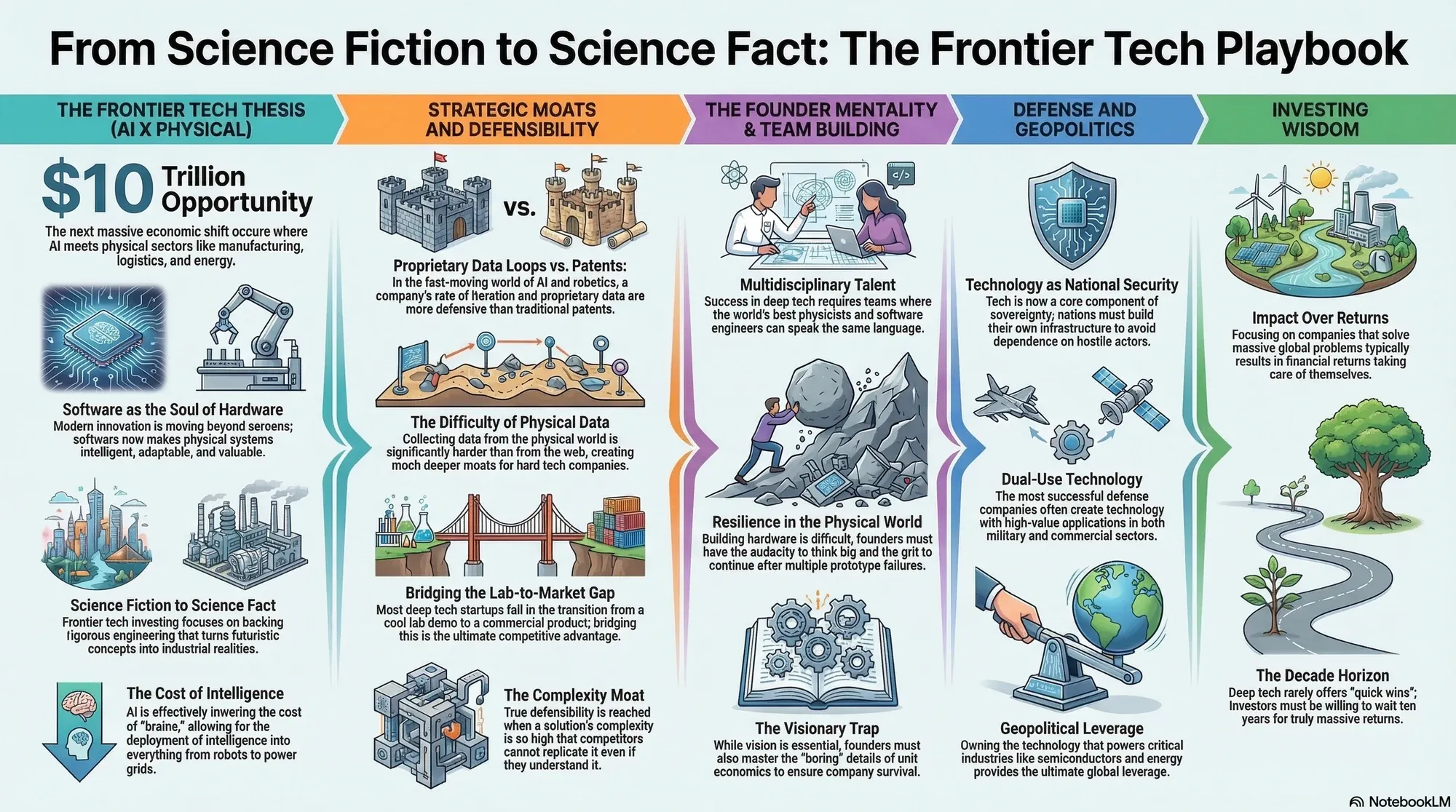
Part 1: The Frontier Tech Thesis (AI x Physical World)
- On the AI–Physical World Opportunity: Zuberi argues that the next major technology platform will emerge where AI meets the physical world—in factories, vehicles, supply chains, energy systems, and defense. — BZ Notes ↗
- On Software-Defined Physical Systems: As intelligence becomes cheaper, software can give machines and physical systems the ability to perceive, act, learn, and improve. — BZ Notes ↗
- On the Falling Cost of Intelligence: Falling intelligence costs make it possible to embed increasingly capable decision-making in physical products and industrial systems. — MIT CSAIL interview ↗
- On Frontier Technology: Zuberi looks for areas where sustained scientific and engineering progress is turning what once looked like science fiction into practical technology. — The Full Ratchet interview ↗
- On Solving Consequential Problems: Technology matters most when it improves the physical world—how people manufacture goods, treat disease, produce energy, and use scarce resources. — BZ Notes ↗
- On Moving Beyond Screens: The next wave of AI will not remain confined to digital interfaces; it will increasingly shape machines, matter, infrastructure, and other physical systems. — BZ Notes ↗
- On the Difficulty of Hardware: Hardware companies must coordinate software, mechanical and electrical engineering, supply chains, manufacturing, and quality control; success depends on mastering the details across all of them. — BZ Notes ↗
- On Turning Science into a Product: A scientific breakthrough becomes a product only when it addresses a real user need, earns willingness to pay, and can support a repeatable business. — BZ Notes ↗
- On Intelligent Manufacturing: Zuberi expects AI to reshape factories and supply chains by giving industrial systems more capacity to perceive, decide, and adapt. — BZ Notes ↗
Part 2: Strategic Moats and Defensibility
- On Deep-Tech Moats: Deep-tech companies can combine technical breakthroughs with regulatory knowledge, specialized teams, government relationships, and data or network effects to create layered defensibility. — The Full Ratchet interview ↗
- On Specialized Teams as a Moat: The ability to recruit and retain people who can solve difficult cross-disciplinary engineering and manufacturing problems can itself become a competitive advantage. — BZ Notes ↗
- On Execution Beyond Patents: In hardware, defensibility often comes from accumulated engineering and manufacturing know-how—the unglamorous details required to build reliably at scale—not patents alone. — BZ Notes ↗
- On Step-Change Advantage: Zuberi favors products that create a step-change in capability rather than incremental improvements that established competitors can readily match. — The Full Ratchet interview ↗
- On Data Moats in Physical Systems: Connected physical products can become more defensible when use generates proprietary data that improves the product and strengthens a network effect. — The Full Ratchet interview ↗
- On Speed as a Startup Advantage: A startup’s structural advantage is speed: focused teams can learn and ship faster than large incumbents when they stay close to the problem. — Fault Lines interview ↗
- On Commercializing Lab Technology: Teams should own the customer problem rather than remain attached to one technical solution; that flexibility creates multiple paths from research to a viable product. — BZ Notes ↗
- On Multidisciplinary Barriers to Entry: The coordination of specialized hardware, software, manufacturing, and supply-chain talent creates a barrier that is difficult for generalist competitors to reproduce. — BZ Notes ↗
Part 3: The Founder Mentality & Team Building
- On Mission-Driven Founders: Zuberi looks for tenacious founders who are motivated by changing the world, not merely by the economics of a transaction. — BENS interview ↗
- On Persistence in Hard Technology: Frontier companies take time, so Zuberi values founders who can stay committed through long development cycles and repeated setbacks. — BENS interview ↗
- On Multidisciplinary Teams: Hardware startups need complementary specialists across hardware, software, manufacturing, and operations who can work as one integrated team. — BZ Notes ↗
- On Mission-Driven Leadership: Zuberi says he often invests in industries he wishes did not need to exist, because the underlying problems are real and still need to be solved. — BENS interview ↗
- On Startup Flexibility: Early companies should remain flexible about the solution while staying anchored to the customer problem and the evidence of willingness to pay. — BZ Notes ↗
- On Taking Advice: Seek advice before a crisis, learn from people who have faced similar problems, and listen even when you ultimately choose a different course. — BZ Notes ↗
- On Product Without a Market: Zuberi’s automotive startup produced advanced technology but entered a cost-plus contract with poor unit economics—a lesson that an impressive product is not enough without a viable market and business model. — BENS interview ↗
- On Reducing Product Risk: Test the customer problem and willingness to pay early; technical progress does not remove the risk of building something users will not buy. — BZ Notes ↗
- On Hands-On Venture Partnership: Zuberi describes venture support as work across hiring, product, go-to-market, and capital strategy—not merely supplying a check. — Post Money interview ↗
Part 4: Defense, Geopolitics, and Sovereignty
- On National Security Technology: Modern national security increasingly depends on commercial technology, making private-sector innovation an essential part of defense capability. — BENS interview ↗
- On Bridging Technology and Policy: Technologists should understand how government works and accept responsibility for how their products affect institutions and the wider world. — BENS interview ↗
- On Dual-Use Companies: Zuberi points to SpaceX and Palantir as rare examples of companies that built large commercial businesses while also serving defense and national-security customers. — BENS interview ↗
- On the Defense Innovation Gap: As important innovation moves into the private sector, defense institutions need faster ways to acquire and deploy commercial products. — BENS interview ↗
- On Technology and Global Competition: Zuberi argues that venture-backed science and technology companies contribute to national competitiveness by translating inventions into deployed capabilities. — BENS interview ↗
- On Responsible Company Building: Zuberi emphasizes backing good people who aim to build responsible, ethical companies around consequential technologies. — BENS interview ↗
- On Government as a Customer: A government-funded project becomes a product business only when customers repeatedly buy it; grants and one-off contracts do not by themselves prove a scalable market. — Defense interview ↗
- On Supply-Chain Resilience: Dependence on a geopolitical rival for critical technology and manufacturing inputs creates strategic risk that countries and companies must take seriously. — BENS interview ↗
Part 5: Investing Wisdom and Career Growth
- On the Role of Venture Capital: High-risk capital matters, but Zuberi says money is often the cheapest part of venture support; time, attention, networks, and operating help can matter more. — BENS interview ↗
- On Long-Term Commitment: Frontier founders need the tenacity to stay with a difficult mission for years while the technology, market, and institution around it develop. — BENS interview ↗
- On Moving Research into Industry: Venture investing can help turn work originating in universities and laboratories into companies that manufacture, deploy, and scale new technology. — MIT CSAIL interview ↗
- On Building Relationships Early: Build bridges to advisers and practitioners before you need help; relationships formed in advance are more useful when difficult decisions arrive. — BZ Notes ↗
- On Learning from Founder Failure: Zuberi’s automotive experience taught him to examine customer incentives and unit economics, not only the technical merit of a product. — BENS interview ↗
- On Revising an Investment View: After his startup experience, Zuberi initially avoided automotive investments; later evidence from companies such as Zoox and Applied Intuition pushed him to reconsider the sector. — BENS interview ↗
- On Experience and Bias: Prior experience can provide pattern recognition, but it can also create bias; investors must remain willing to update when new founders and evidence contradict an old conclusion. — Fault Lines interview ↗
Learn more:
- The Next $10 Trillion Opportunity
- Tech + AI to Transform the Physical World
- Hardware Is Not Software Wrapped in Plastic
- Own the Problem, Not Just the Solution
- Advice May Be Cheap, but Take It
- BENS — Building the Base, Episode 27
- The Full Ratchet — Episode 149
- MIT CSAIL Alliances — Investing in the Age of AI
- Post Money — Physical World AI
- From Tanks to Teleportation — Department of Defense Interview