Bill Buxton is a designer and computer scientist whose work spans human–computer interaction, sketching user experiences, the history of input devices and the long development of technological ideas. This profile draws practical lessons from his writing, research and interviews about design exploration, device ecosystems, human experience and organizational choices. — Microsoft Research Podcast — Bill Buxton.
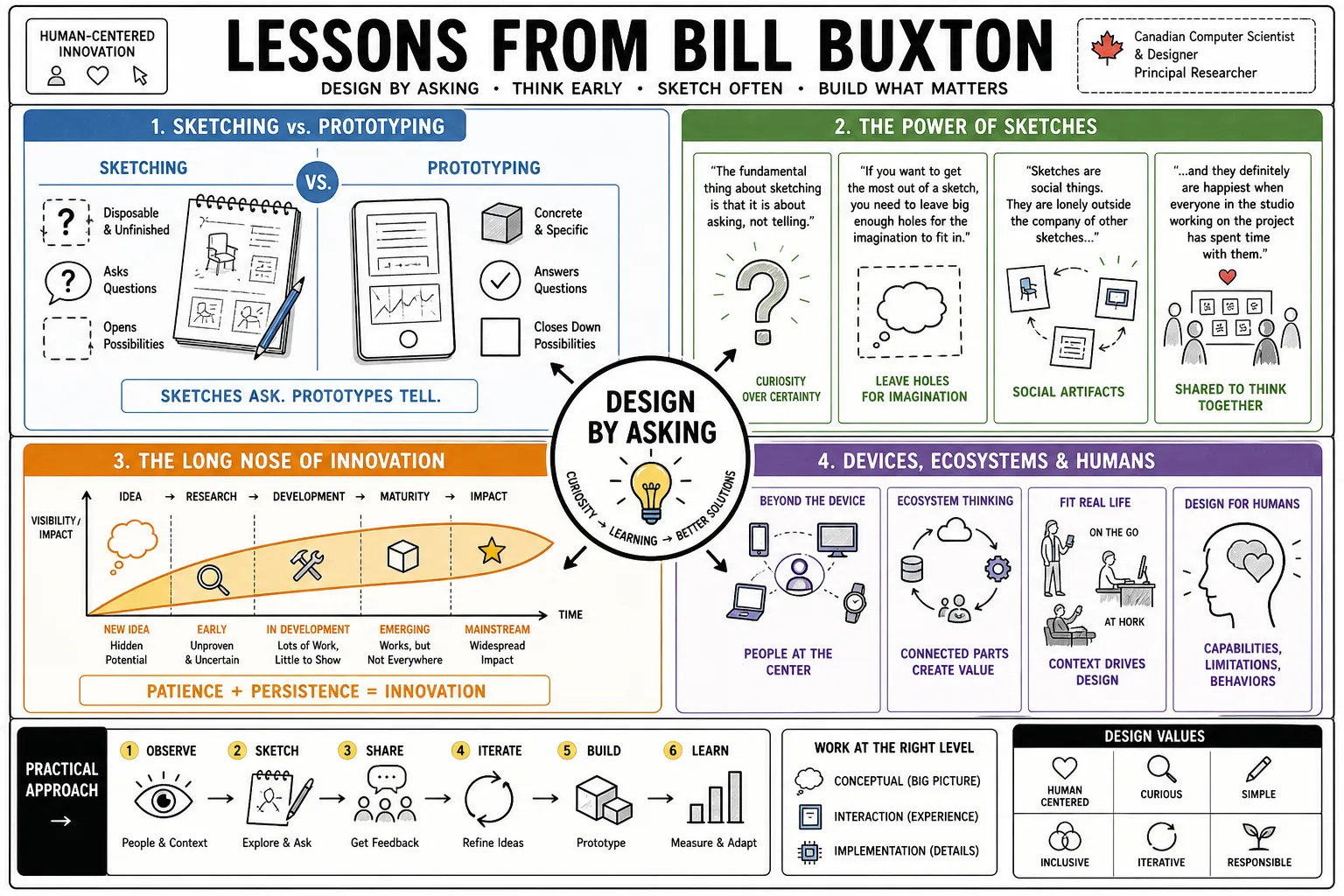
Part 1: Sketching vs. Prototyping
- Sketches invite questions: Buxton treats a sketch as an invitation to explore a design idea, not a finished rendering meant to close the conversation. — Sketching User Experiences — original chapters.
- Leave room for interpretation: A sketch benefits from deliberate ambiguity: viewers, including its maker, can interpret it in different ways and see new relationships. — Sketching User Experiences — original chapters.
- Keep sketches in conversation: Buxton describes sketches as plentiful and most meaningful alongside other sketches; their low-detail form can catalyze discussion among designers. — Sketching User Experiences — original chapters.
- Sketches and prototypes have different jobs: Sketches help explore many uncertain concepts early, while more costly prototypes tend to serve later convergence and testing. Buxton describes a continuum, not a strict either-or split. — Sketching User Experiences — original chapters.
- Match fidelity to uncertainty: A polished representation too early can imply that a concept is already decided. Buxton recommends just enough refinement for the stage of exploration. — Sketching User Experiences — original chapters.
- Sketching is an activity, not a medium: Buxton says sketching is about exercising imagination and understanding; the material can be pencil, a physical model, or even a computer. — Sketching User Experiences — original chapters.
- Keep early exploration inexpensive: Because ideas are cheap to test at the front of the design process, teams can explore and learn before their investment makes changes more costly. — Sketching User Experiences — original chapters.
- Generate alternatives before converging: Early ideation calls for many quick, inexpensive sketches; more refined prototypes become useful as a design converges. — Sketching User Experiences — original chapters.
- Investment changes the design conversation: Prototypes typically take more time and investment than sketches, so they are less disposable and call for more formal evaluation as a project proceeds. — Sketching User Experiences — original chapters.
Part 2: Getting the Right Design
- Frame the right question: Buxton argues that the designer should diagnose the underlying problem before committing to an answer; the value of the early stage lies in asking better questions. — Microsoft Research Podcast — Bill Buxton.
- Get the right design: Buxton distinguishes solving a stated problem well from first establishing whether it is the right problem to solve. — Microsoft Research Podcast — Bill Buxton.
- Polish cannot rescue the wrong problem: A technically competent solution can still miss the underlying need if the team begins building before it understands the problem. — Microsoft Research Podcast — Bill Buxton.
- Explore before choosing: Early exploration of multiple alternatives improves the chance of finding a stronger approach; it does not guarantee one. — Microsoft Research Podcast — Bill Buxton.
- Evaluate the intended experience: Buxton begins with what people are trying to accomplish and how they should experience the result, beyond whether the technology works mechanically. — Microsoft Research — Buxton Putting Design into MIX.
- Bring design in from the start: Buxton argues that design, technology and business should be equal partners from the beginning, rather than adding aesthetic polish after the product is specified. — Microsoft Research — Buxton Putting Design into MIX.
- Build design literacy across disciplines: Buxton asks engineers to develop design awareness and designers to develop technical literacy, while respecting that professional practice in either field takes dedicated training. — On Engineering and Design — Bill Buxton.
- Use artifacts to provoke exploration: Buxton treats an early sketch as a catalyst for discussion and new interpretations, not a final specification. — Sketching User Experiences — original chapters.
Part 3: The Long Nose of Innovation
- Apparent breakthroughs have long histories: Buxton argues that a technology likely to have a major impact soon usually has years of earlier research and refinement behind it; the mouse and multi-touch are his examples. — The Long Nose of Innovation — Bill Buxton.
- Innovation includes refinement: Against the lone-invention myth, Buxton emphasizes prospecting, mining, refining and financing an idea over a long period before widespread use. — The Long Nose of Innovation — Bill Buxton.
- Adoption can take decades: Among the information technologies in a National Academies history Buxton cites, roughly 20 years of refinement was typical and 30 years was not unusual; he does not present this as a fixed law for every technology. — The Long Nose of Innovation — Bill Buxton.
- Reward those who shorten adoption: Buxton argues that shortening a technology’s long path to adoption by 10–20% can be as valuable as originating the idea. — The Long Nose of Innovation — Bill Buxton.
- Look beyond the newest idea: Buxton urges innovators to look for neglected ideas already developed in labs instead of focusing only on an allegedly brand-new invention. — The Long Nose of Innovation — Bill Buxton.
- Value accrues through augmentation: Buxton asks institutions to reward the many contributors who refine and augment an initial creation over time, not only the first inventor. — The Long Nose of Innovation — Bill Buxton.
- An invention needs its ecosystem: The mouse was demonstrably useful long before mass adoption; Buxton says displays, processors, operating systems and applications also had to mature. — The Long Nose of Innovation — Bill Buxton.
- Explain why an old idea is different: Buxton describes how a proposal can be dismissed as “done before” when listeners lack the familiarity to see its meaningful differences; stories, examples and prototypes can help make those differences visible. — A Familiar Problem — Bill Buxton.
- Trace an idea’s earlier path: Buxton advises anyone forecasting near-term impact to trace the idea’s earlier research and evolution; otherwise the prediction may be poorly grounded. — Microsoft Research Podcast — Bill Buxton.
Part 4: The Ecology of Devices
- Design the device ecosystem: Buxton asks designers to consider how devices, applications and services work together, instead of evaluating each product in isolation. — Microsoft Research Podcast — Bill Buxton.
- A universal device has tradeoffs: A reconfigurable touch device can serve many tasks, but Buxton warns that it may become a jack-of-all-trades compromise where specialized controls would work better. — Multi-Touch Systems — Bill Buxton.
- Choose for task and context: Buxton’s axiom is that each input technology is best for some purposes and worst for others; the right choice depends on the task, person, place and reason for use. — Multi-Touch Systems — Bill Buxton.
- Design the handoffs: Buxton’s society-of-devices model requires data to move between specialized devices and appear in a form appropriate to each one. — Sentient Data Access — Bill Buxton.
- Reduce cumulative complexity: Even individually useful devices can collectively overwhelm people; Buxton argues that each addition should reduce, not add to, the complexity of the whole ecosystem. — Microsoft Research Podcast — Bill Buxton.
- Relationships can be the innovation: Buxton argues that an important advance may come from changing how existing and emerging devices relate to one another, rather than inventing one more isolated gadget. — Microsoft Research Podcast — Bill Buxton.
- Match form to function: Buxton’s ubiquitous-computing model places differently sized devices in different settings and tailors their interfaces to the physical space and function they serve. — Ubiquitous Media and the Active Office — Bill Buxton.
- Make computing less intrusive: Buxton describes ubiquitous computing as technology integrated into the surrounding environment so that its presence does not intrude on the space or activity. — Ubiquitous Media and the Active Office — Bill Buxton.
- Design for physical and social location: Buxton argues that distance and location shape how people and devices interact, so a system should adapt to the setting in which an exchange occurs. — Sentient Data Access — Bill Buxton.
Part 5: History and Precedence
- Use history as design memory: Buxton keeps historical interaction devices as reference material so teams can recognize earlier solutions before they build anew. — Microsoft Research Podcast — Bill Buxton.
- Study earlier attempts without expecting a blueprint: Buxton examines old devices and prototypes for patterns and lessons; they provide a starting bearing for exploration, not an exact recipe for future success. — Microsoft Research Podcast — Bill Buxton.
- Credit the long chain of research: Buxton’s mouse and multi-touch histories show how research and refinement across institutions contributed to products later viewed as sudden breakthroughs. — The Long Nose of Innovation — Bill Buxton.
- Look with new eyes: Buxton uses Marcel Proust’s image of “new eyes” to argue that a fresh lens can reveal significant differences and relationships in familiar technologies. — A Familiar Problem — Bill Buxton.
- Good ideas can create inertia: Buxton warns that a successful interface idea can become difficult to replace even after new options emerge; he uses the GUI and QWERTY keyboard as examples. — Information Appliances: Less is More — Bill Buxton.
- Multi-touch predates smartphones: Buxton documents multi-touch research and applications decades before the smartphone era, including University of Toronto work in the 1980s. — Multi-Touch Systems — Bill Buxton.
- Learn patterns from precedent: Buxton describes design as a repeatable profession when practitioners study prior technology trajectories and use those patterns to guide, not guarantee, their next exploration. — Microsoft Research Podcast — Bill Buxton.
Part 6: Experience Over Artifacts
- Design experiences, not just objects: Buxton says the value of a product lies in the individual, social and cultural experiences it enables, not only in the physical or digital object. — Designing Experience — Bill Buxton.
- Start with the person’s goal: Buxton begins experience design by asking what the person wants to accomplish and how they should feel through the process, beyond whether the tool works mechanically. — Microsoft Research — Buxton Putting Design into MIX.
- Physical skills shape digital use: Buxton notes that touchscreens can demand eyes-on, two-handed interaction, while physical controls or a stylus may fit certain situations better. — Multi-Touch Systems — Bill Buxton.
- Build on existing user skills: Buxton’s ubiquitous-media approach aims to use familiar human skills and fit technology to the setting instead of making users learn unnecessary new conventions. — Ubiquitous Media and the Active Office — Bill Buxton.
- Natural interaction needs deliberate design: Buxton and coauthors warn that a touch screen alone does not make an interface natural; designers must understand each input method’s strengths, weaknesses and fit to the task. — Direct Display Interaction — Hinckley, Pahud and Buxton.
- Design for social interaction: Buxton’s ubiquitous-media work treats communication as a situated social activity and asks electronic interactions to respect the protocols people use in physical settings. — Ubiquitous Media and the Active Office — Bill Buxton.
- Design for the task’s attention demands: Buxton and coauthors show that display choices can help or hinder a person’s ability to focus on one item or divide attention across several. — Transparent Interface Objects — Buxton and colleagues.
- Test experience in real settings: Buxton and coauthors say laboratory studies provide useful controlled evidence, but wider claims about collaborative media require observation in actual workplaces too. — Media Space Field Study — Buxton and colleagues.
Part 7: Ethics and Human Context
- Remember that technology is not neutral: Buxton invokes historian Melvin Kranzberg’s first law—that technology is neither simply good nor bad, nor neutral—to frame the ethical effects of design choices. — Microsoft Research Podcast — Bill Buxton.
- Own the consequences of technology decisions: Buxton says introducing technology into society involves ethical choices, even when designers do not initially recognize them, and asks creators to take responsibility for mistakes. — Microsoft Research Podcast — Bill Buxton.
- Watch for unintended social effects: In a workplace video study, Buxton and coauthors saw people unplug the system or change work hours when its privacy controls and feedback were inadequate; field observation exposed consequences the initial design missed. — The Design of a Media Space — Buxton and colleagues.
- Shape a responsible design culture: Buxton says technological choices carry ethical consequences and describes changing an organization’s design culture so design is a real partner in decisions, rather than a cosmetic afterthought. — Microsoft Research Podcast — Bill Buxton.
- Account for different abilities: Buxton and coauthors present one-handed typing as an access option for people who cannot use a standard two-handed keyboard, showing how input design can serve a wider range of users. — Half-QWERTY — Matias, MacKenzie and Buxton.
- Technology changes social protocols: Buxton and coauthors found that a media space changed interpersonal distance and communication cues; the team had to design controls and feedback around existing social expectations. — The Design of a Media Space — Buxton and colleagues.
- Make privacy controllable and visible: In their media-space design, Buxton and colleagues treated privacy as control over who can connect, awareness of when a connection occurs, and feedback that does not itself become intrusive. — Realizing a Video Environment — Buxton and colleagues.
Part 8: Leadership and Organizational Culture
- Give design a seat at the top: Buxton argues that organizations need equal strength in design, technology and business leadership; bringing design in only after the product is specified reduces its influence. — Microsoft Research — Buxton Putting Design into MIX.
- Do not let the incumbent block its successor: Buxton warns that a profitable existing product can lead leaders to reject a promising replacement because it threatens current revenue. — The Problem with Great Ideas — Bill Buxton.
- Pair engineering and UX expertise: Buxton says product teams need strong professional competence in both engineering and user-experience design, with each discipline learning enough about the other to collaborate. — On Engineering and Design — Bill Buxton.
- Invest before the first answer hardens: Buxton argues that early problem-setting and exploring alternatives are relatively inexpensive compared with correcting a mistaken direction after a project is built. — Microsoft Research Podcast — Bill Buxton.
- Design organizational transitions: Buxton says leaders should invest in the design and innovation needed to move from a successful product to its successor, not only in the successor technology. — The Problem with Great Ideas — Bill Buxton.
- Treat inertia as a strategic risk: Buxton warns that depending on a still-profitable product while dismissing its replacement can leave an organization vulnerable to competitors willing to make the transition. — The Problem with Great Ideas — Bill Buxton.
- Value problem-framing as design work: Buxton describes design as helping a team identify the right problem and build a design-aware culture, not just making a finished interface attractive. — Microsoft Research Podcast — Bill Buxton.