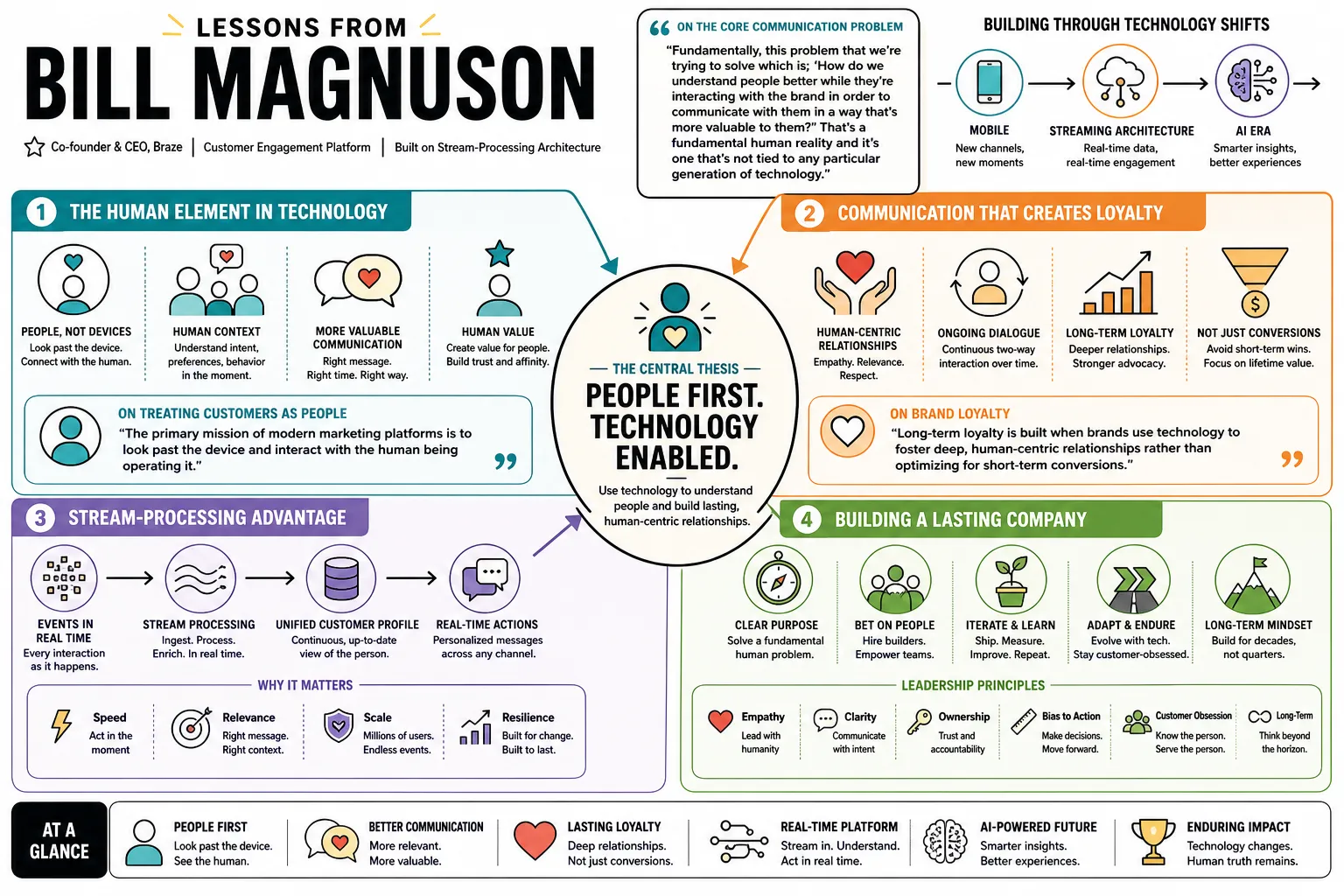
Lessons from Bill Magnuson
Bill Magnuson is the co-founder and CEO of Braze, a customer engagement platform built on a stream-processing architecture. He made his name arguing that brands should treat customers as humans rather than devices, pushing the industry away from isolated marketing channels. This profile collects his lessons on leading engineering teams and building a lasting company through technology shifts like mobile and AI.
Part 1: The Human Element in Technology
- On the core communication problem: "Fundamentally, this problem that we’re trying to solve which is; 'How do we understand people better while they’re interacting with the brand in order to communicate with them in a way that’s more valuable to them?' That’s a fundamental human reality and it’s one that’s not tied to any particular generation of technology." — Braze: Resources & Perspectives]
- On treating customers as people: "The primary mission of modern marketing platforms is to look past the device and interact with the human being operating it." — Braze: Resources & Perspectives]
- On brand loyalty: "Long-term loyalty is built when brands use technology to foster deep, human-centric relationships rather than optimizing for short-term conversions." — First Round Review: About]
- On communication silos: "So much of what was built before us was really siloed and constrained by thinking about the channel first and then thinking about the customer. We tried to be customer centric." — SaaStr: Podcasts & Sessions]
- On empathy in software: "The best enterprise software allows the people using it to express empathy to their end consumers." — World of DaaS: Bill Magnuson Interview]
- On humanizing relationships: "Brands must focus on humanizing their relationships with customers if they want to survive the transition away from physical retail spaces." — Braze: Resources & Perspectives]
- On the limitations of technology: "No amount of automation can compensate for a fundamental lack of understanding of what the customer actually wants or needs." — Coalesce: Resources]
- On authentic interactions: "Consumers can easily detect when a brand is treating them like a row in a database instead of a person with context and history." — SaaStr: Podcasts & Sessions]
- On the continuity of human needs: "While the mediums we use to talk to each other change constantly, the desire to be understood and valued remains static." — Braze: Resources & Perspectives]
Part 2: Product Strategy and Architecture
- On real-time infrastructure: "You cannot deliver personalized, in-the-moment experiences if your underlying architecture relies on batch processing overnight." — World of DaaS: Bill Magnuson Interview]
- On stream processing: "We looked at high-frequency trading systems to understand how to process data and deliver messages in real-time at massive scale." — First Round Review: About]
- On breaking legacy models: "The channel-first approach of older marketing clouds forced marketers into a fragmented view of their own campaigns." — SaaStr: Podcasts & Sessions]
- On building an abstraction layer: "We built an unbundling abstraction layer at the bottom of our stack so that new channels could be added without rewriting the core customer logic." — First Round Review: About]
- On product composability: "Enterprise software needs to be modular enough that customers can swap out adjacent tools without breaking the core engine." — Coalesce: Resources]
- On architectural decisions: "The decisions you make about data structures in year one will dictate what features you are capable of shipping in year ten." — Braze: Resources & Perspectives]
- On speed as a feature: "In consumer engagement, the speed at which a system processes an event holds equal weight to the message it sends." — World of DaaS: Bill Magnuson Interview]
- On continuous delivery: "You have to build a product culture that expects to ship updates constantly, because the consumer platforms you integrate with change without warning." — Braze: Resources & Perspectives]
- On technical debt: "Taking on technical debt to hit a launch date is sometimes necessary, but you have to pay it down before the market forces you to scale." — First Round Review: About]
Part 3: The Mobile Revolution
- On early mobile gaps: "We found that while there was a slew of tools to help people understand their customers in brick and mortar, on the web and on TV, mobile was way behind." — OpinionX: Blog]
- On the shift in connectivity: "We can communicate with each other instantaneously. We can access knowledge and information no matter where we are. And that is a kind of a step change as a species." — World of DaaS: Bill Magnuson Interview]
- On form factors: "The connectivity that smartphones enable is significantly more profound than the physical glass rectangles we use to access it." — World of DaaS: Bill Magnuson Interview]
- On push notifications: "Early mobile marketing treated push notifications like email blasts, completely missing the personal nature of the device." — Braze: Resources & Perspectives]
- On the intimacy of smartphones: "The phone is the first screen that wakes up with you and goes to sleep with you, requiring a completely different standard of respect from brands." — First Round Review: About]
- On evaluating progress: "I think when I reflect back on the early days it's a really great example of the adage of how we overestimate progress in the short term, and then we underestimate in the long term." — World of DaaS: Bill Magnuson Interview]
- On mobile as a forcing function: "Mobile forced companies to realize they needed a unified view of the customer, because user tolerance for disjointed experiences dropped to zero." — SaaStr: Podcasts & Sessions]
- On building for mobile first: "If you tried to port your web marketing strategy directly to mobile, you failed. The context was entirely different." — First Round Review: About]
- On ambient computing: "The smartphone established the global infrastructure necessary for the next wave of ambient, always-on computing." — Coalesce: Resources]
- On the app ecosystem: "The initial app store gold rush taught us that distribution is easy, but retention is the actual business." — Braze: Resources & Perspectives]
Part 4: Data and Privacy
- On the death of cookies: "Unfortunately what a lot of brands were doing before with respect to their data strategy is they were just trying to figure out who you were and then trying to go figure out things about you that came from that identity." — World of DaaS: Bill Magnuson Interview]
- On first-party data: "We encourage our customers to look at and respond to behaviors and real revealed preferences, which don't actually need to be tied to a rigid identity." — World of DaaS: Bill Magnuson Interview]
- On dodgy data: "Relying on third-party data sets often leads brands into territory where the information is outdated, creepy, or simply wrong." — World of DaaS: Bill Magnuson Interview]
- On the gift of preference: "When a customer tells you what they want through their actions in your app, that is a gift you have to honor with better service." — Braze: Resources & Perspectives]
- On privacy as a feature: "Respecting user privacy acts as a fundamental pillar of maintaining brand trust, rather than a mere compliance requirement." — SaaStr: Podcasts & Sessions]
- On data agility: "Having data isn't enough; you need the agility to route that data into a live campaign within milliseconds." — Coalesce: Resources]
- On over-collection: "Don't collect data you have no immediate plan to use. It creates liability without generating any value." — Braze: Resources & Perspectives]
- On context over identity: "Understanding what a user is trying to accomplish in a specific moment is often more useful than knowing their demographic profile." — First Round Review: About]
- On the value exchange: "Customers will willingly share their data if you explicitly demonstrate how it improves their experience with your product." — SaaStr: Podcasts & Sessions]
Part 5: Navigating Platform Shifts
- On market timing: "The market wasn't ready for us to sell to it yet. Our best answer to 'why now?' was to get a multi-year head start on something we had." — First Round Review: About]
- On surviving early stages: "A lot of early beta customers will churn simply because their own business models fail, not because your product is flawed." — First Round Review: About]
- On building adaptability muscles: "Companies must develop the internal muscle to identify platform shifts early and adapt their core product without losing focus." — World of DaaS: Bill Magnuson Interview]
- On avoiding hype: "The strategy is to execute on long-term trends with focus, rather than chasing every short-term hype cycle that hits the industry press." — SaaStr: Podcasts & Sessions]
- On AI agents: "The next era of marketing will involve marketers acting as strategic conductors overseeing AI agents rather than acting as manual campaign tacticians." — Braze: Resources & Perspectives]
- On LLM adoption: "If Large Language Models are going to become truly useful companions, the existing global infrastructure of smartphones will be the delivery mechanism." — Coalesce: Resources]
- On observing the world: "Be observant. Like get your head up and look around you and critically think about everything that you see around you. Things that are around you are a certain way because someone decided to make them that way by and large." — Braze: Resources & Perspectives]
- On systems thinking: "Curiosity applied to systems and processes ultimately leads to an ability to read the market's tea leaves better than competitors." — Braze: Resources & Perspectives]
- On predicting the future: "You can't predict exactly what the market will look like in five years, but you can build an architecture flexible enough to handle it." — Braze: Resources & Perspectives]
- On enduring concepts: "Focus on the foundational behaviors that won't change, even as the specific devices and interfaces evolve completely." — First Round Review: About]
Part 6: Company Culture and Values
- On ignoring smoke: "What this value is actually impressing upon you is not that you should just complain about everything you see, but rather that we need to act with urgency when something might be wrong." — Braze: Resources & Perspectives]
- On difficult values: "Values are only useful if they are difficult to live by, especially when teams need to prioritize or make tough operational decisions." — SaaStr: Podcasts & Sessions]
- On taking your seat at the table: "We expect employees to actively participate and share their perspectives, regardless of their title or tenure." — Braze: Resources & Perspectives]
- On equity and inclusion: "A culture designed to be inclusive actively monitors its own processes and policies to identify gaps and invest in an equitable future." — Braze: Resources & Perspectives]
- On shaping the future: "Startups require people who refuse to accept the world as it is and feel a personal responsibility to shape how it will operate tomorrow." — Braze: Resources & Perspectives]
- On seeking the truth: "Cultivating a culture where people seek the truth means valuing objective reality over ego, even when the data disproves your favorite idea." — Braze: Resources & Perspectives]
- On global hiring: "Building a global company means adapting your hiring and operational strategies to find the best talent in local markets, rather than enforcing a rigid headquarters mentality." — Braze: Resources & Perspectives]
- On internal transparency: "As you scale, you have to over-communicate the 'why' behind decisions so that teams can operate autonomously without drifting off course." — First Round Review: About]
- On embracing curiosity: "A stagnant culture is one where people stop asking how things work; curiosity is the engine of continuous product improvement." — Braze: Resources & Perspectives]
Part 7: Leadership and Growth
- On introvert leadership: "There is no one type of CEO; being an introvert does not preclude someone from being a successful leader, a lesson learned over years of scaling." — SaaStr: Podcasts & Sessions]
- On transitioning from CTO to CEO: "Moving from technical leadership to the CEO role requires shifting focus from building the product to building the organization that builds the product." — Braze: Resources & Perspectives]
- On long-term vision: "We set out to build a generational company, which meant making decisions that optimized for the next decade rather than the next quarter." — World of DaaS: Bill Magnuson Interview]
- On vanity metrics: "Leaders need to look past vanity metrics, focus on what will endure, and build for the market of tomorrow while it is still developing." — SaaStr: Podcasts & Sessions]
- On enterprise expansion: "Breaking into top-tier enterprise brands globally requires a localized presence with in-person sales and success teams, as a good Zoom pitch rarely closes the deal alone." — SaaStr: Podcasts & Sessions]
- On technical fluency in leadership: "Having a CEO who understands the hands-on technical challenges allows the company to make more accurate bets on long-term engineering investments." — Coalesce: Resources]
- On delegating: "Scaling yourself as a founder means constantly firing yourself from jobs you used to love doing so you can focus on the jobs only you can do." — First Round Review: About]
- On continuous learning: "The rate at which your company grows is fundamentally bottlenecked by the rate at which the leadership team can learn new skills." — Braze: Resources & Perspectives]
- On handling crisis: "Leadership is tested most when the macro environment shifts; maintaining focus on core values during these times is what prevents the culture from fracturing." — SaaStr: Podcasts & Sessions]
Part 8: The Entrepreneurial Journey
- On taking leaps: "Walking down an alleyway and you come up to a big wall and you can’t see what’s on the other side. And sometimes in life, you gotta just take off your baseball cap and throw it over the wall if for no other reason than to force you to climb over and see what’s on the other side." — Braze: Resources & Perspectives]
- On lean startup limits: "The lean startup methodology has limitations when you are trying to build an audacious, technically complex vision that requires years of runway before validation." — Braze: Resources & Perspectives]
- On fundraising timelines: "It took six years after inception and reaching Series D before the founders finally received more than one term sheet in a funding round." — First Round Review: About]
- On conviction: "When the market doesn't exist yet, you have to rely entirely on your internal conviction that the problem you are solving is an inevitable future reality." — First Round Review: About]
- On early customer feedback: "You have to parse early feedback carefully to determine if a customer is asking for a feature that serves their specific edge case or one that expands your core platform." — Braze: Resources & Perspectives]
- On the value of patience: "Building foundational infrastructure is slow and unglamorous work, but it creates an unbridgeable moat once the market finally catches up." — World of DaaS: Bill Magnuson Interview]
- On founder alignment: "The relationship between co-founders is the bedrock of the company; if you cannot resolve disagreements technically and philosophically, the product will suffer." — First Round Review: About]
- On the grind: "The reality of the entrepreneurial journey is that for every moment of public success, there are hundreds of hours of obscure, difficult problem-solving." — Braze: Resources & Perspectives]
- On changing roles: "A founder has to be willing to evolve their role completely every 18 months as the scale of the business changes the definition of their job." — SaaStr: Podcasts & Sessions]
- On leaving a legacy: "Ultimately, the goal is to alter the trajectory of how businesses interact with the people they serve, far beyond shipping a successful software product." — Coalesce: Resources]