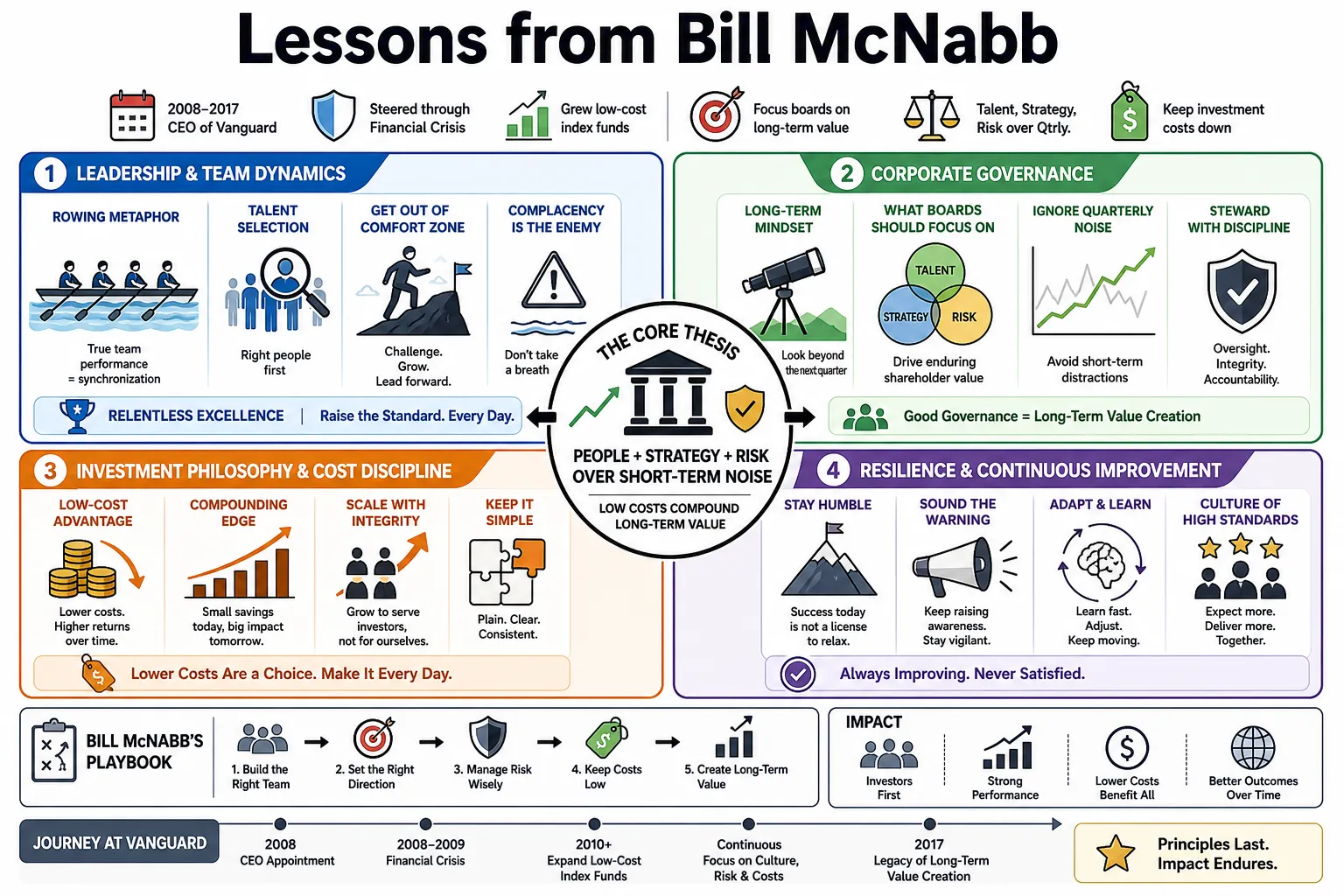
Lessons from Bill McNabb
Bill McNabb, Vanguard’s former CEO, argues that corporate boards should look beyond short-term returns and consider talent, strategy and risk as drivers of long-term value. — IR Impact — Talent, Strategy and Risk.
Part 1: Leadership and Team Dynamics
- On the Rowing Metaphor: McNabb uses rowing to show how talented individuals must coordinate their effort for the whole crew to perform. — Wharton — High-Performance Teams.
- On Talent Selection: McNabb says high-performing teams begin with deliberate selection: Vanguard tested candidates with real cases and observed how they worked with others. — Wharton — High-Performance Teams.
- On Comfort Zones: McNabb links effective leadership to a growth mindset and grit, urging leaders to keep learning and stretching beyond familiar roles. — Wharton — High-Performance Teams.
- On Complacency: McNabb says success can make it difficult to improve; leaders need to question why the apparent numbers look good rather than stop at the surface. — Wharton — High-Performance Teams.
- On Humility in Knowledge: When Vanguard’s reported market share looked stable, McNabb pushed the team to ask why; a deeper look found a decline among the original product’s core clients. — Wharton — High-Performance Teams.
- On Defining Success: Coming out of the crisis, McNabb’s leadership team translated Vanguard’s broad purpose into ten initiatives so employees knew what to accomplish. — LEADERS — Serving the Client.
- On Raising the Bar: At Vanguard, McNabb used stretch objectives, leader rotation and new talent to challenge an organization that was already performing well. — Wharton — High-Performance Teams.
- On Teaming as the Future: McNabb says competitive rowing made team orientation central to his leadership; at Vanguard he invested in coaching that reinforced lessons across teams. — Valence — AI: Now or Never.
Part 2: Navigating Crises and Market Volatility
- On Crisis Communication: During the 2008 downturn, McNabb told Vanguard employees to concentrate on clients instead of worrying about layoffs; he says the firm made no staff reductions. — LEADERS — Serving the Client.
- On Earning Your Keep: McNabb’s crisis instruction was operational: maintain web availability, staff client support and keep investors informed when markets were volatile. — LEADERS — Serving the Client.
- On Market Turbulence: McNabb treated volatility as a recurring feature of investing, not a reason to abandon a long-term allocation whenever markets moved sharply. — McNabb — Investing Resolutions.
- On Staying the Course: For McNabb, staying the course means maintaining a suitable plan through declines rather than trying to time market highs and lows. — McNabb — Investing Resolutions.
- On Tempering Volatility: McNabb recommends balancing stocks, bonds and cash-like holdings and diversifying within asset classes; he presents bonds as a possible stabilizer, not a guarantee. — McNabb — Investing Resolutions.
- On the Illusion of Control: McNabb contrasts unpredictable market returns with the investment costs an investor can choose to control. — McNabb — Investing Resolutions.
- On Reactionary Behavior: McNabb warns against changing a portfolio just because recent market conditions feel frightening; he says no one can reliably time the peaks and troughs. — McNabb — Investing Resolutions.
- On Leadership Visibility: Vanguard stayed available through web updates, television and live investor meetings during the crisis, so leaders could hear concerns and explain their approach. — LEADERS — Serving the Client.
- On Crisis as a Test of Culture: McNabb says Vanguard’s client-owned structure simplified crisis priorities: retain staff, support clients and keep technology investment moving. — LEADERS — Serving the Client.
- On Historical Perspective: McNabb notes that periods of severe market fear have occurred before; history can frame uncertainty without promising when or whether a specific loss will recover. — Wharton — The Importance of Being Long-Term.
Part 3: Cost Discipline and Passive Investing
- On the Math of Investing: McNabb points out that lower fund costs leave more of a fund’s return with the investor; the advantage accumulates with time, subject to actual market results. — McNabb — Investing Resolutions.
- On Giving Away Returns: McNabb asks investors to view fees as a share of returns surrendered: a 1% fee consumes a quarter of a hypothetical 4% fund return. — McNabb — Investing Resolutions.
- On Lowering Fees: While leading Vanguard, McNabb said the firm intended to keep reducing investment costs, including in active management and advice. — Vanguard — Expense-Ratio Reductions.
- On Active Management: McNabb did not declare active investing dead; he argued that active managers need substantially lower costs to improve their odds of delivering value. — Wharton — Future of Investment Management.
- On Industry Competition: McNabb saw low-cost funds and competitive pressure changing the economics of investment management and lowering the prices investors could expect to pay. — Vanguard — Expense-Ratio Reductions.
- On the Passive Misnomer: McNabb rejects the idea that holding an index fund means being passive about company governance: a permanent investor has reasons to engage with boards. — McNabb — Significant Shareholder Engagement.
- On Structural Alignment: McNabb says Vanguard’s client ownership gives the company one constituency to serve, making investor interests central to its strategy. — LEADERS — Serving the Client.
- On Investor Behavior: McNabb warned that investors’ realized returns can lag the fund’s reported returns when they exit during volatility and return too late. — Wharton — Future of Investment Management.
- On Simpler Costs: McNabb expected pressure on advisory fees as investors gained access to lower-cost investment products and advice. — Wharton — Future of Investment Management.
Part 4: Corporate Governance and Board Engagement
- On Demystifying Governance: McNabb says boards and major investors should explain how they govern and vote rather than leave each side guessing about the other. — McNabb — Significant Shareholder Engagement.
- On Direct Board Dialogue: McNabb urged companies to speak directly with long-term investors, particularly when a vote or governance concern is developing. — McNabb — Significant Shareholder Engagement.
- On Board Self-Awareness: McNabb favors periodic, candid board evaluation and complementary director skills over relying only on fixed age or tenure rules. — Governance Intelligence — Board Oversight.
- On Engagement Beyond the Ballot: McNabb argues that proxy votes should not surprise boards; sustained dialogue can surface concerns and context before the annual ballot. — McNabb — Significant Shareholder Engagement.
- On Stewardship: Because Vanguard’s index funds can hold companies for very long periods, McNabb viewed governance oversight and board engagement as duties to fund investors. — McNabb — Significant Shareholder Engagement.
- On the Board as Eyes and Ears: McNabb calls independent board composition central because directors represent shareholders in hiring the CEO and overseeing strategy, risk and pay. — McNabb — Significant Shareholder Engagement.
- On Behind-the-Scenes Engagement: McNabb’s governance example shows Vanguard raising concerns privately before a vote; the company later acted on input from Vanguard and other holders. — McNabb — Significant Shareholder Engagement.
- On Director Diversity: McNabb wants directors with complementary expertise and different ways of thinking, supported by board evaluation rather than a one-size-fits-all rule. — Governance Intelligence — Board Oversight.
Part 5: Rethinking Value: Talent, Strategy, Risk
- On Flawed Metrics: McNabb argues that a quarterly earnings beat or miss by a penny says little about value created over a decade. — IR Impact — Talent, Strategy and Risk.
- On Talent, Strategy and Risk: McNabb recasts TSR for board work as talent, strategy and risk—the areas directors can oversee to improve the odds of long-term value creation. — IR Impact — Talent, Strategy and Risk.
- On Building Leadership Depth: For McNabb, board talent oversight goes beyond choosing a CEO: directors should examine the executive bench and emerging leaders. — IR Impact — Talent, Strategy and Risk.
- On Strategic Communication: McNabb says a credible long-term investor story must explain governance of talent, strategy and risk and let shareholders judge progress. — IR Impact — Talent, Strategy and Risk.
- On Centering Risk: McNabb treats risk as inseparable from strategy: boards should challenge management about material risks while the business plan evolves. — IR Impact — Talent, Strategy and Risk.
- On Closing Knowledge Gaps: McNabb favors bringing outside investors and relevant experts into board discussions to test what directors and management may be missing. — Governance Intelligence — Board Oversight.
- On the Activist Lens: McNabb asks boards to examine their own blind spots as an activist might, including costs, management assumptions and perceived vulnerabilities. — McNabb — Significant Shareholder Engagement.
Part 6: Long-Termism and Countering Short-Term Pressures
- On Toxic Short-Termism: McNabb warns that fixation on a single quarter’s earnings can distract companies from the talent, strategy and risk decisions that compound over years. — IR Impact — Talent, Strategy and Risk.
- On Permanent Capital: McNabb says index-fund owners often cannot simply exit a holding; that long horizon gives them an incentive to engage on governance. — McNabb — Significant Shareholder Engagement.
- On Sustainable Business: McNabb argues that environmental and social concerns should be integrated into a company’s strategy and material risks, not treated as a separate check-box report. — Governance Intelligence — Board Oversight.
- On the Savings Mandate: McNabb calls saving more than expected necessary for financial resilience when future market returns are uncertain; this is general investing perspective, not a personal prescription. — McNabb — Investing Resolutions.
- On Patience as an Edge: McNabb urges investors to prepare for uncertainty with a balanced long-term plan instead of relying on hot tips or a near-term forecast. — McNabb — 2017 Investor Letter.
- On Ignoring the Noise: McNabb distinguishes being informed about markets from reacting to every movement; he tells investors to know their portfolio and resist impulsive trades. — McNabb — 2017 Investor Letter.
Part 7: Client-Centricity and the Mutual Structure
- On Predicting Strategy: McNabb says Vanguard’s client-owned structure and one clear constituency help explain its choices: serve fund shareholders rather than an outside owner. — LEADERS — Serving the Client.
- On Structural Alignment: At Vanguard, McNabb said client ownership avoids a competing external shareholder constituency and keeps the firm’s focus on end investors. — LEADERS — Serving the Client.
- On Knowing What You Own: McNabb asks investors to understand the components of their portfolio and the role each plays in a long-term plan. — McNabb — 2017 Investor Letter.
- On Trust as an Operating Metric: McNabb says Vanguard tracked client loyalty alongside financial measures and employee engagement, linking durable trust to the firm’s operating performance. — IR Impact — Talent, Strategy and Risk.
- On Passing Along Lower Costs: Under McNabb, Vanguard reported successive expense-ratio reductions and quantified client savings; he connected lower costs with its investor-first model. — Vanguard — Expense-Ratio Reductions.
- On Broad Access to Indexing: McNabb argued that broad stock and bond market exposure could be bought through low-cost index funds and ETFs, making diversified access affordable to ordinary investors. — Vanguard — Expense-Ratio Reductions.
- On Fiduciary Duty: McNabb reminds boards that assets under management are clients’ money, not the management team’s; their responsibility is to meet fund investors’ expectations. — IR Impact — Talent, Strategy and Risk.
- On Clear Investor Information: McNabb’s investor letter asks people to understand how portfolio pieces fit together; clarity should support disciplined decisions rather than market-timing. — McNabb — 2017 Investor Letter.
- On the Investor’s Real Result: McNabb distinguishes a fund’s published performance from the return an investor actually realizes after fees and ill-timed entry or exit. — Wharton — Future of Investment Management.
Part 8: The Future of Advice, Technology, and Simplicity
- On Practical AI Experiments: In a board discussion of AI, McNabb urges companies to test use cases that fit their business rather than spend indefinitely debating the technology. — Valence — AI: Now or Never.
- On Technology and Human Advice: McNabb says AI can handle wealth-management mechanics while an adviser remains central to the client relationship; this is his view of the profession, not a prediction proved for all cases. — Arca — Advisor-Led Wealth Management.
- On the Enduring Role of Advisors: McNabb argues that an adviser’s lasting impact comes from human judgment and relationships, even as technology helps with operational work. — Arca — Advisor-Led Wealth Management.
- On Behavioral Support: McNabb notes that investors can undermine published fund returns by selling during declines and buying back too late; an adviser can help clients maintain an appropriate plan. — Wharton — Future of Investment Management.
- On Learning Through AI Adoption: McNabb recommends a portfolio of AI experiments: keep building internally where useful while trying specialized outside tools for focused problems. — Valence — AI: Now or Never.
- On the Ultimate Goal: McNabb describes Vanguard’s purpose as giving investors a better chance of success through client service, low costs and a long-term plan. — LEADERS — Serving the Client.