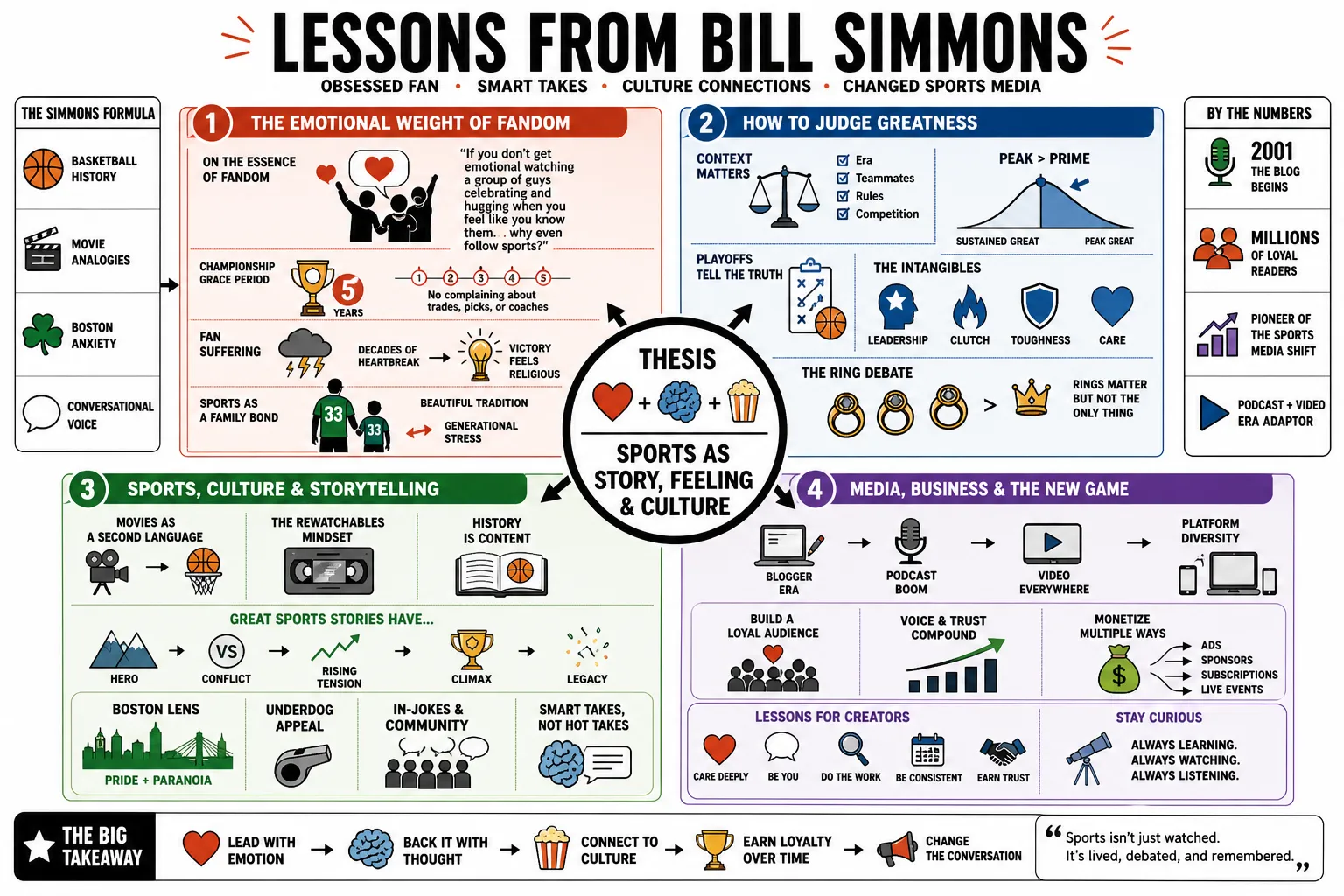
Lessons from Bill Simmons
Bill Simmons built a sports-and-pop-culture voice through his fan-centered columns and later created Grantland to combine writing, podcasts and other storytelling formats. — Simmons — Welcome to Grantland.
Part 1: The Emotional Weight of Fandom
- On the Emotion of Fandom: Watching the 2004 Red Sox celebrate, Simmons argued that feeling connected to the players through a season’s highs and lows is part of why he follows sports. — ESPN — The Nation’s Destination.
- On Championship Grace Periods: Simmons proposed a five-year no-complaining rule for himself after a favorite team wins a title, then tested his own rule when Pedro Martínez left Boston. — ESPN — The Final Punchado.
- On Accumulated Fan Pain: Simmons treats long title droughts and repeated near misses as cumulative experiences that change how fans receive an eventual win. — ESPN — The Levels of Losing.
- On Sports as a Family Bond: Simmons traces his Celtics attachment to games with his father and says their shared NBA-draft ritual became one of his most valued memories. — ESPN — Thanks for Everything, Dad.
- On Seeing a Team Win in Your Lifetime: Before the Patriots’ 2002 title, Simmons described a fan’s fear of spending a lifetime waiting for a championship that never arrives. — ESPN — Now I Can Die in Peace.
- On Levels of Losing: Simmons classifies defeats by how close a team came, the event’s significance and the history of fan disappointment, treating pain as a subjective fan experience. — ESPN — The Levels of Losing.
- On Keeping Sports in Perspective: Simmons argues that deeply invested adult fans can still distinguish the stakes of games from the stakes of real life. — ESPN — Taking a Collective Step Back.
- On Bandwagon Fandom: Simmons told Chuck Klosterman he disliked childhood bandwagon support for whichever team was winning, making long attachment part of his own fan ethic. — Simmons–Klosterman — Curious Guy.
- On Geographic Loyalty: In a debate with Chuck Klosterman, Simmons treated hometown allegiance as meaningful; Klosterman challenged that premise rather than sharing it. — Simmons–Klosterman — Curious Guy.
Part 2: Basketball History and The Pyramid
- On the Secret of Basketball: Simmons credits Isiah Thomas with a team-first lesson: stars improve a title team when they set aside individual statistics and ego for the group. — ESPN — The Book of Basketball’s Lost Pages.
- On the Eye Test: Simmons’s player comparisons consider movement, passing and on-court decisions alongside a player’s numbers. — ESPN — I Love This Game.
- On Remembering Greatness: Simmons warns that earlier stars can fade from fan memory even without being surpassed; he urges readers to keep historical context when evaluating the present. — ESPN — Fading Sports Memories.
- On Wilt’s 1962 MVP Finish: Simmons contrasts Wilt Chamberlain’s 50-point-per-game 1962 season with Bill Russell’s player-voted MVP win to show that the award reflected more than scoring volume. — The Ringer — Historic NBA MVP Column.
- On Ranking Players in Tiers: Simmons argues a tiered Hall of Fame would distinguish borderline honorees, defining superstars and all-time greats more clearly than a single membership label. — ESPN — Building the Halls of Justice.
- On Combining Numbers and Observation: Simmons uses statistical measures and live observation together when judging players, and is willing to revise a numbers-based impression if the play looks different. — Grantland — The Worst Contracts.
- On the Pantheon Tier: At the top of Simmons’s proposed pyramid sits a small Pantheon of players he regards as defining greats, distinct from routine Hall of Fame selections. — ESPN — Building the Halls of Justice.
- On Basketball What-Ifs: Simmons uses draft choices, injuries and trades as counterfactuals to examine how different decisions might have altered NBA history. — Grantland — Sports’ Two Most Intriguing Words.
- On Basketball Style: Simmons’s comparisons dwell on how players pass, move and create shots, not only on the totals in a box score. — ESPN — I Love This Game.
Part 3: Evaluating Players and Theories
- On the Ewing Theory: Simmons popularized a theory devised by his friend Dave Cirilli: some teams exceed expectations after a heavily featured star becomes unavailable. — Simmons — Ewing Theory 101.
- On the Value of a Supporting Player: For Simmons, Robert Horry illustrates how a role player’s defense, timing and understanding of his limitations can matter to a contender. — Simmons — Big Shot Bob.
- On Challenging Scouting Assumptions: Simmons describes testing prospects against specific NBA-ready skills and revisiting his own misses rather than trusting hype alone. — ESPN — Spot the Future All-Star.
- On Work Beyond the Box Score: Simmons points to Horry’s help defense and ability to fit around stars as contributions easy for casual viewers to overlook. — Simmons — Big Shot Bob.
- On Trade Value: Simmons ranks players by hypothetical trade resistance: which assets teams would refuse to give up in a plausible exchange, not scoring averages alone. — Grantland — NBA Trade Value.
- On Irrational Confidence: Simmons distinguishes several kinds of highly confident role players; some can swing a quarter, while others become costly when they take shots beyond their role. — Grantland — NBA Playoffs Are Wired.
- On Good Stats and Bad Teams: Simmons distinguishes a player who posts numbers on a weak team from one whose skills translate into a useful role on a contender. — Grantland — 2015 NBA Trade Value.
- On the Disease of More: Simmons applies Pat Riley’s “disease of more” to repeat contenders: after winning, individual demands can threaten the sacrifices that made the team work. — ESPN — The Next NBA Champs.
- On Stable Playoff Rotations: Simmons praised the Celtics for giving a core eight or nine players clearer minutes, arguing that continuity made their roles easier to manage. — Grantland — The Rebirth of the Celtics.
Part 4: Pop Culture as a Lens
- On Sports and Pop Culture: Simmons built Grantland to publish both sports and pop-culture work, and routinely used one to explain the other. — Simmons — Welcome to Grantland.
- On Movie Analogies: In an NBA offseason column, Simmons used Boogie Nights dialogue and themes as a deliberate framework for discussing basketball transactions. — Simmons — NBA Offseason and Boogie Nights.
- On SNL as a Sports Analogy: Simmons compared LeBron outgrowing Cleveland to an SNL star eventually outgrowing a television cast, using entertainment careers to frame a sports prediction. — Simmons — NBA’s Rank and File.
- On the NBA as TV Drama: Simmons framed one NBA offseason through Game of Thrones, using the show’s power struggles to organize movement among teams and stars. — Simmons — Game of NBA Thrones.
- On the Tyson Zone: A reader proposed the premise of an erratic celebrity whose next bizarre headline would seem believable; Simmons named and developed it as the Tyson Zone. — ESPN — Sports Guy Glossary.
- On Scrutinizing Directors Like Athletes: Reviewing Invictus, Simmons argued that directors’ reputations deserve the same career-by-career scrutiny sports fans give athletes. — Simmons — Invictus Failed to Deliver.
- On Wrestling Heel Narratives: Simmons used the wrestling heel metaphor for the public backlash to LeBron James’s 2010 Cleveland departure, showing how sports coverage can cast a star as a villain. — Simmons — God Loves Cleveland.
Part 5: The Boston Sports Experience
- On the Red Sox Curse: Simmons’s pre-2004 writing records how Boston’s accumulated near misses made him expect another painful finish. — ESPN — Now I Can Die in Peace.
- On the Yankees Rivalry: Simmons wrote that beating the Yankees changed the Red Sox’s sense of history, yet the rivalry quickly revived competitive urgency after Boston won. — ESPN — Sox-Yanks, Chapter 102.
- On Larry Bird: Simmons values Bird’s passing, competitive play and decisive performances as much as his scoring totals. — Simmons — Larry Legend vs. Big Papi.
- On Brady and Boston’s Expectations: Simmons described Tom Brady and the 2001 Patriots as changing what Boston fans thought possible after a long run of disappointment. — ESPN — Now I Can Die in Peace.
- On the 2004 ALCS Comeback: Simmons’s account of Boston overcoming a 3–0 series deficit against the Yankees captures how unlikely and personally significant that week felt to him. — ESPN — The Nation’s Independence Day.
- On David Ortiz’s Big Moments: Simmons compares Ortiz’s late-game hits with Bird’s decisive plays and recounts how Red Sox fans came to expect Ortiz to deliver. — Simmons — Larry Legend vs. Big Papi.
- On Boston’s Changed Fortunes: Simmons contrasted late-1990s Boston sports despair with the unfamiliar experience of following several contenders at once in 2007. — ESPN — Feeling Like Clooney.
- On Belichick’s Roster Decisions: Simmons observed that Belichick often parted with familiar stars earlier than fans expected, while acknowledging that some such calls were wrong. — The Ringer — All-Patriots Mailbag.
- On Celtics Tradition: For Simmons, the Celtics’ championship history gives rivalry games and roster eras a context that ordinary standings cannot capture. — ESPN — I Loved This Game.
- On Owning His Fan Bias: Simmons has explicitly described making his Boston loyalties visible in his column instead of pretending to write from a neutral fanless perspective. — ESPN — Book of Basketball Excerpt.
Part 6: Media, Journalism, and Grantland
- On Writing From the Fan’s Seat: Simmons’s account of his column emphasizes a distinctive fan voice and recurring devices rather than the posture of detached beat reporting. — ESPN — Book of Basketball Excerpt.
- On Long-Form Writing: Simmons recalls writing very long mailbags but says doing a column properly required time he could not spare while running television and site work. — Vox — Simmons on The Ringer.
- On Building an Editorial Team: Simmons made finding distinctive writers a Grantland goal and later relied on a trusted editorial core to shape The Ringer’s voice and recruit talent. — Vox — Simmons on The Ringer.
- On Quality Over Pageviews: At Grantland’s launch, Simmons said sponsorship could let the site favor work he valued over the sheer volume of stories needed to chase pageviews. — Simmons — Welcome to Grantland.
- On Recovering Untold Accounts: Simmons used a Malice-at-the-Palace oral history to illustrate how reporting from participants can surface details that routine postgame access missed. — Grantland — Simmons–Gladwell Exchange.
- On Covering Entertainment Seriously: Simmons made television, film and nostalgia part of his sports-media portfolio instead of treating them as unrelated side topics. — Vulture — Simmons on Podcasts.
- On Creative Room for Writers: One of Simmons’s stated Grantland goals was to recruit writers he trusted and give them room to pursue the work they did best. — Simmons — Welcome to Grantland.
- On the Reader Mailbag: Simmons adapted Letterman’s Viewer Mail into an online sports column, publishing his address and building recurring columns from reader messages. — Simmons — The Always Reliable Mailbag.
Part 7: Podcasting and the Audio Revolution
- On Trying Podcasting Early: Simmons began podcasting after hearing an ESPN audio interview, testing the format with modest equipment and learning from early guests. — Vox — Simmons on Podcasting.
- On the Conversational Model: Simmons wanted his podcast conversations to recall sports-radio hosts whose rapport made listeners feel included. — Vox — Simmons on Podcasting.
- On Recurring Guests: Simmons turned repeated conversations with friends such as Sal and JackO, and later his father, into familiar parts of his podcast. — Vox — Simmons on Podcasting.
- On Immediate-Reaction Shows: Simmons distinguishes timely Ringer shows that respond to fresh sports news from evergreen programs whose subjects remain useful when games stop. — Vulture — Simmons on Podcasts.
- On Podcast Chemistry: Simmons says shared knowledge and interpersonal chemistry matter when choosing audio guests, recalling an early interview that lacked common ground. — Vox — Simmons on Podcasting.
- On Open-Ended Interviews: Simmons recalls early podcast guests enjoying wide-ranging career conversations that were less scripted than their usual publicity appearances. — Vox — Simmons on Audio Interviews.
- On Designing a Media Network: Simmons planned a podcast network alongside Grantland’s writing, then developed The Ringer with writing, audio and video as complementary formats. — Vox — Simmons on The Ringer.
- On Carrying a Voice Across Formats: Simmons found that the audience for his writing could also recognize his voice through podcasts, creating another way to maintain a direct relationship. — Simmons — 12 Years Later.
Part 8: Legacy, Influence, and the Future
- On the NBA’s Extended Calendar: Simmons observed that drafts, free agency and summer speculation could make weeks after the Finals nearly as absorbing to fans as the games themselves. — Simmons — Approaching the Finish Line.
- On Player-Empowerment Trade Risk: Simmons argues that in the player-empowerment era teams must consider whether a star wants to stay before assigning trade value. — The Ringer — 2022 Trade Value.
- On Moving Beyond Writing Alone: Simmons designed The Ringer as a multimedia operation while still treating writing as the site’s core editorial identity. — Vox — Simmons on The Ringer.
- On Betting and Viewing: Simmons writes that having a wager made some games more engaging for him, while acknowledging losses and excess in his own betting experience. — ESPN — You Wanna Bet?.
- On Preserving Sporting Context: Simmons’s 30 for 30 pitch sought stories whose vivid contemporary details had been flattened or forgotten, including the 2004 ALCS. — Simmons — 30 for 30 Essay (2009 Archive).
- On Revisiting Wrong Predictions: Simmons notes that readers send him old predictions he missed, including a Jay Williams-over-Yao call, and uses the archive to revisit what changed. — Grantland — Sports’ Two Most Intriguing Words.
- On the 30 for 30 Pitch: Simmons proposed underexplored sports documentaries and creative room for filmmakers, selecting stories for fresh angles rather than simply famous names. — Simmons — 30 for 30 Essay (2009 Archive).
- On Changing Formats: Simmons moved from columns into podcasts and later built a multimedia outlet, while describing the strain that made a return to regular columns difficult. — Vox — Simmons on The Ringer.
- On Finding the Story: Simmons says strong sports writing and documentary work starts with a story not fully explored, then follows the details that make it compelling. — Simmons — 30 for 30 Essay (2009 Archive).