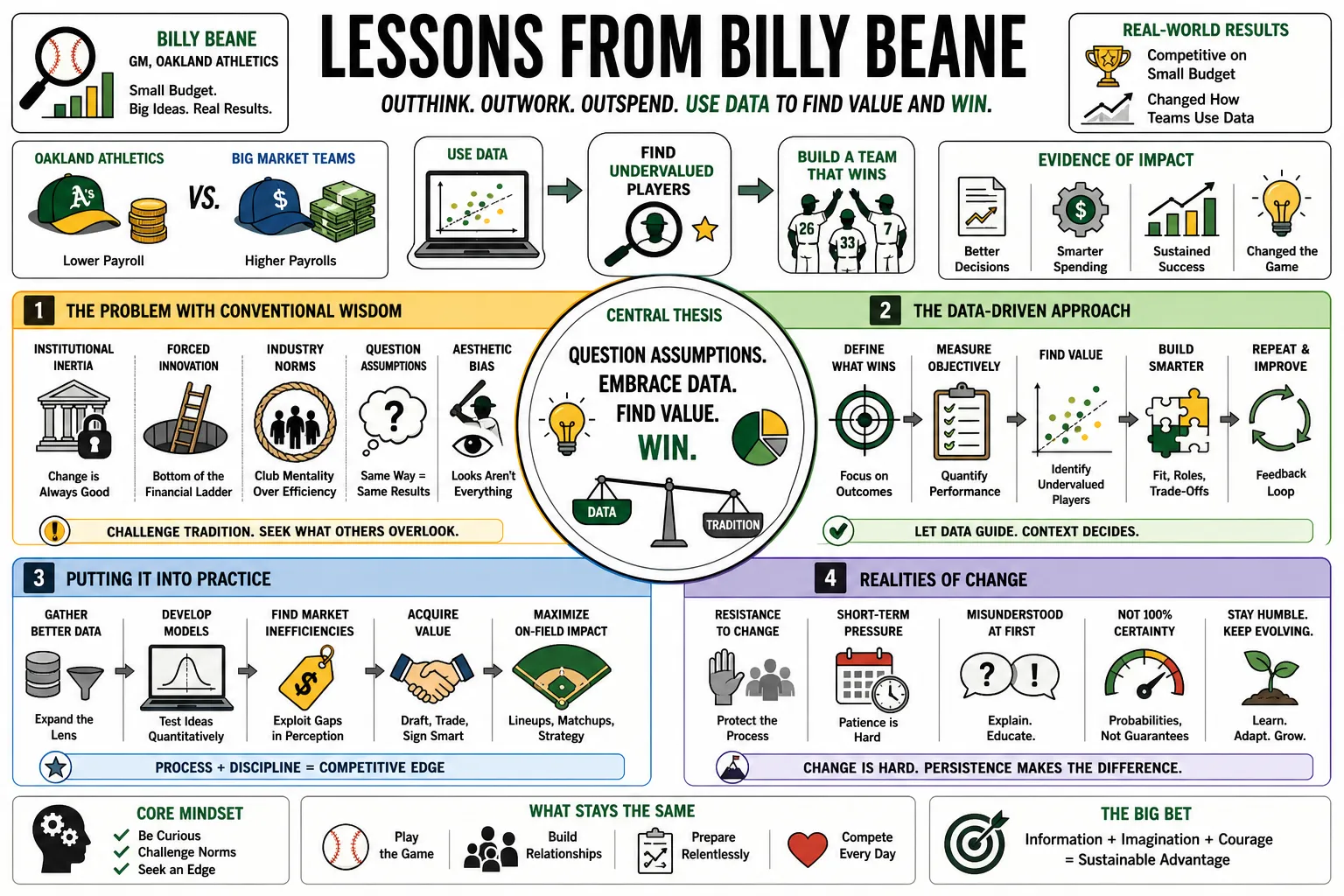
Lessons from Billy Beane
As General Manager of the Oakland Athletics, Billy Beane used statistical analysis to find undervalued players and compete against teams with much larger payrolls. His methods changed how professional sports evaluate talent and spend money. This profile covers his practical approach to data and management, along with the realities of fighting entrenched industry habits.
Part 1: The Problem with Conventional Wisdom
- On institutional inertia: "No matter how successful you are, change is always good. There can never be a status quo." — Source: [Three Book Thursday]
- On forced innovation: "When you are at the bottom of the financial ladder, you cannot afford to operate the same way as the richest teams; doing so guarantees failure." — Source: [Moneyball (Book)]
- On industry norms: "Professional sports often operate like a club where maintaining traditional practices is valued more highly than finding the most efficient way to win." — Source: [Farnam Street]
- On questioning assumptions: "If you do things exactly the way they have always been done, you will only ever get the results you have always gotten." — Source: [MIT Sloan Sports Analytics Conference]
- On aesthetic bias: "Scouts frequently evaluate players based on what a traditional athlete is supposed to look like rather than what their historical performance data actually proves they can do." — Source: [Moneyball (Book)]
- On the danger of experience: "Experience is often a polite way of describing a long history of making the same mistakes without ever correcting the underlying process." — Source: [Baseball Prospectus]
- On subjective evaluations: "The idea that I should trust my eyes more than the stats, I don't buy that because I've seen magicians pull rabbits out of hats and I know that the rabbit's not in there." — Source: [AZ Quotes]
- On herd mentality: "It is safer for a general manager's career to fail while doing exactly what everyone else is doing than to fail trying something completely new." — Source: [Harvard Business Review]
- On meritocracy: "The bottom line is that any business should be a meritocracy. The best and brightest. Period." — Source: [Medium]
- On romanticizing the past: "How can you not be romantic about baseball?" — Source: [AZ Quotes]
Part 2: Rethinking Value and Metrics
- On defining the actual goal: "Your goal shouldn't be to buy players. Your goal should be to buy wins." — Source: [Technori]
- On the true utility of offense: "I pay you to get on first, not to get thrown out at second." — Source: [Ranker]
- On hidden inefficiencies: "The market for baseball players routinely overvalues specific, visible skills like hitting home runs, while ignoring quiet, effective traits like the ability to draw a walk." — Source: [Moneyball (Book)]
- On outcome versus process: "In baseball, you can do something poorly and still get credit... Yet, when you look at historical databases, 80% of the time when a ball is struck with that trajectory and velocity, it is a hit." — Source: [Medium]
- On isolating variables: "To properly evaluate a player, you must separate their individual performance from the context of their teammates and the stadium they play in." — Source: [FiveThirtyEight]
- On college versus high school drafting: "Drafting high school players is inherently riskier because the sample size of their data is smaller and the quality of their opposition is lower compared to college athletes." — Source: [Baseball Prospectus]
- On the math of winning: "To get to the playoffs, you need a specific number of wins; to get those wins, you need a specific number of runs; to get runs, you just need players who do not make outs." — Source: [Moneyball (Book)]
- On market corrections: "Once a metric like on-base percentage becomes widely valued by the rest of the league, its financial utility vanishes, forcing you to find the next undervalued asset." — Source: [MIT Sloan Sports Analytics Conference]
- On defense versus offense: "Evaluating defensive capabilities was traditionally far more subjective than hitting, making it a prime target for future statistical modeling and exploitation." — Source: [The Athletic]
- On minimizing risk: "You are not looking for the perfect player; you are looking for the player whose statistical profile offers the highest probability of success at the lowest available price." — Source: [Farnam Street]
Part 3: Managing Bias and the "Eye Test"
- On cognitive traps: "Human scouts are naturally susceptible to confirmation bias, remembering the few times their gut feeling was right and forgetting the many times it was wrong." — Source: [Farnam Street]
- On objective reality: "The numbers produced over a 162-game season strip away the biases of age, appearance, and personality to reveal exactly what a player is actually contributing." — Source: [Moneyball (Book)]
- On physical appearance: "A player who looks like a professional athlete will be afforded more opportunities to fail than an unconventional looking player who quietly produces better results." — Source: [ESPN]
- On personal history: "Being a highly touted prospect who ultimately failed as a major league player taught me that physical tools mean nothing if the underlying performance data does not support them." — Source: [MLB.com]
- On separating emotion from analysis: "You cannot let your personal affinity for a player cloud your judgment regarding their future statistical decline." — Source: [APU Edge]
- On small sample sizes: "Evaluating a player based on a single weekend scouting trip is mathematically reckless compared to reviewing a thousand minor league plate appearances." — Source: [Baseball Prospectus]
- On the illusion of confidence: "Scouts often mistake a player's outward confidence or makeup for a guarantee of future performance, ignoring the cold mechanics of how often they actually get on base." — Source: [Moneyball (Book)]
- On systematic errors: "The human mind is terrible at calculating probabilities on the fly, which is why a computer model will consistently outperform intuition over a long enough timeline." — Source: [Wall Street Journal]
- On questioning experts: "Just because someone has spent forty years in the game does not mean they have spent those forty years evaluating talent correctly." — Source: [Harvard Business Review]
- On data governance: "If the data disagrees with the scouts, you trust the data; if you start making exceptions, the entire model falls apart." — Source: [MIT Sloan Sports Analytics Conference]
Part 4: Decision-Making Under Financial Constraints
- On structural disadvantages: "The problem we're trying to solve is that there are rich teams and there are poor teams. Then there's fifty feet of crap, and then there's us." — Source: [Wikiquote]
- On continuous improvement: "When you have no money you can't afford long-term solutions, only short-term ones. You have to always be upgrading. Otherwise, you are fucked." — Source: [Three Book Thursday]
- On sunk costs: "You cannot hold onto a declining asset because you spent heavily to acquire it; you have to evaluate players based strictly on their current and future utility." — Source: [Forbes]
- On the cost of mistakes: "You can always recover from the player you didn't sign. You may never recover from the player you signed at the wrong price." — Source: [Three Book Thursday]
- On asymmetric risk: "Small market teams must operate like venture capitalists, taking calculated risks on undervalued players who have the potential for massive returns." — Source: [RedBird Capital Partners]
- On ignoring the media: "Every deal you do will be publicly scrutinized by subjective opinion. Ignore them." — Source: [Three Book Thursday]
- On resource allocation: "You cannot spend a third of your payroll on a closing pitcher who only impacts sixty innings a year; capital must be deployed where it affects the most outcomes." — Source: [Moneyball (Book)]
- On the illusion of fairness: "Complaining about the payroll disparity in baseball is a waste of time; your job is to figure out how to exploit the rules of the system as it currently exists." — Source: [Financial Times]
- On finding replacements: "When you lose a star player to free agency, you do not try to replace him with another star; you replace his aggregate statistical output using a combination of cheaper players." — Source: [Moneyball (Book)]
Part 5: The Dynamics of Trading and Negotiation
- On execution efficiency: "When you get the answer you're looking for, hang up." — Source: [Wikiquote]
- On emotional detachment: "The worst thing you can do in a negotiation is fall in love with a player; you have to be willing to walk away the moment the price exceeds the mathematical value." — Source: [Baseball Prospectus]
- On exploiting panic: "The best time to make a trade is when another general manager is acting out of fear, public pressure, or a desperate need to show immediate progress." — Source: [Sports Illustrated]
- On volume trading: "Making a high volume of small trades allows you to constantly recycle your roster, gathering marginal advantages that compound over the course of a season." — Source: [The Athletic]
- On deadline pressure: "The trade deadline artificially inflates the value of average players; smart teams acquire their pieces months in advance when the market is quiet." — Source: [ESPN]
- On understanding the counterparty: "You have to know exactly what the other team values most, so you can offer them what looks attractive to them but holds little statistical weight for you." — Source: [Harvard Business Review]
- On asset liquidity: "Draft picks and prospects act as currency; you stockpile them to trade for proven major league assets when the time is right, rather than holding them only to play." — Source: [Moneyball (Book)]
- On the element of surprise: "If another team knows exactly what your analytical model values, they will raise the price; you must keep your exact parameters hidden while negotiating." — Source: [MIT Sloan Sports Analytics Conference]
- On walking away: "A successful general manager evaluates their track record by the bad contracts they avoided equally to the good players they acquired." — Source: [Yahoo Sports]
Part 6: Organizational Change and Leadership
- On hiring outside the industry: "Bringing in individuals with backgrounds in economics and mathematics injects necessary cognitive diversity into a room full of former players." — Source: [Farnam Street]
- On cultural resistance: "When you introduce a radically new way of operating, the existing staff will fight you because their entire professional identity is tied to the old methods." — Source: [McKinsey Quarterly]
- On management alignment: "A data driven strategy will fail immediately if the field manager refuses to deploy the players in accordance with the analytics." — Source: [Moneyball (Book)]
- On taking responsibility: "If you implement a controversial system and it fails, you have to absorb the entirety of the blame to protect the staff who executed your vision." — Source: [NetSuite SuiteWorld]
- On continuous learning: "The moment you believe you have solved the puzzle of baseball, the rest of the league will pass you; you must constantly rebuild your analytical models." — Source: [MIT Sloan Sports Analytics Conference]
- On organizational focus: "Every department, from scouting to player development to medical, must use the same language and the same metrics, or the system fractures." — Source: [The Athletic]
- On dealing with scouts: "You do not fire the old scouts; you force them to adjust their vocabulary, demanding they back up their gut feelings with statistical evidence." — Source: [Moneyball (Book)]
- On competitive drive: "I hate losing more than I want to win." — Source: [QuoteFancy]
- On trusting the process: "When the team goes on a losing streak, the hardest part of leadership is resisting the urge to abandon the mathematical model in a panic." — Source: [Wall Street Journal]
Part 7: Surviving Failure and Scrutiny
- On media criticism: "Writers and broadcasters will attack an unconventional strategy violently because its success implies that their traditional understanding of the sport is flawed." — Source: [Moneyball (Book)]
- On playoff variance: "The postseason is largely a coin flip, a short series where luck and variance can override the statistical advantages built over a long season." — Source: [FiveThirtyEight]
- On personal history as a failure: "Failing to live up to my billing as a first round draft pick stripped away my romanticism about raw talent and forced me to look at cold production." — Source: [MLB.com]
- On job security: "You cannot make decisions based on preserving your own job; the most optimal choices often look the riskiest to the public." — Source: [Harvard Business Review]
- On public perception: "It is entirely irrelevant if the entire industry laughs at your methods in April, provided the math holds up and you are in the playoffs in October." — Source: [CBS Sports]
- On validating the model: "We did not invent sabermetrics; we simply had the desperation required to finally apply it in a live, high stakes professional environment." — Source: [Baseball Prospectus]
- On ignoring noise: "During a losing streak, the local media will blame the analytics; during a winning streak, they will credit the players' heart. You have to ignore both narratives." — Source: [The Athletic]
- On the pain of rebuilding: "Tearing down a moderately successful team to build a statistically superior one is agonizing but mathematically necessary to avoid long term mediocrity." — Source: [ESPN]
- On redefining success: "For a small market team, forcing a Game 5 against a team with triple your payroll is a monumental organizational victory, even if it ends in a loss." — Source: [Moneyball (Book)]
Part 8: The Expansion of Analytics Across Sports
- On the globalization of data: "The principles used to evaluate an amateur baseball player in California can be adapted to evaluate a professional soccer player in Europe." — Source: [The Guardian]
- On soccer's inefficiency: "European football, despite its massive wealth, suffered for decades from the exact same subjective, eye test scouting biases that plagued baseball in the 1990s." — Source: [Financial Times]
- On the universal language of math: "Regardless of the sport, the fundamental challenge is always the same: accurately pricing the cost of an action that leads to a victory." — Source: [MIT Sloan Sports Analytics Conference]
- On adapting to new environments: "You cannot simply paste baseball statistics into soccer; you have to build entirely new models that account for fluid play rather than discrete events." — Source: [The Athletic]
- On the advantage of relegation: "The financial penalties of relegation in European soccer make the adoption of efficiency models a survival imperative for mid table clubs." — Source: [Forbes]
- On the future of sports ownership: "The next generation of sports team owners will operate their clubs like hedge funds, using proprietary data pipelines as their primary competitive moat." — Source: [RedBird Capital Partners]
- On cross-disciplinary learning: "We learned as much about managing a sports organization by studying Wall Street trading floors as we did by watching other sports teams." — Source: [Wall Street Journal]
- On player health data: "The next great inefficiency in sports is not evaluating talent, but utilizing biometric data to prevent injuries and optimize player recovery over a long season." — Source: [FiveThirtyEight]
- On his own legacy: "I am not a genius; I was simply the first general manager who was backed into a financial corner tight enough that I was forced to actually listen to the mathematicians." — Source: [APU Edge]