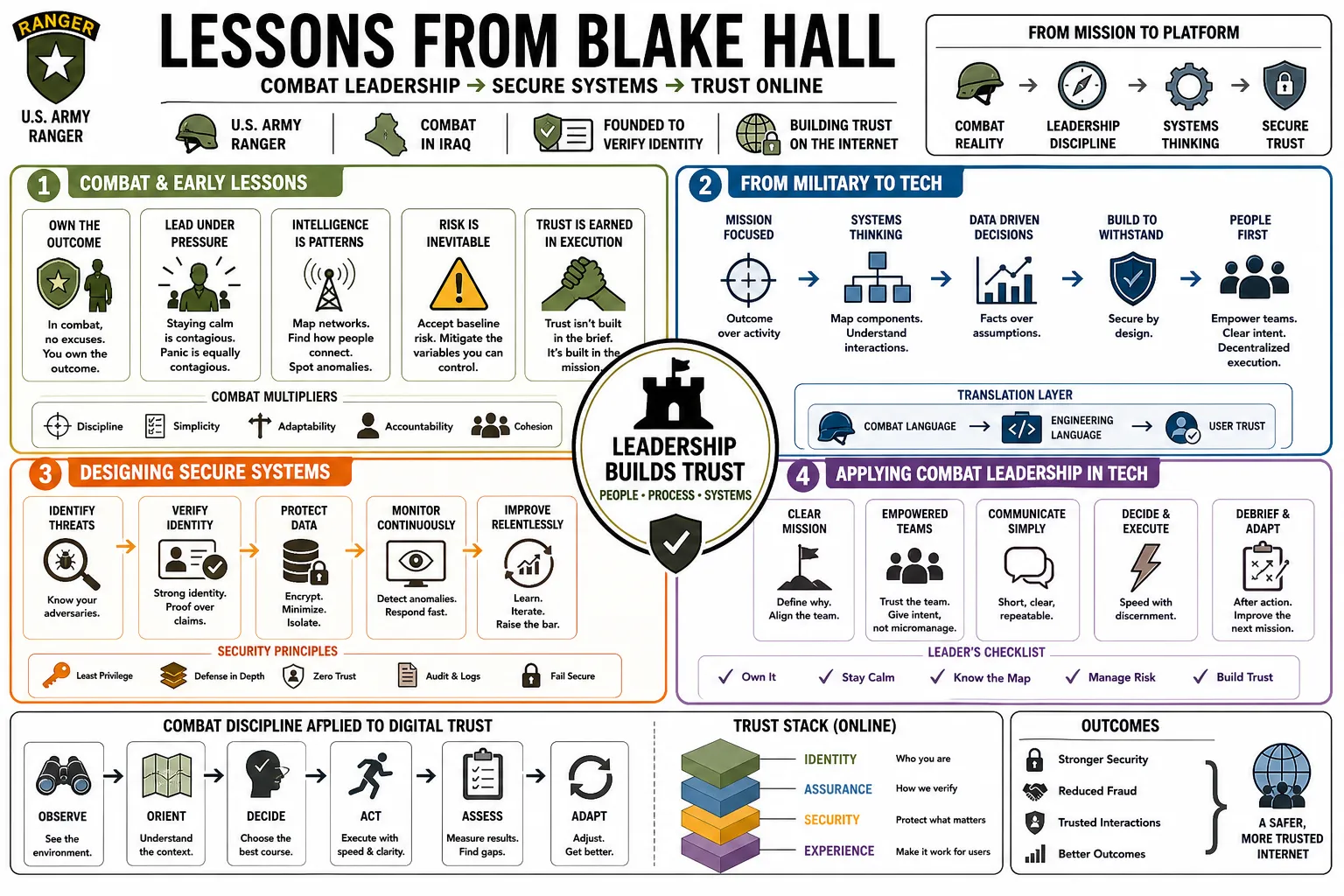
Lessons from Blake Hall
Blake Hall served as a U.S. Army Ranger in Iraq before founding ID.me to verify online credentials and block digital fraud. This collection covers his transition from the military to tech, detailing how he applies combat leadership to the practical mechanics of designing secure systems and establishing trust on the internet. — Military Times Interview.
Part 1: Combat and Early Lessons
- Responsibility for a Platoon: Hall says the safety of his reconnaissance platoon weighed on his decisions in Iraq; preparation was part of his responsibility to the people and families depending on him. — Invest Like the Best, Episode 408.
- Leading Through Combat: Hall led 450 combat patrols in Iraq as a reconnaissance platoon leader without a casualty in his platoon. The record does not establish his quoted calm-versus-panic maxim. — Military Times Interview.
- Identity Analytics in Combat: Hall says counterterror operations exposed him to data and analytics used to distinguish and verify identities, lessons he later connected to online identity verification. — IT Visionaries Interview.
- Planning for Contingencies: Hall says his platoon rehearsed possible disruptions before missions so the team could still act when communication became difficult under pressure. — Invest Like the Best, Episode 408.
- Showing Care Under Fire: Hall recounts a wounded fellow officer who kept focusing on his men after an explosion, an example he uses to explain why leaders must care for those they serve. — Invest Like the Best, Episode 408.
- Rehearsing Clear Action: Because detailed instructions are hard to communicate in a firefight, Hall emphasizes preparing and rehearsing contingencies before a mission. — Invest Like the Best, Episode 408.
- Duty to a Platoon: Hall led a reconnaissance platoon through 450 combat patrols without a platoon casualty and later said the Army taught him responsibility, leadership, and teamwork under hard conditions. — Military Times Interview.
- Diagnosing the Real Problem: Hall argues that leaders need to diagnose the situation actually unfolding, rather than persist with an inherited playbook when the evidence points elsewhere. — World of DaaS Interview.
Part 2: The Philosophy of Leadership
- Humble Confidence: Hall’s conversation with Simon Sinek explores how confident leaders can acknowledge what they do not know and remain open to learning. — A Bit of Optimism.
- Leadership Across Contexts: Hall says the Army taught him responsibility and teamwork under difficult conditions, and that those habits carried into his company. — Military Times Interview.
- Owning Mistakes: The Fintech Leaders interview describes Hall’s practice of acknowledging mistakes, diagnosing issues, and offering specific improvement plans to build trust. — Fintech Leaders Interview.
- Staying With the Mission: In a later interview, Hall discusses maintaining a sense of mission while navigating criticism and the sacrifices of building ID.me. — Built in America Interview.
- Earning Leadership Credibility: Hall links leadership credibility to care, grit, and skill, saying a leader must keep learning and be willing to do the work required by the role. — Invest Like the Best, Episode 408.
- Learning as Scope Grows: As a founder’s responsibilities widen, Hall argues that the skills needed to lead change and the leader must keep learning. — Invest Like the Best, Episode 408.
- Connecting Work to KPIs: Hall wants reports to explain how teams’ work connects to company profit and loss and to identify the durable KPIs that show whether it is working. — Outlander VC Founder Interview.
- Serving the Front Line: Drawing on a story from his grandfather’s military service, Hall says leaders should care for those at the front before taking care of themselves. — Invest Like the Best, Episode 408.
Part 3: The Transition to Entrepreneurship
- The Veteran-Verification Gap: Hall says veterans had been asked to expose sensitive separation paperwork just to claim routine discounts; the unnecessary disclosure helped inspire what became ID.me. — ID.me 15-Year Reflection.
- Find a Mentor: After leaving the military, Hall emphasizes finding a strong mentor; Kelly Perdew became one of his early guides in entrepreneurship. — IT Visionaries Interview.
- Surviving the Early Years: After choosing ID.me over a higher-paying consulting job, Hall paid himself little and spent months sleeping on a friend’s couch while the company took shape. — Fintech Leaders Interview.
- Adapting the Product: ID.me began with military-focused TroopSwap, developed Troop ID, and then broadened into a reusable identity wallet; Hall’s account shows how the product changed while the verification problem remained central. — ID.me 15-Year Reflection.
- Finding Purpose After Service: Hall says he struggled to find a sense of purpose after leaving the Army and later channeled his service motivation into building a safer way for veterans to claim benefits. — Military Times Interview.
- Testing Investors’ Belief: Hall recalls early investors who believed in him despite doubts about the initial TroopSwap model; he responded by defining hypotheses and running tests rather than treating the first pitch as settled. — World of DaaS Interview.
- Complementary Founding Skills: Hall advises first-time founders to seek mentors for blind spots and build a founding team with complementary rather than duplicate skills. — Outlander VC Founder Interview.
- Allow Time for Identity Networks: Hall compares digital identity networks with payment networks that took decades to develop; multiple institutions must coordinate before reusable credentials become widely accepted. — World of DaaS Interview.
- Grow Into Wider Scope: Hall says a scaling founder takes on wider responsibilities and must keep developing the skills to lead effectively. — Invest Like the Best, Episode 408.
Part 4: Building the Identity Layer
- Fragmented Online Identity: Hall argues that isolated website logins make people repeatedly prove who they are, motivating ID.me’s portable identity-wallet model. — World of DaaS Interview.
- Portable Identity: Hall’s stated goal is that a verified login and credentials move with the user, avoiding repeated proof of identity at each website. — A More Trusted Place.
- Security With Less Friction: Hall describes ID.me’s mission as providing strong security while reducing the friction of proving identity online. — ID.me 15-Year Reflection.
- Reducing Password Burden: Hall argues that managing separate passwords and reverifying at every website creates avoidable friction; he proposes a reusable verified login. — A More Trusted Place.
- The Payment-Network Analogy: Hall compares portable identity credentials with cards in a payment network: one reusable credential can work at many participating sites. — World of DaaS Interview.
- A Consumer-Centric Wallet: Hall envisions a wallet that carries verified information with the user while keeping the trust layer separate from the services that use it. — World of DaaS Interview.
- Cross-Sector Credentials: Hall wants a reusable identity wallet accepted across government, healthcare, consumer services and other sectors, rather than a separate login for each organization. — ID.me 15-Year Reflection.
- Separating Trust From Activity: Hall argues that identity credentials should be handled at a trust layer separate from the applications that store a user’s activity, reducing the risk of combining both kinds of data. — World of DaaS Interview.
Part 5: Fraud, Security, and Bad Actors
- Sophisticated Fraud Networks: Hall says AI tools have enabled more convincing social-engineering attacks and reports seeing nation-state-linked groups generate counterfeit identity documents. — World of DaaS Interview.
- Device Signals in Fraud: Hall says the relationship between an attacker and a device matters in internet fraud because acquiring and managing many devices imposes costs. — World of DaaS Interview.
- An Evolving Defense: Hall presents fraud defense as an iterative contest: a detection method may work now but must be revisited as attackers adapt. — World of DaaS Interview.
- A Separate Anti-Duplicate Check: Hall clarifies that ID.me uses a 1:1 face match for identity verification and, for certain government-program accounts, a separate internal 1:many selfie check once after verification to detect repeated identities. — Enhancing Privacy.
- Balancing Access and Protection: Hall frames identity verification as a context-dependent balance among privacy, security, and legitimate access; overly rigid automated checks need a human route for people they cannot verify. — Enhancing Privacy.
- Beyond Static Identifiers: Hall argues that breached Social Security numbers remain useful to identify records but are inadequate by themselves as proof that a claimant is the person named. — World of DaaS Interview.
- Raising Attack Costs: Hall says anti-fraud controls should make the expected cost of an attack exceed the gain, so attacks become less profitable to scale. — Enhancing Privacy.
Part 6: Equity and Access
- No Identity Left Behind: Hall describes “No Identity Left Behind” as ID.me’s mission: pair a portable login with a video-chat path for people who cannot be verified from existing records. — No Identity Left Behind.
- Thin Files and Exclusion: Hall warns that relying on data-broker records alone can exclude people with little recorded financial history from online government services. — No Identity Left Behind.
- A Human Verification Route: ID.me added live video-chat verification for people whose documents or records do not pass its automated checks, including veterans living abroad. — No Identity Left Behind.
- Serving Veterans Abroad: Hall recounts an elderly veteran in Japan who could regain access to VA benefits through a video-verification route after conventional record matching had failed him. — No Identity Left Behind.
- Testing for Unequal Outcomes: ID.me says it tested automated face-match failures against skin-tone categories and offered human review when automated verification did not work; these are company-reported safeguards, not independent proof of equal outcomes. — No Identity Left Behind.
- Identity and Financial Inclusion: Hall argues that a portable identity wallet could make financial and civic services more accessible to people underserved by traditional credit-bureau records. — World of DaaS Interview.
- A Route Beyond Record Matching: People who move, change names, immigrate, or live abroad may fail traditional record matching; Hall argues that supervised verification should offer another route. — Enhancing Privacy.
- Access to Public Services: Hall frames trusted digital identity as both a security and access challenge for government benefits: citizens should be able to prove who they are without a separate, fragile process at every agency. — No Identity Left Behind.
Part 7: Team Building and Shared Context
- Information and Shared Context: Hall argues that giving people more information creates shared context and helps trusted teammates make better decisions. — Fintech Leaders Interview.
- Decisions at the Edge: Drawing on military operations, Hall argues that an adaptive network works better when authority and resources reach people close to fast-changing conditions. — World of DaaS Interview.
- Screening for Character: In a discussion of hiring, Hall highlights optimism, kindness rather than mere niceness, composure under pressure, and refusing to tolerate abusive behavior. — TechTables Interview.
- Creating Transparent Context: Hall says leaders should create conditions for shared context and transparent information-sharing so communication takes less effort. — Fintech Leaders Interview.
- Enforcing Culture Standards: Hall discusses ID.me’s culture in terms of rejecting abusive conduct, favoring candid kindness over superficial niceness, and maintaining an optimistic problem-solving mindset. — TechTables Interview.
- Aligning on the Rationale: The Fintech Leaders interview describes Hall’s emphasis on explaining the rationale behind strategic decisions so stakeholders can align around a plan. — Fintech Leaders Interview.
Part 8: The Future of Digital Trust and AI
- AI-Enabled Fraud: Hall says generative-AI tools have made social-engineering scams and counterfeit identity documents more convincing and easier for criminals to produce. — World of DaaS Interview.
- Defending Against Deepfakes: ID.me says it is developing detection methods to respond to AI-driven fraud and deepfakes; Hall also warns that a method working today may not keep working as attacks change. — ID.me 15-Year Reflection.
- Wallet Convergence as a Forecast: Hall predicts that a small number of reusable identity wallets could emerge, while noting that payment-like networks can take decades to mature. — World of DaaS Interview.
- A More Trusted Place: Hall states ID.me’s mission as making online interactions more trusted while reducing the friction of proving identity. — ID.me 15-Year Reflection.