Blake Mycoskie founded TOMS and developed its original One for One shoe-giving model. In his accounts of the company, he describes how a clear giving promise shaped its early sales, how rapid growth strained its culture, and how he later reconsidered his role and definition of success. — Harvard Business Review Essay.
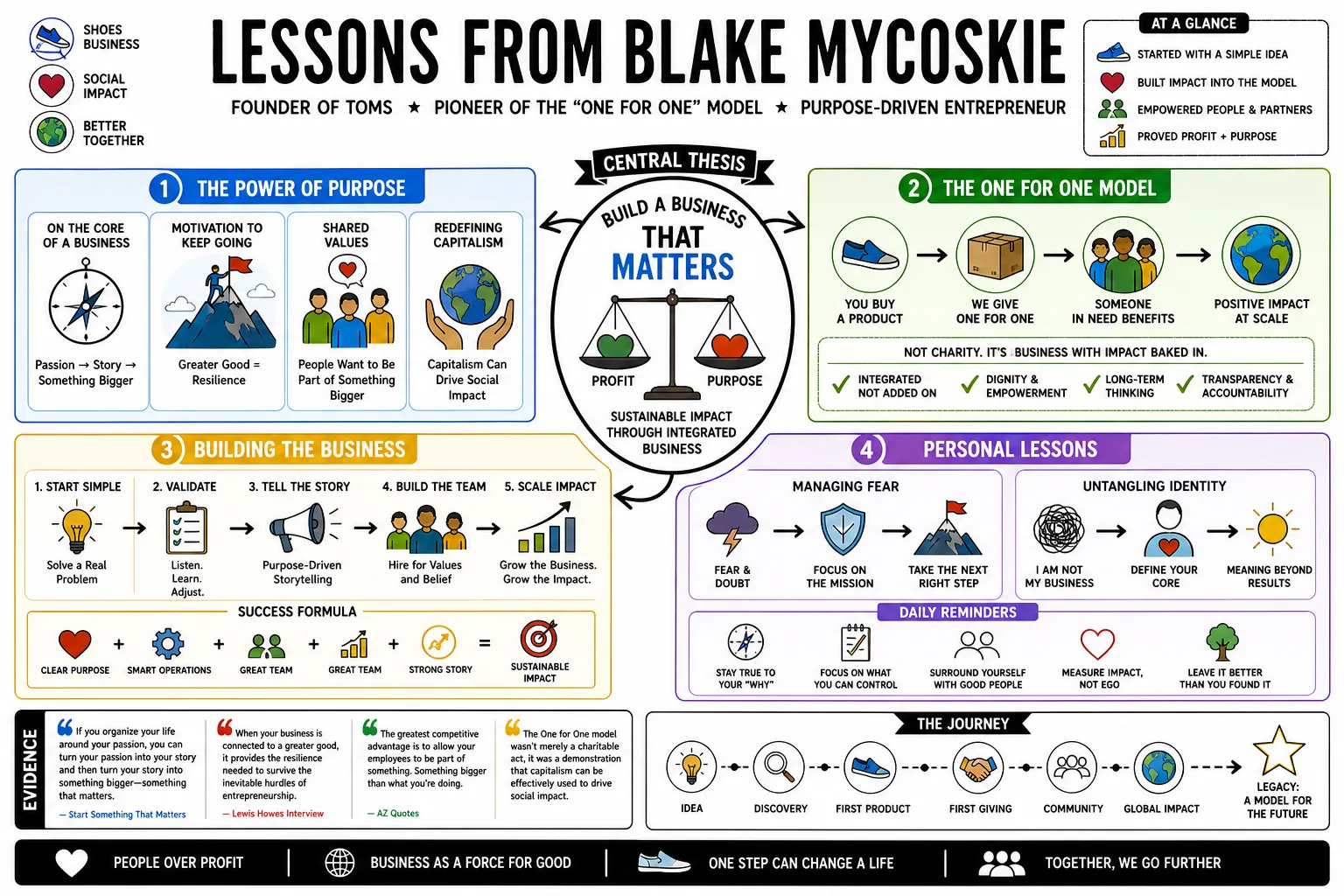
Part 1: The Power of Purpose
- Connect Purpose to the Product: Mycoskie built TOMS around a purchase-linked giving promise so its social purpose was part of how the shoe business operated, not a separate donation program. — Harvard Business Review Essay.
- Purpose as Motivation: Mycoskie says TOMS’s mission gave employees a reason to care about their work even as the company faced the pressures of growth. — Harvard Business Review Essay.
- Purpose as Competitive Distinction: Mycoskie describes TOMS’s mission as a competitive advantage because it both motivated staff and gave customers a reason to connect with the company beyond the shoe itself. — Harvard Business Review Essay.
- Use Business to Sustain Giving: Mycoskie chose a for-profit model that tied each sale to giving another pair, rather than relying on a recurring appeal for donations. — Harvard Business Review Essay.
- Make Giving Shareable: After TOMS had a shoe customers wanted, its giving story gave them a concrete reason to tell other people about the product. — Tim Ferriss Interview #249.
- Give Customers a Way to Help: Mycoskie describes TOMS as making participation in giving simple for customers through an ordinary purchase. — Startups.com Interview.
- Let the Mission Carry Through Setbacks: Mycoskie links the TOMS mission to his own perseverance, while also recounting the practical supply problems and fears he encountered as the business grew. — Tim Ferriss Interview #249.
- Keep the Giving Promise Concrete: TOMS made its original promise tangible: a shoe purchase was linked to a shoe gift. Mycoskie says that clarity helped people understand and retell the business story. — Tim Ferriss Interview #551.
- Pair Mission With Expertise: Mycoskie says the TOMS mission attracted an experienced shoemaking executive, whose production knowledge helped the company scale. — Berkeley Haas Interview.
- Revisit Purpose as Scale Changes: Mycoskie found that growth alone did not keep TOMS connected to its original mission; after a sabbatical, he returned to make that purpose more explicit in the company’s next phase. — Harvard Business Review Essay.
Part 2: Storytelling and Branding
- Tell a Story Worth Sharing: Mycoskie says the TOMS story helped customers spread its message at a fraction of what conventional advertising would have cost. — Harvard Business Review Essay.
- Let the Customer Participate: The Lewis Howes interview presents Mycoskie’s view that a giving story works better when the customer can see themselves as a participant rather than merely an audience for the brand. — Lewis Howes Interview.
- Use a One-Sentence Promise: Mycoskie recalls a store display that condensed TOMS’s offer to buying one pair and giving one pair, making the company’s purpose easy to grasp. — Tim Ferriss Interview #551.
- Enable Customer Retelling: Mycoskie recounts customers explaining the TOMS giving story to others, turning a purchase into a conversation about the company’s purpose. — Tim Ferriss Interview #249.
- Sell a Product That Stands Alone: Mycoskie tested whether people would buy the shoe before he told them about the giving model; he concluded that a viable product and a meaningful story work together. — Tim Ferriss Interview #249.
- Do Not Confuse Brand and Self: Mycoskie says TOMS grew so central to his identity that he needed time away to reconsider both his personal role and the company’s mission. — Harvard Business Review Essay.
Part 3: Overcoming Fear and Taking Action
- Fear Can Become a Prompt to Act: Mycoskie has described fear as sometimes paralyzing and sometimes motivating; he points to his responsibility to people expecting TOMS shoes as one reason he kept going. — Tim Ferriss Interview #551.
- The Weight of a Giving Promise: After TOMS’s first distribution, Mycoskie says he feared disappointing the people who had begun relying on its promise; that responsibility also motivated him. — Tim Ferriss Interview #551.
- Test a Small Batch: Mycoskie began with 250 pairs of shoes, using a small first run to learn whether people wanted the product before trying to build a larger company. — Harvard Business Review Essay.
- Make Failure Discussable: Mycoskie argues that leaders should disclose their own mistakes and let teams learn from failures quickly instead of treating every setback as a reason for blame. — Berkeley Haas Interview.
- Delay Outside Funding When Feasible: Mycoskie says he started TOMS with a small shoe run and preferred to postpone outside investment while the business idea could still be tested cheaply. — Tim Ferriss Interview #249.
- Learn From a Failed Channel: After a failed reality-television venture, Mycoskie concluded that relying on a few cable distributors left the business vulnerable; the experience influenced how he approached his next company. — Berkeley Haas Interview.
Part 4: Simplicity and Resourcefulness
- Design for Immediate Understanding: Mycoskie says he intentionally made the One for One mechanism straightforward so someone could understand how a shoe purchase related to a shoe gift. — Startups.com Interview.
- Start With a Small Operation: Mycoskie recounts building TOMS initially from an apartment with a small team and limited inventory, before the company’s demand created more complex supply needs. — Harvard Business Review Essay.
- Notice When Process Crowds Out Purpose: As TOMS grew, Mycoskie says added hierarchy and process dulled its entrepreneurial energy and drew attention away from the mission. — Harvard Business Review Essay.
- Expand Within the Mission: Mycoskie expanded TOMS into coffee as another way to connect a purchase to giving, while trying to keep the original mission recognizable across products. — Harvard Business Review Essay.
- Combine Outside Perspective With Industry Skill: Mycoskie entered shoes without deep manufacturing experience, then brought in a veteran shoe executive when scaling exposed how much specialist expertise TOMS needed. — Berkeley Haas Interview.
Part 5: Leadership and Company Culture
- Keep Bureaucracy From Displacing Experimentation: Mycoskie recounts that new hierarchy, internal conflict and process weakened TOMS’s earlier willingness to experiment. — Harvard Business Review Essay.
- Model Learning From Failure: Mycoskie says leaders can make failure safer to discuss by admitting their own mistakes and letting teams test and learn quickly. — Berkeley Haas Interview.
- Hire for Mission and Skill: Mycoskie describes recruiting a seasoned shoemaking executive who cared about TOMS’s giving mission and also knew how to solve its production challenge. — Berkeley Haas Interview.
- Respond to Giving-Model Criticism: Mycoskie says he was initially defensive about criticism of TOMS’s shoe giveaways, then brought in public-health expertise and changed parts of production and distribution to address local concerns. — Berkeley Haas Interview.
- Keep Purpose While Changing Methods: Mycoskie describes adjusting TOMS’s products, giving practices and leadership structure while trying to make its founding purpose relevant to its next stage. — Harvard Business Review Essay.
Part 6: Rethinking Philanthropy and Business
- Look Beyond the Initial Gift: Mycoskie acknowledges that shoe giveaways could affect local economies, and says TOMS responded with some local manufacturing and closer integration with health programs. — Berkeley Haas Interview.
- Build Purpose Into the Business: Mycoskie argues that a social purpose works best when it shapes how a company makes and sells its products, not only what it donates after a sale. — Berkeley Haas Interview.
- Profit and Purpose Need Not Be Opposites: Mycoskie argues that a company can pursue a viable business and social purpose together, while choosing a model suited to the problem rather than assuming one structure fits all. — Berkeley Haas Interview.
- Show the Purchase-to-Giving Connection: When TOMS introduced eyewear, Mycoskie emphasized making the effect of each purchase clear to customers rather than leaving the giving mechanism abstract. — Fast Company Interview.
- Inspire Other Companies to Give: Mycoskie says he values seeing other businesses adopt purchase-linked giving approaches after TOMS, while recognizing that later models may need to differ from its original shoe formula. — Startups.com Interview.
- Recognize a Later Company Shift: TOMS now describes a giving approach based on a share of profits, cash grants, and partnerships with community organizations, rather than only the original pair-for-pair shoe model. This is a later company policy, not a decision attributed here to Mycoskie. — TOMS Impact FAQ.
- Include People and Planet in the Bottom Line: Mycoskie advocates considering people and planet alongside profit when judging what a business creates. — Berkeley Haas Interview.
Part 7: Mental Health and Personal Identity
- Success Was Not a Stable Identity: Mycoskie says he had built his sense of worth around achievement and later struggled when the company no longer supplied the same role, purpose and community. — I Had Everything. It Still Wasn’t Enough.
- Separate Worth From Achievement: In reflecting on his own difficult period after TOMS, Mycoskie says he had to question his belief that another achievement would make him feel sufficient. — I Had Everything. It Still Wasn’t Enough.
- Notice the Community a Role Provides: Mycoskie says that leaving TOMS also meant losing a daily community and sense of purpose, losses that made the transition harder for him. — I Had Everything. It Still Wasn’t Enough.
- Success Did Not Bring the Peace He Expected: Mycoskie says business success and social impact did not produce the lasting peace he once expected from them. — No Magic Pill.
- No Single Fix Worked for Him: Mycoskie describes trying different approaches to his mental well-being and finding that none was a universal answer for him. — No Magic Pill.
- Share Experience Without Claiming Expertise: Mycoskie says he chose to speak openly about his mental-health experience in hopes that others would feel less alone, while making clear that he is not a clinician. — I Had Everything. It Still Wasn’t Enough.
- Practice the Idea of Enough: Mycoskie describes “enough” as something to return to rather than a finish line reached by one more business milestone. — I Had Everything. It Still Wasn’t Enough.
- Ask for Help When Needed: In recounting his own depression, Mycoskie says he sought help rather than resolving the crisis through another business achievement. — I Had Everything. It Still Wasn’t Enough.
Part 8: Reevaluating Success and Fulfillment
- Value Relationships Over Possessions: Mycoskie told Tim Ferriss that relationships and shared memories had become more important to him than accumulating possessions. — Tim Ferriss Interview #249.
- Question External Applause: Mycoskie reflects that public recognition and outside approval did not settle his deeper questions about meaning and well-being. — Finding Mastery Interview.
- Hand Over Operating Responsibility: After realizing his strengths lay more in setting vision than running day-to-day marketing, Mycoskie helped bring in an experienced CEO and changed his own role. — Harvard Business Review Essay.
- Shift From Building to Living: Mycoskie’s later work on ENOUGH grew from his realization that another business achievement would not answer his questions about identity, connection and well-being. — I Had Everything. It Still Wasn’t Enough.
- Make Room for the Present: In conversation with Tim Ferriss, Mycoskie emphasizes enjoying relationships and present experiences rather than postponing life for a future business milestone. — Tim Ferriss Interview #249.