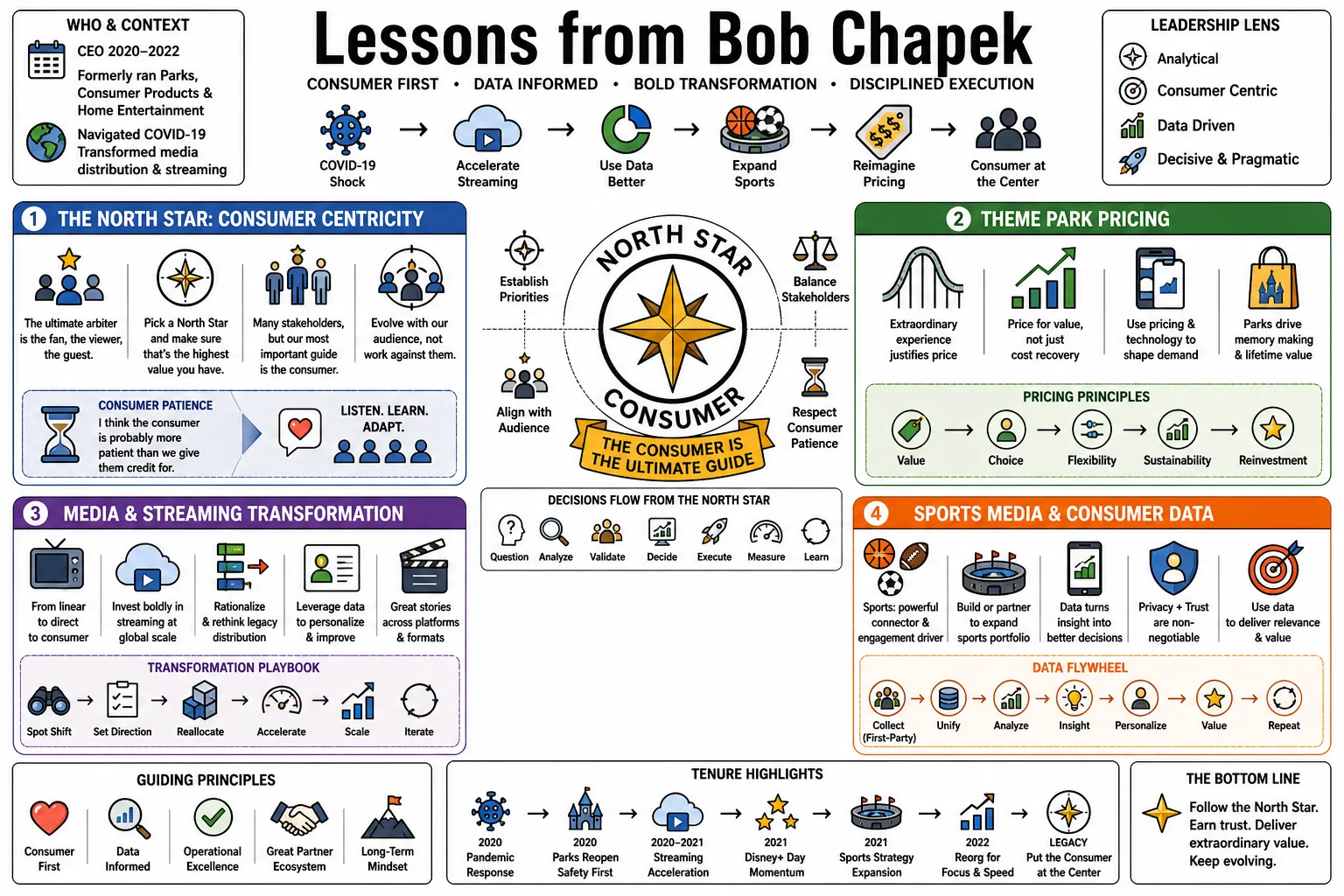
Lessons from Bob Chapek
Bob Chapek served as Disney's CEO from 2020 to 2022 after a long career running the company's parks, consumer products, and home entertainment divisions. During his tenure, he navigated the COVID-19 pandemic and overhauled Disney's media distribution to accelerate its streaming business. This profile collects his statements on theme park pricing, corporate restructuring, sports media, and consumer data to highlight his analytical approach to entertainment leadership.
Part 1: The North Star and Consumer Centricity
- On the Consumer as the Ultimate Guide: "The ultimate arbiter of what Disney can and can't be is the fan, the viewer, the guest." — Disney: News & Statements]
- On Establishing Priorities: "Pick a North Star and make sure that's the highest value you have." — Indiana University: About]
- On Stakeholder Balance: "We are a big company with many constituents and stakeholders... But at the end of the day, our most important guide — our North Star — is the consumer." — Disney: News & Statements]
- On Aligning with the Audience: "We must evolve with our audience, not work against them. And so we will put them at the center of every decision we make." — Disney: News & Statements]
- On Consumer Patience: "I think the consumer is probably more impatient than they've ever been before... I'm not sure there's a going back." — Disney: News & Statements]
- On Targeted Engagement: "It's about having a granular understanding of what the consumption patterns are, and then speaking to the consumers in a way that's going to be relevant." — Disney: News & Statements]
- On Content Preferences: "When [adults] put their kids to bed at night after watching [an animated film], they're probably not going to tune into another animated movie. They want something for them." — Disney: News & Statements]
- On the Evolution of Home Entertainment: The "Disney Vault" marketing strategy was designed to drive demand by creating artificial scarcity for classic films during periodic re-releases. — Fox Business: Markets]
- On Brand Management Roots: His early career in brand management at H.J. Heinz Company and J. Walter Thompson laid the foundation for his data-focused approach to consumer goods. — Disney: News & Statements]
- On Exceeding Expectations: Having a "North Star" meant prioritizing exceeding guest expectations to create memories that last a lifetime. — Indiana University: About]
Part 2: Navigating the Theme Park Ecosystem
- On Theme Park Fandom: "If we move a churro cart ten feet, it's a big deal." — Disney: News & Statements]
- On Pricing and Demand: "Our ticket prices and constraints we put on how often people can come and when they come is a direct reflection of demand." — Disney: News & Statements]
- On Market Corrections: "When is it too much? Demand will tell us when it's too much." — Disney: News & Statements]
- On Balancing Audiences: "We love all our fans equally... But at the same time, we've got to make sure that there's room in the park for the family from Denver that comes once every five years." — Disney: News & Statements]
- On Walt's Original Vision: "It was Walt's vision for our theme parks to be places where Disney stories come to life in amazing ways." — Disney: News & Statements]
- On Managing Capacity: Virtual Queues were implemented as a practical tool intended to help manage long lines and high-demand attractions. — Disney: News & Statements]
- On Passholder Propositions: Unlimited access for some annual pass holders made it increasingly difficult to maintain a balanced proposition for less frequent visitors. — Disney: News & Statements]
- On Park Reopenings: "Our guest satisfaction scores since we've reopened across the world have shown that, indeed, our guests are even more satisfied than they were prior to the pandemic." — Blooloop: Theme Park News]
- On the Creative Team: The realization of immersive park projects relies heavily on a team of artists and dreamers having no shortage of inspiration. — Disney: News & Statements]
Part 3: Data, Efficiency, and Operational Philosophy
- On Forward Momentum: "We keep moving forward, doing new things, because we're curious, and curiosity keeps leading us down new paths." — Indiana University: About]
- On Organizational Evolution: "The very DNA of what Walt has given us... is that you've got to keep evolving or you'll become a dinosaur." — Indiana University: About]
- On Willpower: "To an extent, running for me was a symbol of wanting to persevere and do something bigger and better, starting with college." — Disney: News & Statements]
- On Personal Strength: Willpower is arguably the greatest strength in both sports and business leadership. — Disney: News & Statements]
- On Finding Truth: "It's really about finding your element of truth and representing that truth in everything you do." — Indiana University: About]
- On Data-Driven Decisions: An analytical, process-focused mindset prioritized using consumer data to guide decision-making for growth and profitability. — Disney: News & Statements]
- On Delegation: He preferred delegating tasks and making clear, final decisions without imposing views through lengthy collaborative debates. — Disney: News & Statements]
- On Financial Management: A strong reputation as a numbers-oriented executive who focused heavily on financial performance, cost management, and organizational efficiency. — Disney: News & Statements]
- On Driving Innovation: Using analytical insights allowed the company to speak to consumers in ways relevant to their specific content preferences. — Disney: News & Statements]
- On Personal Drive: He compared his personal ambition and energy to Iron Man drawing continuous power from an arc reactor. — Disney: News & Statements]
Part 4: The Shift to Direct-to-Consumer Streaming
- On Streaming as a Hub: Disney+ was envisioned as more than a service, operating instead as a lifestyle portal for fandom. — Disney: News & Statements]
- On Re-engineering the Company: Streaming was positioned as the core focus of a re-engineered company. — Disney: News & Statements]
- On Shifting Financial Goals: Streaming entered a new phase that fundamentally prioritized income over rapid subscriber growth. — Disney: News & Statements]
- On Cost Realignment: Navigating the next phase of the streaming wars required a strict focus on realigning costs to reach profitability. — Disney: News & Statements]
- On Changing Release Windows: "They've had the luxury of an entire year of getting titles at home pretty much when they want them. I'm not sure there's going back." — Quartz: About]
- On Platform Growth: "The rapid growth of Disney+ in just three years since launch is a direct result of our strategic decision to invest heavily in creating incredible content." — Disney: News & Statements]
- On Global Expansion: Rolling the direct-to-consumer service out internationally was recognized as a required step for long-term success. — Disney: News & Statements]
- On Immersive Storytelling: Moving toward next-generation storytelling meant extending the brand's reach into deeper digital audience engagement. — Disney: News & Statements]
- On Consumer Control: The shift toward direct-to-consumer models was viewed as the most effective way to understand and serve individualized viewing preferences. — Disney: News & Statements]
Part 5: Reorganizing the Corporate Structure
- On Content vs. Distribution: "Managing content creation distinct from distribution will allow us to be more effective and nimble." — Disney: News & Statements]
- On Delivering Content: Reorganization ensured making the content consumers want most could be delivered in the way they prefer to consume it. — Disney: News & Statements]
- On Strategic Positioning: "We are strategically positioning our Company to more effectively support our growth strategy and increase shareholder value." — Disney: News & Statements]
- On Accelerating DTC: Restructuring the media and entertainment businesses was meant to capitalize on the success of Disney+ and accelerate the direct-to-consumer business. — Disney: News & Statements]
- On Centralizing Operations: The creation of the DMED division successfully centralized distribution, monetization, and advertising sales under a single unified unit. — The Walt Disney Company: About]
- On P&L Accountability: Shifting profit-and-loss accountability to the distribution division fundamentally altered the power dynamics away from creative studio heads. — Disney: News & Statements]
- On Reorganization Intent: The primary goal of restructuring was to strip away internal silos to make data-driven decisions about where content should live. — Disney: News & Statements]
- On Structural Friction: Centralizing decision-making in the hands of distribution executives led to internal disillusionment among the creative community. — Disney: News & Statements]
- On Efficiency Goals: Realigning the corporate structure was driven by a desire for operational efficiency and maximizing the return on content investments. — Disney: News & Statements]
- On Market Adaptation: The organizational shift reflected a belief that legacy media structures were too slow to adapt to changing consumer digital habits. — Disney: News & Statements]
Part 6: Leading Through the Pandemic Crisis
- On Supply Chain Resilience: "The supply chain is healthy … but the resurgence of Covid and Delta did impact production." — Disney: News & Statements]
- On Production Impacts: Unforeseen pandemic waves led directly to "a lighter production quota in Q4 then we might have expected." — Disney: News & Statements]
- On the Scarlett Johansson Dispute: The corporate stance harshly criticized the actress for a "callous disregard for the horrific and prolonged global effects of the Covid-19 pandemic." — Disney: News & Statements]
- On Cash Preservation: Leadership during the early pandemic was heavily focused on immediate cost-cutting measures and preserving the company's cash position. — Disney: News & Statements]
- On Pandemic Layoffs: Financial pragmatism drove the difficult decision to push forward with layoffs rather than waiting for federal relief programs to materialize. — Disney: News & Statements]
- On Park Reservations: Implementing strict new reservation systems was necessary because post-pandemic demand often drastically exceeded the capacity. — Blooloop: Theme Park News]
- On Evolving Consumer Habits: The pandemic fundamentally retrained audiences to expect premium entertainment at home, accelerating the decline of traditional theatrical exclusivity. — Quartz: About]
- On Managing Disruption: Stepping into the CEO role in February 2020 meant instantly pivoting from long-term strategic planning to daily crisis management. — Disney: News & Statements]
- On Personal Reflection: Post-departure, he privately described his unprecedented pandemic-era tenure as CEO as three years of hell. — Disney: News & Statements]
Part 7: Navigating Social Issues and Controversy
- On Corporate Silence: "Speaking to you, reading your messages, and meeting with you have helped me better understand how painful our silence was." — Disney: News & Statements]
- On Letting Employees Down: "You needed me to be a stronger ally in the fight for equal rights and I let you down. I am sorry." — Disney: News & Statements]
- On Human Rights: "It is clear that this is not just an issue about a bill in Florida, but instead yet another challenge to basic human rights." — Disney: News & Statements]
- On Avoiding Divisiveness: He initially defended a neutral stance by arguing that corporate statements were often weaponized by one side or the other to further divide and inflame. — Disney: News & Statements]
- On Driving Social Change: The initial philosophy held that the company was ultimately more effective at driving meaningful social change through the inclusive content it produced rather than political statements. — Disney: News & Statements]
- On Internal Trust: Navigating political controversies caused significant damage to his standing and trust with both employees and the creative community. — Disney: News & Statements]
- On Navigating Politics: The backlash to the Florida legislation proved that modern corporate leadership cannot easily separate business operations from employee social values. — Disney: News & Statements]
- On Listening to Feedback: The reversal on the Florida bill demonstrated a willingness to publicly admit fault after receiving overwhelming internal pushback from cast members. — Disney: News & Statements]
- On The Culture Clash: His pragmatic, analytical approach to public relations often clashed with the highly emotional expectations inherent to the brand's culture. — Disney: News & Statements]
Part 8: The Future of Sports and Media
- On ESPN's Potential: "I believe that ESPN could be every bit the juggernaut it is in the streaming world as it has been in the cable world." — Disney: News & Statements]
- On Minority Partnerships: "Strategically, I don't really see a benefit in bringing on yet another minority partner into ESPN." — Disney: News & Statements]
- On Transitioning Platforms: The massive transition of live sports from traditional cable television to streaming platforms will undoubtedly be fraught with challenges. — Disney: News & Statements]
- On Indispensability: "How do you make yourself indispensable to the sports viewer so that they stay on with you?" — Disney: News & Statements]
- On the Clearinghouse Model: ESPN should evolve into a centralized clearinghouse for sports content, similar to the Apple TV interface for shows and movies. — Disney: News & Statements]
- On Aggregation Value: A centralized hub prevents users from having to search through multiple separate apps individually to find the specific live games they want to watch. — Disney: News & Statements]
- On Financial Realities: Selling ESPN was not feasible during his tenure because the company was carrying significant debt from the Fox acquisition and pandemic impacts. — Disney: News & Statements]
- On Cash Flow Generation: During times of extreme corporate financial stress, legacy linear sports networks remained a necessary cash flow generator for the wider company. — Disney: News & Statements]
- On Sports Rights: Navigating the future of sports media requires careful balancing between the high costs of broadcast rights and the changing subscription habits of modern viewers. — Disney: News & Statements]