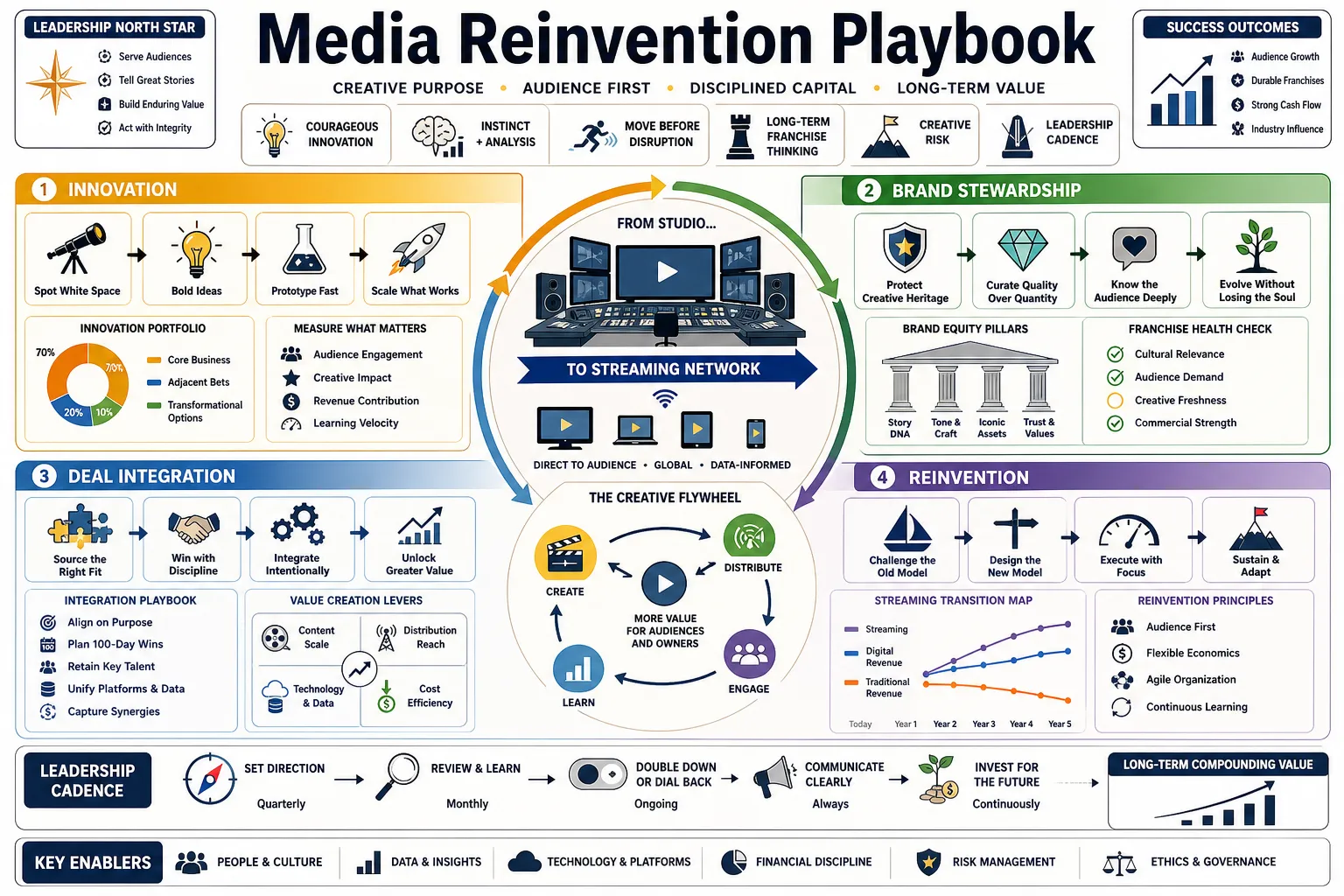
Lessons from Bob Iger
Bob Iger led Disney through the acquisitions of Pixar, Marvel, Lucasfilm and 21st Century Fox while arguing that technology was changing how media is created and delivered. These lessons examine his own accounts of risk, creative leadership and strategic focus. — The Ride of a Lifetime — Publisher Excerpt.
Part 1: The Courage to Innovate
- On creative risk: “Fear of failure destroys creativity,” Iger wrote while explaining why leaders need courage to back creative work. — The Ride of a Lifetime — Publisher Excerpt.
- On innovation: Iger framed innovation as a matter of survival in a changing business; he used “If You Don’t Innovate, You Die” as a chapter title in his memoir. — The Ride of a Lifetime — Publisher Excerpt.
- On adapting to change: Iger argues that leaders should embrace change instead of living in denial while staying faithful to what makes their brand distinctive. — The Ride of a Lifetime — Publisher Excerpt.
- On listening to a warning instinct: Iger recalls reversing his support for a proposed Disney purchase of Twitter after reflecting over a weekend and concluding that the deal did not feel right. — USC — Bob Iger Conversation.
- On honoring a legacy: Iger sees preserving Disney’s legacy and keeping the company relevant as complementary responsibilities, not reasons to freeze its business in place. — Disney — Iger on Leadership.
- On courageous decisions: For Iger, meaningful innovation in acquisitions, investment and creative choices requires intelligent risk-taking rather than fear of mistakes. — The Ride of a Lifetime — Publisher Excerpt.
- On changing distribution: Iger argued that Disney needed to adopt modern digital distribution so audiences could reach its stories in more convenient ways. — The Ride of a Lifetime — ABC Excerpt.
- On recognizing technology shifts: Before Disney+ launched, Iger said Disney’s relevance would be challenged if consumers could not access its content in mobile and digital formats. — The Ride of a Lifetime — ABC Excerpt.
Part 2: Acquiring and Integrating IP
- On acquisition fit: Iger’s Marvel rationale centered on a strong character library that Disney could distribute and develop across its global platforms. — Disney–Marvel Acquisition Announcement.
- On the Pixar decision: Iger pursued Pixar because its people and films could help revive Disney’s feature animation business; he acknowledged that the acquisition carried risks. — Iger–Jobs Interview Transcript.
- On preserving Pixar’s culture: Iger said Disney needed to protect Pixar’s distinctive culture because it was central to its creative output and ability to attract and retain talent. — Disney–Pixar Acquisition Call.
- On expanding a character library: Iger expected Marvel’s characters and brand to create opportunities across Disney’s entertainment platforms and international markets. — Disney–Marvel Acquisition Announcement.
- On protecting what an acquisition does well: Iger described a negotiated “social compact” for the Pixar deal that identified elements of Pixar’s identity and working culture Disney would preserve. — Masters of Scale — Bob Iger, Part 1.
- On integrity: Iger places the quality and integrity of a company’s people and products above short-term expedience. — The Ride of a Lifetime — Publisher Excerpt.
- On strategic acquisitions: Disney presented the Pixar purchase as consistent with its strategy of owning high-quality content and deploying capital where it saw a sustainable advantage. — Disney–Pixar Acquisition Call.
- On market size: Iger repeated former boss Dan Burke’s trombone-oil analogy to make the point that being excellent in a tiny market still limits a business’s scale. — Variety — Bob Iger Interview.
- On Lucasfilm’s story universe: Disney bought Lucasfilm for the Star Wars universe and announced plans for new films while building on an existing relationship with Lucasfilm attractions in its parks. — Disney–Lucasfilm Announcement.
- On recognizable brands: Iger’s acquisition strategy favored high-quality, recognizable brands as a way to help audiences choose among an expanding range of entertainment. — Disney–Marvel Acquisition Announcement.
Part 3: Managing Creative Talent
- On creative accountability: Iger wanted creative leaders to own decisions about what to make and how their work would reach audiences, connecting autonomy with financial responsibility. — Disney — Iger at MoffettNathanson.
- On quality standards: Iger argues that making creative work great takes sustained effort and a refusal to settle for mediocrity, while separately warning against a culture of fear. — The Ride of a Lifetime — Publisher Excerpt.
- On responding to creative failure: Iger says creative failures are inevitable; his preferred response is to learn what went wrong rather than punish the people involved. — USC — Bob Iger Conversation.
- On curiosity: Iger treats curiosity about people, places, ideas and changing markets as a starting point for innovation. — The Ride of a Lifetime — Publisher Excerpt.
- On the responsibility of stories: Iger says Disney must be mindful that its stories can inspire audiences or perpetuate stereotypes, and he wants its storytelling to be a positive force. — Amanpour & Company — Bob Iger Interview.
- On backing creative talent: Iger pursued Pixar partly to bring its animation talent into Disney, accepting deal risk because he believed great people and storytelling could revive the business. — Iger–Jobs Interview Transcript.
- On a creative feedback loop: Iger says managers of creative work need a tangible feedback loop that connects decisions about what is made and spent to the results. — TIME — Bob Iger on Disney’s Future.
- On combining creative brands and platforms: Iger says Disney sought to preserve acquired creative cultures while giving their stories access to its global distribution and other businesses. — D23 — Bob Iger Interview.
- On listening with humility: Reflecting on Disney’s expansion in China, Iger credited humility and careful listening to local culture alongside a commitment to quality. — D23 — Bob Iger Interview.
- On protecting trust in the brand: Iger frames stewardship of Disney as protecting what makes it distinctive while continuing to adapt its storytelling for new audiences. — Disney — Iger on Leadership.
Part 4: Decisiveness and Strategy
- On indecision: Iger warns that chronic indecision can erode morale; he expects difficult decisions to be made in a timely way. — The Ride of a Lifetime — Publisher Excerpt.
- On timely decisions: Iger recommends weighing diverse opinions while still making and implementing decisions without prolonged delay. — The Ride of a Lifetime — Publisher Excerpt.
- On thoughtful decisions: Iger says leaders should gather knowledge and form informed opinions before acting, because that makes judgments more credible and more likely to be right. — The Ride of a Lifetime — Publisher Excerpt.
- On narrowing priorities: Iger narrowed his early CEO strategy to three priorities so Disney could concentrate its time and capital on what mattered most. — The Ride of a Lifetime — ABC Excerpt.
- On communicating priorities: Iger argues that a leader must repeat a small set of priorities clearly so teams know where to focus their work. — The Ride of a Lifetime — ABC Excerpt.
- On organizing for priorities: Iger says identifying opportunities is only the first step; leaders also have to organize people and the company to pursue them. — TIME — Bob Iger on Disney’s Future.
- On acting on priorities: Iger’s return strategy identified specific workstreams—studio quality, streaming profitability, parks investment and ESPN’s digital shift—and linked them to operating decisions. — Disney — Iger at MoffettNathanson.
- On cost discipline: Iger said Disney needed to reduce streaming marketing costs while investing in product technology that could target at-risk subscribers more effectively. — Disney — Iger at MoffettNathanson.
- On creator accountability: When Iger returned to Disney, he judged the separation of creative investment from P&L responsibility a mistake and restored more direct accountability for content decisions. — Disney — Iger at MoffettNathanson.
Part 5: Ego, Self-Awareness, and Failure
- On resisting the pull of a title: Iger warned that a senior title can distort a leader’s sense of self; he tries to remain aware of who he is beyond the job. — Amanpour & Company — Bob Iger Interview.
- On authentic leadership: Iger describes authenticity as essential to leadership: he believes people need to know what their leader genuinely stands for. — Disney — Iger on Leadership.
- On owning decisions: During his candidacy for Disney CEO, Iger refused to blame Michael Eisner for decisions in which he himself had participated. — The Ride of a Lifetime — ABC Excerpt.
- On honest mistakes: Iger argues that people who make honest mistakes should have a chance to recover, because a punitive culture can inhibit initiative. — The Ride of a Lifetime — Publisher Excerpt.
- On seeking counsel: Iger sought Steve Jobs’s counsel on consequential Disney moves, including the Marvel acquisition, even after their Pixar deal was complete. — Bob Iger — Remembering Steve Jobs.
- On integrity in small decisions: Iger argues that the same ethical standard should govern small interactions and major corporate decisions. — The Ride of a Lifetime — Publisher Excerpt.
Part 6: Respect, Empathy, and Fairness
- On fairness: Iger’s leadership principles call for empathy, accessibility and fair treatment, including giving people room to recover from honest errors. — The Ride of a Lifetime — Publisher Excerpt.
- On candid relationships: Iger recalls that his friendship with Jobs was strong enough for them to speak frankly and disagree with each other. — Bob Iger — Remembering Steve Jobs.
- On difficult conversations: Iger says leaders should handle a termination empathetically but directly, explaining the decision rather than letting the process drag on. — TIME — Bob Iger Interview.
- On making room for opportunity: Iger says a workplace should offer people meaningful chances to grow and do valuable work; he connects his long tenure to the opportunities Disney afforded him. — TIME — Bob Iger on Disney’s Future.
- On leading through tragedy: Iger says that when people face tragedy, sharing feelings, providing community and communicating candidly can help them through a difficult moment. — USC — Bob Iger Conversation.
- On respectful dissent: Iger says a senior deputy should challenge a leader respectfully and productively, without turning disagreement into a public battle that harms the relationship or company. — Harvard Business Review — Bob Iger Interview.
- On a legacy beyond products: In his tribute to Steve Jobs, Iger emphasized not only Jobs’s inventions but also the people he inspired. — Disney — Iger on Steve Jobs.
- On earning trust: Iger’s Pixar negotiations depended partly on Jobs coming to trust that Disney would respect the people and culture behind Pixar’s work. — Bob Iger — Remembering Steve Jobs.
Part 7: Optimism and Focus
- On practical optimism: Iger treats optimism as a practical leadership stance: pessimism alone does not motivate people to pursue ambitious work. — The Ride of a Lifetime — Publisher Excerpt.
- On setting a hopeful tone: Iger argues that leaders should communicate a sense of possibility even while facing difficult choices and imperfect outcomes. — The Ride of a Lifetime — Publisher Excerpt.
- On focus: Iger defines focus partly as directing time, energy and resources toward a few high-priority goals. — The Ride of a Lifetime — Publisher Excerpt.
- On clearing organizational distractions: Iger recalls that ending internal corporate battles helped Disney employees concentrate on more productive work. — Harvard Business Review — Bob Iger Interview.
- On rebuilding confidence: Iger says one of his early CEO goals was to help Disney employees feel enthusiastic about and believe in their company again. — Harvard Business Review — Bob Iger Interview.
- On optimism without denial: For Iger, optimism does not require ignoring hard choices or disappointing outcomes; it means approaching them without defeatism. — The Ride of a Lifetime — Publisher Excerpt.
Part 8: Navigating Disruption and the Future
- On streaming profitability: Iger described a shift from costly subscriber acquisition toward better engagement, lower churn and a more profitable streaming business. — Disney — Iger at MoffettNathanson.
- On over-investment in streaming: Iger said Disney had invested too aggressively in streaming content ahead of returns, and that producing too much contributed to weaker quality. — Disney — Iger at MoffettNathanson.
- On AI as a platform opportunity: In 2025, Iger described generative AI as a possible way to make Disney’s direct-to-consumer platforms more engaging, while stressing the need to protect its intellectual property. — Disney FY2025 Q4 Earnings Call.
- On funding a distribution transition: Iger’s account of Disney’s streaming transition acknowledges heavy upfront investment and losses while pursuing a direct-to-consumer business. — Disney — Iger at MoffettNathanson.
- On content and distribution: Iger tied Disney’s relevance to both high-quality branded stories and more convenient digital ways for audiences to access them. — The Ride of a Lifetime — ABC Excerpt.
- On platform integration: Iger described integrating Hulu into Disney+ as an engagement strategy and reported encouraging early signals; he expected better engagement to help reduce churn. — Disney — Iger at MoffettNathanson.
- On storytelling through technology: Iger viewed technology as a way to create and deliver Disney’s stories and characters through formats audiences could reach more easily. — Iger–Jobs Interview Transcript.