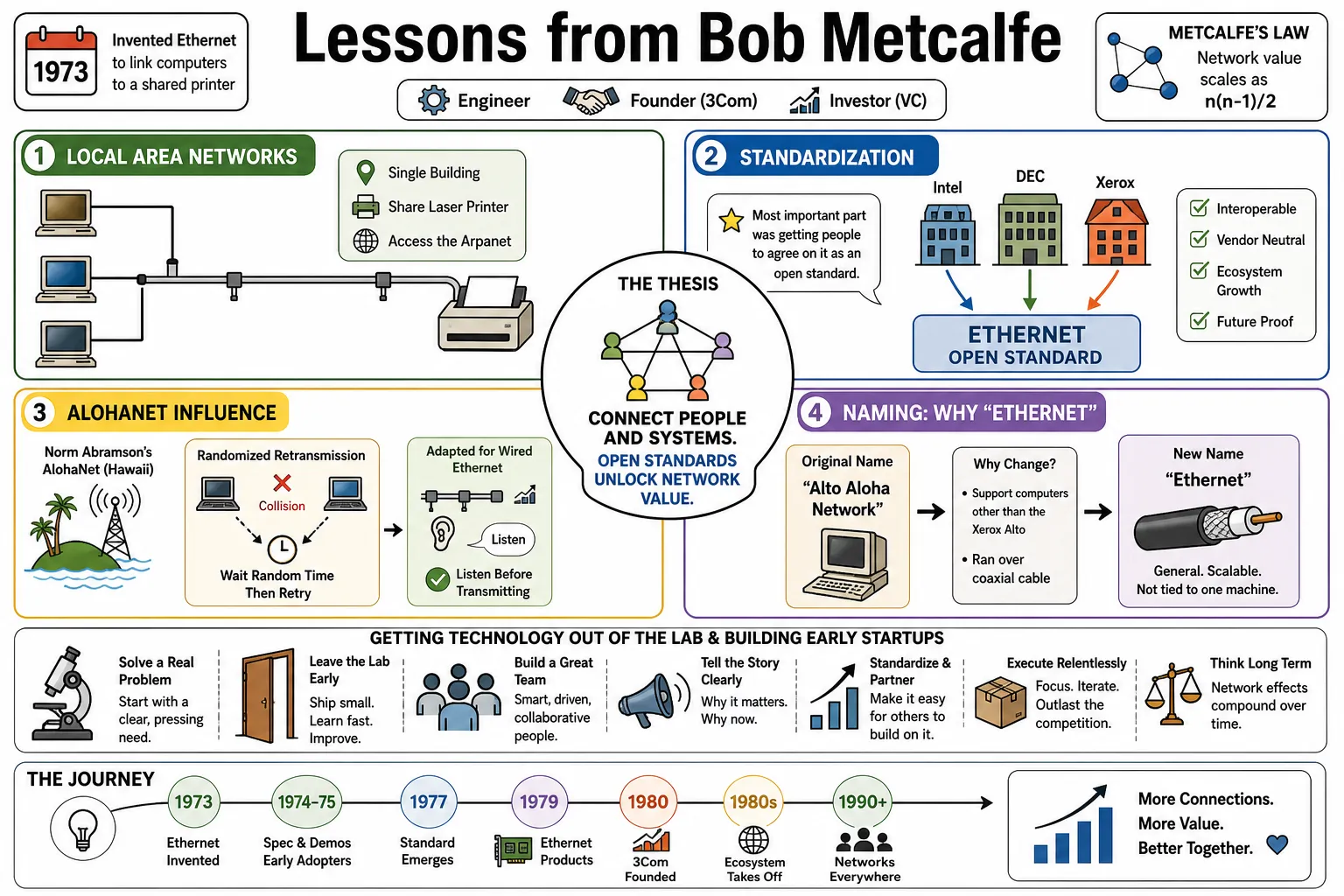
Lessons from Bob Metcalfe
Bob Metcalfe co-invented Ethernet at Xerox PARC to connect desktop computers, shared printers, and other devices. He later founded 3Com to commercialize network technology and pursued subsequent careers in sales, journalism, venture investing, and university innovation. — The Henry Ford Metcalfe Interview.
Part 1: The Invention of Ethernet
- On Local Area Networks: At Xerox PARC, Ethernet's initial purpose was to connect desktop workstations to a shared high-speed laser printer; the workstations also needed a path to the ARPANET. — Computer History Museum Oral History (1988).
- On Standardization: Metcalfe helped bring DEC, Intel and Xerox together around an open Ethernet specification, creating a compatible market that 3Com could serve. — Computer History Museum Oral History.
- On ALOHANET: Ethernet adapted ALOHANET's randomized retransmissions to a coaxial cable, adding carrier sensing and collision detection to reduce wasted capacity. — Computer History Museum Oral History (1988).
- On Naming: In his May 1973 memo Metcalfe renamed the working 'Alto ALOHA Network' the 'Ether Net.' He used 'ether' for the passive cable medium and wanted a network that could serve different kinds of computers. — Computer History Museum Oral History.
- On the First Sketches: Metcalfe's 1973 Ethernet memo included hand-drawn diagrams showing how branched cable, telephone and radio 'ethers' could be interconnected. — Computer History Museum: Original Ethernet Memo.
- On Opening a Market: Metcalfe saw the DEC/Intel/Xerox collaboration and public Ethernet specification as the basis for a broad compatible-products market, which became 3Com's founding premise. — Computer History Museum Oral History.
- On Coaxial Cables: Early Ethernet used coaxial cable with passive 'vampire taps' that punctured the cable to attach workstations; making those taps reliable was an engineering challenge. — Computer History Museum Oral History.
- On Packets to the Desktop: Metcalfe describes Ethernet's enduring contribution as bringing packet-based communication from shared computers all the way to desktop machines, enabling data such as images as well as typed characters. — Seeking Truth in Networking: Bob Metcalfe Pt. 2.
- On the First Ethernet Speed: The first Ethernet ran at 2.94 Mbps because its designers borrowed the Xerox Alto's system clock and used Manchester encoding, with two clock ticks per bit. — Computer History Museum Oral History.
Part 2: Innovation vs. Invention
- On Invention and Innovation: Metcalfe contrasts invention in a sheltered research setting with the harder work of getting a new technology adopted in the world. — InnoLead: Inside the Mind of Bob Metcalfe.
- On Adoption: For Metcalfe, innovation goes beyond invention: it means arranging for a new technology to have real-world and commercial impact. — InnoLead: Inside the Mind of Bob Metcalfe.
- On Visionaries: Metcalfe warned against being branded a 'visionary'; in his own experience, building and selling a company mattered more than being credited with seeing the future. — WIRED: The Visionary Thing.
- On Research Labs: Metcalfe describes Xerox PARC as a fertile place for invention, while recounting how Xerox struggled to transfer many lab ideas into successful products. — WIRED: The Visionary Thing.
- On the Status Quo: Metcalfe tells would-be innovators to expect resistance from established companies and practices when they try to bring a new technology to market. — InnoLead: Inside the Mind of Bob Metcalfe.
- On Commercialization Timing: 3Com had to bridge the period before desktop PCs created a market for Ethernet cards; Metcalfe says selling Ethernet for PCs was difficult when there were not yet PCs to connect. — The Henry Ford Metcalfe Interview.
- On Infrastructure: Metcalfe describes connectivity as a pervasive feature of modern life, while warning that its rapid expansion has brought new problems society has not yet learned to manage. — Seeking Truth in Networking Interview.
- On Execution: Metcalfe distinguishes inventing Ethernet from the long work of building 3Com and selling the technology; he credits the latter with his commercial success. — WIRED: The Visionary Thing.
Part 3: Metcalfe's Law and Network Effects
- On Metcalfe's Law: Metcalfe's Law models a compatible network's systemic value as growing roughly with the square of its number of connected devices or users. — Metcalfe: Law after 40 Years.
- On 3Com's Sales Pitch: Metcalfe developed the law as an early-1980s 3Com sales tool to explain why a tiny Ethernet starter kit was less useful than a network that had reached critical mass. — Metcalfe: Law after 40 Years.
- On Social-Media Network Effects: Metcalfe argues that Facebook illustrates a true network effect: users benefit when people they want to connect with also join. — The Tim Ferriss Show Transcript.
- On Possible Connections: The intuition behind Metcalfe's Law is pairwise connectivity: with N compatible devices, the possible device-to-device connections number about N squared. — Metcalfe: Law after 40 Years.
- On Cost and Value: Metcalfe's original sales graph contrasted roughly linear network costs with a quadratic model of systemic value to explain why larger compatible networks could become worthwhile. — Metcalfe: Law after 40 Years.
- On Interoperability: Metcalfe argued that splitting otherwise connectable users into separate networks sacrifices potential network value; he favored fixing and connecting the Internet rather than partitioning it. — Smithsonian: Metcalfe Remarks.
- On Critical Mass: Metcalfe used the idea of critical mass to explain why a small network might cost more than it was worth, while a sufficiently large one could deliver greater systemic value. — Metcalfe: Law after 40 Years.
- On Testing the Model: In a later analysis, Metcalfe fitted his quadratic model to Facebook's first decade of user growth and revenue, using revenue as a proxy for network value. — Metcalfe: Law after 40 Years.
- On the Law's Limits: Metcalfe acknowledges objections that connections differ in value and that network size cannot grow without limit; he presents the quadratic rule as a useful model, not an exact valuation for every case. — Metcalfe: Law after 40 Years.
Part 4: Founding and Scaling 3Com
- On Founder Fit: Metcalfe learned that founding 3Com did not automatically make him the best person to run it at every stage; he accepted an experienced CEO when the board judged the company needed one. — The Tim Ferriss Show Transcript.
- On Shifting Gears: As 3Com's revenue grew, Metcalfe found that people who succeeded at one scale could reach their operating limit; he calls replacing or reassigning leadership 'shifting gears.' — The Tim Ferriss Show Transcript.
- On the 3Com Name: Metcalfe chose '3Com' to stand for computer, communication and compatibility, reflecting the company's focus on interoperable networking standards. — Computer History Museum Oral History.
- On Customer-Funded Development: Exxon Office Systems paid 3Com to develop three early networking products under a nonexclusive license. Metcalfe says the arrangement funded development but complicated venture fundraising. — Computer History Museum Oral History.
- On Difficult Personnel Changes: Metcalfe says rapid growth can outpace an employee's fit for a role, making reassignment or departure painful but sometimes necessary. — The Tim Ferriss Show Transcript.
- On Recruiting and Culture: At 3Com, Metcalfe personally interviewed early hires and came to view deliberate recruiting as a major force shaping company culture. — InnoLead: Inside the Mind of Bob Metcalfe.
- On Competing Standards: Metcalfe tried to enlist IBM in the Ethernet coalition, but IBM backed its own Token Ring effort; he describes the ensuing contest in IEEE standardization as a prolonged fight. — Computer History Museum Oral History.
- On the CEO Transition: 3Com's board appointed Bill Krause CEO as Metcalfe's early revenue forecast slipped. Metcalfe accepted a sales-and-marketing role instead of leaving, though the change initially hurt. — The Tim Ferriss Show Transcript.
- On the Board's Role: After 3Com's board replaced him as CEO, Metcalfe concluded that the board had done its job by judging who was best suited to lead the company. — The Tim Ferriss Show Transcript.
- On Startup Focus: Before raising venture capital, Metcalfe heard investors cite founder ego, lack of focus and lack of money as three common causes of startup failure; he tried to address those concerns in his 3Com pitch. — The Tim Ferriss Show Transcript.
Part 5: Sales and Communication
- On Learning Sales: An engineer by training, Metcalfe took Xerox sales instruction and later learned personal selling while taking 3Com from no sales team to its first substantial revenue. — The Tim Ferriss Show Transcript.
- On Listening: Metcalfe credits Bill Krause with teaching him to listen during operating meetings; he came to regard listening as one of his most useful leadership skills. — The Tim Ferriss Show Transcript.
- On Listening Closely: When checking references, Metcalfe advises listening carefully and seeking information beyond a candidate's supplied list; a polite reference can still signal a problem. — Tim Ferriss Show Transcript.
- On Promises: Metcalfe advises building credibility in recruiting and selling by making small promises, keeping them and gradually earning trust for larger commitments. — The Tim Ferriss Show Transcript.
- On Explaining Technology: As 3Com's early seller, Metcalfe used his credibility as Ethernet's inventor to secure customer meetings and explain a technology whose market was still emerging. — The Henry Ford Metcalfe Interview.
- On Selling a Standard: Metcalfe says 3Com built products implementing Ethernet, TCP/IP, and UNIX standards, but the company also had to learn how to sell and market those products. — The Henry Ford Metcalfe Interview.
- On Connecting Engineers and Customers: Metcalfe's innovation ecology includes scientists, engineers, salespeople, and customers; the challenge is connecting technical knowledge with what customers need or want. — The Henry Ford Metcalfe Interview.
- On Credibility in a Pitch: Metcalfe argues that a persuasive pitch depends on credibility earned through small, kept commitments before asking someone to join or buy. — The Tim Ferriss Show Transcript.
- On Writing: Metcalfe treats writing as an important professional skill alongside selling; he edited an early ARPANET usage guide, wrote an InfoWorld column and recommends learning to write well. — Seeking Truth in Networking: Bob Metcalfe Pt. 2.
Part 6: Forecasting and Admitting Mistakes
- On the 1996 Forecast: In 1995 Metcalfe publicly predicted that 1996 would bring an Internet outage exceeding one billion lost user-hours—a 'gigalapse'—rather than the permanent disappearance of the network. — Computer History Museum Oral History.
- On Eating His Words: After the forecast failed, Metcalfe blended the offending InfoWorld column with water and ate it before an audience at the 1997 World Wide Web conference. — Computer History Museum Oral History.
- On a Self-Denying Forecast: Metcalfe later suggested that his warnings may have prompted some network operators to address weaknesses, while acknowledging that the predicted 1996 gigalapse never occurred. — Computer History Museum Oral History.
- On Publicly Admitting Error: Metcalfe publicly acknowledged that his specific gigalapse prediction was wrong, apologized, and ate his published column while continuing to argue for better network operations. — NANOG: Eating My Collapse Column.
- On the Token Ring Rivalry: IBM's Token Ring remained a serious rival to Ethernet through a long standards contest; Metcalfe recalled that it took roughly fifteen years to fade, not that it lost immediately. — Computer History Museum Oral History.
- On Forecasting Limits: Metcalfe's 1996 Internet-collapse forecast was wrong; his later account distinguishes that failed prediction from the capacity and management problems he believed were real. — Computer History Museum Oral History (2006).
- On Admitting a Bad Forecast: After his predicted 1996 Internet collapse failed to occur, Metcalfe publicly ate a copy of the column; his account treats the spectacle as accountability for a specific failed prediction, not proof that it made him a better analyst. — Computer History Museum Oral History (2006).
- On Forecasting and Responsibility: Reflecting on his Internet-collapse prediction, Metcalfe said a columnist must balance being interesting with the obligation to be right—an ethical tension for provocative forecasts. — Computer History Museum Oral History.
Part 7: The Value of Connectivity
- On the Human Condition: Metcalfe calls widespread human connectivity a major new fact of modern life: communications have expanded from roads, mail and telephones to Internet networks linking people and devices. — Broadband Library: Bob Metcalfe Interview.
- On Connectivity's Pathologies: Metcalfe sees connectivity as broadly beneficial but says societies are still learning to manage problems it enables, including junk news, bullying and spam. — Broadband Library: Bob Metcalfe Interview.
- On Democracy: Metcalfe expresses the view that better connectivity can help democracy and prosperity by reducing barriers to communication; this is his optimism, not a demonstrated universal law. — Broadband Library: Bob Metcalfe Interview.
- On Abundant Bandwidth: Metcalfe describes Ethernet as helping move computing from scarce local bandwidth toward much more abundant capacity, making richer packet-based applications such as voice and video possible. — Seeking Truth in Networking: Bob Metcalfe Pt. 2.
- On Reducing Friction: Metcalfe argues that connecting more people and devices reduces communication friction and creates more opportunities for collaboration. — Broadband Library: Bob Metcalfe Interview.
- On Layers of the Internet: Metcalfe describes a progression from Ethernet's packet plumbing to the Web's linked information, then search and social media as successive ways people used that connectivity. — Seeking Truth in Networking: Bob Metcalfe Pt. 2.
- On Geothermal Startups: Metcalfe later led a U.S. Department of Energy program to develop a startup ecosystem around deep geothermal energy, hoping oil-and-gas expertise could be redirected toward drilling for heat. — Seeking Truth in Networking: Bob Metcalfe Pt. 2.
- On Value from Connections: For Metcalfe, a network's value comes from the possible connections among compatible participants and the collaboration those connections allow—not merely from adding machines. — Broadband Library: Bob Metcalfe Interview.
- On Connected PCs: Metcalfe says personal computers are less useful standing alone than as parts of a network; Ethernet and PCs developed together because each increased the other's usefulness. — The Henry Ford: Serial Innovator.
Part 8: Careers and Lifelong Learning
- On Multiple Careers: Metcalfe describes his work as a series of careers in technological innovation, including engineering, journalism, venture capital, and university innovation work. — The Henry Ford Metcalfe Interview.
- On Learning from Mentors: Metcalfe names Steve Jobs and Xerox PARC's Butler Lampson as mentors; he says Jobs taught him high standards and Lampson taught him to reconsider an argument independently. — Tim Ferriss Show Transcript.
- On Steve Jobs at His Wedding: Metcalfe confirmed that Steve Jobs attended his wedding and joked that guests remembered Jobs more than the ceremony. — Tim Ferriss Show Transcript.
- On University Innovation: At MIT, Metcalfe found hour-long startup office hours more useful than short consultations and argued that universities can increase impact by helping research-based startups. — MIT News Inoversity Interview.
- On Evaluating Startups: When assessing a startup, Metcalfe first asks whether the idea is large enough to justify the effort and whether the team knows enough to execute it. — Seeking Truth in Networking Interview.
- On the Ethernet Team: Metcalfe stresses that Ethernet depended on David Boggs and many other engineers; the 2022 Turing Award recognizes the Ethernet invention, but the inherited first-person award quotation is not authenticated. — The Henry Ford Metcalfe Interview.
- On Sustained Learning: Metcalfe advises finding work one enjoys enough to practice and get good at; he treats innovation as a skill developed through preparation rather than a sudden flash of inspiration. — The Henry Ford Metcalfe Interview.