Brad Stone is the senior executive editor for technology at Bloomberg News. Before Bloomberg he covered technology for Businessweek, The New York Times and Newsweek. He is the author of The Everything Store, The Upstarts and Amazon Unbound. — The Big Picture (Barry Ritholtz), "Transcript: Brad Stone" (2021).
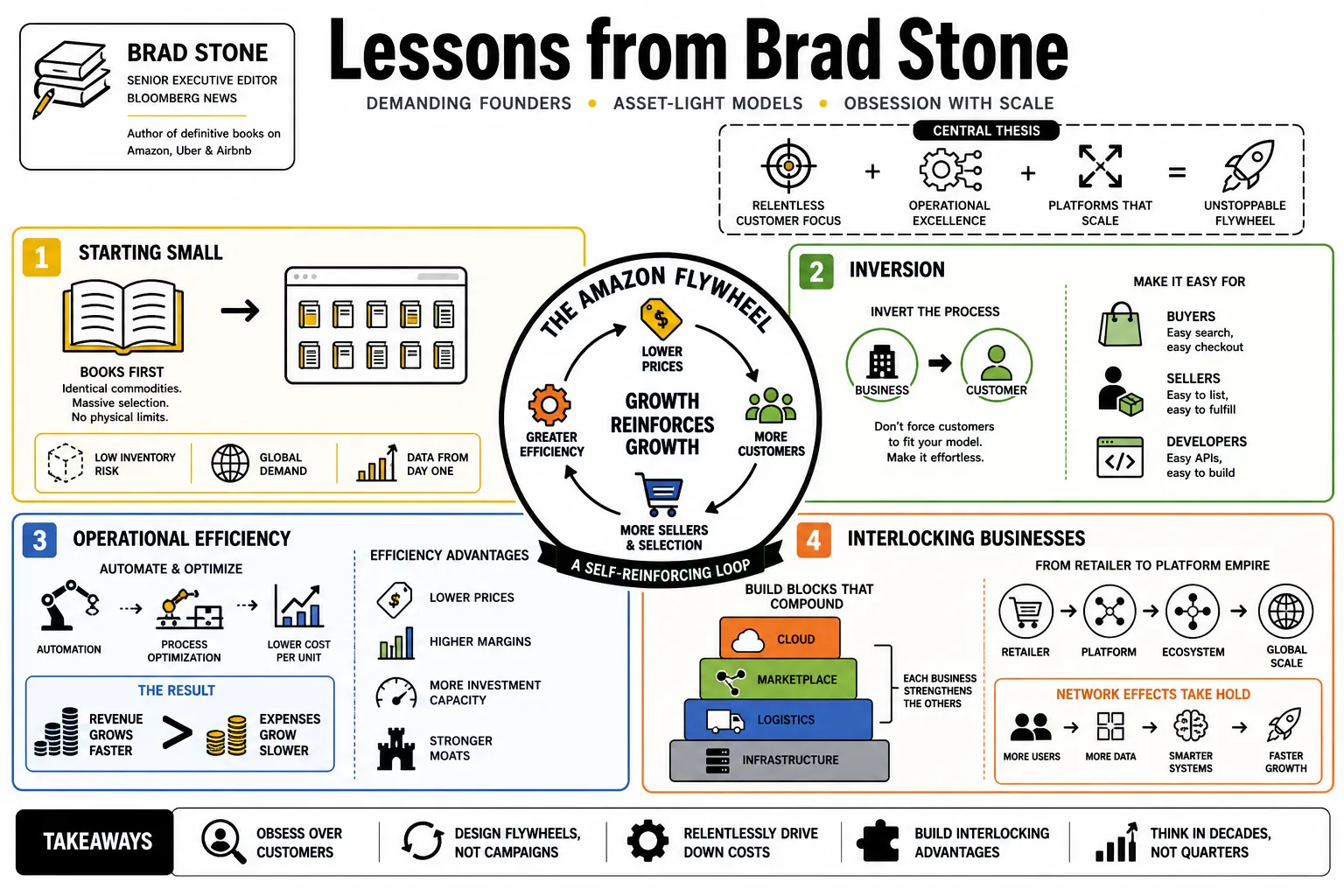
Part 1: The Amazon Flywheel and Strategic Foundations
- On Patience With AWS: Stone says Bezos, "across the 10 years of this — of AWS's growth, he thinks long term. He thinks competitively. He didn't want to tip off competitors to how good of a business this was and he kept it hidden." — The Big Picture (Barry Ritholtz), "Transcript: Brad Stone" (2021).
- On Inventing the Company Repeatedly: Stone describes Bezos "really inventing his company at every turn and thinking ambitiously and in an unbound way of how what Amazon could become." — The Big Picture (Barry Ritholtz), "Transcript: Brad Stone" (2021).
- On a Computer in the Cloud: Stone recounts that Bezos emailed colleagues in late 2010: "We should build a computer whose brains are in the cloud, that's completely controllable by your voice." That became Alexa. — The Big Picture (Barry Ritholtz), "Transcript: Brad Stone" (2021).
- On the iPod Wake-Up Call: Stone: around 2004, "Bezos is basically watching Apple vaporize his music business with the iPod and iTunes store," which pushed Amazon toward e-books and devices. — The Big Picture (Barry Ritholtz), "Transcript: Brad Stone" (2021).
- On Global Selling: Stone says the turning point for the marketplace was when Amazon "quite consciously, in about 2015 started pursuing the global selling opportunity," after Bezos saw Alibaba's AliExpress and Wish. — The Big Picture (Barry Ritholtz), "Transcript: Brad Stone" (2021).
- On Falling Prices: Brad Stone: "So in the case of Wusthof, the prices kept falling because Amazon was matching the low prices of other sellers on the Internet." — appstorechronicle.com/2014/10/brad-stone-interview-everything-store.html.
- On Regret Minimization: Jeff Bezos, quoted by Brad Stone: "I knew that I might sincerely regret not having participated in this thing called the Internet that I thought was going to be a revolutionizing event." — An excerpt from Brad Stone’s “The Everything Store” (NBC News).
- On Letting Rivals Sell: Brad Stone: "And even employees of Amazon were upset about it because here they were competing on their own site with other merchants, and yet Bezos really persevered." — One-Stop Shop: Jeff Bezos Wants You To Buy 'Everything' On Amazon | Fresh Air Archive: Interviews with Terry Gross.
- On Weaving Small Advantages: Brad Stone: "And even Bezos has admitted over the years that the patent system is broken, but he's also said something that I think is revealing, which is we don't have many big advantages, so we have to weave together a chain of smaller advantages." — One-Stop Shop: Jeff Bezos Wants You To Buy 'Everything' On Amazon | Fresh Air Archive: Interviews with Terry Gross.
Part 2: Customer Obsession and Perspective
- On a Company That Outgrew Its Book: Stone: "The company that I had written about in 2013 was a giant and was interesting, but it had a $100 billion market cap with maybe 40,000 or 50,000 employees," so he needed to update his history. — American Enterprise Institute: "5 Questions for Brad Stone on the Rise of Amazon and the Future for Jeff Bezos" (2021).
- On Judging Bezos Fairly: Stone: "Maybe we have to disassociate our generalized distaste for extraordinary wealth at a time of huge and worrying income inequality with the particulars of Bezos." — American Enterprise Institute: "5 Questions for Brad Stone on the Rise of Amazon and the Future for Jeff Bezos" (2021).
- On Amazon's Faults and Conveniences: Stone: "for all of Amazon's faults, I don't think I would have written two books if I didn't generally believe that, in the end, it's brought a lot of conveniences to our lives." — American Enterprise Institute: "5 Questions for Brad Stone on the Rise of Amazon and the Future for Jeff Bezos" (2021).
- On Poor Evangelism: Stone says Bezos "can do a fairly poor job of evangelizing for his own interests," citing his thanking Amazon employees for paying for the whole space launch. — American Enterprise Institute: "5 Questions for Brad Stone on the Rise of Amazon and the Future for Jeff Bezos" (2021).
- On New Leadership Principles: Stone notes Amazon "added a couple of principles to their 14 sacrosanct leadership values," including being more employee-focused and considering the ramifications of their actions for society. — American Enterprise Institute: "5 Questions for Brad Stone on the Rise of Amazon and the Future for Jeff Bezos" (2021).
- On Fearing eBay: Brad Stone: "They were desperately concerned about the rise of Ebay in the 1990s because Ebay wasn't stocking or shipping its own inventory." — One-Stop Shop: Jeff Bezos Wants You To Buy 'Everything' On Amazon | Fresh Air Archive: Interviews with Terry Gross.
- On a Prime Number Price: Brad Stone: "Seventy-nine dollars was basically selected because it's a prime number and because it didn't seem like it was giving too much away or that it was too expensive." — One-Stop Shop: Jeff Bezos Wants You To Buy 'Everything' On Amazon | Fresh Air Archive: Interviews with Terry Gross.
- On Loyalty as the Payoff: Brad Stone: "It would be enormously difficult for anyone, for any analyst, to figure out if Prime is profitable or not, because it really creates an intangible - which is a customer's loyalty to Amazon." — One-Stop Shop: Jeff Bezos Wants You To Buy 'Everything' On Amazon | Fresh Air Archive: Interviews with Terry Gross.
Part 3: Innovation, Invention, and Risk
- On Not Becoming a Country Club: Stone: "Bezos, early on, never wanted Amazon to become a country club, a place where employees got comfortable," and worried long-tenured fulfillment workers could be receptive to union organizing. — The Big Picture (Barry Ritholtz), "Transcript: Brad Stone" (2021).
- On Productive Years: Stone on Bezos's philosophy: "He wants people to come to Amazon to have the most productive years of their career, to move at breakneck speed." — The Big Picture (Barry Ritholtz), "Transcript: Brad Stone" (2021).
- On Making Fulfillment Work: Brad Stone: "That was the key turning point – the journey from 1999 to around 2002 to make those massive facilities work well." — appstorechronicle.com/2014/10/brad-stone-interview-everything-store.html.
- On HQ2 and a Changed Climate: Stone: "the political environment kind of drastically changed under them as they embark on this search, which lasted much longer than they thought." — The Big Picture (Barry Ritholtz), "Transcript: Brad Stone" (2021).
- On a Verdict, Not a Contest: Stone says HQ2 turned into "verdict about the role that tech companies and even big companies are playing in our communities" rather than a show of who wanted Amazon. — The Big Picture (Barry Ritholtz), "Transcript: Brad Stone" (2021).
- On an Expensive Experiment: Brad Stone: "They're like nothing that you can't get from a 7-Eleven or a gas station, but why I think that's interesting is because the whole Go store experiment has been a very expensive technology trial." — Inside Amazon’s Empire With Author Brad Stone | WIRED.
- On Failure Enabling Risk: Brad Stone: "Because it failed, maybe they were able to take a little bit more risks and invest more and advertise on the Superbowl and do all this other stuff with Alexa that maybe they wouldn't otherwise have done." — Inside Amazon’s Empire With Author Brad Stone | WIRED.
- On Reusing What You Build: Brad Stone: "How can we take what we do and use it in other ways?” When you look at all the things Amazon’s done, it’s always been an answer to that question, so the Amazon Marketplace, “Well, we sell things." — History of Amazon With Brad Stone - FourWeekMBA.
Part 4: Leadership Intensity and Culture
- On Peeling the Onion: Stone: "when you peel back the layers of the onion on most major inventions at Amazon, on most big strategic moves, you get to Jeff Bezos and the decision that he made." — The Big Picture (Barry Ritholtz), "Transcript: Brad Stone" (2021).
- On a Calling Card: Stone says "The Everything Store was kind of a calling card" that let him reach hundreds of people for the sequel, since some saw it as an accurate retelling of the company's early years. — The Big Picture (Barry Ritholtz), "Transcript: Brad Stone" (2021).
- On Value Created: Stone notes The Everything Store "covers the creation of about $80 billion in market capitalization" while the sequel covers about $1.6 trillion, making it in some ways "the more dramatic business story." — The Big Picture (Barry Ritholtz), "Transcript: Brad Stone" (2021).
- On Relentlessness: Brad Stone: "I think from the very earliest days of Amazon, Bezos’ relentlessness, his drive to expand, to move beyond just bookselling into selling everything, into becoming a full-fledged technology company, has impacted the culture." — Marketplace: What challenges face Amazon without Bezos at the helm?.
- On a Demanding Founder: Brad Stone: "I’d also say he’s demanding and impatient of anything less than the best effort of his employees." — appstorechronicle.com/2014/10/brad-stone-interview-everything-store.html.
- On the Loudest Voice: Brad Stone: "We'll also see how much leeway Bezos gives Jassy to make those kinds of changes because he's still going to be the loudest voice in the conference room, right?" — Inside Amazon’s Empire With Author Brad Stone | WIRED.
- On Rejecting a Kirkland-Style Brand: Brad Stone: "I actually described in the book, they have a private label that is called Bloom Street That Bezos reviews and rejects after they've done a ton of work on it because he doesn't want a Kirkland style brand." — Inside Amazon’s Empire With Author Brad Stone | WIRED.
- On the Clockwork: Brad Stone: "That'll have to be a slow process because Bezos has finely tuned the mechanics and the clockwork right down to the review process, the leadership principles." — Inside Amazon’s Empire With Author Brad Stone | WIRED.
- On Inspiring More Than Intimidating: Brad Stone: "Maybe at Blue Origin, he's let the demons out a couple of times, but I think he understands now maybe because of some of these depictions that he needs to inspire more than intimidate." — Inside Amazon’s Empire With Author Brad Stone | WIRED.
Part 5: Identifying the Big Waves
- On Brainstorming the Coming Wave: Brad Stone writes: "Shaw and Bezos would meet for a few hours each week to brainstorm ideas for this coming technological wave, and then Bezos would take those ideas and investigate their feasibility." — An excerpt from Brad Stone’s “The Everything Store” (NBC News).
- On Radically Inaccurate Projections: Brad Stone writes: "Then they drove northwest, Bezos sitting in the passenger seat, typing revenue projections into an Excel spreadsheet—numbers that would later prove to be radically inaccurate." — An excerpt from Brad Stone’s “The Everything Store” (NBC News).
- On Growing the Market: Brad Stone writes: "Uber wasn’t just taking passengers out of yellow cabs, it was growing the overall market for paid transportation." — The inside story of the rise and rise of Uber | TechCrunch.
- On Owning Cars: Brad Stone writes: "Kalanick strongly disagreed, arguing that it was folly to own the cars and more efficient just to distribute the mobile app to drivers." — Uber: the app that changed how the world hails a taxi | Uber | The Guardian.
- On New Social Contracts: Brad Stone writes: "It’s about a crucial era during which old regimes fell, new leaders emerged, new social contracts were forged between strangers, the topography of cities changed, and the upstarts roamed the earth." — The Upstarts - the Most Radical Companies in Silicon Valley | Root, a part of Accenture.
- On Pitching Existing Operators: Brad Stone writes: "Instead of buying a dozen flashy Mercedes, Camp, along with Kalanick, would pitch the app to owners and drivers of limousines." — Uber: the app that changed how the world hails a taxi | Uber | The Guardian.
- On Storytellers and Politicians: Brad Stone: "They’re storytellers, they’re charismatic, they’ve had to be politicians when called upon, and they’ve woven together political coalitions and activated their customer base." — Full transcript: Tech journalist and author Brad Stone on Recode Decode | Vox Skip to main content The homepage Vox Vox logo.
Part 6: Disrupting Gatekeepers and Navigating Regulation
- On Growing Without Guardrails: Stone on Uber: the company "grew from 500 employees to 11,000 in the span of two years. They did that without creating the guardrails of a professional HR organization." — Software Engineering Daily: "The Upstarts with Brad Stone" (transcript, 2017).
- On Amazon as the Model: Stone: "in a lot of ways Amazon is the model for Uber… Amazon never really had a big advantage. Anyone could sell books. Anybody could sell toys. Your relationship with your customer was only as good as the last experience they had with you." — Software Engineering Daily: "The Upstarts with Brad Stone" (transcript, 2017).
- On Renegades: Brad Stone: "Or are they renegades that grew in large part through contempt for the status quo?" — Brad Stone: ‘We should watch Uber and Airbnb closely’ | Business and finance books | The Guardian.
- On Subsidizing the Growth Product: Brad Stone writes: "Uber had a more established brand and more money in the bank as well as upscale product lines, like Uber Black and Uber SUV, whose profits could be used to subsidize UberX rides and offer financial incentives to new drivers." — The inside story of the rise and rise of Uber | TechCrunch.
- On an Unjust Law: Brad Stone: "It felt the law was unjust, which it might have been, but nevertheless they were all systems go." — Full transcript: Tech journalist and author Brad Stone on Recode Decode | Vox Skip to main content The homepage Vox Vox logo.
- On Travis’s Law: Brad Stone writes: "But Kalanick still had his trusty playbook as well as the political theorem known as Travis’s Law, which dictated that politicians accountable to the people could be pressured to accommodate any service that was markedly better than the alternative." — The inside story of the rise and rise of Uber | TechCrunch.
Part 7: Data, Metrics, and Algorithms
- On Cutting Prices: Brad Stone writes: "The theory was that if prices went down, customers would use the service more and bypass rental cars, public buses, and subways." — The inside story of the rise and rise of Uber | TechCrunch.
- On Rebuilding Systems to Keep Up: Brad Stone writes: "Pham reorganized Uber’s technical team, accelerated the hiring of engineers, and oversaw a complete revision of its dispatch algorithms and database storage systems to keep up with a business that was doubling every six months and showing no signs of slowing down." — The inside story of the rise and rise of Uber | TechCrunch.
Part 8: The Arc of Founders and Monopolies
- On Ruthless and Idealistic: Stone: "I think being ruthless, but also being idealistic, is like the sweet spot. Jeff Bezos does it very well." — Software Engineering Daily: "The Upstarts with Brad Stone" (transcript, 2017).
- On Amazon, Not Apple: Stone, on Airbnb borrowing Amazon's playbook: "It's Amazon, not Apple; Bezos, not Jobs." — Software Engineering Daily: "The Upstarts with Brad Stone" (transcript, 2017).
- On Inventor, Operator or Monopolist: Brad Stone: "He wants to be seen as an inventor but by his admirers, he will largely be seen, I think, as an operator and entrepreneur, a creator of amazing business value, and by his critics, as a monopolist, right, and the verdict is still out on this." — Transcript: Brad Stone - The Big Picture.
- On Changing the Contract: Brad Stone: "And fundamentally, I think it’s going to be changing the contract that they have with their employees, making that relationship and the warehouses less transactional and being seen as a more benevolent employer." — Marketplace: What challenges face Amazon without Bezos at the helm?.
- On a Conspicuous Failure: Brad Stone: "HQ2 [Amazon’s corporate offices in Virginia] is a great example and what I think of as a conspicuous failure because of how much negative press they got, and of course, the ignominious withdrawal from New York City." — Marketplace: What challenges face Amazon without Bezos at the helm?.
- On Addressing Employer Status: Brad Stone: "And I think what we’ve seen recently is Amazon pivot and address its status as a large employer in all of its messaging." — Marketplace: What challenges face Amazon without Bezos at the helm?.
- On Legacy: Brad Stone: "So, I think he wants to be seen — he wants Amazon’s legacy to be one that has contributed to the economy in positive ways." — Transcript: Brad Stone - The Big Picture.
- On Reputation and Halo: Brad Stone: "You compare his reputation to Elon's, and it's remarkable the halo that is over Elon's head and almost opposite when people consider Jeff and his public image, but I think that's why he's starting to take philanthropy seriously and try to improve that legacy as well." — Inside Amazon’s Empire With Author Brad Stone | WIRED.