Brad Wilson is a professional poker player, high-stakes coach and the founder and head coach of Chasing Poker Greatness (CPG). The site says he has been a professional poker player since 2004, has won millions in live cash games and has coached hundreds of players. — Chasing Poker Greatness: Wolf Tryouts.
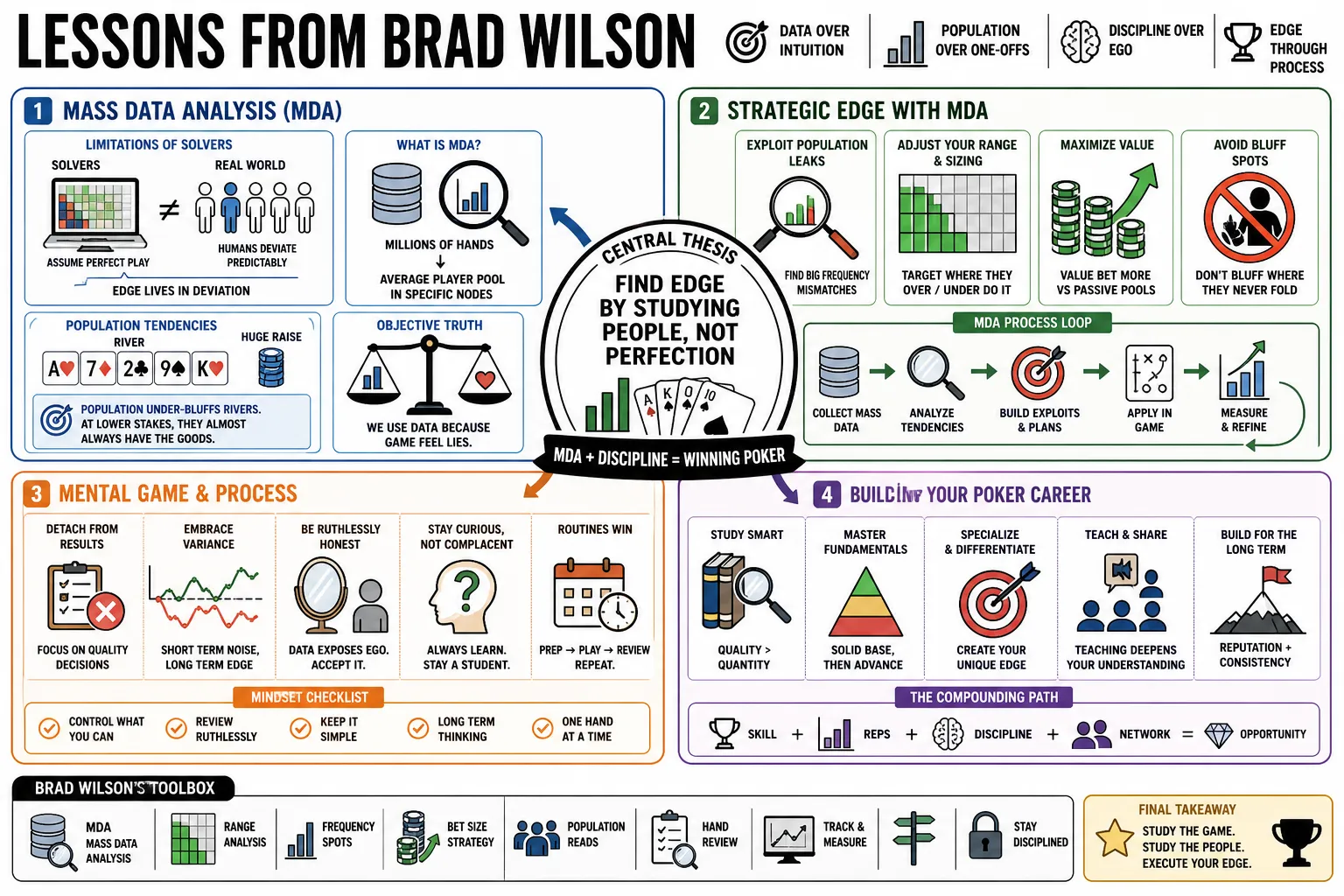
Part 1: Mass Data Analysis (MDA)
- On Mass Data Analysis: The NUFFLE course page describes it as a product of Wilson's "Mass Data Analysis process, in which millions of poker hands are analyzed" to extract +EV formulas against player behavior. — Chasing Poker Greatness: NUFFLE (Neutralize Flop Leads) course page.
- On Data Over Theory: CPG pitches its Neutralize Leads courses as "No Theory; Just Hard Data for Result" and "Data Solutions Based on Actual Hands," with bluff and value-bet strategies against donk bets. — Chasing Poker Greatness: NUFFLE (Neutralize Flop Leads) course page.
- On Where the Profits Come From: Brad Wilson: "we’re incentivized to play lots of pots against the recreational players in your games, because that’s where 80% of your overall profits as a poker player comes from" — chasingpokergreatness.com/tactical-tuesday-free-poker-training-video-facing-chec.
- On GTO and Rock Paper Scissors: Brad Wilson: "the way that I think of GTO versus exploitable players, I always use the metaphor of Rock Paper Scissors" — chasingpokergreatness.com/maria-konnikova-the-champion-of-poker-we-need-but-dont.
- On New Players: Brad Wilson: "I think the natural tendency of new poker players is to be a more passive" — chasingpokergreatness.com/maria-konnikova-the-champion-of-poker-we-need-but-dont.
- On Quantifying Bluff Frequency: Brad Wilson: "we should be bluffing 32% of the time, like, how do you quantify that in the moment and then actually apply it over time" — chasingpokergreatness.com/jonathan-little-2x-wpt-champ-7-million-14x-poker-strat.
- On Teaching Poker: Brad Wilson: "it is exceptionally difficult to communicate concepts in a way that another human can actually use them while they’re playing poker" — chasingpokergreatness.com/jon-apestyles-van-fleet-20-million-in-online-mtt-cashe.
- On Node Locking: Brad Wilson: "when you node lock, right, you’re locking their strategy, and then the solver is spitting out what you know, the appropriate response versus this specific strategy." — Dara O’Kearney: $4.1 Million in Tourney Winnings, Author, and Award Winning Podcast Host | Chasing Poker Greatness | Poker Players |.
- On Applying Solver Output Blindly: Brad Wilson: "And when you take the GTO, the solver results, and then just apply it to your game across the board, you’re going to get your brains beat in, because you’re not playing against the actual strategies folks are employed." — Dara O’Kearney: $4.1 Million in Tourney Winnings, Author, and Award Winning Podcast Host | Chasing Poker Greatness | Poker Players |.
- On Being Humble and Assertive: Brad Wilson: "You need to be humble enough to know that you don’t have the answers, but also assertive enough to go for it and be confident in what you do know." — chasingpokergreatness.com/jonathan-little-2x-wpt-champ-7-million-14x-poker-strat.
Part 2: Preflop Foundations
- On Preflop Mistakes: CPG's Live Cash Preflop Bootcamp page opens: "Preflop Mistakes become Postflop problems." — Chasing Poker Greatness: Live Cash Preflop Bootcamp course page.
- On Butchering Preflop: CPG: "You're never going to be a winning poker player if you consistently butcher hands preflop." — Chasing Poker Greatness: Live Cash Preflop Bootcamp course page.
- On Snowballing Errors: CPG says minor preflop mistakes "snowball on future streets and you end up getting buried by the river." — Chasing Poker Greatness: Live Cash Preflop Bootcamp course page.
- On the Structure of the Preflop Course: The Live Cash Preflop Bootcamp is built around "3 Main Modules of Preflop study: RFI & Overcall, vs. Fish, & vs. Regs," with 88 preflop ranges, 16 video lessons and flash-card decks. — Chasing Poker Greatness: Live Cash Preflop Bootcamp course page.
- On Adjusting to Three-Bets: Brad Wilson: "If villains are three-betting way too much, then maybe you have to tighten up your opening range." — Lyle Bateman: Managing Editor of Pokernews Canada | Chasing Poker Greatness | Poker Players |.
- On a Baseline Strategy: Brad Wilson: "There’s different archetypes at the table that affect those ranges, there are a baseline strategy that you should always be willing to deviate from, based on the available information that you have." — Lyle Bateman: Managing Editor of Pokernews Canada | Chasing Poker Greatness | Poker Players |.
- On Being Risk Averse: Brad Wilson: "If you’re always risk averse, and you’re folding way too often, you never get this, you never gain clarity." — Jonathan Little Round 2: ACR Ban, #PokerGOAT, & Excelling at Tough NLHE Games | Chasing Poker Greatness | Poker Players |.
- On Playing Pots Against Recreational Players: Brad Wilson: "You can’t reach those nodes if you first fold preflop , we’re incentivized to play lots of pots against the recreational players in your games, because that’s where 80% of your overall profits as a poker player comes from." — chasingpokergreatness.com/tactical-tuesday-free-poker-training-video-playing-4-b.
- On Sticking to a Script: Brad Wilson: "Don’t just stick to a script and play based on that, because the results are not going to be so great." — Lyle Bateman: Managing Editor of Pokernews Canada | Chasing Poker Greatness | Poker Players |.
Part 3: Navigating Postflop Volatility
- On Flop Leads From Fish: CPG on flop leads: "It feels weird when you raise preflop and your fishy opponent leads into you on the flop, right? If they really had a strong hand, wouldn't they wait for you to bet before they pounced?" — Chasing Poker Greatness: NUFFLE (Neutralize Flop Leads) course page.
- On Questions a Lead Raises: The NUFFLE page frames the problem as questions: "Should you raise their flop lead when you have air? What do you do when you have a hand like bottom pair?" — Chasing Poker Greatness: NUFFLE (Neutralize Flop Leads) course page.
- On Folding the Turn: Brad Wilson: "So honestly, I would fold the turn here if I were the student because the best hand that you beat is ace queen." — chasingpokergreatness.com/tactical-tuesday-free-poker-training-video-playing-4-b.
- On Reaching Deeper Nodes: Brad Wilson: "We talked about it in hand number one where a plane gets wrecks, we want to get to the deeper nodes because they allow us to exploit and find the high EV decisions." — chasingpokergreatness.com/tactical-tuesday-free-poker-training-video-playing-4-b.
Part 4: Neutralizing Opponent Aggression (NURRLE & NUFFLE)
- On Neutralizing Leads by Street: CPG teaches responses to leads street by street: "Neutralize Flop Leads (NUFFLE)," "Neutralize Turn Leads (NUTTLE)," and "Neutralize River Leads (NURRLE)." — Chasing Poker Greatness: Live Cash Preflop Bootcamp course page.
Part 5: The Mental Grind and Variance
- On Clarity Over Content: CPG's Wolf program pitch: "You don't need more content. You need clarity." — Chasing Poker Greatness: Wolf Tryouts.
- On Feedback Loops: CPG claims its coaches and vetted peers "create tight feedback loops where insights turn into more profit within sessions, not months." — Chasing Poker Greatness: Wolf Tryouts.
- On Randomness: Brad Wilson: "I think humans are tricked by randomness a lot" — chasingpokergreatness.com/luckychewy/.
- On Fearing Variance: Brad Wilson: "the fear of the other shoe dropping, I think is something people think way too much about" — chasingpokergreatness.com/tommy-angelo-author-elements-of-poker-world-class-poke.
- On the Urge to Punt: Brad Wilson: "there is this like demon inside of me that certainly wants to punt, always in these tournaments" — chasingpokergreatness.com/brett-richey-from-bobbys-room-battler-to-running-a-sta.
- On Finding Your Limit: Brad Wilson: "you can never find your limit, unless you go through the suffering that gets you there" — chasingpokergreatness.com/kristen-bicknell-2/.
- On Slaying the Monsters: Brad Wilson: "slaying the monsters, being in the dungeon being an action is actually the most fun part of this whole process" — chasingpokergreatness.com/dgaf-unmasked-high-stakes-and-hustler-live/.
- On Feeling Uncomfortable: Brad Wilson: "you have to experiment and you got to be willing to feel uncomfortable, because that’s a lot of times where the growth comes into play" — chasingpokergreatness.com/jonathan-little-2x-wpt-champ-7-million-14x-poker-strat.
- On Pushback: Brad Wilson: "you need some pushback" — chasingpokergreatness.com/dgaf-3/.
Part 6: Exploitative Poker Strategy
- On Solvers and Identity: CPG's Philosophical Friday 001 has Brad Wilson and Duncan "go down the rabbit hole of Solvers and Game Optimal Theory attempting to answer questions about their identity, purpose, limitations and usefulness." — Chasing Poker Greatness: Philosophical Friday 001, "Is GTO The End Of Poker?".
- On Exploits Being Exploitable: Brad Wilson: "And always bear in mind that with any exploits, when you are executing an exploit, it is naturally exploitable to you as well, if they take the right and appropriate strategy, you have the right and appropriate defense for the exploit." — Jonathan Little: WPT Player of the Year, 2X WPT Champ, & Founder of PokerCoaching.com | Chasing Poker Greatness | Poker Players |.
- On Not Bucketing Losing Players: Brad Wilson: "And if you put everybody that’s a losing player into the same bucket, and think that they’re all going to make the same mistakes, you’re just setting yourself up to get kicked in the nuts because you really have to hone in on what people are doing wrong." — Darren Elias: The Only 4-Time WPT Champ, $11.3 Million Online & Live Tourney Winnings, and Poker End Bos | Chasing Poker Greatness | Poker Players |.
- On Raising Against Tight Blinds: Brad Wilson: "And the blinds are two 70-year-old men, that are super overly tight, you should be raising 100% of your button range." — Lyle Bateman: Managing Editor of Pokernews Canada | Chasing Poker Greatness | Poker Players |.
- On Fold Equity: Brad Wilson: "And realizing their fold equity because actual equity is one thing, and fold equity is a whole another thing that’s absolutely real and should be thought about more." — Lyle Bateman: Managing Editor of Pokernews Canada | Chasing Poker Greatness | Poker Players |.
- On Passive Players Reopening the Action: Brad Wilson: "this guy just reopened the action here on the turn, which is not a thing that passive players typically want to do, especially if they have like a hand like a draw." — chasingpokergreatness.com/tactical-tuesday-free-poker-training-video-playing-4-b.
Part 7: Bankroll and Career Management
- On the Path of Most Resistance: Brad Wilson: "What if instead of poker being this giant nut that feels virtually impossible to crack, you’ve been following the path of most resistance, simply because you’ve never had a trusted guide to show you an easier way." — chasingpokergreatness.com/tommy-angelo-author-elements-of-poker-world-class-poke.
- On Unspoken Considerations: Brad Wilson: "We don’t always even say all of the things that we’re taking into consideration because you just can’t verbalize them all." — chasingpokergreatness.com/marle-cordeiro-high-stakes-cash-game-crusher-co-host-o.
- On Taking Shots: Brad Wilson: "So if you have a smaller bankroll, you can take a lot more shots than if you have say a $100,000 bankroll, because $100,000 bankroll is harder to replace." — Jaime Staples: OG Poker Streamer and PartyPoker Pro | Chasing Poker Greatness | Poker Players |.
- On Learning From Experience: Brad Wilson: "Because if you’re not learning from your experiences, you’re not going to be able to make it as a professional for very long." — Leo Wolpert: $10k Heads Up WSOP Bracelet Winner | Chasing Poker Greatness | Poker Players |.
- On Live Variance: Brad Wilson: "your win rate, the variance should be much smaller playing live, because the fields, the competition is way weaker" — chasingpokergreatness.com/dara-okearney/.
- On Built-In Resilience: Brad Wilson: "So, you have to have this built-in resilience to be successful over a long period of time." — Jon “Apestyles” Van Fleet: $15.8 Million in Tournament Winnings and Online Poker Legend | Chasing Poker Greatness | Poker Players |.
- On Your Inner Circle: Brad Wilson: "Who are the people in your inner circle giving you feedback, all of these things matter, like you need great reps in order to improve over time as a poker player." — Andrew “Luckychewy” Lichtenberger: Everything Is a Miracle | Chasing Poker Greatness | Poker Players |.
Part 8: The Philosophy of Greatness
- On Poker as a Teacher: Brad Wilson: "Poker is a great teacher in that way of just find a good decision, make a good decision, one foot in front of the other, make another good decision" — chasingpokergreatness.com/fergal-nealon-poker-pro-hand-delivering-supplies-to-uk.
- On Humility and Growth: Brad Wilson: "the poker players conundrum of needing to be humble, so that you can learn and continue growing" — chasingpokergreatness.com/phil-galfond-nosebleed-cash-legend-run-it-once-poker-f.
- On Loving the Process: Brad Wilson: "that you have to love it, you have to be immersed in the process, you have to love the game, you have to love playing the game." — chasingpokergreatness.com/karina-disrupting-mindset-performance-training/.
- On Curiosity: Brad Wilson: "all the decisions that I’ve made in my life have generally stemmed from Curiosity" — chasingpokergreatness.com/karina-disrupting-mindset-performance-training/.
- On Supporting the Good Guys: Brad Wilson: "you have to start taking action and do whatever you can to support the good guys in this world" — chasingpokergreatness.com/phil-galfond-nosebleed-cash-legend-run-it-once-poker-f.
- On Taking It Upon Yourself: Brad Wilson: "because nobody’s just going to hand you the money" — chasingpokergreatness.com/marle-cordeiro-high-stakes-cash-game-crusher-co-host-o.
- On Prioritizing Information: Brad Wilson: "there’s a little bit of a misnomer that top level players process a lot more information than other people" — chasingpokergreatness.com/dgaf-3/.
- On Finding an Expert: Brad Wilson: "find somebody who is an expert that can help you do things the right way, because there is a right way and there is a wrong" — chasingpokergreatness.com/justin-hammer-growing-the-game-making-guarantees/.
- On Risk Aversion: Brad Wilson: "If you’re always risk averse, and you’re folding way too often" — chasingpokergreatness.com/jonathan-little-round-2-acr-ban-pokergoat-excelling-at.