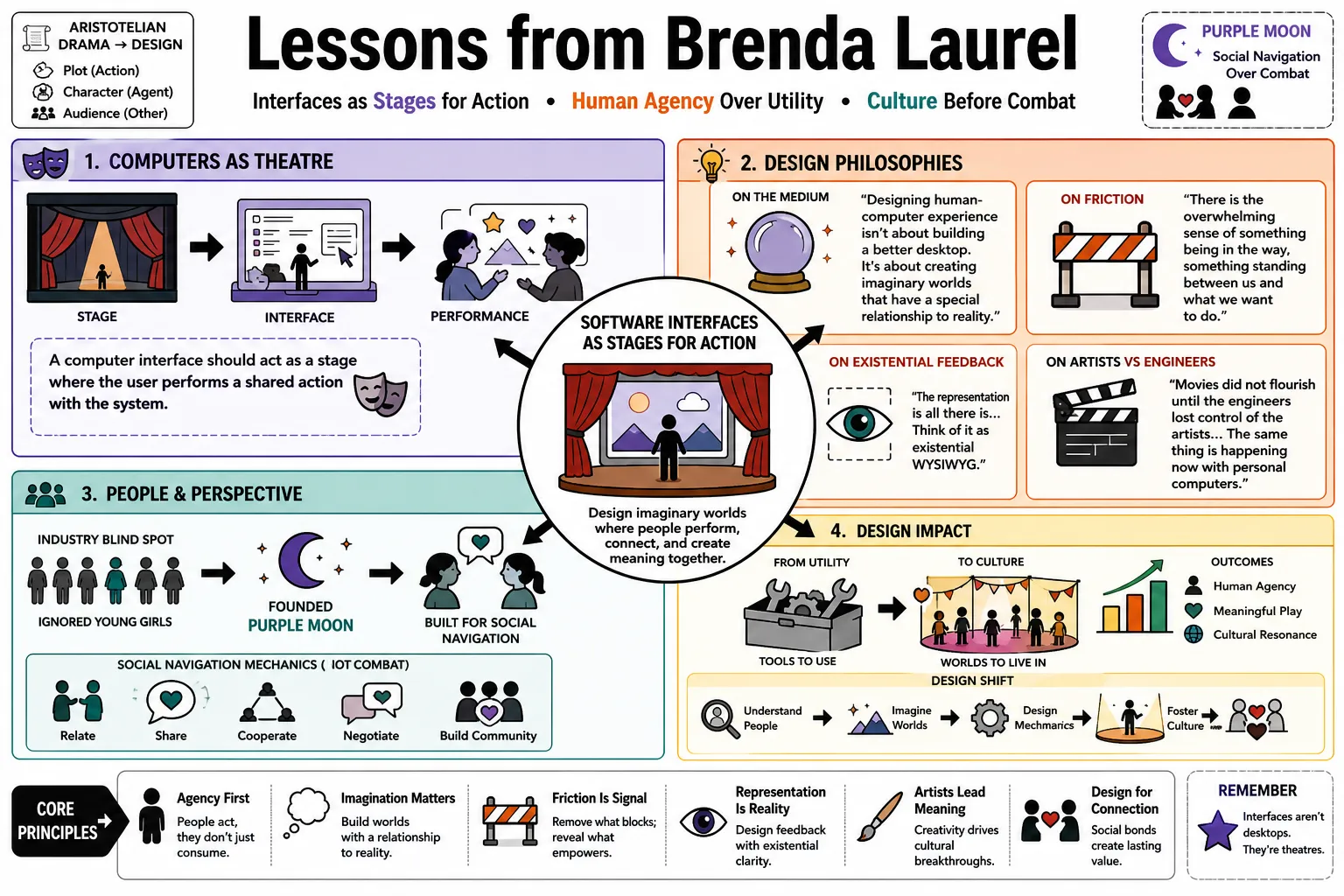
Brenda Laurel treated software interfaces as stages for action, applying Aristotelian drama to computer design. When the video game industry ignored young girls, she founded Purple Moon to build mechanics around social navigation rather than combat. This collection of her writing and interviews explores how technology can prioritize human agency and culture over pure utility.
Part 1: Computers as Theatre & Interface Design
- On the medium: "Designing human-computer experience isn't about building a better desktop. It's about creating imaginary worlds that have a special relationship to reality." — Source: [Computers as Theatre]
- On friction: "There is the overwhelming sense of something being in the way, something standing between us and what we want to do." — Source: [CMU Interview]
- On existential feedback: "The representation is all there is... Think of it as existential WYSIWYG." — Source: [Computers as Theatre]
- On software as performance: A computer interface should act as a stage where the user performs a shared action with the system. — Source: [MediaMatic]
- On artists versus engineers: "Movies did not flourish until the engineers lost control of the artists... The same thing is happening now with personal computers." — Source: [Missing Witches]
- On engagement: "Engagement is what happens when we are able to give ourselves over to a representational action, comfortably and unambiguously." — Source: [Computers as Theatre]
- On the illusion of tools: Treating software purely as a utility forces users to become mechanics, whereas treating it as a drama allows them to become participants. — Source: [Computers as Theatre]
- On first-personness: True software engagement creates a feeling of direct agency, where the user feels they are doing the action rather than ordering a machine to do it. — Source: [Stanford Seminar Archives]
- On completion: "A design isn't finished until someone is using it." — Source: [Utopian Entrepreneur]
- On complicity: Using a good interface requires a willing suspension of disbelief; we must agree to think and feel within the conventions of its mimetic context. — Source: [Computers as Theatre]
Part 2: Narrative & Interactive Storytelling
- On the negotiate button: "I remember when I came to Atari back in 1979, I played 'Star Raiders' fanatically. But my first reaction was, 'where is the negotiate button?'" — Source: [Henry Jenkins Blog]
- On interactivity: "Interactivity is the ability of a person to influence the form and/or content of a mediated experience." — Source: [Computers as Theatre]
- On structure: Software action should model Aristotelian drama, possessing a clear beginning, middle, and end that satisfies the user's intent. — Source: [MediaMatic]
- On characters and agents: "A computer-based 'agent' is defined as a bundle of functionality that performs some task for a person, either in real time or asynchronously." — Source: [SFU Archives]
- On play: "The real issue is: How can people participate as agents within representational contexts? Actors know a lot about that, and so do children playing make-believe." — Source: [Computers as Theatre]
- On catharsis over efficiency: Enjoyment and emotional resolution are just as necessary in task-oriented software as speed and error reduction. — Source: [Computers as Theatre]
- On non-linear plots: Rather than a single track of progression, interactive stories must adapt to the player's agency without losing their structural integrity. — Source: [The Genesis of Virtual Reality]
- On storytelling logic: The internal logic of a system must align with its outward representation, just as a character's motives align with their dialogue. — Source: [Computers as Theatre]
- On extending capacity: We build digital worlds not to escape reality, but to extend, amplify, and enrich our capacities to think, feel, and act. — Source: [Computers as Theatre]
Part 3: The Purple Moon Era & Designing for Girls
- On industry blind spots: "There was a steadfast belief in the game industry that girls didn't play games, and didn't want to play games." — Source: [TED]
- On the mission: "Our thought was to try to do some research to figure out how we might get girls engaged with technology so they wouldn't be afraid of it." — Source: [TED]
- On meeting users: "That company was about meeting girls where they were, not where we wanted them to go or where society thought they should be." — Source: [Purple Moon Retrospective]
- On rejecting violence: "I developed a strong allergy to the kinds of games that were being produced. All the shooting didn't really do much for me." — Source: [NEA Interview]
- On the cooties strategy: "We strove to create a game that gave boys 'cooties,' because we didn't want boys to touch the Purple Moon games at all." — Source: [ShiftSpace]
- On creating safe spaces: To keep boys from pushing girls off shared computers, games had to be aesthetically designed to repel male interest while deeply validating female interests. — Source: [TED]
- On inner lives: Games like Secret Paths were built to address the hopes and dreams of young girls, rather than offering abstract logic puzzles. — Source: [Purple Moon Archives]
- On boys playing female games: Despite marketing to girls, a quarter of Purple Moon's audience were boys trying to figure out how girls worked. — Source: [Purple Moon Retrospective]
- On long-term impact: "I still get at least an email a week from a girl who played these games and who thanks me and who says my life was changed for the better." — Source: [NEA Interview]
- On paving the way: Although Purple Moon folded, its demonstration of a massive female gaming demographic laid the groundwork for The Sims and the casual game market. — Source: [Polygon Retrospective]
Part 4: Social Navigation & Emotional Gameplay
- On emotional mechanics: "You just got to have some emotional rehearsal space... you could make an emotional decision. We called this emotional navigation." — Source: [TED]
- On non-violent conflict: Games can offer complex challenges by facilitating relationship building and social problem-solving rather than physical combat. — Source: [Henry Jenkins Blog]
- On the outer social life: The Rockett series treated middle school as a tactical environment, where navigating it depended on reading social cues and managing peer dynamics. — Source: [NEA Interview]
- On alternative gameplay verbs: Instead of shooting or jumping, mechanics like snooping through lockers allowed players to investigate character motivations. — Source: [TV Tropes]
- On the myth of the trajectory: Girls did not inherently hate video games; they were simply bored by the linear, trajectory-based combat paradigms the industry forced upon them. — Source: [TED]
- On empathy as a mechanic: Allowing players to choose whether a character reacts with shyness, confidence, or anger turns empathy into a core gameplay loop. — Source: [Purple Moon Archives]
- On addressing social anxieties: Providing a virtual sandbox for girls to test social reactions helped them navigate the real-life situations of adolescence. — Source: [NEA Interview]
- On the value of secrets: Narrative progression through sharing secrets and folk tales proved that quiet, introspective pacing could hold a player's attention. — Source: [Fandom Wiki]
- On neurodivergent players: Purple Moon's emotional navigation mechanics unexpectedly became a valuable tool for children on the autism spectrum learning to decode social cues. — Source: [Purple Moon Retrospective]
Part 5: Virtual Reality & Embodied Telepresence
- On taking your body with you: "Telepresence is a medium that allows you to take your body with you into some other environment. You get to take some subset of your senses with you." — Source: [The Genesis of Virtual Reality]
- On the definition of VR: Telepresence makes a person feel as if they are physically present in a different place or time, whether the environment is computer-generated or camera-originated. — Source: [Be There Here]
- On gender and VR perception: Early in VR development, men often described it as an out-of-body experience, while women described it as taking their sensorium into a new place. — Source: [Voices of VR Podcast]
- On embodiment: "Forcing people to enter the bodies of animals was a way to bring their attention to the fact that they were embodied in the space." — Source: [Voices of VR Podcast]
- On medium contradictions: Telepresence balances an obsession with photorealism from computer graphics and a penchant for metaphor from the realm of interface design. — Source: [Stanford Seminar Archives]
- On philosophy and tech: "It's amazing how the virtual reality dialogue has brought people out of the woodwork in philosophy." — Source: [The Washington Post]
- On smart costumes: VR avatars should act as smart costumes that alter how the user perceives and interacts with the virtual environment. — Source: [Voices of VR Podcast]
- On full-sensory interfaces: A functional virtual reality must go beyond visual immersion to engage the entire human sensorium. — Source: [Be There Here]
- On the interface disappearing: In a successful telepresence environment, the hardware and software mediators vanish, leaving only the direct experience of the space. — Source: [The Genesis of Virtual Reality]
- On spatial storytelling: Virtual reality drops users onto a stage where they must physicalize the narrative. — Source: [Computers as Theatre]
Part 6: Utopian Entrepreneurship & Culture Work
- On doing good business: A Utopian Entrepreneur uses the tools of business, storytelling, technology, and economics to do socially positive work. — Source: [Utopian Entrepreneur]
- On ethics and the market: "A 'new economy' that doesn't confront issues of politics and ethics is as 'old' as child labor and poorhouses; we can do better than always placing public benefit in opposition to private gain." — Source: [Utopian Entrepreneur]
- On popular culture: "Popular culture is the language in which societies discuss politics, religion, ethics, and action... Change the stories, and you change the way people think." — Source: [AZ Quotes]
- On the purpose of culture work: "Culture work is values-driven work. It is work you are doing because you think it's a good thing to do." — Source: [Utopian Entrepreneur]
- On the cultural immune system: To create lasting change, a creator must inject new material into the culture without activating its immune system, disguising progressive ideas within familiar entertainment formats. — Source: [Utopian Entrepreneur]
- On making money from values: Design innovators must also become economic innovators, ensuring that products driven by social values can survive and compete in a capitalist market. — Source: [Utopian Entrepreneur]
- On avoiding didacticism: Pushing an ethical agenda fails if the product feels like a lecture; the social message must be seamlessly woven into a genuinely enjoyable experience. — Source: [Utopian Entrepreneur]
- On assuming responsibility: "We make the implicit assumption that we can do good, and therefore that we can know what is good to do." — Source: [Utopian Entrepreneur]
- On structural survival: Building a progressive company requires as much attention to the underlying business model as to the software being designed. — Source: [Utopian Entrepreneur]
Part 7: Research & User-Centered Design
- On trusting the player: "Trusting research to inform design ultimately means trusting the players... for Purple Moon, girls and their needs and desires were the entire point of making games at all." — Source: [Dokumen Archives]
- On mapping versus innovating: "Asking people to choose their favorites among all the things that already exist doesn't necessarily support innovation; it maps the territory but may not help you plot a new trajectory." — Source: [Utopian Entrepreneur]
- On continuous research: "Proper research must be continuous and therefore necessarily incomplete." — Source: [Utopian Entrepreneur]
- On prioritizing the user: "You don't have to please everyone—you have to please the user." — Source: [Utopian Entrepreneur]
- On qualitative depth: Rather than just collecting demographic data, designers must conduct deep, qualitative interviews to uncover the unarticulated anxieties and desires of their audience. — Source: [TED]
- On ignoring industry assumptions: Market research that relies solely on past sales data will only replicate past products, missing audiences that have been historically ignored. — Source: [Dokumen Archives]
- On design humility: Creating effective software requires stripping away the designer's ego and replacing it with a rigorous curiosity about the target audience's actual lived experience. — Source: [Utopian Entrepreneur]
- On iterative prototyping: Playtesting is not about validating the designer's idea, but about observing where the user naturally wants the system to go. — Source: [Utopian Entrepreneur]
- On defining the audience: You cannot build a product for a marginalized group by guessing what they want; you must spend time observing how they already interact with the world. — Source: [Dokumen Archives]
Part 8: Activism, Ethics, & The Future
- On active optimism: "Hope is an active verb." — Source: [Missing Witches]
- On the slider philosophy: "You can't move all the sliders all at once... So pick a slider and work on that slider and support other people who are working on the other ones." — Source: [ShiftSpace]
- On technology and myth: "Culture and technology exist in a dynamic reciprocal relationship. Culture comprehends technology through the means of narratives or myths, and those narratives influence the future shape and purposes of technology." — Source: [AZ Quotes]
- On the ongoing need for diversity: While computer literacy among girls improved significantly, the software industry still suffers from a severe lack of diverse, female-led design voices. — Source: [Media Jazz]
- On designing for reality: Software is never culturally neutral; every interface choice either reinforces the status quo or proposes an alternative way of living. — Source: [Utopian Entrepreneur]
- On subverting the medium: True innovation often requires taking a technology built for military or corporate efficiency and repurposing it for human connection. — Source: [Utopian Entrepreneur]
- On collective progress: Systemic change in technology isn't achieved by a single product, but by a network of designers simultaneously working on different problems. — Source: [ShiftSpace]
- On the limits of code: No amount of programming can fix a product that is fundamentally disconnected from the ethical and emotional realities of its users. — Source: [Utopian Entrepreneur]
- On the ultimate goal: The end purpose of technology should not be to tether us to machines, but to give us better tools for understanding and communicating with each other. — Source: [Computers as Theatre]