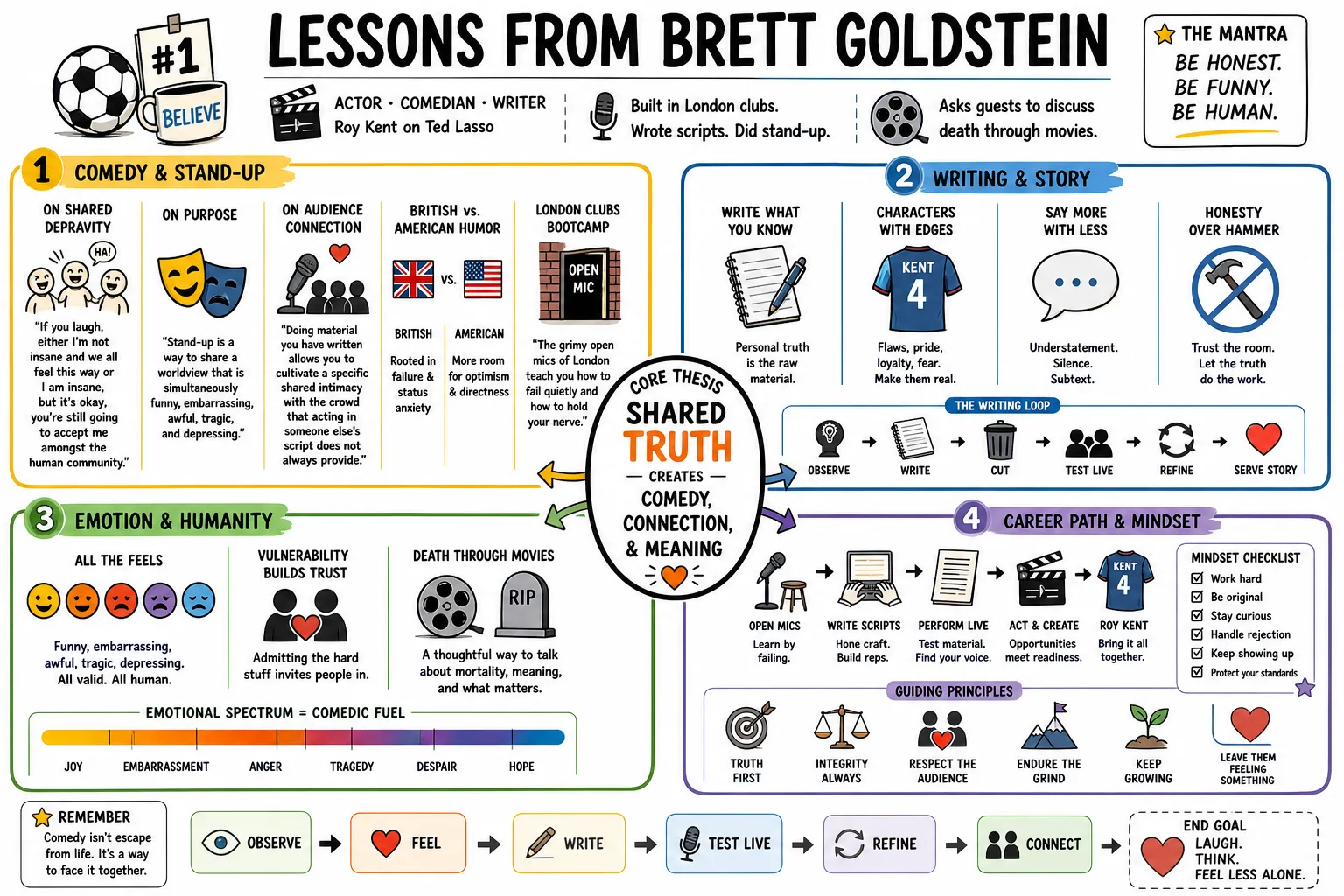
Lessons from Brett Goldstein
Brett Goldstein is an actor, comedian and writer who plays Roy Kent on Ted Lasso and writes for the show. He co-created Shrinking and hosts the podcast Films to Be Buried With. — Fresh Air: "Take it from real-life Roy Kent: Soccer is catharsis for people who won't do therapy" (2023).
Part 1: Comedy and Stand-up
- On Asking Whether You Are Mad: Goldstein: "When I do a new material night, I'm not asking, Is this funny? What I'm asking is, Am I mad? Am I insane? And if you laugh, either, oh, thank God, we all feel this way, I'm not completely mad. Or, I am completely mad, but you accept me and it's all gonna be okay." — Awards Radar: "Brett Goldstein Reveals His True Passion" (2025).
- On Not Being Alone: On new material, Goldstein says "It depends on if they laugh. It's like, oh, I'm not alone. You also think this." — NPR Wild Card (via NCPR): "Brett Goldstein avoids emotions at all costs" (2025).
- On Stand-Up Being the Opposite of TV: Goldstein: "And stand-up is the opposite. You go, I just had this thought. I could say it right now, and let's see what happens." — NPR Wild Card (via NCPR): "Brett Goldstein avoids emotions at all costs" (2025).
- On Compromise: Goldstein: "TV and film are amazing, but they involve 200 people and constant compromise." Standup, he says, is "just me saying: Here's what I thought today." — The Observer: "Drama without humour is bad art" (2025).
- On Standup as Heroin: Goldstein: "Standup is like heroin," he says. "It doesn't make me feel good, but it does make me feel normal." — The Observer: "Drama without humour is bad art" (2025).
- On Feeding Each Other: Goldstein: "Stand-up's really good for your brain: The adrenaline when you're on stage makes your brain work so fast, and I think that keeps me sharp when I'm in the writers' room." — TheWrap: "Why Brett Goldstein Returned to Stand-Up Comedy After Ted Lasso and Shrinking" (2025).
- On Not Filming Stand-Up: Goldstein: "I've done 17 years of stand-up, but there's no proof." He says "I've always resisted filming, and I never put stuff I did online." — TheWrap: "Why Brett Goldstein Returned to Stand-Up Comedy After Ted Lasso and Shrinking" (2025).
- On Chasing the First Gig: Of his first gig, Goldstein says "I've never been better than I was that first gig. I come on the stage and I'm like, bang, bang, bang, and it went really well. I'm still chasing that first one." — Awards Radar: "Brett Goldstein Reveals His True Passion" (2025).
- On Low Expectations: Goldstein: "I think it probably worked in my favor, because their expectations must have been very low." — TheWrap: "Why Brett Goldstein Returned to Stand-Up Comedy After Ted Lasso and Shrinking" (2025).
- On Waiting to See a Joke Work: Goldstein: "Sometimes you write a joke for a film, you don't know if it'll work until two years later when you see it with an audience." — Awards Radar: "Brett Goldstein Reveals His True Passion" (2025).
Part 2: Ted Lasso and Roy Kent
- On the Self-Tape Email: Goldstein describes his email with the self-tape: "if this is terrible and embarrassing, you can pretend you never got this email, and I will never ask about it." — Fresh Air: "Take it from real-life Roy Kent: Soccer is catharsis for people who won't do therapy" (2023).
- On Roy Kent's voice: "It’s a manifestation of the fact that he is covering feelings that he cannot let out. He has to keep his voice almost like a cork and hold everything down." — Source: [Reddit AMA]
- On the Cork in Roy's Throat: Goldstein: "it's literally like a cork is in his throat, like a cork is holding all his emotions in because if he let it out, he'd be such a wreck." — Fresh Air: "Take it from real-life Roy Kent: Soccer is catharsis for people who won't do therapy" (2023).
- On Being Roy Without the Care: Goldstein: "He's me if I didn't care what people thought of me. Annoyingly, I still do. A bit." — Rolling Stone: "How Brett Goldstein Became the Breakout Star of Ted Lasso" (2021).
- On Struggling With Vulnerability: Goldstein says he is "much friendlier in real life" than Roy, but "I also have the struggle with vulnerability that he has." — The Sydney Morning Herald / WAtoday: "Why this Ted Lasso fan favourite is still absolutely terrified of the quiet" (2023).
- On the End of a Football Career: On footballers he grew up around, Goldstein says "you don't really have any other life skills. You've been living in this sort of weird bubble." — Fresh Air: "Take it from real-life Roy Kent: Soccer is catharsis for people who won't do therapy" (2023).
- On Understanding the Rage: Goldstein: "I understood the sadness of that," and "I understood his depression. And, most of all, I fully understood the rage." — Rolling Stone: "How Brett Goldstein Became the Breakout Star of Ted Lasso" (2021).
- On the Gunslinger Stance: Goldstein: "part of the job is intimidation. It's scaring the other team. That's why Roy stands like a gunslinger ready to fire at all times." — Vanity Fair: "Brett Goldstein Doesn't Think Ted Lasso Is as Warm and Fuzzy as You Do" (2021).
- On Where Roy Came From: Asked whom he based Roy on, Goldstein says "Bill Sykes if he hadn't killed Nancy." — Vanity Fair: "Brett Goldstein Doesn't Think Ted Lasso Is as Warm and Fuzzy as You Do" (2021).
Part 3: The Craft of Writing
- On Reading the Script: Goldstein describes Jason Sudeikis's rule: "look at the script, look at the characters, and the answer is almost always there." — Vanity Fair: "Brett Goldstein Doesn't Think Ted Lasso Is as Warm and Fuzzy as You Do" (2021).
- On Real Troubles: Goldstein: "as much as Ted is nice and he's kind and he's passionate, his troubles are real. He doesn't exist in a vacuum. The world of Ted Lasso isn't a fairy tale." — Vulture: "How Ted Lasso's Brett Goldstein Found the Softer Side of Roy Kent" (2020).
- On Writing About Relationships: Goldstein on Soulmates: "We also love writing about relationships. That's always my favorite." — Vulture: "How Ted Lasso's Brett Goldstein Found the Softer Side of Roy Kent" (2020).
- On Loving Your Characters: Goldstein: "My one sort of rule of writing is you have to love all your characters. You have to." Even the worst people: "You, the writer, have to write them with love." — NPR Wild Card (via NCPR): "Brett Goldstein avoids emotions at all costs" (2025).
- On Humanizing a Bad Person: Goldstein says of Ted Lasso and Shrinking: "Taking a bad person and then humanizing them and giving them love and then making it harder and harder for an audience to hate them is interesting." — NPR Wild Card (via NCPR): "Brett Goldstein avoids emotions at all costs" (2025).
- On Drama Without Humour: Goldstein: "dramas without humour are bad art. I watch them and think: You've not observed life properly." — The Observer: "Drama without humour is bad art" (2025).
- On Funny and Tragic Together: Goldstein: "Life is funny and tragic and embarrassing all at once. So I like my dramas funny, and my comedies sad." — The Observer: "Drama without humour is bad art" (2025).
- On Where Funny Comes From: On Roy, Goldstein asks "doesn't funny come from serious stuff?" — TheWrap: "Brett Goldstein Talks Ted Lasso and the Art of Nuanced Swearing" (2022).
Part 4: Cinema and "Films to Be Buried With"
- On Bad Art: Of a bleak film he hated, Goldstein says "if you make something that doesn't have any of that, I think it's bad art. I think you've not watched life." — Fresh Air: "Take it from real-life Roy Kent: Soccer is catharsis for people who won't do therapy" (2023).
- On Jokes in Survivors' Stories: Goldstein: "if you've read books written by survivors of horrible events, there are always, always jokes in them. There's a moment where they laugh. There's a moment where they held each other." — Fresh Air: "Take it from real-life Roy Kent: Soccer is catharsis for people who won't do therapy" (2023).
- On a War-Zone Documentary: Of the documentary For Sama, Goldstein says "it's one of the most romantic films I've ever seen" and "has far more laughs than you might think from the description." — Fresh Air: "Take it from real-life Roy Kent: Soccer is catharsis for people who won't do therapy" (2023).
- On Don't Look Now: Goldstein says "The film that I go on about and drive people mad is Don't Look Now," calling it "the best married couple acting you have ever seen in any film." — Vanity Fair: "Brett Goldstein Doesn't Think Ted Lasso Is as Warm and Fuzzy as You Do" (2021).
- On TV Shows to Be Buried With: Asked for his own TV shows to be buried with, Goldstein says "My personal TV shows to be buried with would be The Wire, Deadwood, Mad Men." — TheWrap: "Brett Goldstein Talks Ted Lasso and the Art of Nuanced Swearing" (2022).
- On Going to the Cinema Alone: Goldstein: "I hate experiencing emotions and do my best to avoid them at all times. But I do go to the cinema alone to get them out." — NPR Wild Card (via NCPR): "Brett Goldstein avoids emotions at all costs" (2025).
- On Sesame Street: Of a day on Sesame Street, Goldstein says "it was truly, like, a collective everyone imbuing this thing with magic. And it was so fun and so lovely and so stupid." — NPR Wild Card (via NCPR): "Brett Goldstein avoids emotions at all costs" (2025).
Part 5: Vulnerability and Emotion
- On Knowing and Doing: Goldstein: "I objectively know it is better to be vulnerable and open. But I struggle to do it a lot." — The Sydney Morning Herald / WAtoday: "Why this Ted Lasso fan favourite is still absolutely terrified of the quiet" (2023).
- On Saying I Love You Through Sport: Goldstein: "I think sport is there so men can say I love you without saying I love you." — Fresh Air: "Take it from real-life Roy Kent: Soccer is catharsis for people who won't do therapy" (2023).
- On Facing Forward: Goldstein says "you're both facing forward. You don't have to look at each other," and his university friends' therapy van worked because "as long as no one has to look at each other, it's fine." — Fresh Air: "Take it from real-life Roy Kent: Soccer is catharsis for people who won't do therapy" (2023).
- On Football as Therapy: Goldstein: "sometimes I think football is, like, a therapeutic good for the world, for people who can't ever bring themselves to go to therapy." — Fresh Air: "Take it from real-life Roy Kent: Soccer is catharsis for people who won't do therapy" (2023).
- On Changing Your Worldview: Goldstein: "I am proof that people can change, I suppose, and that you can change your worldview." — Fresh Air: "Take it from real-life Roy Kent: Soccer is catharsis for people who won't do therapy" (2023).
- On Therapy: On what changed him, Goldstein says "one is therapy, for sure. Therapy was hugely helpful." — Fresh Air: "Take it from real-life Roy Kent: Soccer is catharsis for people who won't do therapy" (2023).
- On Gratitude: Goldstein: "It's about gratitude. And the more you practice it, the more you see wonderful things around you, even in terrible things." — NPR Wild Card (via NCPR): "Brett Goldstein avoids emotions at all costs" (2025).
- On Being Interested: Goldstein: "If you're interested in people, in anything, then it makes life much more exciting." — The Sydney Morning Herald / WAtoday: "Why this Ted Lasso fan favourite is still absolutely terrified of the quiet" (2023).
- On Loving Anyone: Goldstein: "I think if you look hard enough at anyone, you can love them." — NPR Wild Card (via NCPR): "Brett Goldstein avoids emotions at all costs" (2025).
- On Everyone Having a Story: Goldstein: "I do believe everyone is interesting if you ask the right question. Everyone has a story — even people that you hate." — Rolling Stone: "How Brett Goldstein Became the Breakout Star of Ted Lasso" (2021).
Part 6: Acting and the Creative Process
- On Instinct in Acting: Goldstein says the writers analyze every angle, "But when it came to acting it, it's all instinctual." — Fresh Air: "Take it from real-life Roy Kent: Soccer is catharsis for people who won't do therapy" (2023).
- On Roy's Posture: Goldstein: "he walks with his shoulders back, really far back, and really tall, A, because he's ready to headbutt anyone at any moment." — Fresh Air: "Take it from real-life Roy Kent: Soccer is catharsis for people who won't do therapy" (2023).
- On Sending the Tape: Goldstein: "I also knew I would hate myself if I didn't try, because I felt very, very strongly that I got this character in such a deep way." — TheWrap: "Brett Goldstein Talks Ted Lasso and the Art of Nuanced Swearing" (2022).
- On a Calling: Goldstein: "It was like a calling, like Roy is inside me." — TheWrap: "Brett Goldstein Talks Ted Lasso and the Art of Nuanced Swearing" (2022).
- On Getting Roy: Goldstein: "I really understand Roy. I really get Roy. I think Roy is within me." — Town & Country: "How Brett Goldstein Went from the Ted Lasso Writer's Room to Playing Roy Kent" (2021).
- On Typecasting: Goldstein: "I usually play a softer character. It's probably my typecast up to that point." — Vulture: "How Ted Lasso's Brett Goldstein Found the Softer Side of Roy Kent" (2020).
- On the Train Passing: Goldstein: "In terms of my career, I was definitely at a point where it felt like the train had passed me by." — Rolling Stone: "How Brett Goldstein Became the Breakout Star of Ted Lasso" (2021).
- On Casting Harrison Ford: On Shrinking, Goldstein says "We thought, we're never getting Harrison Ford." — Fresh Air: "Take it from real-life Roy Kent: Soccer is catharsis for people who won't do therapy" (2023).
- On Falling for Ted Lasso: After his call with Jason Sudeikis, Goldstein says "It finished and I was like, Oh God, I'm in love. I really want this to happen." — Rolling Stone: "How Brett Goldstein Became the Breakout Star of Ted Lasso" (2021).
Part 7: Fame, Success, and Industry
- On Fear of the Quiet: Goldstein: "I'm absolutely terrified of the quiet. I feel every second. Otherwise, I will discover what's really underneath, which is a mess." — The Sydney Morning Herald / WAtoday: "Why this Ted Lasso fan favourite is still absolutely terrified of the quiet" (2023).
- On Opened Doors: Goldstein: "it's changed my life 100%. It's definitely opened a lot more doors that would probably have been closed to me before." — TheWrap: "Brett Goldstein Talks Ted Lasso and the Art of Nuanced Swearing" (2022).
- On Not Believing It: Goldstein: "I constantly feel like it's a prank and we're going to be told Oh no, we're only joking." — Rolling Stone: "How Brett Goldstein Became the Breakout Star of Ted Lasso" (2021).
- On Doing All Three: Goldstein: "As long as I'm allowed to, I would love to act, write and do stand-up. I would never want to stop any of them." — TheWrap: "Why Brett Goldstein Returned to Stand-Up Comedy After Ted Lasso and Shrinking" (2025).
- On Keeping Something Sacred: Goldstein: "I need a part of my life to be kept sacred, or it gets corrupted. Otherwise you can't make art." — The Observer: "Drama without humour is bad art" (2025).
- On Life in the Work: Goldstein: "A lot of what happens in my life goes into the work. I can look at a script and know exactly what I was going through when I wrote it." — The Observer: "Drama without humour is bad art" (2025).
- On Doing This Before: Goldstein: "I'm lucky to be doing exactly what I always wanted to do, but I was also doing this before Ted Lasso, just not at the same level." — TheWrap: "Brett Goldstein Talks Ted Lasso and the Art of Nuanced Swearing" (2022).
- On Knocking on Doors: Goldstein: "It was harder to knock on doors and have people say, Who's this guy?" — TheWrap: "Brett Goldstein Talks Ted Lasso and the Art of Nuanced Swearing" (2022).
Part 8: Philosophy and Worldview
- On Jokes in War Zones: Goldstein: "People make jokes in war zones, you know?" — The Observer: "Drama without humour is bad art" (2025).
- On Preordained Things: Goldstein: "I like the idea that everything's preordained, but then why preordained terrible stuff? But then so many magical things also happen." — NPR Wild Card (via NCPR): "Brett Goldstein avoids emotions at all costs" (2025).
- On a Lovely Picture: On stepping in a puddle amid good things, Goldstein says "This wasn't the worst thing that ever happened. It was just a little bit in this lovely picture." — NPR Wild Card (via NCPR): "Brett Goldstein avoids emotions at all costs" (2025).
- On an Angel Having a Bad Day: Of terrible events, Goldstein says he wonders "is it, like, an angel having a bad day?" — NPR Wild Card (via NCPR): "Brett Goldstein avoids emotions at all costs" (2025).
- On a Not-Too-Good Special: On his HBO special, Goldstein says "So I wanted this special to be good, but I didn't want it to be so good that you had nothing to live for." — NPR Wild Card (via NCPR): "Brett Goldstein avoids emotions at all costs" (2025).
- On Making Your Own World: Goldstein: "So I do kind of believe this thing of you make your own world." — NPR Wild Card (via NCPR): "Brett Goldstein avoids emotions at all costs" (2025).
- On Looking Around: Goldstein: "if you're miserable all the time, look around and actually look at what you have, what your life is, the people that you're around." — The Sydney Morning Herald / WAtoday: "Why this Ted Lasso fan favourite is still absolutely terrified of the quiet" (2023).